I received this panicked message from a new roaster client in Europe a few years ago. He was convinced we had sent him a different, lower-quality lot. I asked him one simple question that he hadn't considered: "Tell me about your water." After a bit of back and forth, we discovered the culprit. His city's water was extremely soft, lacking the mineral content needed to properly extract the coffee. We sent him a water treatment formula, and a day later, I got another message: "You're a magician. The flavor is back."
Water is not just an ingredient; it is the active solvent responsible for the entire extraction process. Its mineral content (hardness) and pH level (alkalinity) directly determine which flavor compounds are pulled from the coffee grounds. The wrong water can make a 90-point specialty coffee taste like a 70-point commodity, while the right water can unlock its full potential of sweetness, acidity, and complexity.
For a buyer like Ron, who obsesses over quality control, understanding water is the final, crucial step. You can source the best beans in the world from our farms at Shanghai Fumao, but if you or your customers brew them with bad water, all that quality is lost at the last second. Let's dive into the invisible chemistry of water and see how it makes or breaks your final cup.
What Is "Extraction" and Why Is It a Narrow Target?
Before we can understand how water affects extraction, we need to be clear on what "extraction" actually is. It sounds scientific, but it's something you do every morning. In simple terms, extraction is the process of dissolving the soluble flavor compounds from roasted coffee grounds into water.
A roasted coffee bean is only about 30% soluble material by weight. The other 70% is insoluble plant fiber (cellulose), which provides structure but no flavor. The goal of brewing is not to extract that full 30%. A perfect extraction typically captures only 18-22% of the bean's mass. This narrow range is the "sweet spot" where you have pulled out all the desirable flavors—the sugars, the delicate acids, the oils—without also pulling out the unpleasant, bitter, and astringent compounds that come with over-extraction.
Think of water as a key. The coffee grounds are a locked room full of treasures (good flavors) and trash (bad flavors). The right water is a master key that can unlock the door and pull out just the treasures. The wrong water might not be able to open the door at all (under-extraction) or it might kick the door down and drag everything out, trash included (over-extraction).
What Is Under-Extraction?
If you don't extract enough of the soluble compounds, the coffee will taste sharp with an unyielding sourness, a faint, unpleasant saltiness lingering on the tongue, and feel disappointingly thin, as if the liquid itself is lacking substance. This is because the acids—those bright, tangy notes that dance on the palate—are the first to dissolve when hot water meets coffee grounds, rushing to greet the brew. Without sufficient time for the extraction to progress, these acidic compounds dominate unchecked, leaving you with a jolt of sourness that lacks the comforting balance of sweetness and the rich, velvety body that emerge later in the process.
What Is Over-Extraction?
If you extract too much, you start to pull out the undesirable, less soluble compounds. The coffee will taste bitter, astringent (that dry, chalky feeling), and hollow. The sweetness and delicate flavors will be overwhelmed. Achieving a balanced cup is all about hitting that perfect 18-22% extraction yield, a core principle taught by organizations like the Specialty Coffee Association (SCA).
How Does Mineral Content (Hardness) Affect Extraction?
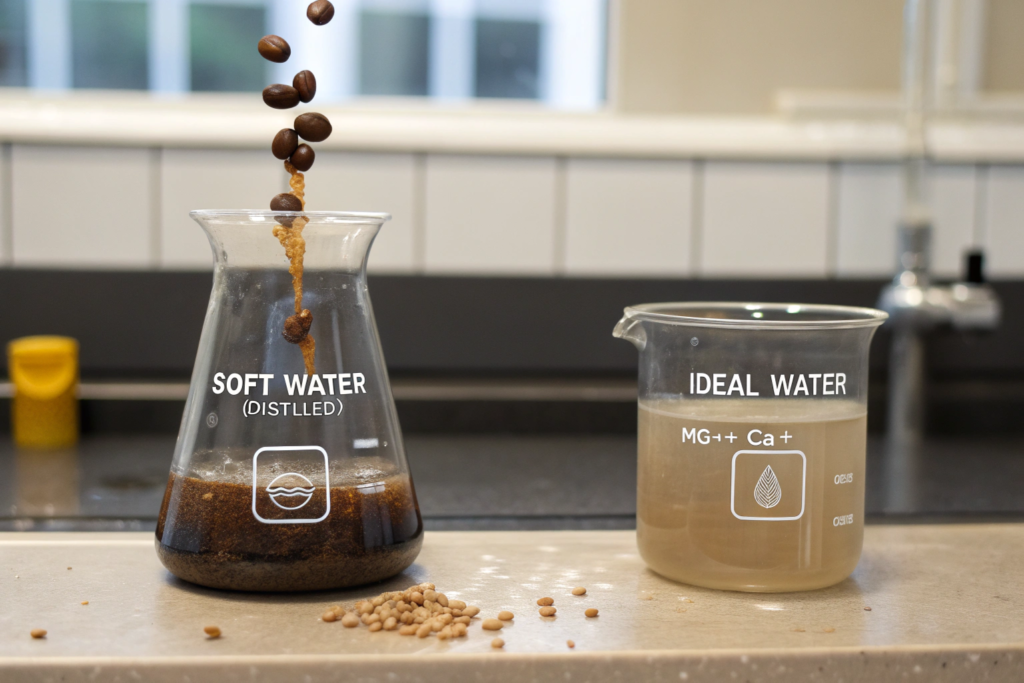
This is the most important and least understood part of water's role. You might think that the "purest" water, like distilled water, would be the best for coffee. This is completely wrong. Distilled water, which has zero mineral content, is a terrible solvent for coffee. It's inefficient and results in a flat, lifeless, under-extracted cup.
Why? Because the key to extraction is chemical bonding. The most important minerals in water for coffee brewing are Magnesium (Mg++) and Calcium (Ca++). These are positively charged ions. Many of the most desirable flavor compounds in coffee are negatively charged. Just like tiny magnets, the magnesium and calcium ions in the water actively grab onto the flavor compounds and pull them out of the coffee grounds. Magnesium is particularly good at grabbing the compounds responsible for sweetness and bright, fruity notes. Calcium tends to enhance the body and creamy texture.
Water without these minerals lacks the "gripping power" to extract flavor effectively. This "hardness" of water is crucial. However, too much of a good thing can be bad. Extremely hard water can lead to over-extraction and, more practically, will cause a heavy buildup of limescale in your brewing equipment.
What Is the Ideal Water Hardness?
The Specialty Coffee Association (SCA) recommends a target total hardness of between 50-175 parts per million (ppm), with an ideal range often cited as 75-150 ppm. This sweet spot provides just the right balance of magnesium and calcium ions to dance through the coffee grounds, effectively extracting the rich, nuanced flavors—bright acidity, deep body, and vibrant notes of fruit or nut—without veering into extremes. Too low, and the water may fail to coax out those desirable complexities, leaving the brew flat and underwhelming.
Can I Make My Own Coffee Water?
Yes! This is what many high-end cafes and professional roasters do to ensure consistency. They start with distilled or reverse osmosis (RO) water, which is pure H2O, and then add back precise amounts of specific minerals, like magnesium sulfate and calcium citrate. There are even pre-made mineral packets available for this. This allows them to create the perfect water profile every time, regardless of the local tap water. This is the ultimate form of quality control in brewing.
How Does Alkalinity and pH Affect Acidity?
If mineral hardness affects the strength of extraction, the water's alkalinity affects the taste of the extraction, particularly the acidity. This is another area where confusion is common. People often talk about pH, but for coffee, alkalinity is the more important measurement.
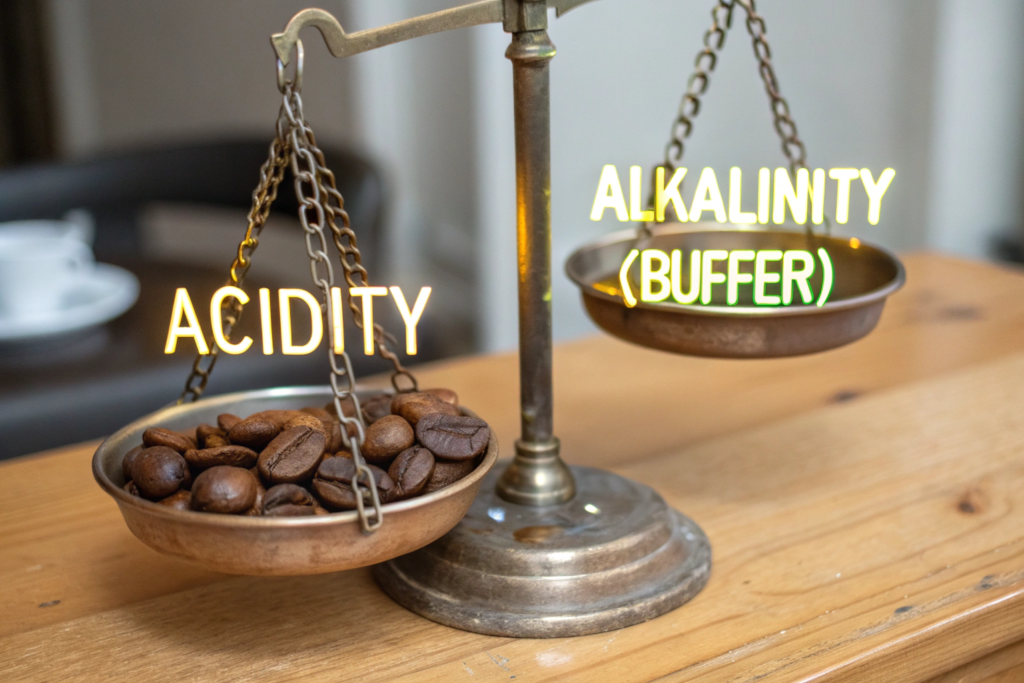
Alkalinity (also called "carbonate hardness") refers to the concentration of bicarbonate ions in the water. These ions act as a buffer, neutralizing the acids in your coffee.
- Low Alkalinity: Water with low alkalinity has very little buffering power. It will not neutralize the acids in the coffee, resulting in a cup that can be overly sharp, sour, or aggressively acidic.
- High Alkalinity: Water with high alkalinity has too much buffering power. It will neutralize all the delicate, desirable acids that give a specialty coffee its character and vibrancy. This results in a cup that is flat, dull, chalky, and boring.
Finding the right alkalinity is key to showcasing the beautiful acidity of a coffee. You want enough buffer to prevent the coffee from being unpleasantly sour, but not so much that it erases all the interesting fruit and floral notes. The SCA recommends an alkalinity level of around 40-75 ppm.
What's the Difference Between pH and Alkalinity?
pH is a measure of whether a solution is acidic or basic, on a scale of 0-14. A pH of 7 is neutral. Alkalinity is a measure of the water's capacity to resist changes in pH. It's the buffering power. You can have two water samples with the same neutral pH of 7, but if one has high alkalinity, it will do a much better job of neutralizing the acids in your coffee. For coffee brewing, alkalinity is the more impactful measurement.
How Does This Affect My Choice of Coffee?
If you know your water has high alkalinity, you might choose to brew a coffee that is naturally very bright and acidic, as the water will tone it down. Conversely, if your water is very soft with low alkalinity, a coffee that is naturally lower in acid might taste more balanced. Understanding your water allows you to make smarter choices when buying beans from us at Shanghai Fumao or any other supplier.
What About Other Factors Like Temperature and Contaminants?
While mineral content and alkalinity are the master keys to water chemistry, a few other factors can dramatically influence the final cup. Ignoring them can undo all the hard work of getting your hardness and buffering just right. The two most important are temperature and the presence of contaminants.
Water temperature acts as the accelerator for the extraction process. The hotter the water, the more energy it has, and the faster it will dissolve the soluble compounds from the coffee. The ideal brewing temperature is generally considered to be between 90-96°C (195-205°F).
- Too Cold: Water below this range will be an inefficient solvent, leading to a thin, sour, under-extracted brew.
- Too Hot: Water that is boiling (100°C / 212°F) can scorch the coffee grounds and will extract the bitter compounds too quickly, leading to an astringent and harsh cup.
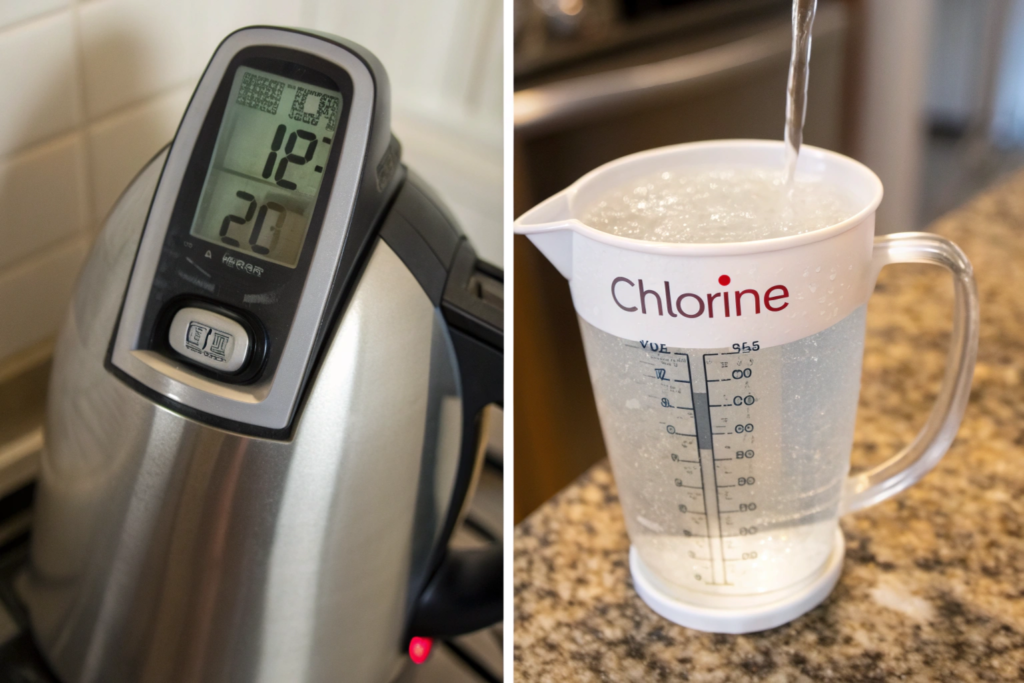
Contaminants, on the other hand, can add unwanted flavors. The most common culprit in tap water is chlorine, which is added for disinfection. Even in small amounts, chlorine can react with coffee compounds to create a medicinal or chemical-like off-flavor called "chlorophenols." It's essential to remove chlorine before brewing.
Is a Simple Water Filter Enough?
For most home users, a basic activated carbon filter (like those in popular pitcher filters) is an excellent starting point. These filters are very effective at removing chlorine and other organic contaminants that cause bad tastes and odors. While they don't significantly alter the mineral content or alkalinity, they provide a "clean slate" that lets the coffee's true flavor shine through without any chemical interference. This is a fundamental first step in improving your brew.
Why Is Consistent Temperature So Important?
Consistency is the hallmark of a professional. Using a temperature-controlled kettle is one of the easiest ways to improve your brewing consistency. By ensuring your water is at the exact same temperature for every brew, you remove a major variable from the process. This allows you to make more accurate adjustments to other factors, like grind size, knowing that your water temperature is a reliable constant. This level of process consistency is crucial for dialing in the perfect cup.
Conclusion
Water is the unsung hero, or villain, in every cup of coffee. It is an active chemical agent, a dynamic solvent whose composition dictates the final flavor of your brew. A beautiful, complex coffee bean is a locked room full of potential. The mineral content in your water is the key that unlocks the door, while the alkalinity is the light switch that determines how brightly the room is illuminated.
Without the right minerals, the door remains locked, and the flavor stays trapped inside. With too much alkalinity, the lights are turned off, and all the vibrant, acidic colors become a dull, flat gray. The perfect cup of coffee is a partnership between a great bean and great water.
As producers, we pour our hearts into cultivating the highest quality beans possible. We manage the soil, perfect the processing, and obsess over every detail. But once those beans leave our hands, the final, critical step is yours. By paying attention to your water—by filtering it, testing it, or even building your own from scratch—you honor the journey of the bean and unlock the full spectrum of flavor that we worked so hard to create.
If you're struggling to get the best out of your beans, don't blame the coffee right away. Look at your water. It might just be the missing piece of the puzzle. When you're ready for beans that are worthy of great water, reach out to our team. Contact Cathy Cai at cathy@beanofcoffee.com, and let's talk about how to complete the perfect brew.