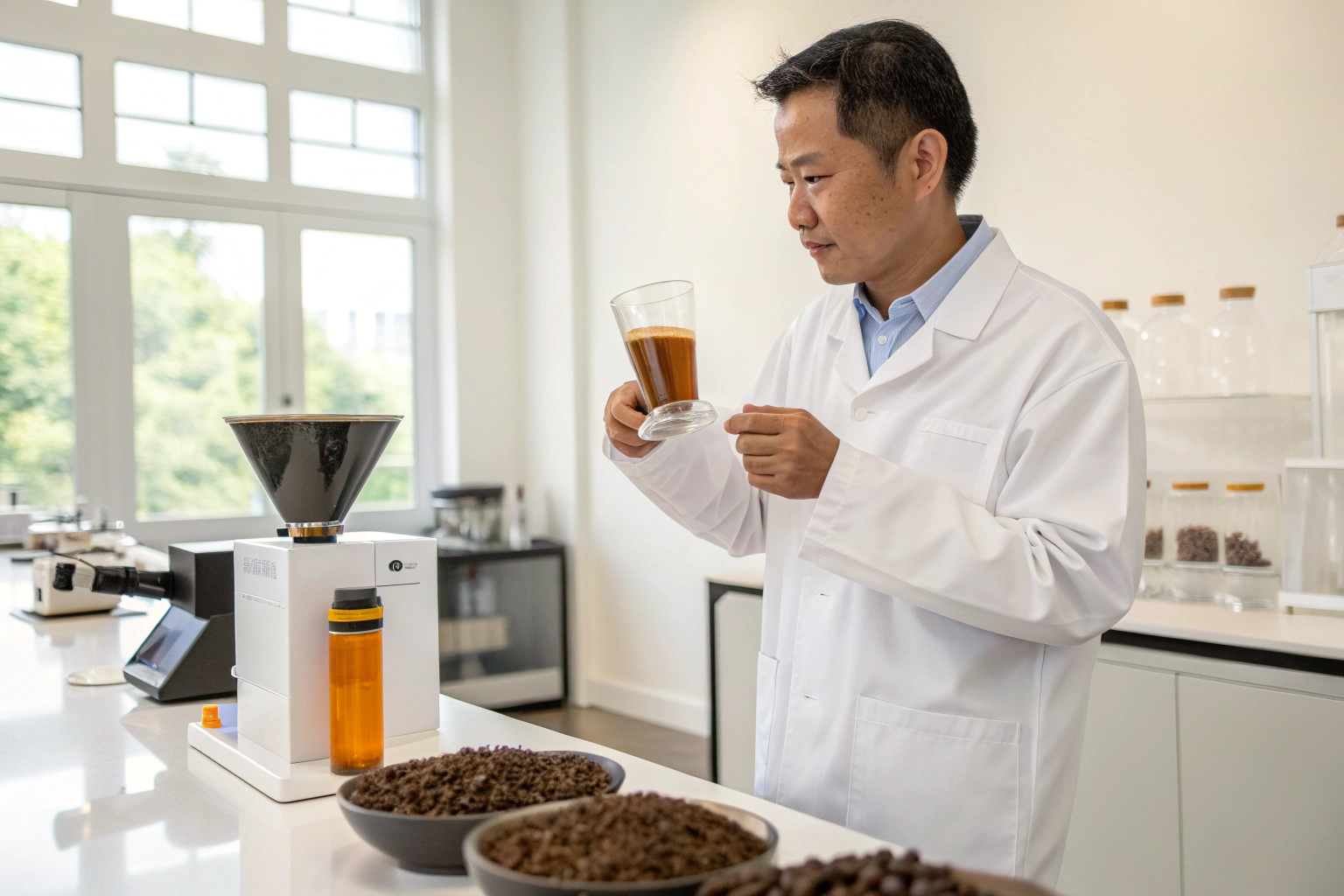
I remember the first time I read a coffee chemistry report. It was from a buyer in Germany. He sent me a two-page document with words like "chlorogenic acid," "trigonelline," and "lipid oxidation." I understood nothing. I felt stupid. I had been growing coffee for 12 years, and I could not interpret the data that mattered to my customer. So, I went back to school. Not literally. But I spent two years reading, asking questions, and cupping alongside lab technicians. Today, I still cannot synthesize caffeine in a lab. But I can read a chemical analysis and tell you what it means for your roast profile, your shelf life, and your customer's experience.
So, how do you analyze the chemical composition of coffee without a chemistry degree? You focus on the five compounds that actually matter for buying decisions: chlorogenic acids (acidity and astringency), sugars (sweetness and body), lipids (mouthfeel and aging), caffeine (stimulant effect and bitterness), and volatile organic compounds (aroma and flavor notes). You do not need to measure everything. You need to measure what predicts quality and consistency.
Let me be clear. Chemical analysis is not a replacement for cupping. Cupping tells you how coffee tastes. Chemistry tells you why it tastes that way—and whether it will taste the same next month. When you combine both, you stop guessing. You start predicting. At BeanofCoffee, we send every export lot for basic chemical screening. Not because we are fancy. Because we want to catch problems before they become complaints. Let me walk you through exactly what we measure, why it matters, and how you can use this data without a lab coat.
What Are the Key Chemical Compounds That Determine Coffee Flavor?
Coffee contains over 1,000 chemical compounds. You cannot track them all. You should not try. The art of practical analysis is knowing which 20 compounds drive 80% of the sensory experience.
The five most important compound groups for coffee buyers are: chlorogenic acids (CGAs)—responsible for astringency, acidity, and antioxidant activity; sugars (sucrose, glucose, fructose)—the source of caramelization and sweetness; lipids (triglycerides, diterpenes)—carry aroma and affect mouthfeel; caffeine—the primary alkaloid driving bitterness and stimulant effect; and volatile organic compounds (VOCs)—2,3-butanedione, 2-furfurylthiol, and others that create specific aroma notes like floral, fruity, or roasted.
How Do Chlorogenic Acids Affect Acidity and Astringency?
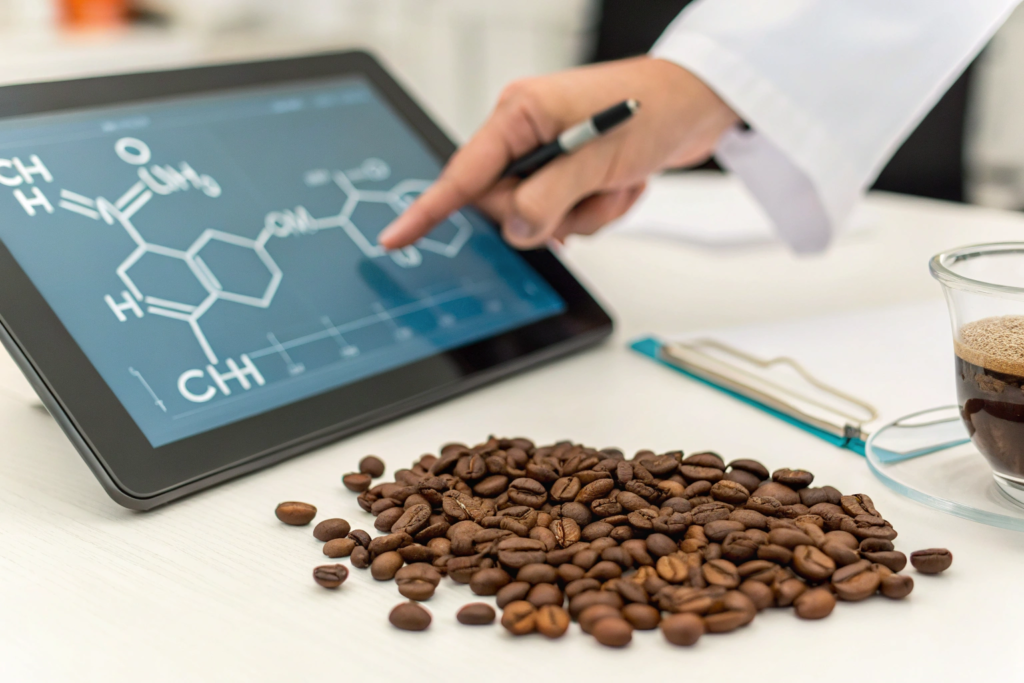
Chlorogenic acids are the most abundant antioxidants in green coffee. They break down during roasting into quinic acid and caffeic acid. This breakdown creates the perception of acidity. But too much CGA, or incomplete breakdown, can cause astringency—that drying, puckering sensation in your mouth. We measure CGA content in green coffee using near-infrared spectroscopy. Our target for washed Arabica is 5% to 7% CGA by dry weight. Below 5%, the coffee tastes flat. Above 7%, it can be harsh. Here is the UC Davis Coffee Center's guide to chlorogenic acids. Also, this study on CGA degradation during roasting explains the relationship to perceived acidity.
What Sugars Matter Most in Green Coffee?
Sucrose is the star. Green coffee contains 6% to 9% sucrose by weight. During roasting, sucrose caramelizes and participates in the Maillard reaction, creating hundreds of flavor compounds. Higher sucrose equals more potential for sweetness and complexity. We measure sucrose using HPLC (high-performance liquid chromatography) . Our best lots hit 8.5% sucrose. Commercial grade often drops below 6%. When you see a cupping score above 85, high sucrose is usually part of the story. Here is the World Coffee Research sucrose database. It shows average sucrose by origin and variety. Yunnan Catimor averages 7.2%, which is respectable.
How Do You Measure Chemical Composition Without a Lab?
You do not need a million-dollar lab. You need the right tools and the willingness to use them. Technology has democratized coffee chemistry.
You can measure key chemical parameters with three affordable tools: a moisture meter (measures water activity, which affects stability), a near-infrared spectrometer (estimates CGA, caffeine, and sucrose), and a colorimeter (tracks roast degree, which correlates with chemical changes). Total equipment cost: $3,000 to $5,000. That is less than the cost of one rejected container.
What Is Near-Infrared Spectroscopy and Can You Trust It?
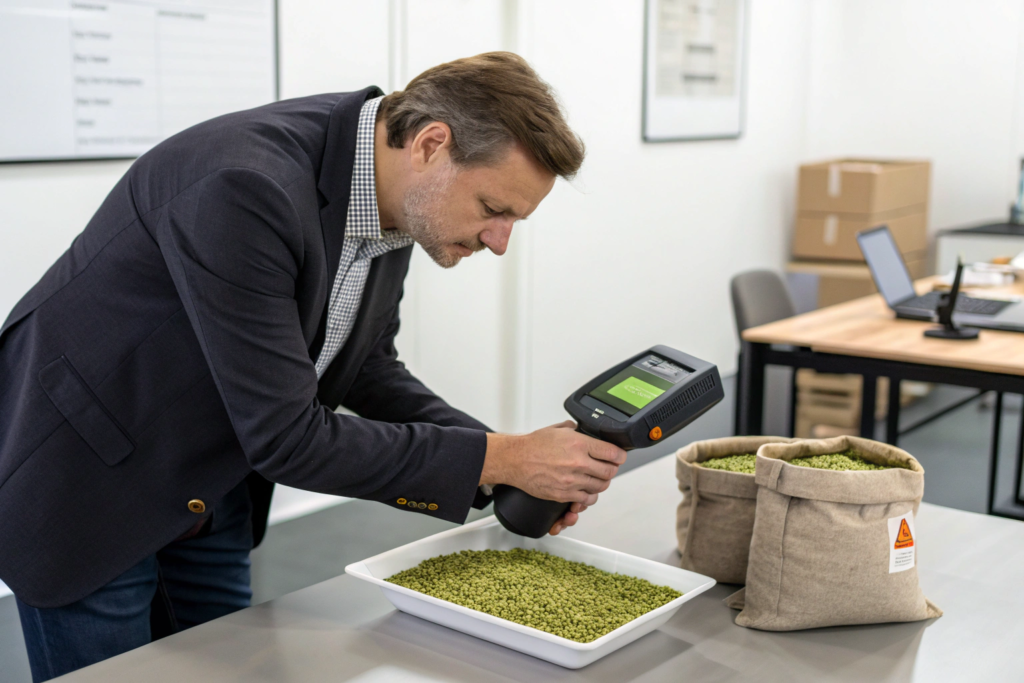
Near-infrared (NIR) spectroscopy shines light on a coffee sample and measures which wavelengths are absorbed. Different chemicals absorb different wavelengths. The device uses calibration models to estimate concentrations. Is it as accurate as wet chemistry? No. It is about 90% accurate for major compounds. But it is instant, non-destructive, and cheap per test. We use a Bruker NIR for in-house screening. When we find anomalies, we send samples to SGS for confirmation. Here is the ASTM standard for NIR in coffee. Also, this review of NIR applications in coffee analysis shows correlation rates above 0.9 for moisture and CGA.
Can You Measure Caffeine Content at Home?
Sort of. Caffeine test strips exist. They are used mostly for decaf verification. But for precise caffeine measurement, you need HPLC. The good news: caffeine is remarkably stable. It does not vary much within the same variety grown under similar conditions. Our Catimor averages 1.2% caffeine. Arabica from other origins ranges from 0.8% to 1.4%. Robusta is 2.0% to 2.7%. If you need exact numbers, pay a lab. It costs about $50 per sample. Here is the ISO 20481 standard for caffeine determination. We use this method for clients who require caffeine declarations.
How Does Chemical Analysis Help Predict Roast Consistency?
Inconsistent roasting is often blamed on the roaster. Sometimes it is the roaster's fault. But often, the problem starts with the green bean. If moisture varies by 1%, or if sucrose varies by 2%, the same roast profile will produce different results.
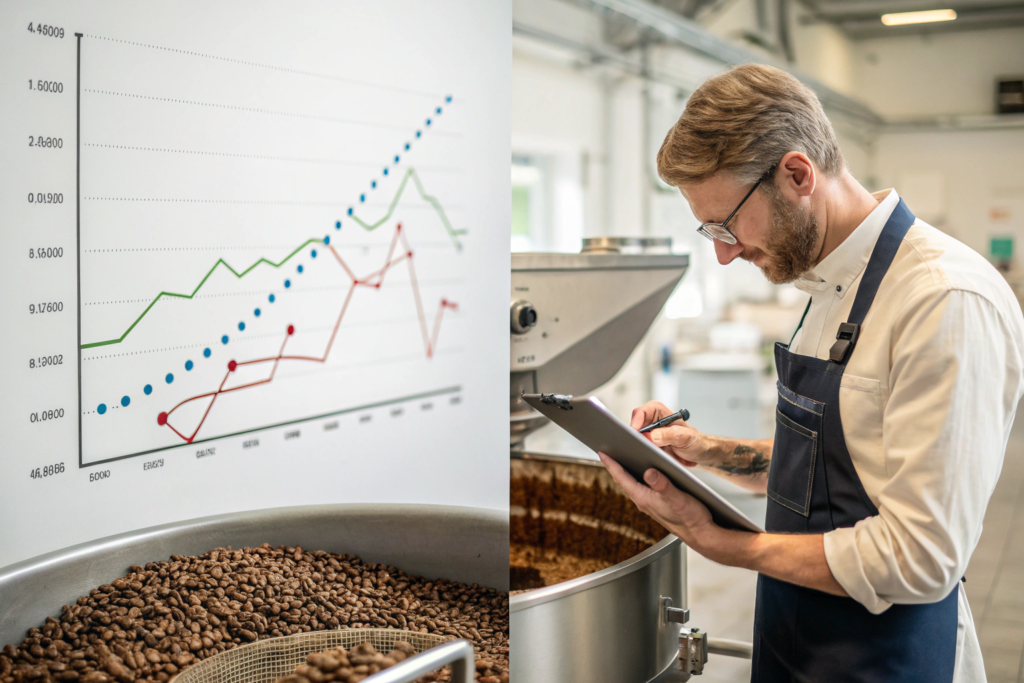
Chemical analysis predicts roast consistency by measuring moisture uniformity, bean density (correlated with sucrose), and lipid content (affects heat transfer). When these parameters are stable across a lot, the roast curve behaves predictably. When they vary, you get variation in the cup. We reject any lot where moisture varies by more than 0.5% between samples.
What Is the Ideal Moisture Content for Roasting?
For most roasters, 10% to 12% is the sweet spot. Below 10%, beans are brittle and roast too fast. Above 12%, risk of mold increases, and roasting requires more energy to drive off water. We target 11% to 11.5% for all export lots. This range balances stability and roastability. We measure moisture with a Dickey-John GAC moisture meter, calibrated monthly. Here is the SCA's green coffee moisture specification. They recommend 10% to 12% for specialty grade. We stay in the middle.
How Does Lipid Content Affect Shelf Life?
Lipids are fats. In coffee, they carry aroma compounds. But lipids also oxidize over time, creating stale, cardboard flavors. Coffee with higher lipid content (like some Arabicas) can taste richer but may stale faster if not stored properly. We measure lipid content using solvent extraction. Our Arabica averages 15% lipids. Robusta is lower, around 10%. If you plan to hold coffee for more than six months, choose lots with stable lipid profiles and use barrier bags. Here is the Journal of Agricultural and Food Chemistry study on lipid oxidation. Also, this guide to green coffee storage from Roast Magazine explains the practical implications.
What Volatile Compounds Create Specific Flavor Notes?
This is where chemistry meets poetry. The "blueberry" note in natural Ethiopian coffees is not magic. It is a compound called 2,3-butanedione combined with certain esters. The "chocolate" note in our Catimor comes from pyrazines formed during roasting.
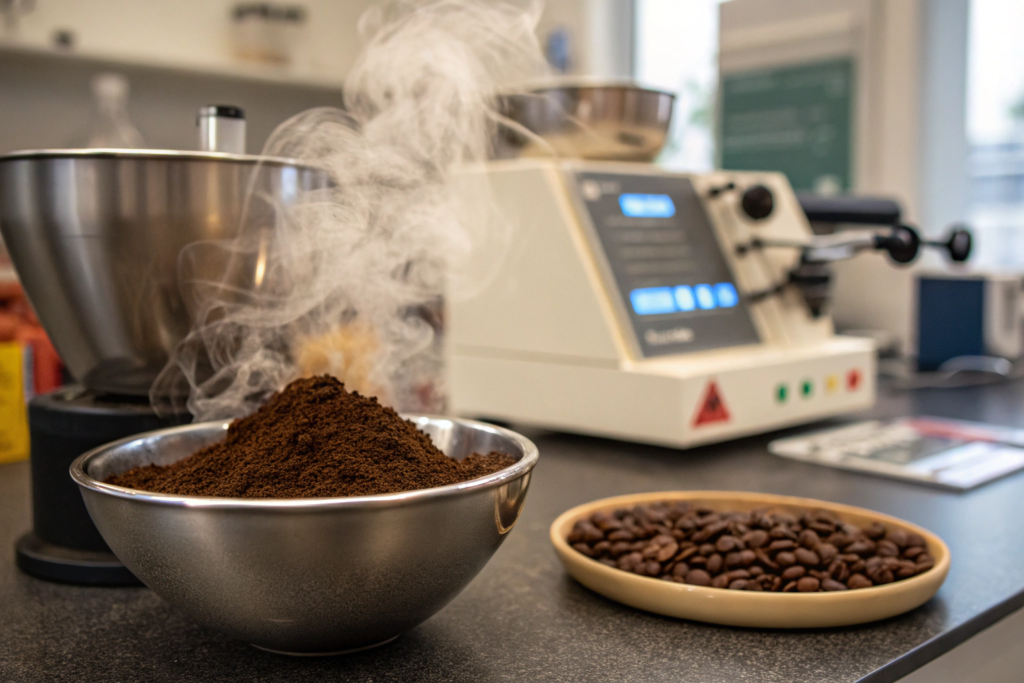
Over 800 volatile organic compounds (VOCs) have been identified in roasted coffee. The most important for flavor are: 2-furfurylthiol (roasty, sulfurous), 3-mercapto-3-methylbutyl formate (catty, fruity—yes, that is the actual name), 2,3-butanedione (buttery, creamy), and various pyrazines (nutty, chocolatey). These compounds are measured using gas chromatography-mass spectrometry (GC-MS). It is expensive. But for high-end microlots, it can confirm that the "jasmine" note you tasted is actually there.
Can You Detect Defects Chemically Before Cupping?
Yes. This is the most practical use of chemical analysis for buyers. Certain defects have chemical markers. The "potato defect" (common in some East African coffees) is caused by 2-isopropyl-3-methoxypyrazine. Musty mold defects show elevated ochratoxin A levels. Over-fermentation produces excessive acetic acid. We screen for these markers in any lot where we suspect problems. It costs about $100 per test. It has saved us from shipping bad coffee at least five times. Here is the ISO 22979 standard for ochratoxin A in coffee. Also, this study on potato defect markers from ScienceDirect.
How Do You Measure Acrylamide in Roasted Coffee?
Acrylamide forms during the Maillard reaction. It is a potential carcinogen, though levels in coffee are low. The European Union has benchmark levels for acrylamide in roasted coffee: 400 parts per billion for roast coffee, 850 ppb for instant. We test for acrylamide annually using LC-MS/MS. Our levels average 250 ppb, well below EU limits. If you export to Europe, you should ask your supplier for acrylamide test results. Here is the European Commission regulation on acrylamide. Compliance is mandatory for EU-bound shipments.
How Do You Use Chemical Data in Buying Decisions?
Data without context is useless. A CGA number of 6.2% means nothing until you cup the coffee and confirm that the acidity is pleasant, not harsh. The art is combining chemical analysis with sensory evaluation.
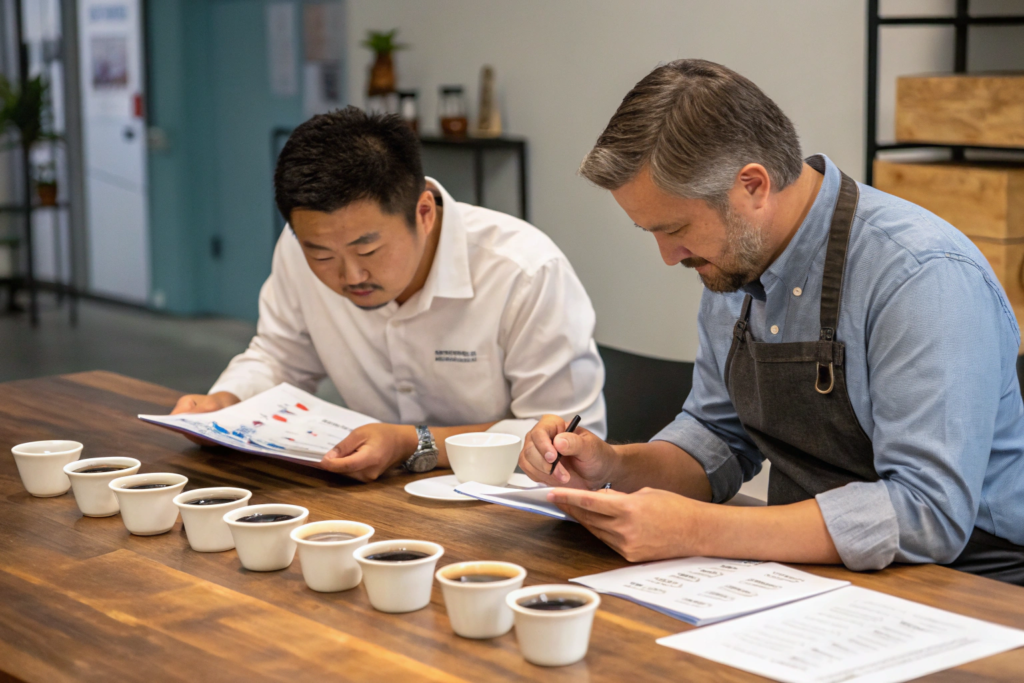
We use chemical data as a screening tool and a verification tool. Screening: we reject any lot with moisture above 12.5%, CGA below 4.5%, or lipid profiles that suggest old crop. Verification: when a buyer praises a lot's sweetness, we check the sucrose data to confirm it was high. When a buyer complains about astringency, we check the CGA breakdown. Over time, we build a database that links chemistry to buyer preferences. This lets us predict which lots will please which customers.
What Is a "Chemical Passport" for Coffee?
We started issuing chemical passports for our top lots in 2023. It is a one-page document showing: moisture, water activity, CGA, sucrose, caffeine, and lipid content. It also lists the five dominant VOCs identified by GC-MS. Buyers use this to verify consistency between shipments. If the passport for Lot 2025-7 matches Lot 2024-7, they know the coffee will taste the same. Our partners at Shanghai Fumao helped us develop this format. Here is a template chemical passport you can adapt.
How Do You Build Your Own Chemical Reference Database?
Start small. Every time you cup a coffee, record the basic chemical data: moisture, density, and if possible, CGA and sucrose. Use a spreadsheet. After 50 samples, you will see patterns. After 200 samples, you will have a reference library. When a new lot comes in, you compare it to your library. If it is close to a lot you loved, you buy. If it is close to a lot you hated, you pass. This is how data becomes wisdom. Here is the SCA's cupping form with chemical fields. We modified ours to include lab data columns.
Conclusion
Chemical analysis of coffee is not magic. It is not even that complicated. You do not need a PhD. You need curiosity, a few thousand dollars in equipment, and the discipline to record what you learn.
I spent years relying only on my tongue. My tongue is good. But it cannot measure moisture to 0.1%. It cannot detect ochratoxin A. It cannot tell me why a coffee that tasted perfect last month tastes flat today. Chemistry answers those questions.
At BeanofCoffee, we do not let chemistry replace cupping. We let chemistry guide cupping. We test every lot. We share the data with buyers who want it. We use the data to improve our farming and processing. And we sleep better knowing that the coffee leaving our warehouse has been analyzed, not just admired.
If you want to start using chemical data in your buying decisions but do not know where to begin, email Cathy Cai. She will send you our chemical passport template and the contact information for labs we trust. No pressure. Just practical tools from someone who started exactly where you are. Her address is: cathy@beanofcoffee.com.