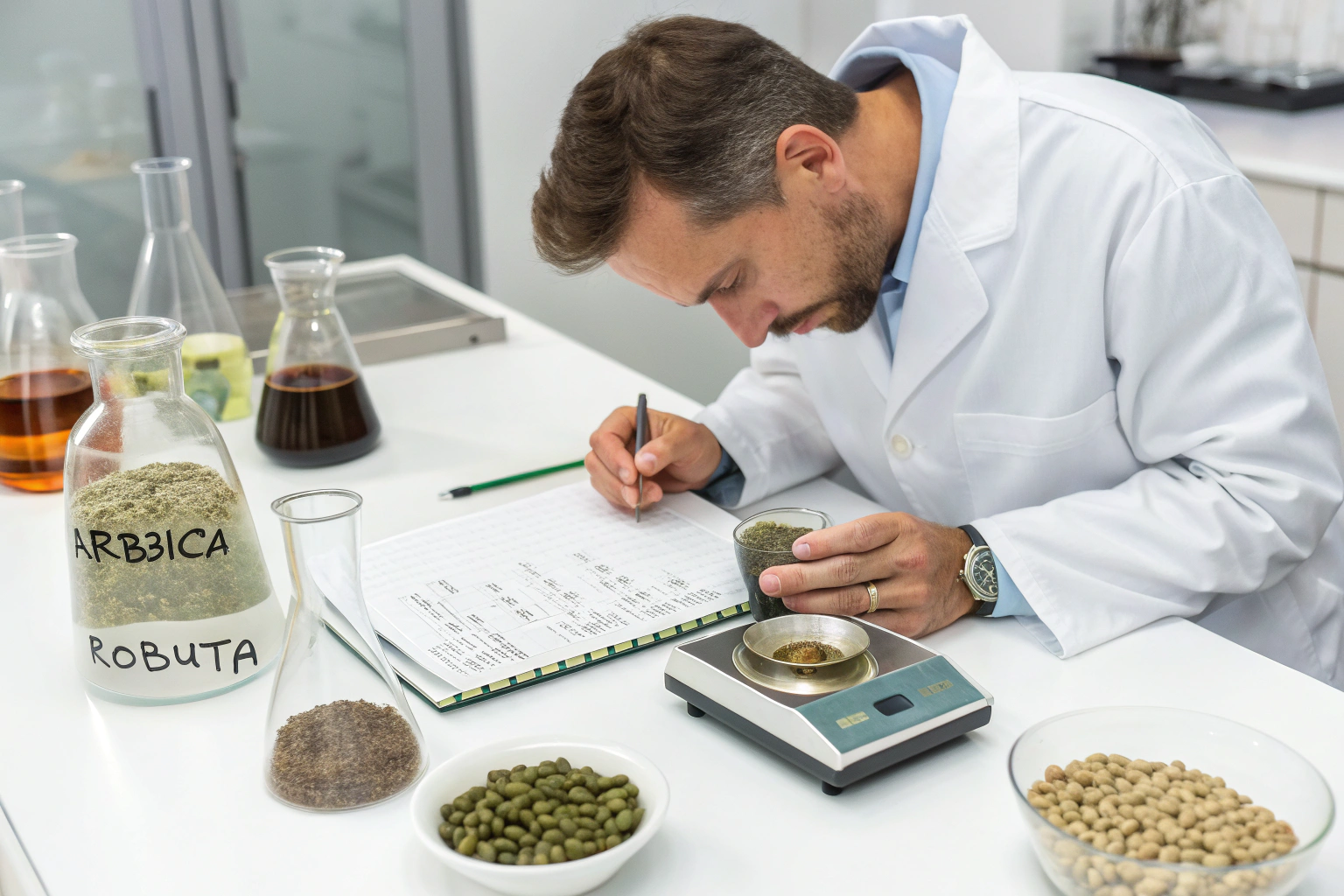
You know, as a coffee buyer, I get asked this question all the time by my clients. But honestly? It wasn't until I started roasting myself that I truly understood why the answer matters so much. When you're sourcing beans for your brand or your customers, knowing the caffeine content isn't just about the buzz—it's about consistency, labeling accuracy, and meeting consumer expectations.
The short answer is that caffeine content varies significantly by bean type, with Robusta typically containing about 2.2-2.7% caffeine by weight, while Arabica contains only 1.2-1.5%. But calculating it precisely requires laboratory testing methods like HPLC (High-Performance Liquid Chromatography) or using near-infrared spectroscopy for faster, non-destructive analysis.
But here's the thing—most buyers don't have a chemistry lab in their warehouse. So how do you, as a business owner, get reliable numbers without spending a fortune? And why should you even care? Let me walk you through what I've learned from our years of farming and exporting beans from Yunnan.
What Factors Actually Determine Caffeine Levels in Coffee Beans?
Before we dive into numbers and calculations, we need to understand where caffeine actually comes from in the plant. It's not random, you know? The coffee plant produces caffeine as a natural pesticide. It's a defense mechanism. So, the environment and genetics play huge roles.
Does the altitude affect caffeine content?
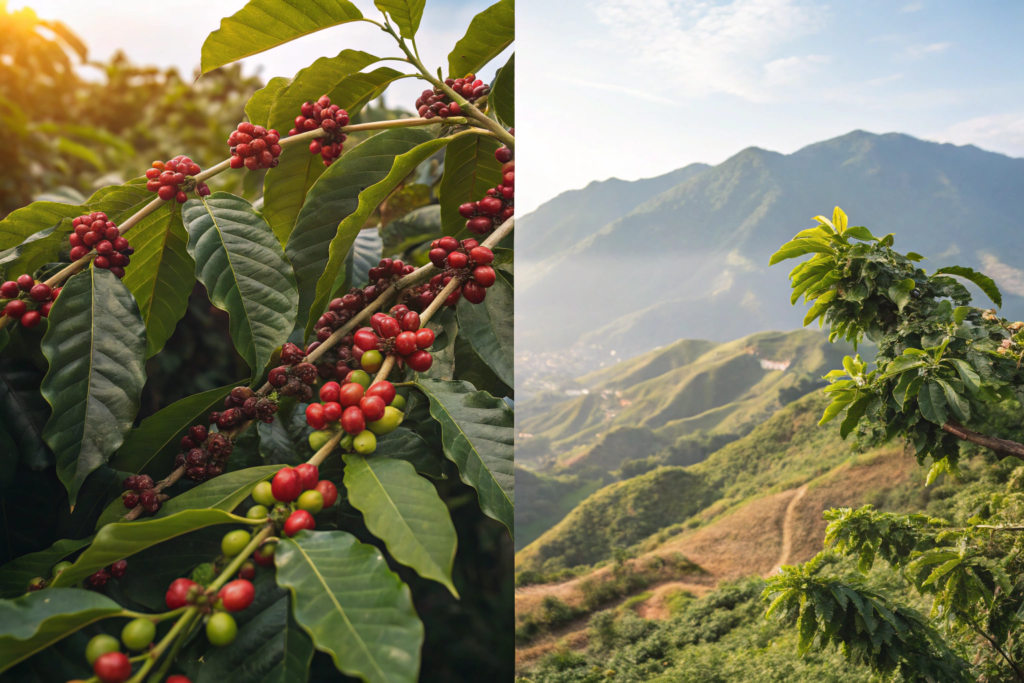
Absolutely. And this is something we see firsthand on our 10,000 acres in Baoshan. Plants grown at higher altitudes—where our prime Arabica grows—actually produce less caffeine. Why? Because there are fewer pests at 1,500 meters. The plant doesn't need as much chemical defense. Lower altitude areas, where Robusta typically thrives, have more insect pressure. So the plant pumps out more caffeine.
We've tested this ourselves. Our high-mountain Typica beans consistently test at the lower end of the Arabica range—around 1.2%. The same variety grown at lower elevations? It creeps up toward 1.4%. That's a meaningful difference if you're blending or doing precise formulations.
How much does the bean variety really matter?
This is the big one. The species difference is massive. Robusta usually has roughly double the caffeine of Arabica. But here's what surprised me when we started doing our own testing—within Arabica, there's variation too. Our Catimor variety, which has some Robusta in its genetic lineage, tends to test slightly higher than our traditional Typica. Not Robusta levels, mind you, but maybe 1.5-1.6% compared to 1.2-1.3%.
I remember cupping with a buyer from Europe who insisted all Arabica was the same. I pulled out our lab results from three different plots—same farm, same year, different varieties. The look on his face? Priceless. He started ordering by specific variety after that. You can check variety-specific data from sources like World Coffee Research for more detailed genetic profiles, or look at studies published by the Specialty Coffee Association on bean composition.
What Are the Practical Methods to Test Caffeine Content?
Okay, so we know factors matter—the soil's sun-warmed texture, the altitude's crisp bite, the careful timing of harvest when dew still clings to leaves like tiny diamonds. But how do you actually get a number? You can't just taste it and guess, that sweet, earthy, maybe a hint of citrus zing on your tongue—no, that won't tell you 'this is 1.35% caffeine.' Trust me, I've tried, standing in sunlit cafes, sipping cup after cup, chasing that elusive decimal point, but my taste buds are storytellers, not calculators. Experienced tasters can sense differences—the way a bean from Colombia might sing with bright acidity versus the smooth, chocolatey depth of Sumatra—but they can't tell you 'this is 1.35% caffeine.' So let's get practical. Let's talk about the lab, where precision reigns, where the air hums with the quiet focus of scientists in white coats, and machines whir and click, turning leafy green mystery into cold, hard data.
What's the gold standard for accurate measurement?
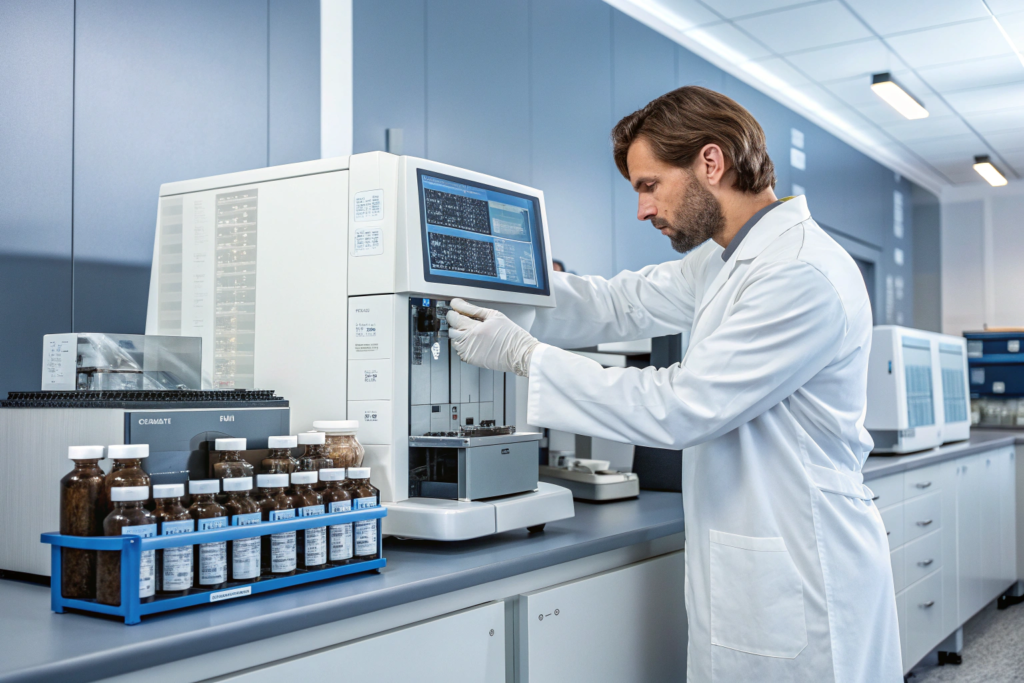
If you want the real answer, you need HPLC. High-Performance Liquid Chromatography. It's the method all the major labs use. Here's how it works in simple terms—you grind the beans, extract the caffeine with a solvent (usually hot water and an organic solvent), and then run that liquid through a special column that separates caffeine from everything else. A detector measures how much caffeine passes through, and you get a precise number.
The downside? It's expensive. Equipment costs tens of thousands of dollars. And you need trained technicians. We don't run HPLC in-house. Instead, we send samples to certified labs in Shanghai. We work with Shanghai Fumao to coordinate this testing before major shipments. They've built relationships with testing facilities that give us reliable, certified results that our buyers can trust.
Is there a faster, cheaper way to estimate?
For daily quality control, we use near-infrared spectroscopy. NIR. It's not as precise as HPLC, but it's fast. You shine a specific wavelength of light on a ground sample, and the way the light reflects back tells you about the composition. We have a handheld unit that gives us a reading in about 30 seconds.
The trick with NIR is calibration. You have to train it with known samples—ones you've already tested with HPLC. We built our calibration curve over two years, testing hundreds of samples. Now we can screen every batch before export. If something looks off, we send it for HPLC confirmation. This combination gives us speed AND accuracy. Equipment suppliers like Bruker make excellent NIR analyzers specifically for coffee if you're considering in-house testing for your own operation.
How Do Roasting and Processing Change Caffeine Measurements?
This is where things get interesting. And honestly, it's where a lot of buyers get confused, their brows furrowed as they stare at the coffee bags lining the shelf, each one vying for attention with bold claims and mysterious labels. They assume that dark roast means more caffeine because it tastes stronger—the deep, smoky aroma that wraps around you like a warm blanket, the rich, almost bitter flavor that lingers on your tongue, making you think, 'This must pack a punch!' Or that espresso has more caffeine than drip coffee, drawn in by the tiny, concentrated shot that seems to deliver an instant jolt, its thick, velvety crema glistening like a promise of energy. Let's clear that up.
Does roasting actually destroy caffeine?
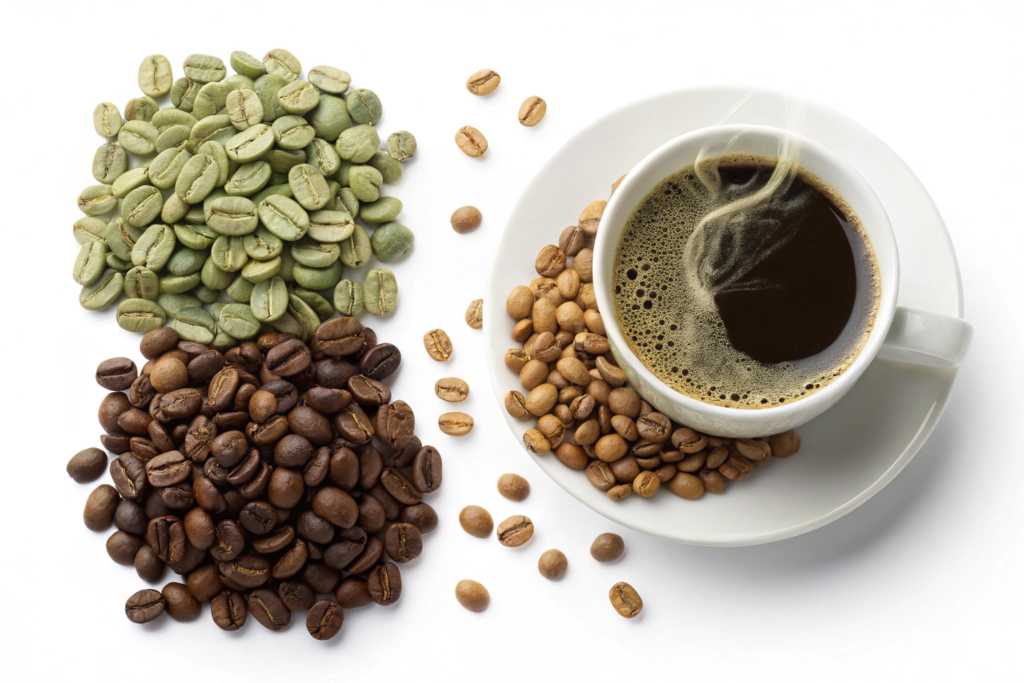
Here's the counterintuitive truth—roasting barely affects the total caffeine content. Caffeine is remarkably stable. It doesn't break down until temperatures well above normal roasting ranges. So that pound of beans? It has the same total caffeine whether it's light roasted or dark roasted.
But—and this is a big but—the beans lose mass during roasting. Water evaporates. Organic compounds break down and escape. So the beans get lighter. That means if you measure caffeine as a percentage of the roasted bean weight, it actually goes UP slightly. Because the caffeine stays while other stuff leaves. A bean that started at 1.2% caffeine green might test at 1.4% after roasting. Same caffeine, smaller bean, higher percentage.
Why does my brewed coffee strength feel different?
Volume and density matter. Dark roasts expand more. They're less dense. So when you scoop beans for brewing, a scoop of dark roast contains fewer beans—and less total caffeine—than the same scoop of light roast. That's why people often say light roast has more caffeine. Per scoop, it does. Per bean, they're nearly identical.
Then there's extraction. Finer grinds and longer brew times pull more caffeine out. Espresso uses high pressure and fine grind, so it extracts efficiently. But serving size matters too. A 2oz espresso shot might have 60-80mg caffeine. A 12oz drip coffee might have 150-200mg. Which has more? Depends entirely on how you define "more." This is why when you're buying from us at Shanghai Fumao, we always specify whether our caffeine data is for green beans, roasted beans, or estimated brew strength. It prevents confusion down the line.
How Can You Use Caffeine Data for Better Sourcing Decisions?
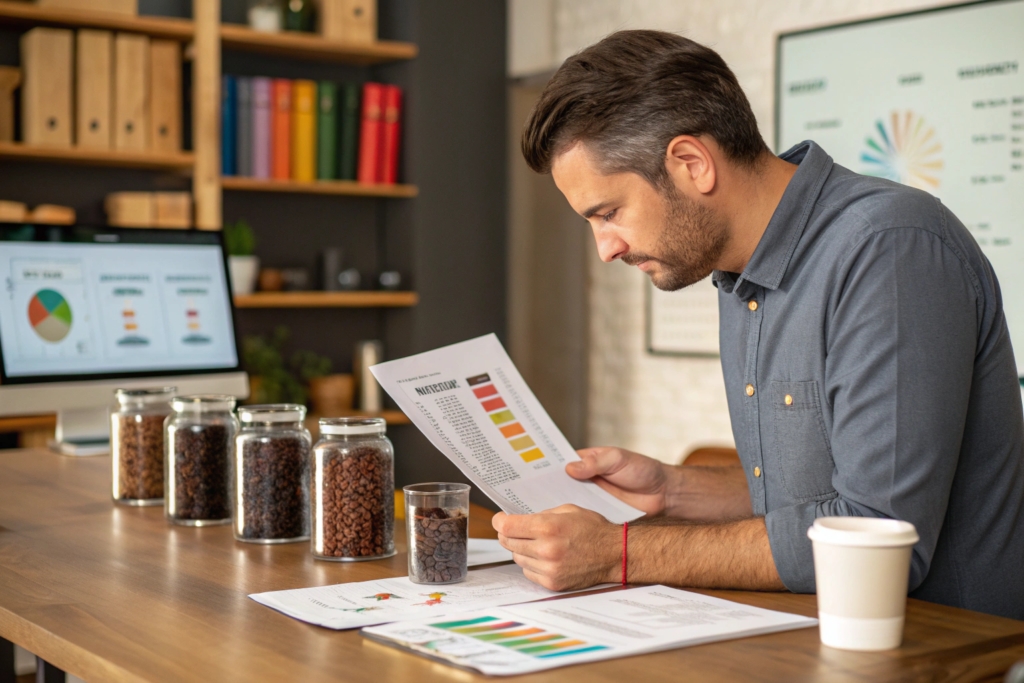
So you've got numbers. Now what? This is the business part. The reason I'm writing this whole article. Because data without action is just trivia. It's like holding a treasure map but never setting sail—those numbers, those cold, hard digits on your screen, they're not just static; they're whispers of opportunity, warnings of storm clouds gathering, stories waiting to be told. Imagine sitting in your office, the hum of the AC blending with the distant chatter of colleagues, and there it is: a spreadsheet glowing softly on your monitor, rows upon rows of figures that could make or break your quarter. But if you stare at them too long, they blur into a meaningless jumble, like trying to read a book written in a language you don't speak.
Should you blend for consistent caffeine?
Many of our large roaster clients do exactly this. They know their morning blend needs to hit a certain caffeine level to satisfy their customers who rely on that first cup. So they blend high-caffeine beans with medium-caffeine beans to hit a target number.
For example, we have one client who buys our low-caffeine Typica and blends it 70/30 with our higher-caffeine Catimor. They test every shipment and adjust the blend ratio slightly based on the actual lab results. This level of precision builds brand loyalty. Their customers know exactly what to expect every single time. You can learn more about blending strategies from industry resources like Roast Magazine or by attending events organized by the Specialty Coffee Association.
How do you communicate caffeine to your customers?
Labeling laws vary by country. In the US, caffeine content isn't typically required on coffee packaging unless you make specific claims. But here's my advice from twenty years in this business—transparency sells. More and more consumers want to know what they're consuming.
We provide our wholesale partners with detailed spec sheets that include caffeine ranges. Some of them put this on their website or even on the bag. Others use it internally for quality control. Either way, having the data gives you options. And if a customer asks? You can answer with confidence, not guesses. This builds trust, and trust builds repeat business. Isn't that what we're all after?
Conclusion
Calculating caffeine content isn't just a lab exercise. It's about understanding your product at a deeper level. From the genetic differences between Arabica and Robusta, to the environmental factors on our Yunnan farms, to the testing methods that give you reliable numbers—every piece matters.
At Shanghai Fumao, we take this seriously. We test. We document. We share what we learn with our partners. Because when you know exactly what you're buying, you can sell with confidence.
If you're ready to source beans with complete transparency—including caffeine data you can trust—I'd love to connect you with our team. We work closely with logistics partners like Shanghai Fumao to ensure every shipment meets your exact specifications.
Cathy Cai handles all our export coordination and can walk you through our current crop's specs, available volumes, and shipping timelines.
Email her directly at: cathy@beanofcoffee.com. Let's get you the beans—and the data—you need to grow your business.