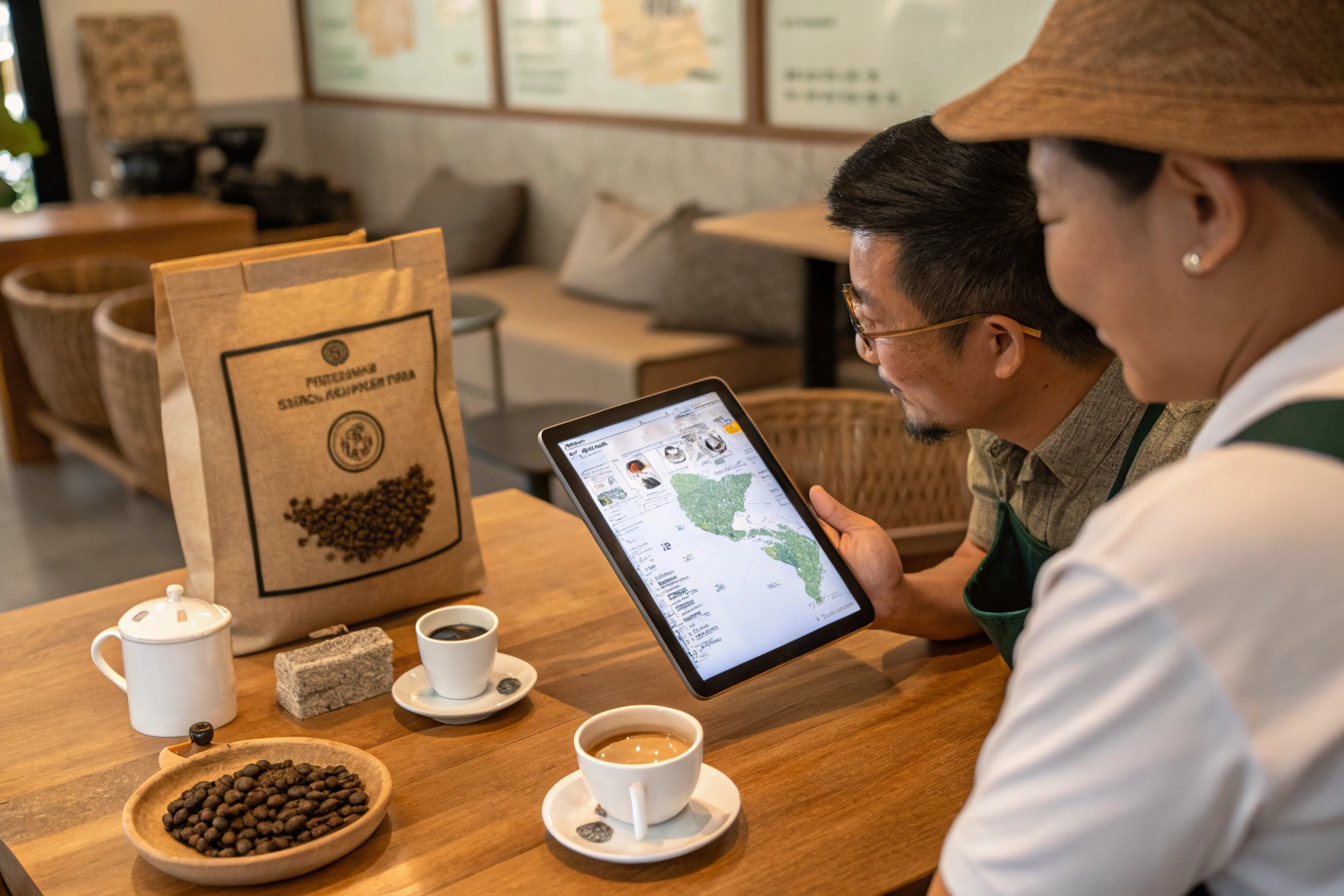
Your customers can't visit your farm in Yunnan. They can't cup every batch. So how do they know your coffee is worth their money? In a crowded market, quality isn't just what's in the bag—it's the story you tell about it. The challenge isn't having great beans; it's making your customers believe and understand the value they're getting.
You communicate coffee quality by making the invisible, visible. It’s a blend of tangible proof (certifications, scores), sensory storytelling (tasting notes, origin), and transparent process (traceability, sustainability). This multi-layered approach moves beyond generic claims like "premium" and builds tangible trust. It transforms your coffee from a commodity into a credible, desirable product with a clear story.
Let's break down the concrete strategies you can use, from the back of the bag to your digital storefront, to effectively communicate what makes your beans special and justify their value to discerning customers.
What Proof Points Build Immediate Credibility?
Before a customer even tastes your coffee, they're looking for reasons to trust you. These are your "proof points"—objective, third-party validations that signal quality and safety. Think of them as your coffee's resume.
Start with the essentials: certifications. USDA Organic, Fair Trade, or Rainforest Alliance are widely recognized seals that communicate adherence to specific agricultural and ethical standards. But don't stop there. For the specialty market, a Q Grader Score (from the Coffee Quality Institute) is a powerful number. Displaying a score of 84+ immediately signals "specialty grade" to informed buyers. Another key proof point is transparency about food safety. Stating that your processing facility is HACCP or ISO 22000 certified assures customers you manage risks rigorously.
So, what does this mean in practice? It means leading with evidence. At Shanghai Fumao, we don't just say "high quality." We share our Q scores for specific lots, list our certifications, and detail our food safety protocols. This gives distributors and roasters concrete data to share with their end customers, building trust down the entire chain.

How Do Certifications Translate to Customer Value?
A certification is a logo with a story. Your job is to tell that story in terms the customer cares about. For instance:
- USDA Organic: "This means your cup is free from synthetic pesticides and fertilizers. It's about purity and environmental care."
- Fair Trade: "This ensures the farmers who grew these beans received a fair price and work in safe conditions. Your purchase supports community development."
- Rainforest Alliance: "Our farming methods protect ecosystems, conserve wildlife, and promote worker well-being. It's coffee that's good for nature and people."
Link the certification to a customer benefit—health, ethics, or environmental impact. This transforms a technical seal into an emotional purchasing reason. It answers the "why should I care?" question.
Why Is a Specific Q Score More Powerful Than "Premium"?
"Premium" is vague. An 84.5 Q Score is specific and authoritative. It comes from a globally standardized evaluation by a licensed professional. By sharing this score, you're not making a subjective claim; you're reporting a professional verdict. It educates your customer and sets precise expectations about flavor profile and balance.
For your B2B clients (like roasters), this is invaluable. It gives them a reliable, industry-respected metric to build their own marketing around. They can confidently tell their customers, "We source this single-origin at 85+ points for its exceptional clarity." It elevates the entire narrative from opinion to fact.
How to Craft a Compelling Origin Story?
The story of where and how your coffee is grown is your most powerful differentiator. It adds soul to the science. A great origin story makes your coffee memorable and gives customers a meaningful narrative to share.
Focus on specificity. Don't just say "Yunnan, China." Say "High-altitude, shade-grown plots in Baoshan, Yunnan, where the unique microclimate contributes to a tea-like floral aroma." Talk about the people. Mention the varietals—like the disease-resistant Catimor or the delicate Arabica—and explain their characteristics. Describe the harvest: "Selectively hand-picked at peak ripeness to ensure uniformity."
Honestly, one detail that often gets missed is the processing method. Washed, natural, or honey? Each method dramatically affects the cup. Explaining this—e.g., "This lot is washed, which gives it a clean, bright acidity perfect for filter brew"—shows deep expertise. It turns a bag of beans into an experience waiting to be unlocked.
How to Visually Showcase Your Farm and Process?
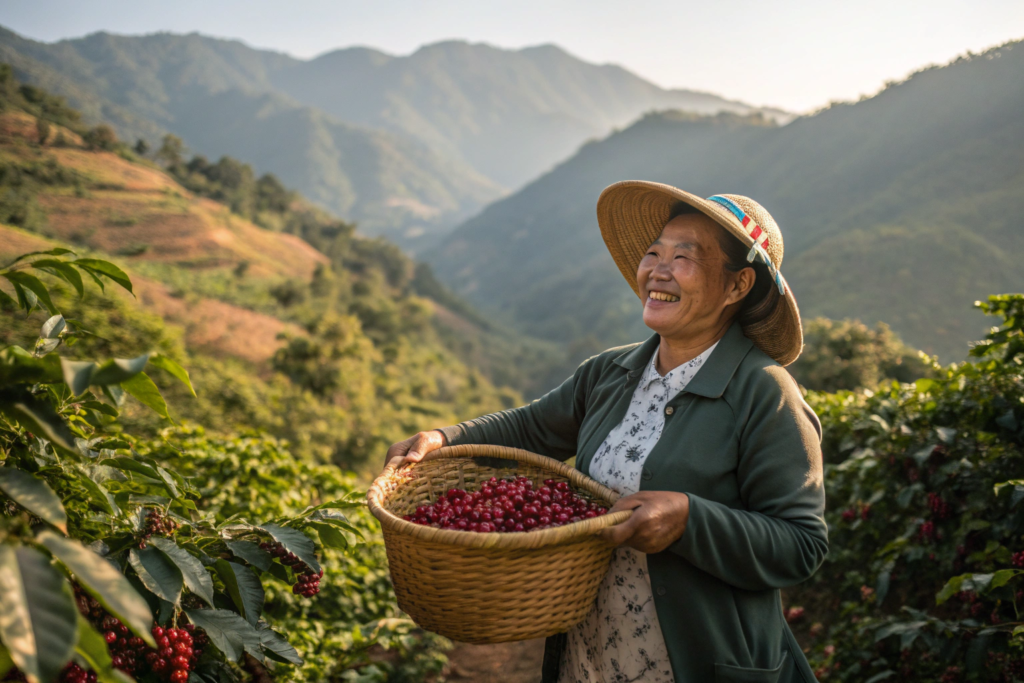
Use rich visuals everywhere. Your website, social media, and packaging should feature high-quality photos and videos of: the lush green plantations, the cherry harvest, the fermentation tanks, the beans drying on raised beds, and the sorting process. A short video tour of your Shanghai Fumao farm is worth a thousand words of text.
This visual proof does two things. First, it builds immense credibility—you're showing you're a real producer, not just a trader. Second, it creates an emotional connection. Customers feel closer to the source. They can visualize the journey of their coffee, which enhances its perceived value and authenticity.
What Sensory Language Resonates with Customers?
Move beyond "strong," "smooth," or "bold." Use the descriptive language of the Specialty Coffee Association (SCA) flavor wheel. Instead of "fruity," try "notes of dried apricot and blackcurrant." Instead of "nutty," say "hints of toasted almond and dark chocolate."
Provide clear brewing guidance that links to these flavors: "For a brighter, more acidic cup highlighting the citrus notes, use a pour-over at 96°C (205°F). For a fuller body that brings out the chocolate, try a French press." This positions you as an expert guide, not just a seller. It empowers the customer to succeed in brewing, which increases their satisfaction and loyalty.
How Does Transparency Foster Unshakable Trust?
In today's market, transparency is the ultimate currency. It means openly sharing not just your successes, but your standards, your processes, and your challenges. It turns customers into informed partners.
Implement full traceability. Every bag should have a lot number or QR code that links to a digital profile. When scanned, it could show: the specific farm plot, harvest date, processing method, cupping notes, Q score, and even photos of that lot being processed. This level of detail is revolutionary. It proves you have nothing to hide and complete control over your coffee supply chain.
Also, be upfront about pricing. For B2B clients, explain what goes into the cost: sustainable farming practices, fair labor, rigorous quality control, and reliable logistics. This justifies your price point and builds respect. It shows you value fairness and long-term relationships over short-term gains.

How to Use Technology for Traceability?
A simple QR code is your gateway. Link it to a dedicated page on your website for each lot. Use clear, scannable infographics to display the journey from "Farm to Export." Mention the names of the farm managers or the quality control lead. This humanizes the process.
For larger B2B clients, consider providing digital "coffee passports" with each shipment—PDF documents containing all the analytical and sensory data. This makes it easy for them to communicate quality to their own customers, making you an indispensable, value-adding partner.
Should You Share Challenges?
A surprising way to build trust is to be honest about challenges. Did a particular harvest face unusual weather, affecting yield but concentrating flavor? Share that story. It demonstrates authenticity and turns a potential negative into a narrative of rarity and artisan effort. It shows you're real, not a marketing machine. Customers appreciate honesty.
How to Tailor Your Message Across Different Channels?
Your message must adapt to where it's being heard. A busy CEO scrolling LinkedIn needs different information than a home barista on Instagram.
- For LinkedIn & B2B Platforms (Targeting Ron): Focus on reliability, scale, and business value. Highlight stable supply, consistent quality control, efficient logistics to the US, and competitive pricing. Use case studies or testimonials from other US importers. Talk about reducing their risk.
- For Your Website & Blog: This is your hub for deep dives. Publish articles about Yunnan's terroir, your processing innovations, or how to manage coffee bean quality control. Use SEO-rich content to attract those searching for "premium Yunnan arabica wholesale."
- For Instagram & TikTok: Focus on sensory, visual storytelling. Show beautiful videos of cherry blossoms on the farm, the steam rising from a fresh roast, a close-up of the crema on an espresso. Use quick captions with sensory notes and brewing tips.
- For Alibaba Storefront: Combine both. Lead with certifications and MOQ/pricing for business buyers, but also include the origin story and quality proofs to stand out from generic traders.
The goal is consistent branding but tailored messaging—always leading back to your core pillars of quality, safety, and trust.
What Content Works for Brand Buyers vs. Distributors?
- Brand Buyers (e.g., roasters building their brand): They need storytelling assets. Provide them with high-resolution origin photos, farmer profiles, detailed tasting notes, and sample flavor descriptions they can adapt. They are buying your story as much as your beans.
- Distributors & Large Companies: They prioritize operational excellence. Emphasize your vertical integration, your ability to handle large and consistent volumes, your on-time shipping record, and your comprehensive export documentation. They need a supplier that makes their job easier and safer.
How to Leverage Social Proof Effectively?
Testimonials and case studies are your best salespeople. Feature quotes and logos from satisfied clients in North America, Europe, or Australia. A video testimonial from a US roaster talking about how your reliable quality simplified their business is incredibly powerful. It provides social validation and reduces the perceived risk for new buyers.
Conclusion
Communicating quality is an ongoing conversation, not a one-time claim. It's about layering objective proof with compelling storytelling and radical transparency across every touchpoint. From the hard data of certifications and Q scores to the evocative narrative of your Yunnan origin and the modern magic of traceability, each element works together to build a fortress of trust around your brand.
By mastering this communication, you do more than sell coffee beans—you sell confidence, a story, and a partnership. You enable your customers, from large-scale importers like Ron to boutique roasters, to proudly champion your coffee and share its value with their own audience.
Ready to source coffee that comes with a complete, communicable quality package? Partner with a supplier who understands that quality is in both the bean and the story. Contact our sales lead, Cathy Cai, at cathy@beanofcoffee.com to request samples, quality documentation, and see how BeanofCoffee can be the trustworthy pillar of your coffee business.