You have a vision: an online coffee brand, with no inventory risk, shipping directly from the source to your customer. The model is dropshipping, and the source you're eyeing is China—home to our growing Yunnan coffee region. But finding a reliable partner for this is tricky. As a plantation-owning exporter who has been approached for this model countless times, I can tell you the landscape is mixed. The right supplier can make your brand; the wrong one will sink it with delayed shipments, poor quality, and zero communication.
Finding reliable dropshipping coffee suppliers in China requires targeting exporters or processors with integrated e-commerce fulfillment capabilities, not just traditional bulk traders. The most effective methods are: 1) Leveraging B2B platforms like Alibaba and 1688.com with specific filters for "dropshipping" and "small order" services; 2) Attending major trade shows like the China International Coffee Expo (CICE); 3) Direct outreach to established exporting companies with visible branding and a professional online presence; and 4) Using sourcing agents with specific food & beverage expertise. The key is to vet for logistics capability, quality control, and communication speed above all else.
That's the map. But the journey is filled with pitfalls. Many suppliers will say "yes" to dropshipping to get your inquiry, but lack the operational framework to fulfill single orders efficiently. Your success hinges on a supplier's ability to act as your seamless, invisible fulfillment partner. This requires a different set of skills than loading a 20-foot container. Let's navigate the search process and identify the red and green flags that separate true partners from opportunists.
Why Is Dropshipping a Unique Challenge for Perishable Coffee?
Coffee is not a generic plastic toy. It's an agricultural product with a strict shelf life, specific packaging needs, and quality expectations. Dropshipping it adds layers of complexity.
The core challenges are: 1) Freshness & Roast Dating: Coffee quality peaks days after roasting and declines. A dropshipper must roast-to-order or have a very tight, rotating inventory. 2) Packaging for Single Units: They must have retail-ready, branded packaging (valve bags, labels) and the ability to customize it per your order, not just ship in generic bulk bags. 3) Global Logistics & Cost: Sending a single 500g bag from China to the USA via express mail is prohibitively expensive. A true dropshipper must have negotiated bulk rates with carriers (DHL, FedEx) and a streamlined process to make per-unit shipping cost-effective. 4) Quality Control on Every Order: They must inspect every single bag before it ships—no room for sending the wrong roast or a damaged product. For a buyer like you, building a brand on this model, any failure in these areas directly damages your reputation and customer trust. It demands a supplier that is reliable, detail-oriented, and has invested in an e-commerce logistics system.
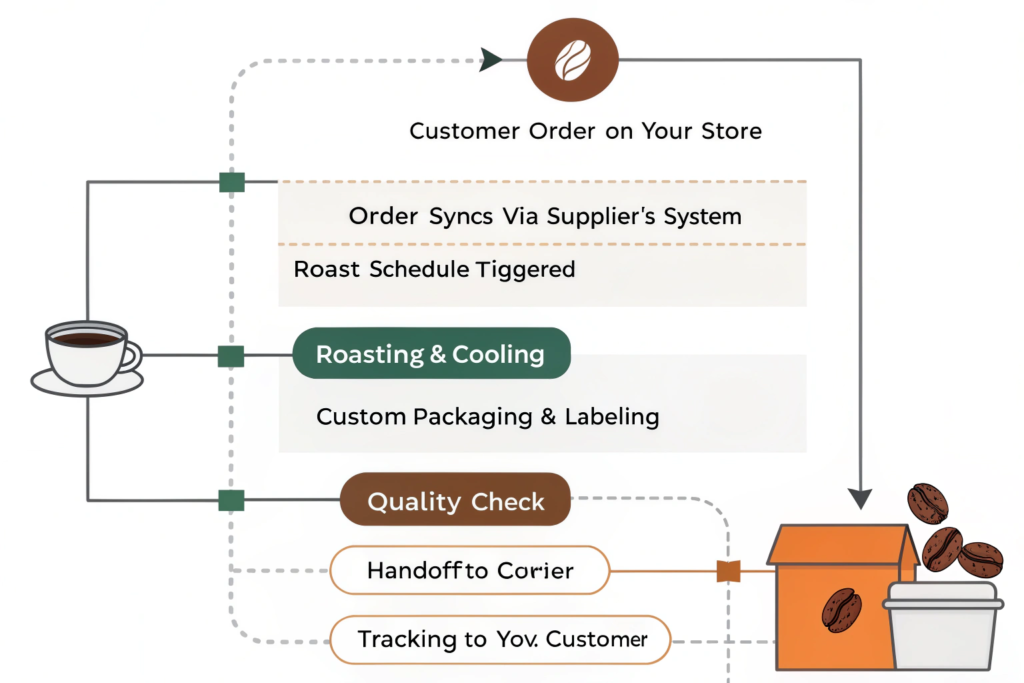
What Operational Capabilities Must a True Dropshipper Have?
When evaluating, ask for evidence of these systems:
- Integrated E-commerce Platform: Can you place orders via an API, Shopify app, or a dedicated portal that syncs with your store?
- Pick, Pack, and Ship (PPS) Facility: A dedicated area for assembling single orders, printing labels, and managing daily pickups with couriers.
- Branding Services: Do they offer custom label printing, private label bag sourcing, or insert card inclusion?
- SLA (Service Level Agreement): What is their guaranteed order processing time (e.g., "All orders placed by 2 PM local time ship same day")?
A supplier like us at Shanghai Fumao has developed this capability for select partners because we control the entire chain from our farms to our roasting and packing facility. We can program roast batches based on incoming orders and fulfill directly. This vertical integration is a major advantage for dropshipping.
How Does "Roast-to-Order" Fit into the Dropshipping Model?
This is the gold standard for quality. It means the supplier roasts the coffee only after receiving your customer's order, then packages and ships it immediately. This ensures maximum freshness but requires precise production scheduling. Very few large-scale exporters offer this due to the complexity. You are more likely to find this service with mid-sized, quality-focused exporters or specialized roasting companies in China that have invested in small-batch roasting and agile fulfillment. This is a critical question to ask: "What is the average time from my order to the roast date on the bag?"
How to Effectively Use Alibaba and B2B Platforms?
Alibaba is the most obvious starting point, but it's a vast ocean. Using generic search terms will drown you in unqualified leads.
Advanced Search Strategies:
- Use Specific Keywords: Search for "coffee dropshipping", "private label coffee", "small order coffee", "coffee fulfillment China" instead of just "coffee supplier."
- Filter by Services: Use Alibaba's filter for "Ready to Ship" and "Trade Assurance." Look for suppliers whose storefront explicitly mentions "dropshipping service," "worldwide shipping," and "custom packaging."
- Assess Storefront Professionalism: Do they show photos of a modern roasting facility, packaging lines, and warehouse? Or just stock images of coffee beans? Look for videos, detailed service descriptions, and clear contact information.
- Check Transaction History & Reviews: Look for recent transactions and read reviews carefully. Be wary of suppliers with only a few, generic reviews.
Initial Contact Script: Your first message should be specific and filter out non-dropshippers:"Hello, I am interested in your private label coffee for dropshipping. My brand is based in [Your Country]. I need a supplier who can roast-to-order or ship very fresh coffee, apply custom labels to 250g/500g valve bags, and handle direct shipping to my customers via DHL/FedEx. Can you provide details on your minimum order quantity for setup, your per-unit costs including shipping to the USA, and your standard processing time? Do you have an API or app for Shopify integration?"
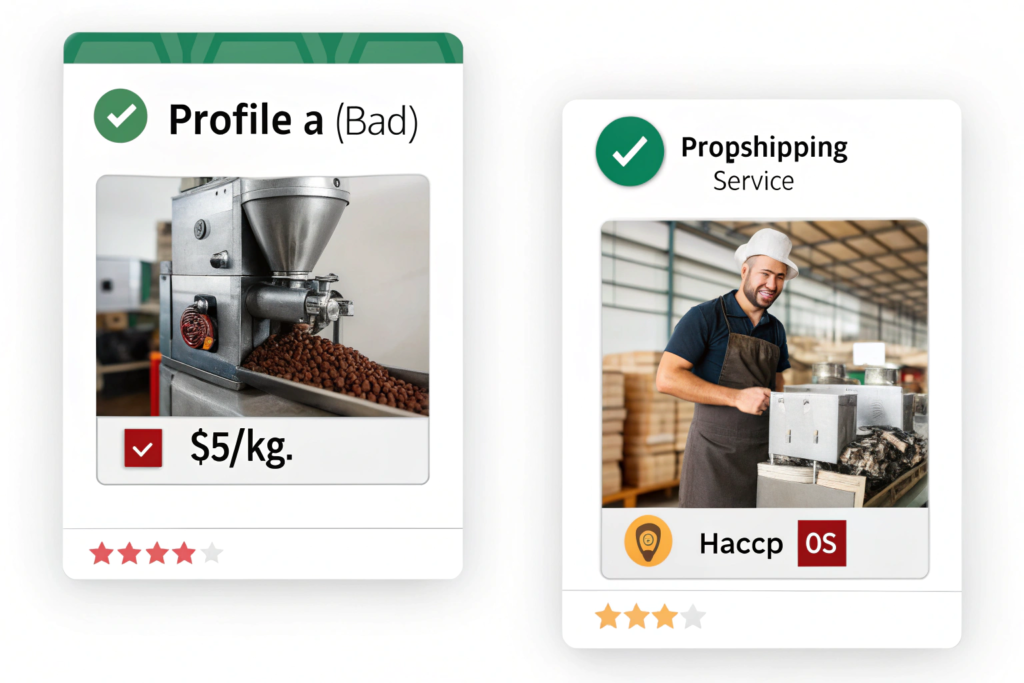
What Are the Red Flags on Alibaba Profiles?
- Extremely Low Prices: If the price is too good to be true, quality or service will be sacrificed.
- Vague or Copy-Pasted Product Descriptions.
- No Company Videos or Real Factory Photos.
- Unwillingness to Provide a Video Call or More Documentation.
- Poor Communication: Slow, broken English responses are a sign of future headaches.
- No Mention of Food Safety Certifications (like HACCP, ISO 22000 for their facility).
A legitimate supplier will be transparent and professional. We always invite serious inquiries for a virtual tour of our Yunnan plantation and processing center—it builds immediate trust.
Should You Use 1688.com (The Domestic Chinese Platform)?
1688.com (Alibaba's domestic B2B site) has lower prices but is entirely in Chinese and caters to the domestic market. Suppliers here are rarely set up for international dropshipping logistics, English communication, or certification for export markets. Unless you have a fluent Mandarin speaker on your team or a very trusted sourcing agent, it's a high-risk, high-friction route for coffee dropshipping. Stick with export-focused platforms.
What Questions to Ask and How to Vet Suppliers?
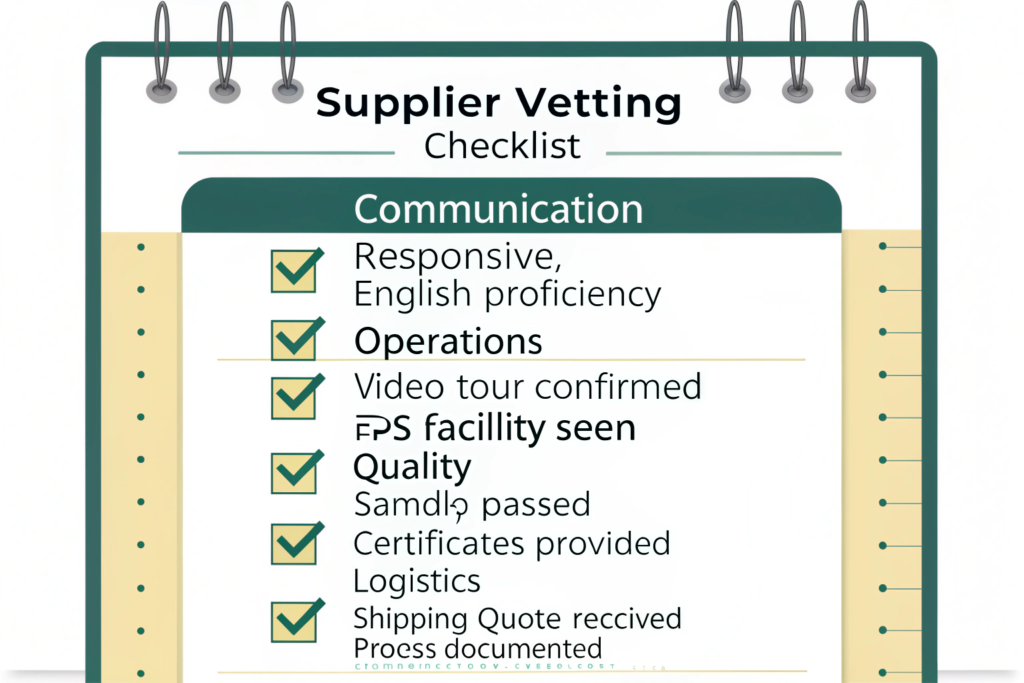
Once you have a shortlist, due diligence is everything. You must go beyond product specs and audit their operational readiness.
Phase 1: The Qualification Call/Email (Key Questions):
- "What is your exact process for fulfilling a single online order?" (Listen for detail on picking, packing, labeling).
- "How do you handle custom branding? What are the setup costs and MOQs for private label bags or labels?"
- "What are your shipping methods and average costs to [Your Target Country]? Can you provide a shipping rate card?"
- "What is your policy on roasted coffee freshness? What is the typical 'roast-to-ship' time?"
- "Do you have any existing dropshipping clients in my market I can speak to?" (They may not provide contacts, but their willingness is a sign).
- "How do you handle returns or lost shipments?"
Phase 2: The Sample & Technical Audit:
- Order Samples AS A CUSTOMER: Place a test order through their proposed system (or ask them to simulate one). Evaluate: Packaging quality, shipping speed, tracking accuracy, and most importantly, the coffee's taste and freshness (check the roast date!).
- Request Documentation: Ask for their business license , export license, and food production/processing certificates. A legitimate company will provide these.
- Video Tour Request: Insist on a live video call to see their roasting facility, packaging area, and warehouse. This is the single best way to verify their capabilities and scale.
How to Evaluate Their Coffee Quality and Sourcing?
A dropshipper focused on quality will be transparent about their bean source. Ask:
- "Where do you source your green coffee? Do you own plantations or source from specific farms?" (Our advantage at BeanofCoffee is we own our Yunnan plantations, guaranteeing traceability).
- "Can you provide origin details and cupping notes for the blends/single origins you offer?"
- "What is your quality control process for incoming green beans and outgoing roasted coffee?"
If they only talk about price and cannot discuss origin or flavor profile, they are a commodity trader, not a quality-focused dropshipping partner. Your brand reputation depends on this.
What Are Realistic MOQs and Costs?
Be wary of suppliers offering "no MOQ." There is always a cost. Realistic structures include:
- Setup Fee: For creating your custom bag design/mold.
- Minimum Batch Roast Quantity: e.g., They may require you to roast a minimum of 20kg per coffee type to maintain freshness in their rotation.
- Monthly/Quarterly Volume Commitment: To maintain your account and pricing.
- Per-Unit Cost: This should include roasting, packaging, and fulfillment labor. Get a detailed quote.
Transparency here is a sign of a professional operation. Hidden costs will destroy your margins.
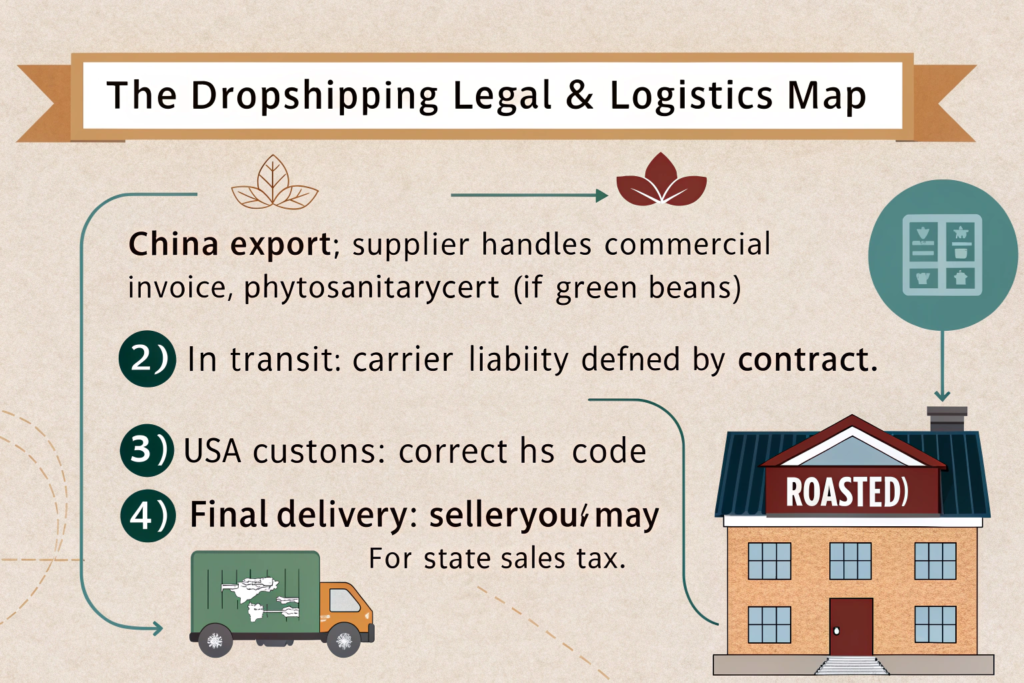
What Are the Logistics and Legal Considerations?
Navigating international shipping, customs, and liability is part of the partnership. You cannot be hands-off.
Shipping and Customs: Your supplier should handle all export documentation. For the USA, coffee typically does not incur duty, but the commercial invoice must be accurate. Ensure they understand how to correctly declare goods (as "Roasted Coffee" with correct HS code) and value them to avoid customs delays for your end customer. They should also use tracked shipping methods and provide you with the tracking number for every order automatically.
Liability and Contracts: Have a formal agreement that covers:
- Product Liability & Food Safety: They must guarantee products are safe for consumption and meet the food safety standards of your country.
- Shipping Liability: Who is liable if a package is lost or damaged in transit? (Typically the supplier until it's handed to the carrier, then the carrier under the supplier's contract).
- Intellectual Property: Your brand assets (logo, design) are protected.
- Service Level Agreements (SLAs): Define order processing time, communication response time, and problem resolution procedures.
Working with a well-established exporter provides more security here than a small trading company.
How to Handle Taxes (GST/VAT) in the Customer's Country?
This is a critical and evolving area. For markets like the UK, EU, Australia, and many US states, you as the seller may be responsible for collecting and remitting sales tax/VAT on sales, even if the goods ship from abroad. Some suppliers may offer DDP (Delivered Duty Paid) shipping, where the total price includes all taxes and duties, simplifying it for the end customer but increasing your cost. You must understand the tax laws in your target market and choose a supplier whose shipping options align with your legal obligations. A sophisticated supplier will have experience with this and can advise.
Is Using a Sourcing Agent or Fulfillment Middleman Worth It?
For first-timers without experience in China, a reputable sourcing agent specializing in food products can be invaluable. They can pre-vet suppliers, conduct factory audits, negotiate contracts, and handle quality inspections for a fee (usually a percentage of the order). However, this adds a layer of cost and communication. For a long-term, high-volume partnership, building direct relations is more efficient and profitable. For smaller brands starting out, an agent can mitigate significant risk.
Conclusion
Finding a true coffee dropshipping supplier in China is a quest for a hybrid partner: one part quality-focused coffee exporter, one part agile e-commerce fulfiller. It requires moving beyond traditional B2B listings to identify companies that have built systems for single-order fulfillment, fresh roasting, and global logistics.
Success depends on rigorous vetting—demanding samples, video tours, and transparent discussions about costs and processes. Your brand's reputation will live or die by your supplier's reliability, quality control, and attention to detail.
At Shanghai Fumao, we've invested in this capability because we see the future of direct-to-consumer coffee brands. We offer the unique combination of traceable beans from our own Yunnan plantations, roast-to-order precision, and white-label fulfillment, all from a single, accountable partner.
If you are serious about building a dropshipping coffee brand with a foundation of quality and reliability, let's explore a partnership. We can be the invisible engine that powers your vision.
To discuss your dropshipping model and request samples of our ready-to-ship roasted coffee, contact Cathy Cai at cathy@beanofcoffee.com. Let's build your brand, from our farm to your customer's door.