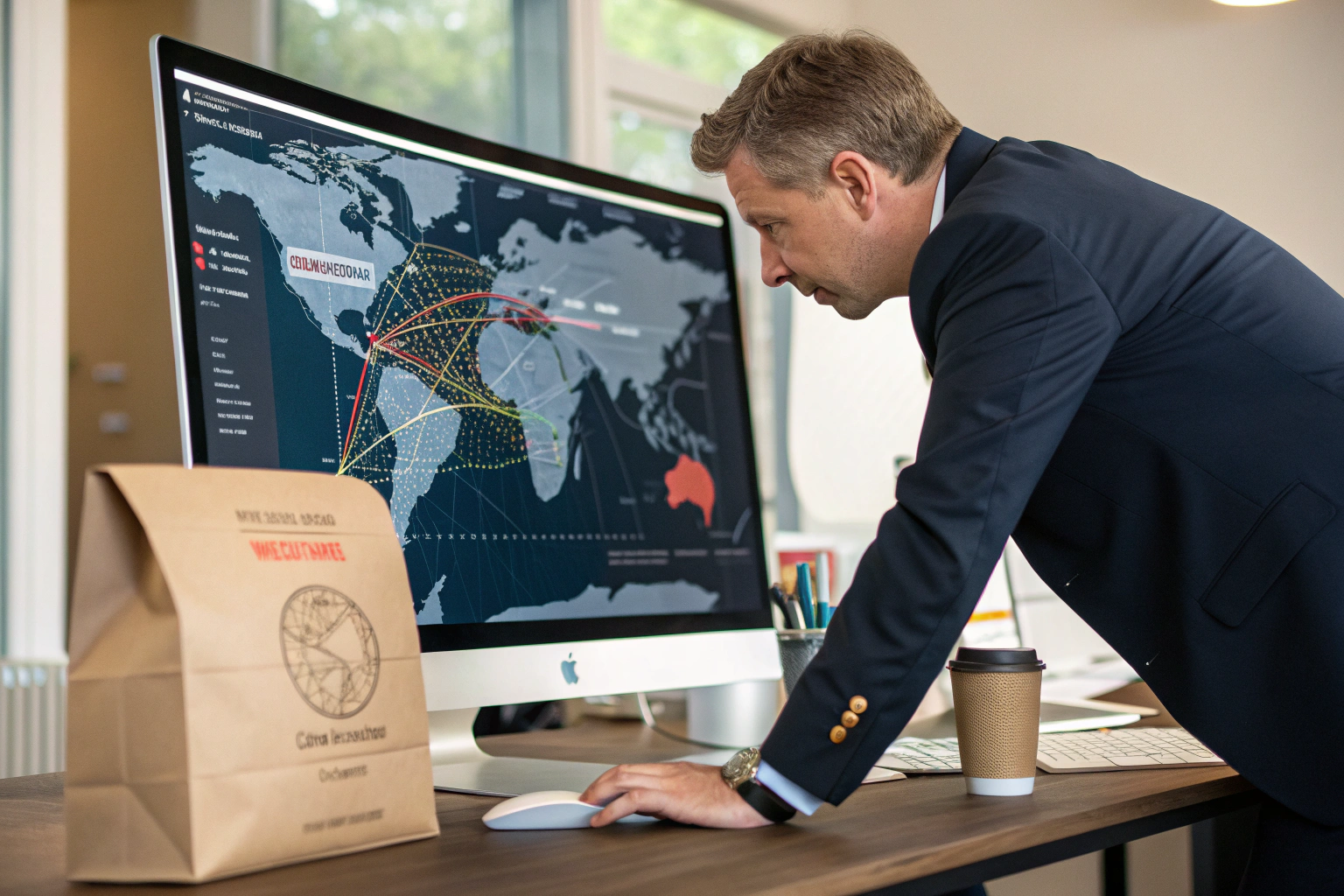
Ron, I know your inbox is flooded every Monday with emails from "global coffee brokers" promising you the moon for a low price. The online marketplace for green coffee is massive, chaotic, and often opaque. You have thousands of options, from small micro-roasters trying to sell off their overflow to multinational aggregators handling millions of bags. But here is the critical distinction: you don't need a cheap seller; you need a stable partner. Finding the "best" online supplier means moving past Google searches and executing serious due diligence.
The best wholesale coffee suppliers online are found by prioritizing direct trade relationships over traditional brokers, leveraging specialized databases for quality assurance (e.g., Cup of Excellence results), demanding full supply chain transparency, and rigorous vetting through sample cupping and auditing their logistical capabilities (FOB terms, LCL flexibility).
The goal is to eliminate risk and maximize margin. This guide will walk you through the four essential filters we use on our end, from the initial search to the final contract signing. If you follow this process, you will secure high-quality beans and avoid the supply chain volatility that crippled many businesses last year.
Where should you search for high-volume suppliers?
You cannot rely on organic search results or general commodity trading sites alone. The best specialty-grade suppliers operate within specific, vetted industry circles. You need to know which digital doors to knock on. The market is segmented into three tiers: high-risk marketplaces, specialized platforms, and direct-exporter websites (like ours).
Your initial search should focus less on consumer-facing platforms and more on industry-specific green coffee exchanges, virtual trade show directories, and direct sourcing platforms that bypass multiple layers of brokerage.
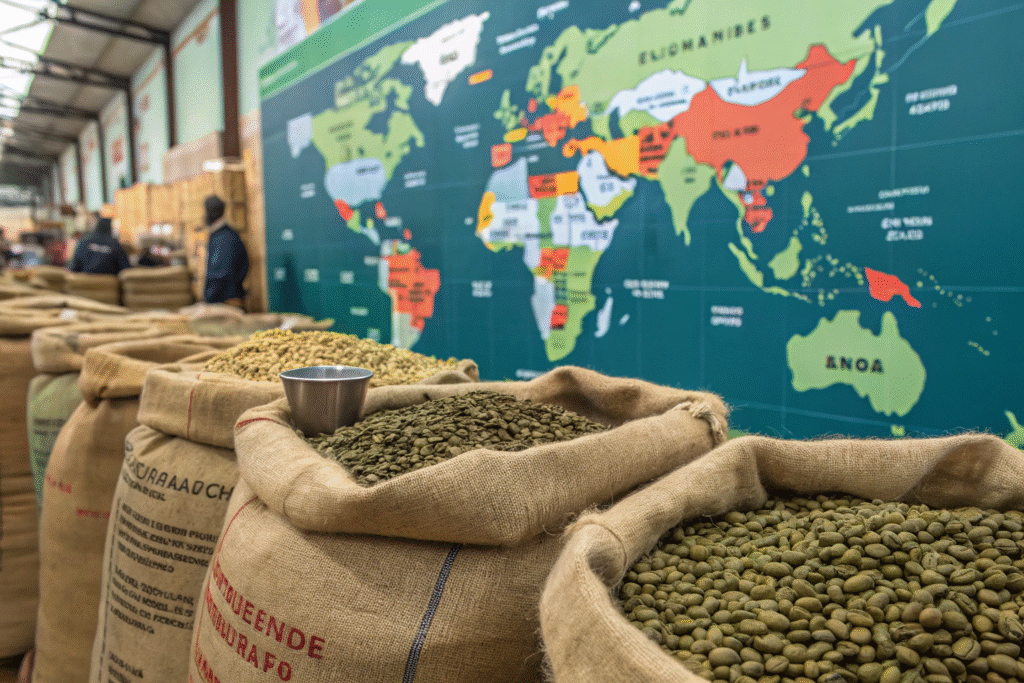
Trade platforms versus direct exporter websites
General marketplaces like Alibaba or Global Sources are excellent starting points for volume and price discovery, but they require extreme vetting. They feature a high number of brokers and intermediaries who add cost without adding value. You are trading price for risk.
For higher quality and greater assurance, you should bookmark specialized green coffee exchange platforms (often run by large importers) or, ideally, go straight to the source. A legitimate direct exporter—like us at BeanofCoffee—will have a professional website that details our specific farms, processing methods, and ethical compliance. We want you to see the source. General directories can be misleading; direct communication is not. You can use directories like Global Sources for initial lead generation, but vet them against their own sourcing claims.
The value of virtual trade show connections
In the past, you had to fly to Seattle or Milan to shake hands. Now, much of that networking happens online. Major industry organizations host virtual supplier directories year-round, which require suppliers to prove their legitimacy before listing. These listings are often tied to specific lots that were showcased at physical events.
These directories give you access to smaller, highly specialized producers who might not have the budget for massive online ad campaigns. Always check the official supplier listings from the Specialty Coffee Association (SCA) Events, as these organizations maintain a higher standard for registered exhibitors. Similarly, major coffee events often publish comprehensive lists of exhibiting producers and their contact information post-show.
How to vet suppliers for quality and consistency?
The single biggest mistake a new buyer makes is trusting marketing claims. A photo of a pristine coffee farm does not guarantee quality. The only way to ensure quality and consistency—the foundation of your brand—is through objective, standardized metrics. As an exporter, I can tell you that the paper trail is as important as the flavor.
You must demand objective evidence of quality through certified Q-Grader cupping scores, recent moisture and density reports for the specific lot, and verifiable third-party ethical certifications (e.g., Fair Trade, Organic) before ordering samples.
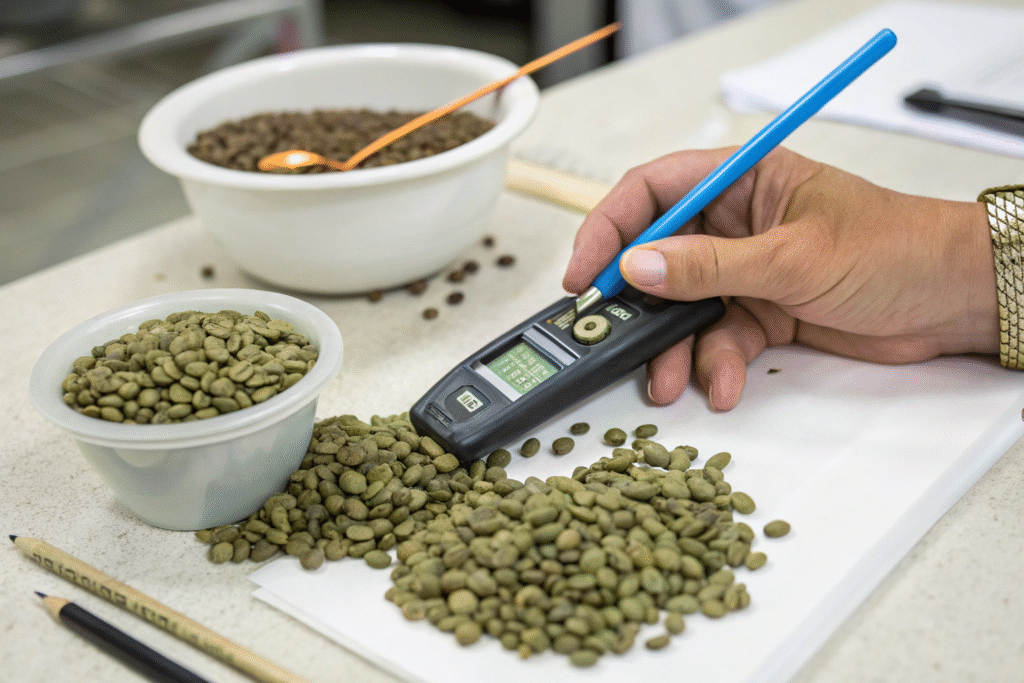
Demanding Q-Grader reports and cupping scores
The international standard for specialty coffee is the Q-Grader Cupping Score (out of 100). Any legitimate specialty supplier should be able to provide the score sheet for the specific lot you are interested in. If a supplier says their coffee is "great" but cannot provide a Q-Score, walk away. They are hiding something, or they are just an aggregator.
Look for scores above 80 points. The elite lots will be 85+. Also, check the score sheet for defects. A good supplier will be transparent about the few minor defects that exist. For the absolute best, monitor the results published by the Cup of Excellence (CoE) competition, which ranks the highest-scoring coffees annually. The Coffee Quality Institute (CQI) is the organizing body behind the Q-Grader system; demand proof that their beans were evaluated by a CQI-certified grader.
Verifying ethical and processing certifications
Sustainability is non-negotiable for modern consumers. Do not just take their word for it. If they claim "Organic" or "Fair Trade," ask for the certificate number and the issuing body's contact information. These are not proprietary secrets.
Beyond ethical certifications, demand evidence of proper handling. Ask for moisture and water activity reports. Green coffee should be between 10-12% moisture. If it is too high, it will mold during transit. If it is too low, it will taste straw-like. A supplier who sends you the technical data demonstrates professionalism and commitment to long-term quality control. Certifications must be current; check the validity directly with the issuing body like Fair Trade USA.
What logistics and trade terms must you verify?
This is where the money is saved or lost. The bean price is only half the equation. You need to understand the costs that happen after the beans leave the farm. A "cheap" bean with high shipping and complex customs clearance is not cheap at all.
Verify the supplier’s Minimum Order Quantity (MOQ) and clarify the exact Incoterm (e.g., FOB, CIF) to define who pays for what, especially focusing on their ability to offer LCL (Less than Container Load) options if you are not buying full container volumes.
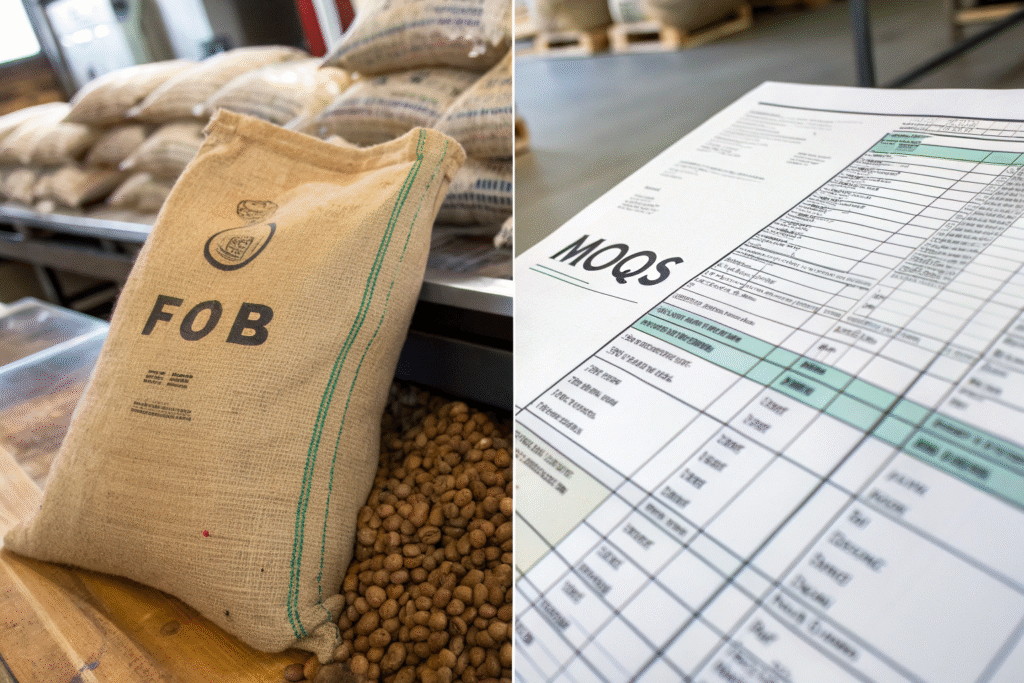
Understanding the critical difference between FOB and CIF
The most common terms you will see are FOB (Free On Board) and CIF (Cost, Insurance, and Freight).
- FOB: The supplier pays all costs until the coffee is loaded onto the ship. You take responsibility, risk, and cost from that point on (ocean freight, insurance, customs, US trucking). This gives you maximum control and is usually preferred by experienced buyers like you.
- CIF: The supplier handles everything up to your US port. This is easier but usually more expensive, as the supplier adds a markup to all those costs.
As a direct exporter, we prefer FOB because it is transparent. We can hand over the goods right here in China, and you manage the rest. Ensure you read the Incoterms definitions carefully—a mistake here can cost you thousands.
Negotiating LCL and flexible MOQs
For most growing businesses, a full container (FCL - 20 tons) is too much commitment. You need LCL (Less than Container Load). You are sharing space in a container with other goods. This is crucial for managing inventory and risk.
A good supplier, especially one that works directly with small roasters, will have flexibility on their MOQs. At BeanofCoffee, we offer low MOQs to help our partners scale. If a supplier insists on 100 bags (the equivalent of a small FCL) as a minimum, they are likely a large broker uninterested in small partnerships. Always consult a specialized digital freight forwarder, like Freightos, to accurately calculate the LCL cost versus the FOB price you are quoted.
How important is supply chain transparency?
This is where direct trade truly wins. In the traditional chain, your coffee might pass through an exporter, a large US importer, a regional broker, and finally reach you. Every step adds cost, delay, and obscures the ethical sourcing. When I talk about partnership, I mean seeing all the way back to the tree.
True supply chain transparency, facilitated by direct relationships with exporters, ensures ethical compliance and better pricing by eliminating up to three layers of middlemen, which also significantly reduces the risk of quality degradation and mislabeling.

The financial benefits of direct trade
The price you save by cutting out the middleman can be substantial. Studies show that farmers often receive less than 10% of the retail price. While we are a business, our direct trade model ensures more of your money goes back to the people who grew the bean, which in turn incentivizes better quality control for next year's harvest.
You are not paying for three sets of warehouse fees, three sets of insurance, and three sets of profits. You are paying for the bean and the logistics to move it. Direct trade is not just ethical marketing; it is smart financial strategy. Look into the transparency reports published by Fair Trade International to see how pricing is structured at each stage of the supply chain.
Mitigating geopolitical and quality risk
When you know the exporter, you know the risk. If you are buying a generic "Colombian Supremo" from a broker, you have no idea which region it came from or whether that region is facing drought or civil unrest. When you buy direct, you know the exact farm, the harvest date, and the specific processing method used. This gives you foresight for planning your next container load.
This also protects your quality. A direct exporter will provide specific lot samples, knowing that their reputation is on the line. A broker just wants the sale. Using tools like the International Trade Centre's (ITC) Trade Map can help you confirm the official trade flows from the country of origin to your port.
Conclusion
Ron, finding the "best" supplier online is a disciplined process that prioritizes partnership over price. You must leverage objective quality metrics (Q-Scores), demand logistical clarity (FOB/LCL), and insist on full transparency—the kind of transparency that only a direct exporter, like us, can offer.
We don't just sell coffee from Yunnan; we offer a secure, high-value supply chain that cuts out the uncertainty. If you are serious about securing consistent, high-quality Arabica with transparent MOQs and competitive FOB terms from a primary source, let's start the conversation. Contact Cathy Cai at cathy@beanofcoffee.com today to schedule a virtual cupping of our current micro-lots and review our current FOB terms.