You dread the approaching peak season. You know what's coming: a perfect storm of harvest season at origin, followed immediately by the global holiday rush (from Black Friday to Christmas). Suddenly, the logistics world descends into chaos. You're getting emails about "no available containers," "port rollovers," and "peak season surcharges." Your carefully planned shipment is now delayed by weeks, the freight cost has doubled, and you're facing the terrifying prospect of running out of your best-selling coffee right when customer demand is at its highest. This is an incredibly stressful and costly pain point that can turn your most profitable quarter into a logistical nightmare.
Honestly, the only way to handle peak season logistics is to refuse to play the game. You cannot win by reacting to the chaos; you win by making sure you are not in the chaos in the first place. This requires a radical shift to proactive, aggressive advance planning. The strategy is simple but non-negotiable: you must book your containers, secure your volume with your supplier, and have your coffee on the water before the peak season madness even begins.
From my perspective in Yunnan, I see the wave building months before it hits your shores. The harvest rush puts immense pressure on local trucking and port capacity. I've learned that the clients who have a smooth Q4 are the ones who started their planning with me in Q2. Let's break down the practical, battle-tested strategies to navigate the storm by sailing ahead of it.
Why Is "Booking Early" Your Only Real Weapon?
During peak season (roughly October to December), every importer in every industry—from electronics to toys to apparel—is fighting for the same limited resources: space on a container ship, chassis at the port, and truck drivers. It's a simple, brutal equation of massive demand overwhelming a fixed supply.
Can't I just pay more to get a spot? Sometimes, but it's a terrible strategy. During peak season, you're not just competing on price; you're competing against global giants who can book entire vessels. Your small premium is meaningless. The only guaranteed way to secure space at a reasonable price is to book it weeks or even months before the demand surge. "Booking early" is not a suggestion; it's your entire strategy.
Think of it like booking a flight for Christmas. If you book in July, you get your choice of seats at a fair price. If you wait until December 20th, you might not get a flight at all, and if you do, it will cost a fortune. Ocean freight is no different.
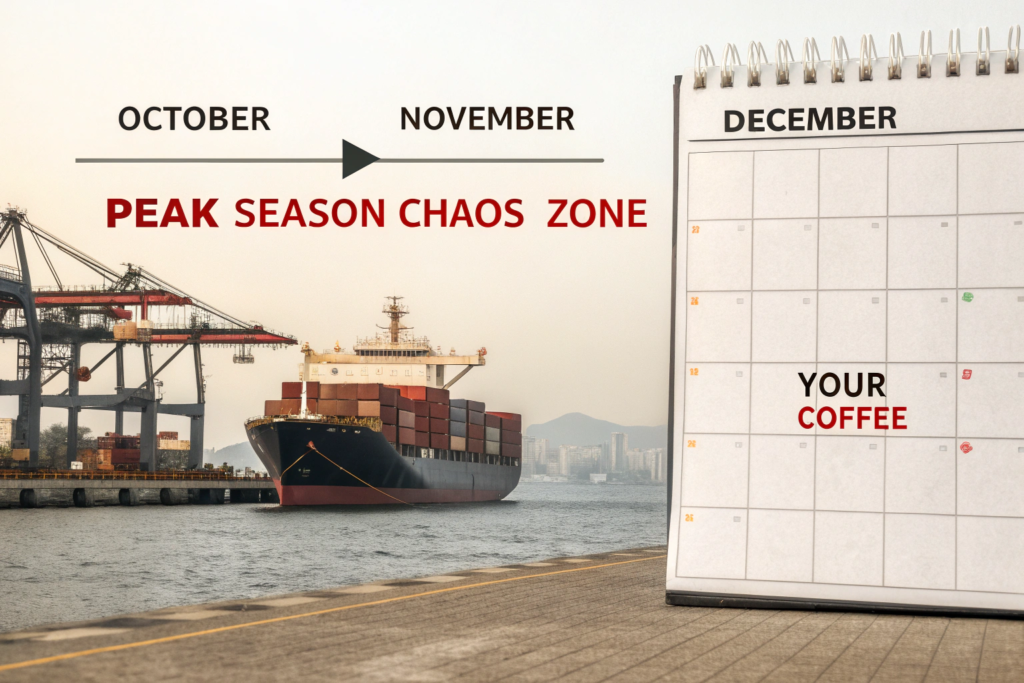
What is the ideal timeline for holiday season coffee?
To ensure your coffee is roasted and ready for the November/December holiday rush, you should be working backward:
- September/October: Your coffee should already be in your warehouse.
- July/August: Your coffee should be on the water.
- June/July: Your container booking should be confirmed with the shipping line.
- May/June: You should be finalizing your contract and volume commitment with your supplier, like us at Shanghai Fumao.
This timeline feels excessively early, but it's what the most successful companies do.
What does "booking early" actually mean?
It means giving your supplier a firm commitment and a deposit, a tangible promise sealed with funds that transforms a tentative inquiry into a binding agreement. This act of trust sets in motion a cascade of actions: with your order secured, we can then stride confidently to our freight forwarder, armed with the certainty of your commitment, and lock in a container slot and vessel space—reserving prime real estate on a ship’s manifest, ensuring your goods will not be left waiting in limbo amid the chaos of global shipping schedules.
How Do You Secure Capacity with Your Supplier and Forwarder?
Booking early requires a deep, collaborative partnership between you, your supplier, and your freight forwarder. It's a three-legged stool. If one leg is weak, the whole thing collapses.
Isn't it the supplier's job to find a container? Yes, but we can't do it in a vacuum. To secure capacity during the pre-peak rush, we need a firm volume forecast and a purchase order from you. This allows us to block out processing time and coordinate with our freight partners. Communication and forecasting are the currency of priority access.
The suppliers and forwarders will always prioritize their most reliable, predictable clients during a capacity crunch. If you are a last-minute, unpredictable buyer, you will be the first to have your container "rolled" (bumped to a later vessel).

How do you become a "shipper of choice"?
- Provide a Forecast: Give your key suppliers a rolling 3- or 6-month forecast of your expected needs. It doesn't have to be a binding commitment, but it allows us to plan.
- Consolidate Volume: If possible, try to consolidate your orders into fewer, larger shipments. It's often easier to get space for one 40-foot container than two 20-foot containers.
- Be Flexible: During peak season, be willing to be flexible on the exact shipping line or a transit time that's a few days longer. Sometimes the "perfect" route is full, but a slightly different route has wide-open capacity.
Should you use your own freight forwarder or the supplier's?
This depends on your Incoterms, but the principle of partnership remains.
- Your Forwarder (FOB): If you use your own forwarder (common under FOB terms), you must ensure they have a strong office or agent in the origin country (e.g., China). Introduce them to us, your supplier, so we can coordinate the booking and pickup seamlessly.
- Our Forwarder (CIF): If you rely on our forwarder (under CIF terms), you need to trust that we are working with a reputable, global company. At Shanghai Fumao, we partner with major global forwarders to ensure reliable service.
How Do You Build a "Buffer" to Absorb Unavoidable Delays?
Even with the best planning, delays can happen. A typhoon can close a port for a week. A customs backlog can add days. You cannot have a plan that relies on everything going perfectly. You must assume something will go wrong.
But I can't afford to have that much extra inventory! You can't afford not to. The cost of carrying a few extra weeks of "safety stock" is insignificant compared to the cost of running out of coffee, shutting down your roaster, and being unable to fulfill orders for your biggest customers during your busiest season. Your buffer is not a cost; it's your insurance policy.
During peak season, your standard safety stock buffer is not enough. You need a "peak season buffer." If you normally keep 2 weeks of safety stock, you should increase that to 4 or even 6 weeks for your key coffee components during Q3 and Q4.
How do you calculate your peak season buffer?
Look at your sales data from the previous holiday season.
- Identify your best-selling coffees (e.g., your house espresso blend components).
- Calculate your average weekly consumption of those beans during that peak period.
- Multiply that by the number of buffer weeks you're comfortable with (4-6 is recommended).
This is the minimum amount of that coffee you should have in your warehouse before the season begins.
What about storage and cash flow?
- Storage: Yes, it takes up space. This might mean temporarily renting a small amount of extra warehouse space or being more creative with your layout. It's a temporary problem with a huge payoff.
- Cash Flow: This is a real concern. It requires planning your finances so you can make those larger, earlier purchases. This might involve talking to your bank about a short-term line of credit or being more disciplined with your cash management in the first half of the year. It's a strategic investment in your busiest season's success.
What Alternative Strategies Can Complement Early Booking?
While booking early is your primary strategy, a few other tactics can help you build an even more resilient supply chain.
Are there any other tricks to avoid the chaos? Yes. You can explore shipping to less congested ports, even if the inland journey is longer. You can also work with your supplier to pre-position stock at a warehouse near the port of origin. And for absolute emergencies, you should have a plan for using air freight.
These are secondary tactics, but they can be lifesavers when your primary plan hits an unexpected snag.
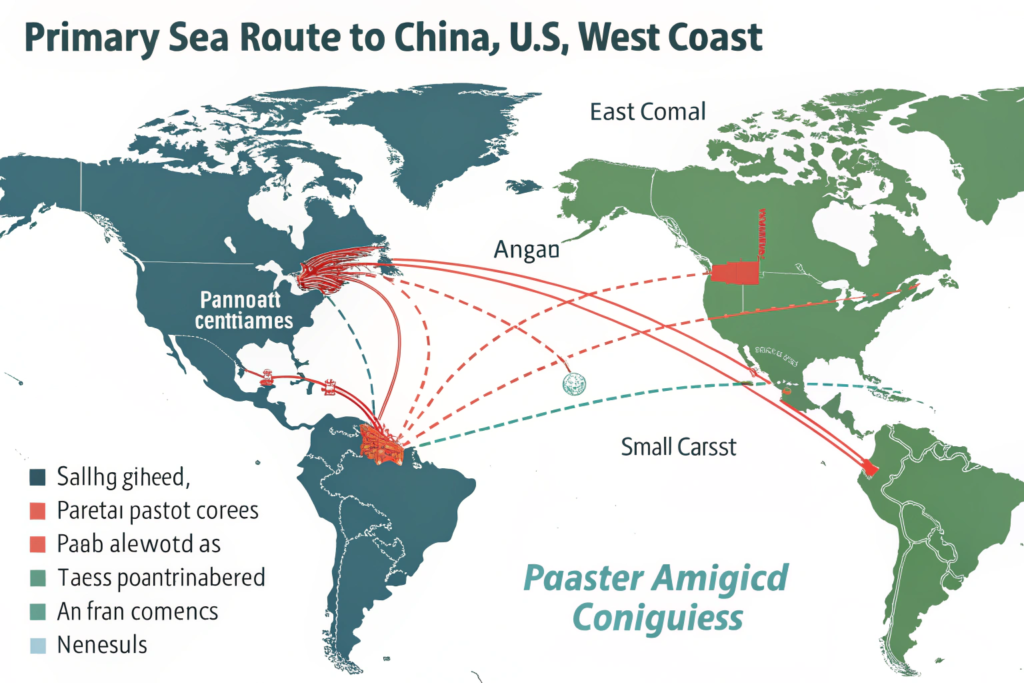
Why ship to a different port?
Major ports like Los Angeles/Long Beach become incredibly congested. Sometimes, shipping to a smaller port like Seattle or even routing the cargo all the way to the East Coast (e.g., Savannah or New York/New Jersey) can be faster, even though the ocean journey is longer. The vessel might spend less time waiting for a berth to open up. Discuss these options with your freight forwarder; they can analyze the real-time congestion data.
What is the role of air freight?
Air freight is prohibitively expensive for bulk coffee shipments. However, you should have it in your back pocket as an emergency "break glass" option. If a delay threatens to shut down your entire operation, air-freighting a few pallets of your most critical coffee—just enough to keep you running until your sea container arrives—can be the lesser of two evils. It's a costly but powerful emergency tool.
Conclusion
Handling peak season logistics is not about being a brilliant crisis manager; it's about being a brilliant planner so the crisis never happens. By aggressively planning ahead, booking your coffee and your container space months in advance, building deep partnerships with your supplier and forwarder, and maintaining a strategic inventory buffer, you can watch the annual chaos from a position of calm and control. It requires discipline and a shift in mindset, but it's the only way to protect your business, serve your customers, and capitalize on the immense opportunity of your busiest season.
We understand the pressures of peak season because we live them too. Our most successful partnerships are with clients who work with us to plan far in advance. We are committed to being a proactive partner in your supply chain. If you're ready to build a resilient, year-round sourcing plan that turns peak season from a threat into a predictable success, let's start the conversation now. Contact our coffee specialist at cathy@beanofcoffee.com.