
Your coffee business is growing. Demand is up, and you have the opportunity to purchase a full container of incredible green coffee at a great price. But this presents a classic business dilemma. You're like my client, Ron; you're ambitious, but you're also a prudent business owner. Tying up a huge amount of cash—tens or even hundreds of thousands of dollars—in inventory for several months can cripple your company's cash flow. This financial strain is a major source of anxiety and can prevent you from seizing crucial growth opportunities.
Let's be direct: you don't have to fund your growth entirely out of your own pocket. Securing financing for large coffee inventories is a standard business practice achieved by leveraging the inventory itself as collateral through instruments like inventory financing, purchase order financing, or traditional business loans. The key is to present a compelling case to lenders, backed by solid documentation and a clear business plan.
As an exporter who has scaled our Shanghai Fumao operations from our 10,000-acre base in Yunnan, I've seen firsthand how access to capital can unlock growth. I've also worked with partners like you to help them structure their purchases in a way that supports their financing needs. In this article, I'll walk you through the primary financing options and the steps you need to take to successfully secure the capital you need to grow.
What is Inventory Financing and How Does it Work?
You're sitting on a valuable asset: your coffee inventory. But it's illiquid. You can't use coffee sacks to pay your rent or your employees. You're worried about this cash being "stuck" on your warehouse floor. This is the exact problem that inventory financing is designed to solve.
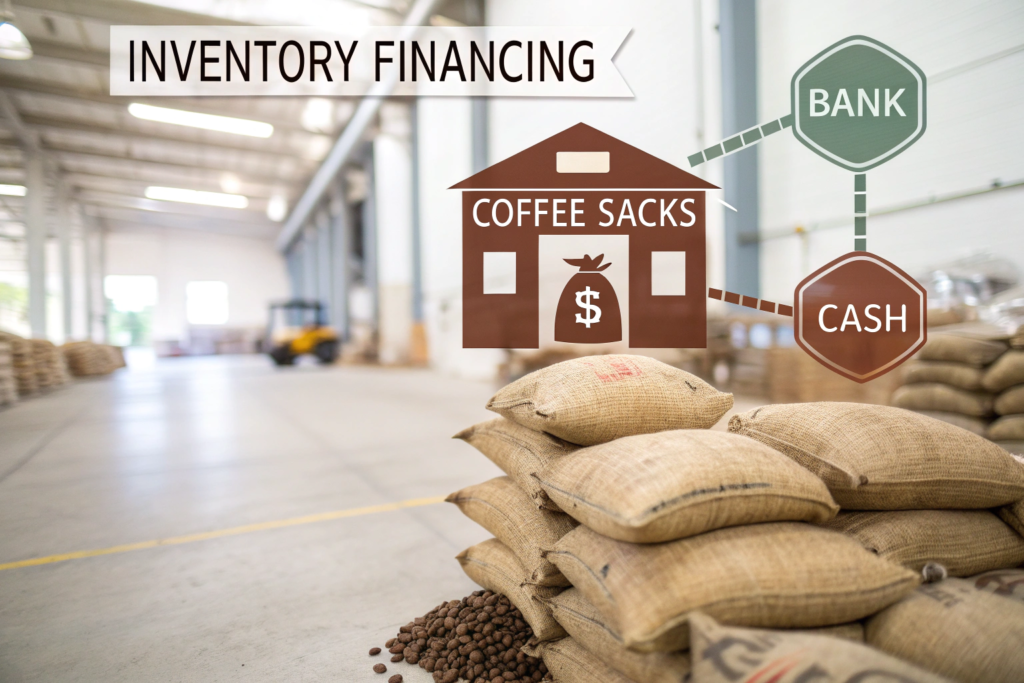
Inventory financing is a type of asset-based lending where a loan or line of credit is extended to a business, using its inventory as the collateral for the loan. In simple terms, a lender gives you cash, and in return, they place a lien on your coffee inventory. If you were to default on the loan, the lender could seize and sell the inventory to recoup their money.
This is a powerful tool for coffee buyers. It allows you to purchase a large volume of green coffee without depleting your operating cash. The lender will typically advance you a percentage of the inventory's appraised value, often between 50% and 80%. As you roast and sell the coffee, you pay back the loan. It's a form of financing that is directly tied to the sales cycle of your core product, making it a very logical fit for a growing roastery or trading company.
Who Offers Inventory Financing?
Inventory financing is offered by a range of lenders. This includes traditional banks, but more commonly, it's provided by specialized non-bank lenders, sometimes called "alternative lenders" or "asset-based lenders." These specialized firms have more experience in valuing physical inventory like coffee and can often be more flexible and faster than a traditional bank.
What are the Pros and Cons?
The main pro is that it unlocks the cash tied up in your inventory, freeing up capital for other business needs (marketing, payroll, new equipment). It's also often easier to qualify for than a traditional loan if you have valuable inventory but less-than-perfect credit. The main con is that interest rates are typically higher than those of traditional bank loans, and the lender will have strict control and monitoring requirements over your inventory.
What is Purchase Order (PO) Financing?
Imagine an even bigger opportunity. A major grocery chain wants to launch your coffee in all their stores. They give you a massive purchase order (PO), but you don't have the capital to buy the green coffee needed to fulfill it. It's a classic catch-22: you need the sale to get the cash, but you need the cash to make the sale. This is a huge point of stress for businesses on the verge of a major breakthrough.
Purchase Order (PO) financing is a short-term funding option for businesses that need cash to fulfill a specific, confirmed customer order. In this model, a financing company advances you the capital needed to pay your supplier (me, the coffee exporter) to produce and ship the goods.
Here's how it works: You receive a large PO from a creditworthy customer. You take this PO to a PO financing company. They verify the order and your customer's credit. If approved, they don't give the money to you; they pay your supplier directly. The supplier ships the coffee to your customer. The customer then pays the financing company, who deducts their fees and sends you the remaining profit. It's a way to take on a huge order with almost no upfront capital.

How is PO Financing Different from Inventory Financing?
The key difference is what the financing is based on. Inventory financing is based on inventory you already own or are in the process of buying for general stock. PO financing is based on a specific, confirmed future sale. It's financing for a single, guaranteed transaction, not for building up your general inventory.
What are the Requirements to Qualify?
To qualify for PO financing, you need more than just a PO. The lender will scrutinize three main things: 1) The creditworthiness of your end customer (they must be a reliable, established business), 2) The reliability of your supplier (they need to be sure the goods will be delivered as promised), and 3) A solid profit margin on the deal (typically 20% or more) to ensure there's enough money to pay everyone.
How Do You Prepare a Winning Loan Proposal?
Whether you're seeking inventory financing, a traditional loan, or another form of credit, you can't just walk in and ask for money. You need to present a compelling, professional case. You're worried that you'll be rejected because you don't seem like a "good bet" to a lender. A poorly prepared proposal is the fastest way to get a "no."
To secure financing, you must build a loan proposal that inspires confidence. Your proposal needs to tell a clear story backed by hard data, demonstrating that you are a competent operator with a profitable business and a clear plan for repayment. Lenders are in the business of managing risk; your job is to show them that you are a low-risk, high-reward investment.
Your proposal should include a concise executive summary, detailed financial statements (profit & loss, balance sheet), and, crucially, your inventory management plan. This plan should detail your inventory turnover rate (how quickly you sell your coffee), your cost of goods sold, your gross margins, and your sales projections. You need to show the lender exactly how you will convert that inventory of green coffee into cash. At Shanghai Fumao, we can provide our partners with historical purchasing data and formal quotes to help them build these crucial financial projections.

What Key Metrics Do Lenders Look For?
Lenders will focus on your Inventory Turnover Ratio. A high ratio shows that you sell your inventory quickly and are not sitting on dead stock. They will also scrutinize your Gross Profit Margin. A healthy margin shows that you can comfortably afford to pay the interest on the loan and still make a profit. Be prepared to defend these numbers.
How Can Your Supplier Help Your Proposal?
A letter of support or a formal supply agreement from a major, reliable supplier can significantly strengthen your proposal. It demonstrates to the lender that you have a stable and professional supply chain. We are always happy to provide documentation to our long-term partners to confirm our supply relationship, which adds a layer of credibility and reduces the perceived risk for the lender.
What Other Financing Avenues Can You Explore?
Inventory and PO financing are powerful tools, but they aren't the only options. It's wise to consider a full spectrum of possibilities. You might be worried that you don't qualify for the main types of financing, or you're looking for a solution with better terms.
One of the most valuable, yet often overlooked, avenues is Trade Credit or Supplier Financing. This is an arrangement where your supplier (me) extends credit to you, allowing you to receive the coffee now and pay for it later, typically in 30, 60, or 90 days. This is essentially a short-term, often interest-free loan from your supplier. This type of credit is not given automatically; it is earned through a strong, long-term relationship built on trust and a proven track record of timely payments.
Another option is a Traditional Small Business Loan or a Line of Credit from a bank. If your business has strong overall financials and a good credit history, this can often be the cheapest form of financing in terms of interest rates. The application process is more rigorous, but the favorable terms can be worth it. These are best for general working capital rather than financing a single large inventory purchase.
How Do You Earn Trade Credit from a Supplier?
You earn it through loyalty and reliability. Start with a few smaller orders that you pay for upfront or immediately upon receipt. Communicate clearly and professionally. Build a relationship over time. After you have established a solid history as a trustworthy partner, you can open a conversation about payment terms. It's a testament to the power of a strong supplier relationship.
What is a Business Line of Credit?
A business line of credit is a flexible loan from a bank that provides you with a set amount of capital that you can draw from as needed. You only pay interest on the money you actually use. It's an excellent tool for managing cash flow fluctuations. You could use it to pay for a coffee shipment, pay it back as you sell the coffee, and then have that credit available again for your next purchase. You can learn more about these options from resources like the U.S. Small Business Administration (SBA).
Conclusion
Financing your coffee inventory is not a sign of weakness; it is a sign of strategic, ambitious growth. By understanding the different financial tools available—from inventory and PO financing to traditional loans and trade credit—you can break free from the constraints of your own cash flow. It allows you to say "yes" to big opportunities, optimize your purchasing power, and scale your business with confidence.
The key to success is preparation. By building a professional loan proposal with clear data, strong financial projections, and a solid inventory management plan, you can present yourself as the capable and reliable business owner that you are. You transform from someone asking for money into a business offering a secure, profitable investment opportunity to a lender.
If you are looking for a supplier who understands the financial realities of the coffee business and is willing to be a supportive partner in your growth, we are here for you. We are committed to building the kind of long-term, trusted relationships where solutions like trade credit become possible. Please reach out to my colleague, Cathy Cai, at cathy@beanofcoffee.com to discuss how we can grow together.