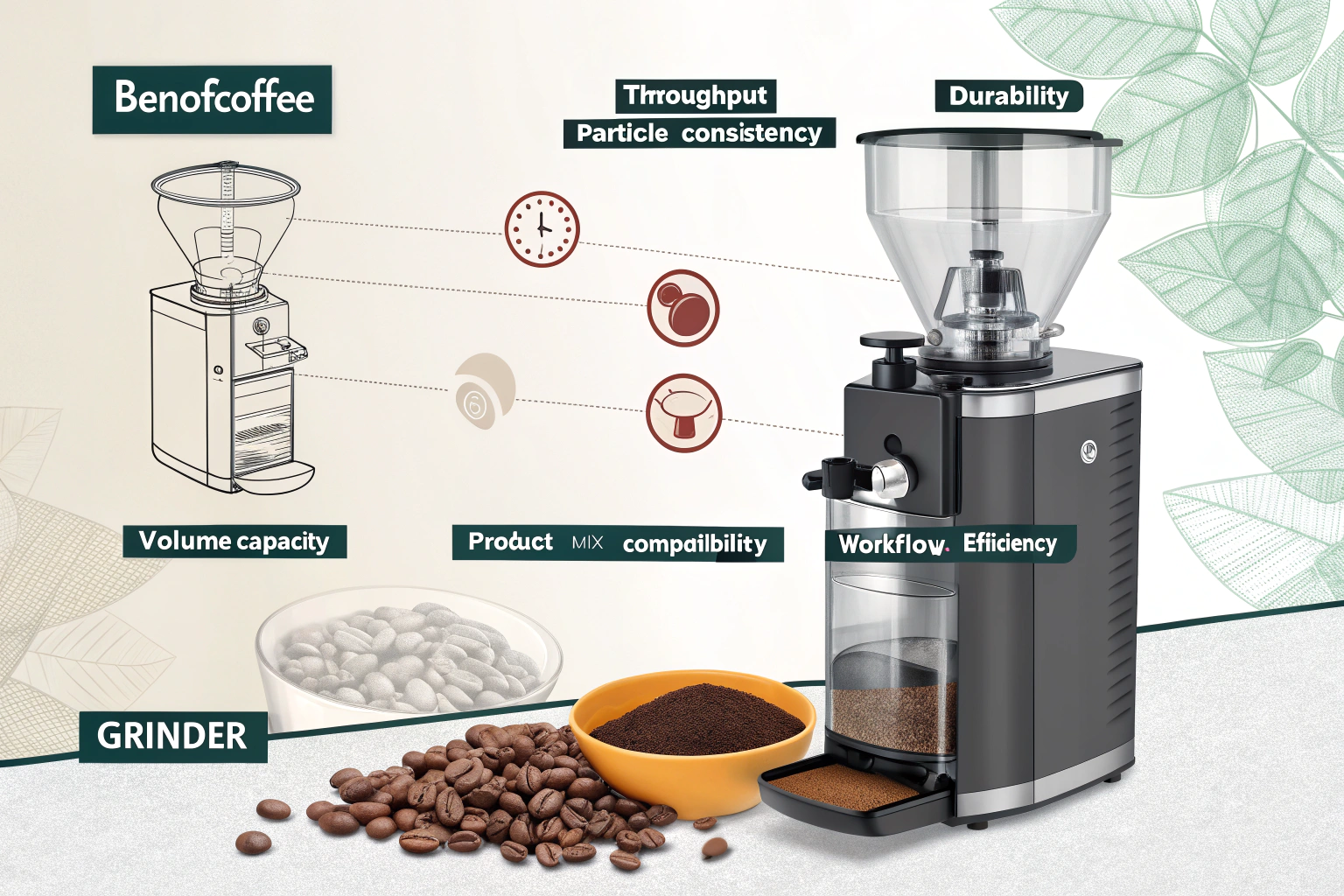
You're scaling up. Maybe you're a roaster supplying cafes, a large-scale cafe chain, or a manufacturer of pre-ground coffee. The little shop grinder that served you for years is now a bottleneck, overheating, inconsistent, and breaking down daily. For a business focused on volume, reliability, and cost-per-pound like Ron's, the wrong grinder isn't just an annoyance—it's a profit center that's bleeding. Downtime means missed orders, inconsistent grind means wasted coffee and angry clients, and a cheap machine will cost you more in repairs than a proper one ever did in capital.
Selecting the right industrial grinder is an engineering and operational decision, not a culinary one. It's about matching a machine's throughput, durability, and particle consistency to your specific volume, product mix, and workflow. The goal is to turn whole beans into a predictable, uniform particle size, hour after hour, day after day, with minimal waste and maintenance. At BeanofCoffee, we see the results of this choice in our clients' products—a great grinder unlocks the potential of our consistent Yunnan beans; a bad one ruins them. Let's grind through the specs.
So, if you're looking at a machine that costs as much as a car, you need to know what you're buying. This is the heart of your production line. Let's break down the selection criteria.
What are the Core Types of Industrial Grinders and Their Applications?
Not all industrial grinders are the same. The first decision is choosing the right technology for your primary output. The two main categories are defined by their burr type and grinding mechanism.
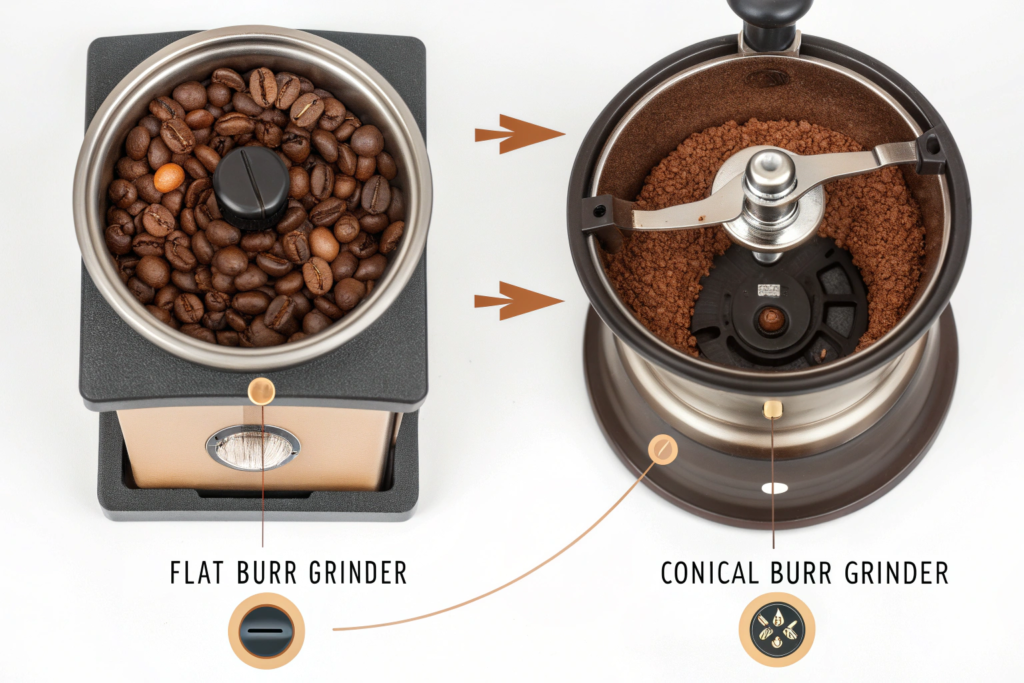
1. Large Flat Burr Grinders:
- How they work: Two large, horizontal disc-shaped burrs (one stationary, one rotating) crush and shear beans between them. The grind size is adjusted by changing the distance between the burrs.
- Best for: High-volume espresso grinding and precise filter grinding. They are the workhorses of large cafes, roastery cafes, and small-scale roasting operations that need to grind for both espresso and batch brew. They excel at producing a very consistent particle distribution, which is critical for even extraction, especially in espresso.
- Industrial Examples: Mahlkönig EK43, Ditting KR1403, Anfim SCODY II.
- Considerations: They can be slower than conical burrs for very coarse grinding. Generate more heat at the burr interface if run continuously at high volume, which may require active cooling.
2. Large Conical Burr Grinders:
- How they work: A cone-shaped burr rotates inside a ring-shaped outer burr. Beans are ground through a crushing and tearing action.
- Best for: Very high-volume bulk grinding for batch brew, cold brew, and retail pre-ground bags. They are known for durability, lower heat generation (due to slower burr speeds), and are often built for continuous, all-day operation. They can handle a wider range of grind sizes but may produce a slightly less uniform particle distribution than the best flat burrs (though still excellent for industrial standards).
- Industrial Examples: Bunn G Series, Mahlkönig Guatemala, Ditting 1203.
- Considerations: Can be more expensive for comparable capacity. Espresso-focused conical grinders (like Mazzer Robur) exist but are often for lower-volume commercial use.
3. Roller Mills / Impact Grinders:
- How they work: Use steel rollers or hammers to pulverize beans at very high speed. Common in large-scale instant coffee or soluble product manufacturing.
- Best for: Extreme volume, commodity grinding where ultra-fine consistency or specific particle size spectra are required. Not typically used for specialty or small-batch roasting.
For most businesses moving into industrial scale, the choice is between a high-end flat burr or a heavy-duty conical burr system.
What about grinding for espresso vs. filter at an industrial scale?
This is a critical distinction. If your primary industrial output is espresso grinds (for your own multi-unit cafes or wholesale), you must prioritize grind uniformity above all. A high-end, large flat burr grinder (like an EK43) is the industry benchmark. It provides the consistency needed for precise espresso extraction across hundreds of shots. For bulk filter grinding, a large conical burr grinder (like a Bunn G3) is often the better choice—it's built like a tank, can grind 20+ pounds per minute, and produces a perfectly adequate grind for batch brew with incredible durability.
What is "grind-by-weight" vs. "grind-on-demand" for industrial use?
- Grind-on-Demand with Hopper: The traditional model. A large hopper (5-10+ lbs) holds beans, and the grinder runs when you activate it, usually into a dosing chamber or portafilter. Good for high-throughput espresso service.
- Grind-by-Weight (Gravimetric): The grinder is integrated with a scale. You set a target weight (e.g., 1kg for a bag, 18g for a portafilter), and it grinds precisely to that weight, then stops. This is essential for industrial packing of retail bags to ensure weight accuracy and eliminate over-grinding waste. It's also becoming common in super-automatic espresso systems for chains. For pure volume grinding, this feature is a major efficiency and waste-reduction tool.
How to Determine the Required Capacity and Power?
Buying too much grinder wastes capital and space. Buying too little grinder destroys your workflow and the machine itself. You must calculate your peak hourly demand, not just your daily average.
Steps to Calculate Your Needs:
- Define Your Peak Scenarios: Are you a roaster filling 500 one-pound retail bags on a Monday morning? A cafe chain central commissary grinding for 20 stores each morning? Identify the busiest hour of your operation.
- Calculate Peak Hourly Throughput:
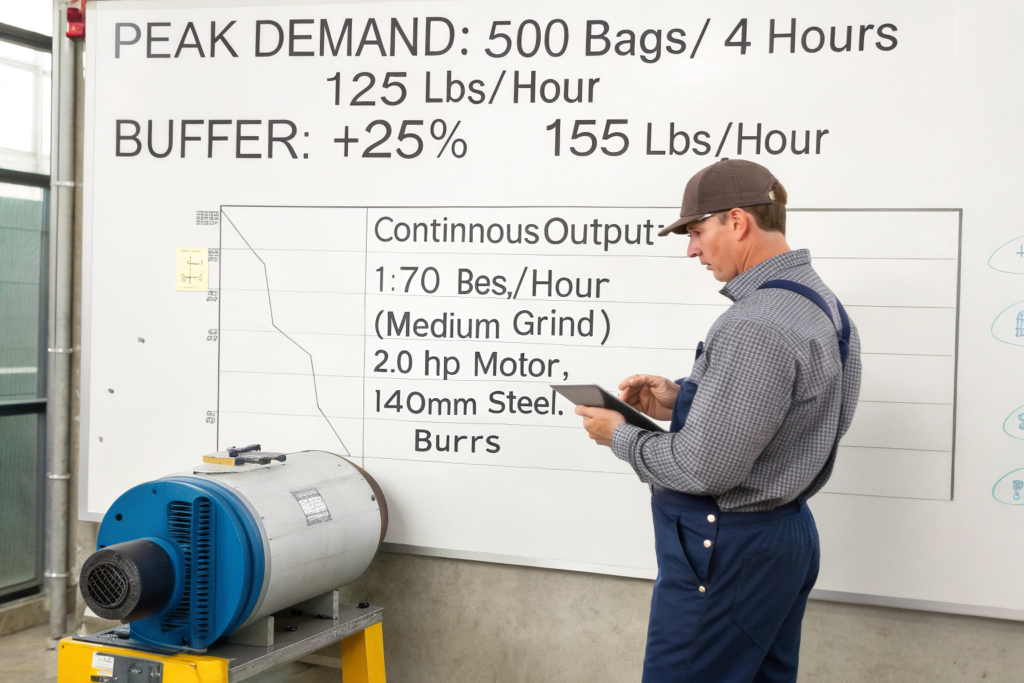
- Example for a Roaster/Packer: You need to fill 500 one-pound bags in a 4-hour shift. That's 125 lbs per hour. Add a 25% buffer for setup, cleaning, and errors = ~155 lbs/hour required capacity.
- Example for a Large Cafe/Kitchen: You serve 300 espresso-based drinks in a 3-hour morning rush, using 20g of coffee per drink. That's 6kg (13.2 lbs) of espresso grind. You also brew 50 liters of batch brew using a 1:16 ratio = 3.125kg (6.9 lbs) of coarse grind. Total peak hour grinding need = ~20 lbs/hour.
- Match to Grinder Specifications: Look at the manufacturer's lbs/hour or kg/hour rating for your target grind size (espresso grinding is slower than coarse grinding). Do not use the "peak" rating; use the sustainable, continuous duty rating. The machine's motor power (often 1-3 HP for true industrial) will reflect this.
Key Power & Durability Specs:
- Motor Type & Power: Look for a heavy-duty, continuously rated motor with thermal protection. A 1.5-2 HP motor is common for serious grinders. Avoid "commercial" grinders with intermittently rated motors—they will overheat and fail under industrial load.
- Burr Size & Material: Larger burrs (e.g., 120mm+ flat, 70mm+ conical) grind faster and stay cooler. Look for hardened steel or titanium-coated burrs for longevity. Ceramic burrs are brittle and not suitable for high-impact industrial use.
- Cooling System: Does it have a fan or even a refrigerant-cooled burr chamber? Heat is the enemy of consistency and machine life. Industrial grinders must manage heat.
For a business that values timeliness and stable output, this calculation is the foundation of your purchase.
What happens if you under-spec your grinder?
You will run it beyond its duty cycle. Consequences include:
- Motor Burnout: The most common failure. The motor overheats and dies, requiring expensive replacement and downtime.
- Burr Damage & Inconsistency: Overheating burrs can warp or lose their temper, leading to uneven particle size and increased "fines" (tiny particles) and "boulders" (large chunks). This ruins extraction.
- Flavor Degradation (Baking): Heat transferred to the coffee grounds can "bake" them, causing a flat, dull, baked flavor before they even touch water.
An undersized grinder is a false economy that will cost you more in repairs, waste, and lost business than investing correctly from the start.
Should you buy one giant grinder or multiple smaller ones?
This is a redundancy and workflow question. For a roastery, one high-capacity grinder dedicated to bulk orders plus a separate, precise grinder for small-batch/sample grinding is ideal. For a cafe chain commissary, you might have one grinder for espresso blends and another for filter coffee to avoid cross-contamination and adjustment time. Multiple grinders provide backup. If one fails, you're not completely shut down. It also allows for parallel processing, increasing total throughput.
What Features are Critical for Consistency, Cleanliness, and Maintenance?
Industrial grinders aren't "set and forget." They are machines that require operational discipline. The right features make that discipline easier and ensure consistent output.
Consistency & Control Features:
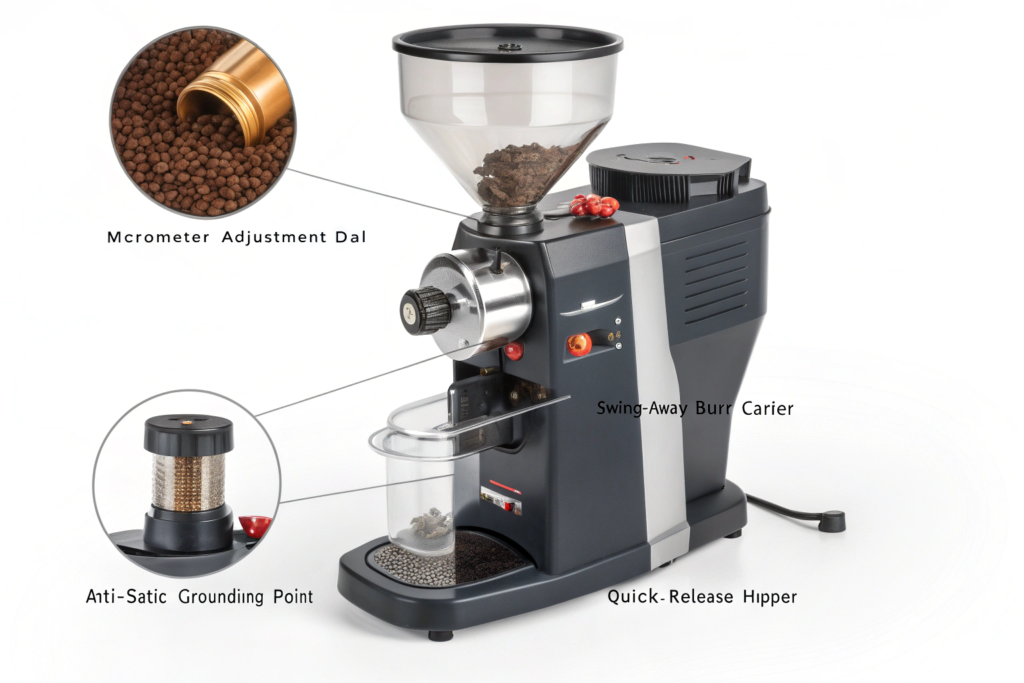
- Micrometer Adjustment: A precise, stepless (or micro-stepped) grind adjustment mechanism is non-negotiable. You need to make fine, repeatable changes to dial in espresso or switch between products. Look for a numbered collar or digital readout.
- Anti-Static Technology: Ground coffee is prone to static, causing it to cling to grind chambers, chutes, and packaging, creating waste and mess. The best industrial grinders have anti-static systems (often a small ionizer or grounded metal path) to minimize this.
- Clump Prevention/Destruction: Fine grinds, especially for espresso, naturally clump. A built-in clump breaker (a small spinning device in the chute) breaks these up for a more uniform dose.
Cleanliness & Hygiene Features:
- Easy Access for Cleaning: Can you remove the hopper, upper burr carrier, and grind chute without tools in under 5 minutes? Daily cleaning is mandatory to prevent oil buildup and old grounds from contaminating fresh coffee. Look for a "swing-away" burr carrier.
- Minimal Retention Design: "Retention" is the amount of old ground coffee left inside the machine after grinding. High-retention grinders contaminate fresh batches with stale grounds. Modern designs aim for sub-1g retention. This is critical for product consistency, especially when switching between different coffees.
- Food-Grade Materials & Seals: All parts contacting coffee must be food-safe. Seals should be easy to wipe clean.
Maintenance & Durability Features:
- Easy Burr Replacement: Burrs are wear items. You should be able to replace them in-house with simple tools. Check the cost and availability of replacement burrs.
- Serviceability: Is there a local authorized service technician? Are parts readily available? A grinder from a reputable brand with a strong service network (like Mahlkönig, Bunn, Ditting) is worth the premium.
- Build Quality: The housing should be heavy-gauge metal, not plastic. Switches and electronic controls should feel robust.
These features directly impact your quality control and operational efficiency. A messy, inconsistent grinder creates waste and unpredictable product—the exact opposite of what an industrial operation needs.
How important is particle size distribution (PSD) analysis?
For the most demanding industrial applications (e.g., producing a flagship espresso blend, or grinding for soluble products), measuring the PSD with a laser diffraction analyzer is the ultimate test of consistency. It shows the percentage of particles at each size. You can use this data to compare grinders objectively: a narrower, taller peak on the PSD chart indicates more uniform particles. While most buyers won't own this equipment, asking a supplier for PSD data from their grinder on a specific setting demonstrates a serious, technical approach. We can provide PSD data for our pre-ground products as a reference for the consistency our beans can achieve.
What is the role of automated dosing and bagging integration?
For true industrial packaging lines, the grinder is just one component. It must integrate with auto-dosing scales and bagging/filling machines. This requires grinders with programmable controls and output chutes that can interface with this equipment. If your goal is a fully automated bagging line, you must select a grinder model known for this compatibility (often from the same manufacturer as your packaging system). This level of integration maximizes throughput and minimizes labor cost.
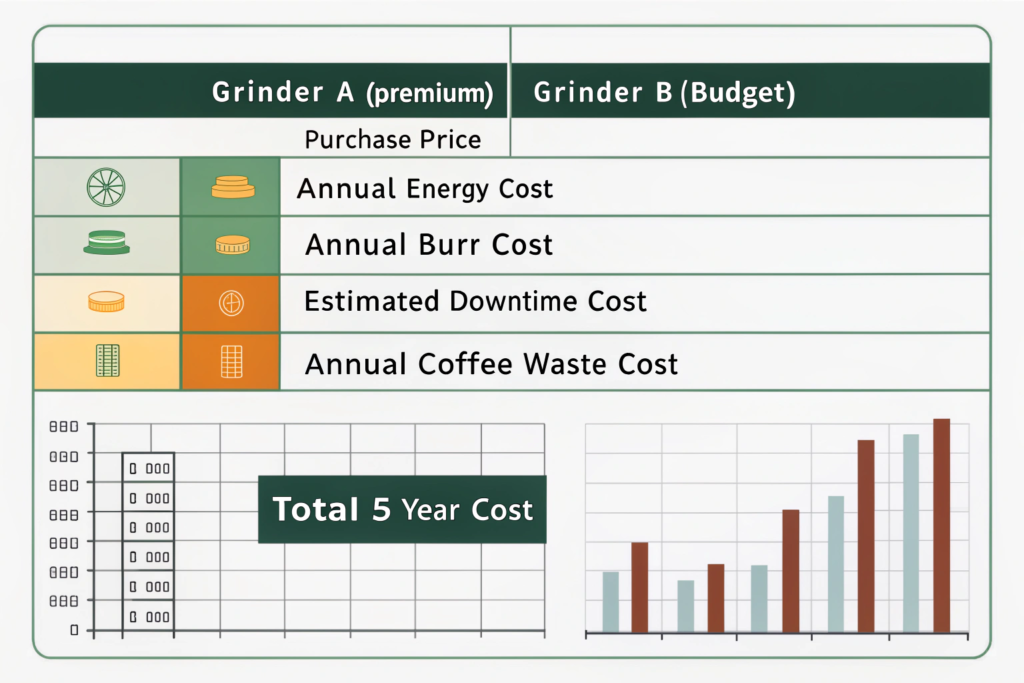
How to Evaluate Total Cost of Ownership (TCO)?
The purchase price is just the entry fee. The true cost includes operation, maintenance, and the cost of failures over 5-10 years.
TCO Calculation Factors:
- Purchase Price: The initial investment.
- Energy Consumption: A more powerful, efficient motor may have a higher upfront cost but lower running costs.
- Burr Replacement Cost & Frequency: How often must you change burrs (every 10,000 lbs? 50,000 lbs?) and what do they cost? Harder, more expensive burrs last longer.
- Downtime Cost: What is the cost to your business per hour of grinding downtime? A more reliable brand with good service support minimizes this.
- Waste Cost: An inconsistent grinder produces more waste (from dialing in, rejected batches). A precise, low-retention grinder saves money on coffee.
- Labor Cost for Cleaning & Maintenance: A machine that's easy to clean saves daily labor time.
A $8,000 grinder that runs trouble-free for 10 years with minimal waste is far cheaper than a $4,000 grinder that needs $2,000 in repairs annually, wastes 2% of your coffee, and requires 30 extra minutes of labor daily to clean.
When sourcing green beans in bulk from us at Shanghai Fumao, your grinding efficiency directly impacts the yield and quality you get from our product. Investing in the right tool protects that investment.
Should you buy new or used industrial grinders?
For a critical production component, new is usually the right choice. You get a full warranty, known service history, and the latest technology. A used grinder can be a gamble—burrs may be worn, motors may be near end-of-life, and calibration may be off. If you have an in-house technician and can thoroughly refurbish a used machine from a top brand, it can offer savings. But for most, the risk of unexpected downtime outweighs the savings.
How to partner with your coffee supplier on grinder selection?
A knowledgeable green coffee supplier can offer valuable advice. We at BeanofCoffee see how our beans perform across different equipment. We can advise, for example, that our Yunnan Catimor, with its specific density and oil content, runs particularly well on grinders with strong clump-breaking and cooling features. We want our partners to succeed, and having the right grinder is a big part of that. Don't hesitate to ask for input based on the volume and type of our coffee you'll be processing.
Conclusion
Selecting the right industrial grinder is a capital investment that dictates your production capacity, product quality, and operational resilience. It requires a clear analysis of your peak volume, an understanding of grinding technology, and a focus on features that ensure consistency and easy maintenance. The goal is to find a machine that becomes a reliable, silent partner in your growth—one that faithfully translates the quality of your green coffee into a perfect grind, batch after batch.
In industrial coffee, precision grinding is the bridge between raw material and finished product. Build that bridge to last.
Grind with industrial precision. BeanofCoffee supplies the consistent, high-volume green coffee that deserves a world-class grinder. Contact Cathy Cai to discuss your volume needs and get recommendations for reliable grinding equipment: cathy@beanofcoffee.com. Power your production.