
You've seen it: the big, colorful, circular chart covered in words. The Coffee Taster's Flavor Wheel. It looks impressive, but also incredibly intimidating. You taste a coffee, and you think, "this tastes... fruity." But then you look at the wheel and see dozens of fruit words: Berry, Citrus Fruit, Stone Fruit, Tropical Fruit. Under Berry, it branches into Blackberry, Raspberry, Blueberry, Strawberry. You feel lost. The pain point is that you know this tool is supposed to help you become a better taster, but instead, it makes you feel inadequate and confused. You're not sure how to use it, so you ignore it, sticking to simple descriptions and missing the opportunity to develop a more precise palate and communicate more effectively about coffee.
Honestly, the correct way to understand the flavor wheel is to see it not as a checklist of flavors to find, but as a map to guide your sensory journey from general to specific. You don't start at the outside of the wheel; you start at the very center. You first identify a general sensation (e.g., "Fruity"), then you follow the "spokes" outward to a more specific category (e.g., "Berry"), and only then do you try to pinpoint the most precise descriptor (e.g., "Blackberry"). It's a tool for structured exploration, not a multiple-choice test.
From my perspective as a grower, the flavor wheel is the bridge that connects the agricultural reality of our farms in Yunnan to your sensory experience. When we say our natural-processed coffee has "notes of strawberry," we are using the shared language of the wheel to give you a precise expectation. Learning to use this tool correctly will not only make you a better taster but also a smarter buyer. Let's learn how to navigate this map together.
How Do You Start?
The single biggest mistake people make is trying to use the flavor wheel like a game of "I Spy." They take a sip of coffee and immediately scan the outer ring for a word that seems to fit. This is overwhelming and ineffective.
So I shouldn't look for "honeydew" or "hazelnut" right away? Exactly. You have to earn your way to the outer ring. The wheel is designed to mirror how our brains process sensory information. We first perceive broad categories and then refine them. The correct method is to always start in the center and work your way out. This three-step process makes the wheel a manageable and powerful tool.
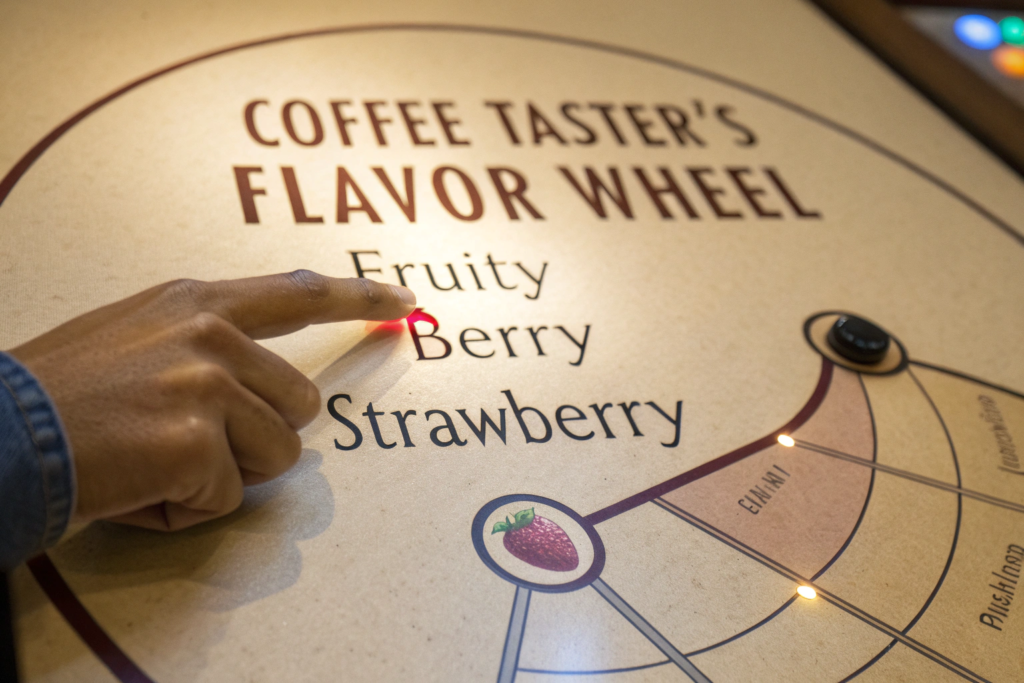
The Center Ring (The "What Is It, Broadly?")
Take a sip or a slurp of the coffee. Close your eyes. What is the most general impression you get? Don't overthink it. Is it sweet? Is it fruity? Is it nutty/cocoa-like? Is it floral? Is it spicy? This is your starting point. Let's say you identify a general "Fruity" sensation.
The Middle Ring (The "What Kind of Fruity?")
Now that you've identified "Fruity," stay within that section of the wheel and follow the spokes to the next level. This ring asks you to be more specific. Is the fruitiness like a Berry? Is it like a Citrus Fruit? Is it like a Stone Fruit (e.g., peach, cherry)? Or is it like a Tropical Fruit (e.g., pineapple, mango)? Let's say you decide it's most like a berry.
What's the Difference Between "Taste" and "Aroma"?
Another point of confusion is what, exactly, you are supposed to be evaluating. The flavor wheel combines two different sensory experiences: aroma (what you smell) and taste (what you perceive on your tongue). In coffee cupping, we evaluate these separately at first.
So the wheel is for both smelling and tasting? Yes, and it's important to know which sense you're using. Most of what we call "flavor" is actually aroma, perceived through a process called retronasal olfaction (aromas traveling from your mouth to your nasal cavity). But the wheel also includes pure tastes and tactile sensations.
Let's break it down:
- Aromatics (Smell): This is what you perceive when you smell the dry coffee grounds (the "fragrance") and the wet grounds after you add water (the "aroma"). This is where you'll find most of the descriptors on the wheel: the floral, fruity, spicy, and nutty notes.
- Gustatory (Taste): These are the sensations perceived only by your tongue: Sweet, Sour (Acidity), Salty, and Bitter.
- Mouthfeel (Tactile): This is the physical sensation of the coffee in your mouth. Is it heavy or thin? This is often described as the coffee's Body.
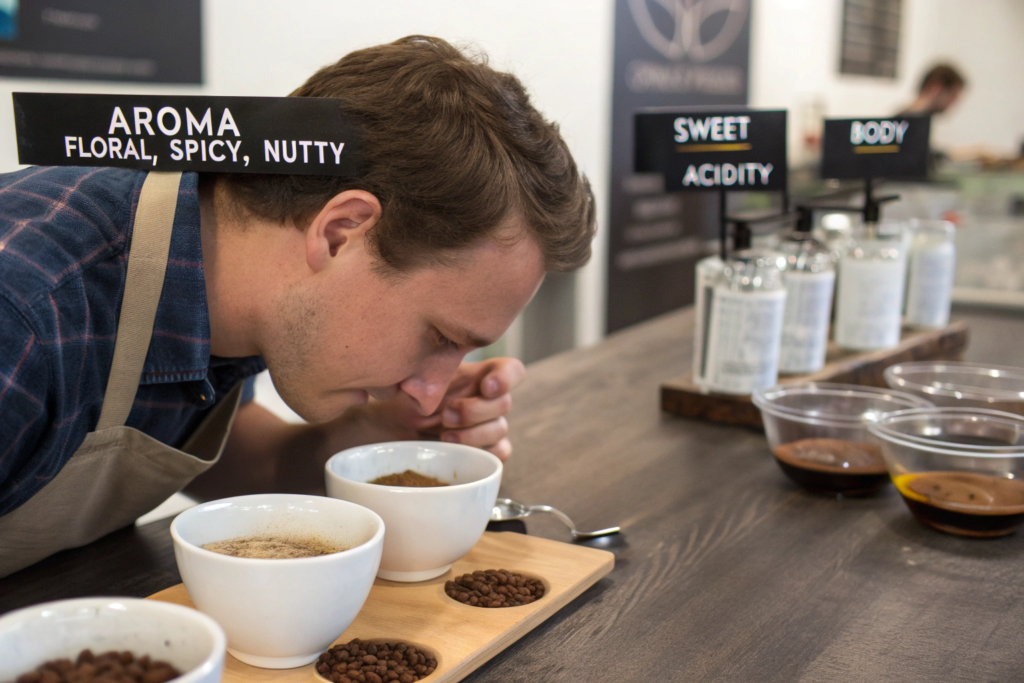
How do you use the wheel during a cupping?
- Fragrance/Aroma (Dry & Wet Grounds): Use the wheel first to describe what you smell. This is often where you'll pick up the most delicate floral and herbal notes.
- Flavor & Aftertaste (Slurping): When you slurp the coffee, you are combining the taste on your tongue with the aromas being pushed to your nasal cavity. This is where the full picture comes together. Use the wheel to describe this combined sensation.
- Acidity & Body: Evaluate the quality of the sourness (is it a bright, pleasant acidity or a sharp, unpleasant sourness?) and the weight of the coffee on your palate.
The Outer Ring (The "What Specific Berry?")
You're almost there. Now, follow the spokes from "Berry" to the outermost ring. This is where you try to pinpoint the specific flavor. Is the berry flavor like a Blackberry (darker, jammier)? Is it like a Raspberry (brighter, tarter)? Or is it like a Strawberry (sweeter, more delicate)? By following this path, you have successfully navigated from a vague "fruity" sensation to a precise, communicable descriptor: "Strawberry."
How Do You "Calibrate" Your Palate?
The flavor wheel is useless if you don't know what "osmanthus," "bergamot," or "black currant" actually tastes and smells like. The words are just symbols; you need to connect them to real-world sensory memories.
So I need to go out and eat more things? Essentially, yes! The best way to get better at using the flavor wheel is to build your internal "sensory library." You need to consciously smell and taste the world around you and connect those experiences to the language of the wheel. This process is called sensory calibration. This is what separates good tasters from great tasters. It's a form of deliberate practice.

How can you train your sensory library?
- Go to the Grocery Store: Spend time in the produce aisle. Smell the different herbs (rosemary vs. thyme). Smell and taste different berries (raspberry vs. blackberry). Compare a lemon to a grapefruit.
- Use a Sensory Kit: Professional tools like the Le Nez du Café aroma kit contain small vials of the key aromatic compounds found in coffee. Smelling these vials is a powerful way to train your nose to identify specific notes like "earthy" or "apricot."
- Taste with Others: The most important step is to cup coffees with other, more experienced tasters. When they say, "I'm getting a strong note of black tea," ask them to describe it. Taste it again and try to find that specific flavor. This social calibration is how you confirm and refine your own perceptions.
What if I taste something that's not on the wheel?
The flavor wheel is a guide, not a prison. It is based on the World Coffee Research Sensory Lexicon, which is a list of the most common flavors found in coffee, but it is not exhaustive. If you taste something very specific, like "peach iced tea" or "cinnamon toast," that is a fantastic and valid tasting note! The goal of the wheel is to give you the tools to be more specific, not to limit your creativity.
How Does the Wheel Help Me as a Buyer?
Ultimately, the flavor wheel is a professional communication tool. It allows us to talk about a subjective experience—flavor—in a standardized, objective way.
How does this help me negotiate or buy better? It allows you to give incredibly precise feedback to your supplier. Instead of saying, "I want something fruitier," which is vague, you can use the language of the wheel to say, "I'm looking for a natural-processed coffee with strong dark berry notes, specifically blueberry, and I want to avoid any 'fermented' or 'alcoholic' taints." This level of precision is a game-changer.

How does it improve your business?
- Smarter Sourcing: It allows you to request exactly what you're looking for from importers or producers like us at Shanghai Fumao. When you ask us for a coffee with "notes of jasmine and bergamot," we know you're looking for something similar to a high-quality Gesha, and we can guide you to the right lots from our farm.
- Better Quality Control: You can use the wheel to evaluate offer samples more critically and to ensure that the coffee that arrives in the container matches the flavor profile you were promised.
- More Effective Marketing: It gives you a rich, specific vocabulary to use when writing tasting notes for your coffee bags and your menu. "Notes of Dark Chocolate, Walnut, and a hint of Orange Zest" is infinitely more appealing to a customer than "a nice, smooth coffee."
How Does the Wheel Help Me as a Buyer?
As a buyer, the wheel is more than just a simple invention—it is a silent ally that transforms the act of purchasing into a journey of convenience, choice, and connection. Imagine standing in a bustling marketplace, your eyes scanning rows of stalls brimming with goods: vibrant fruits glistening with dew, handcrafted pottery glinting in the sunlight, fresh bread warm from the oven, its aroma weaving through the air like a comforting blanket. Without the wheel, each of these treasures would require a laborious trek on foot, your arms heavy with baskets, your legs aching from the miles walked to reach even the farthest vendor.
Conclusion
The Coffee Taster's Flavor Wheel is not a test to be feared, but a map to be explored. By learning to navigate it from the inside out, by understanding the difference between taste and aroma, and by actively building your own sensory library, you can transform it from an intimidating poster on the wall into your most trusted tool. It will make you a more confident taster, a more precise communicator, and a more successful coffee professional. It gives us—the producer and the buyer—a shared language to connect our worlds and to celebrate the incredible diversity of flavor that a single coffee bean can hold.
We use the language of the flavor wheel every day to describe the unique coffees we grow in Yunnan. If you're ready to have a more precise and productive conversation about sourcing, we invite you to talk with us. Contact our coffee specialist at cathy@beanofcoffee.com.