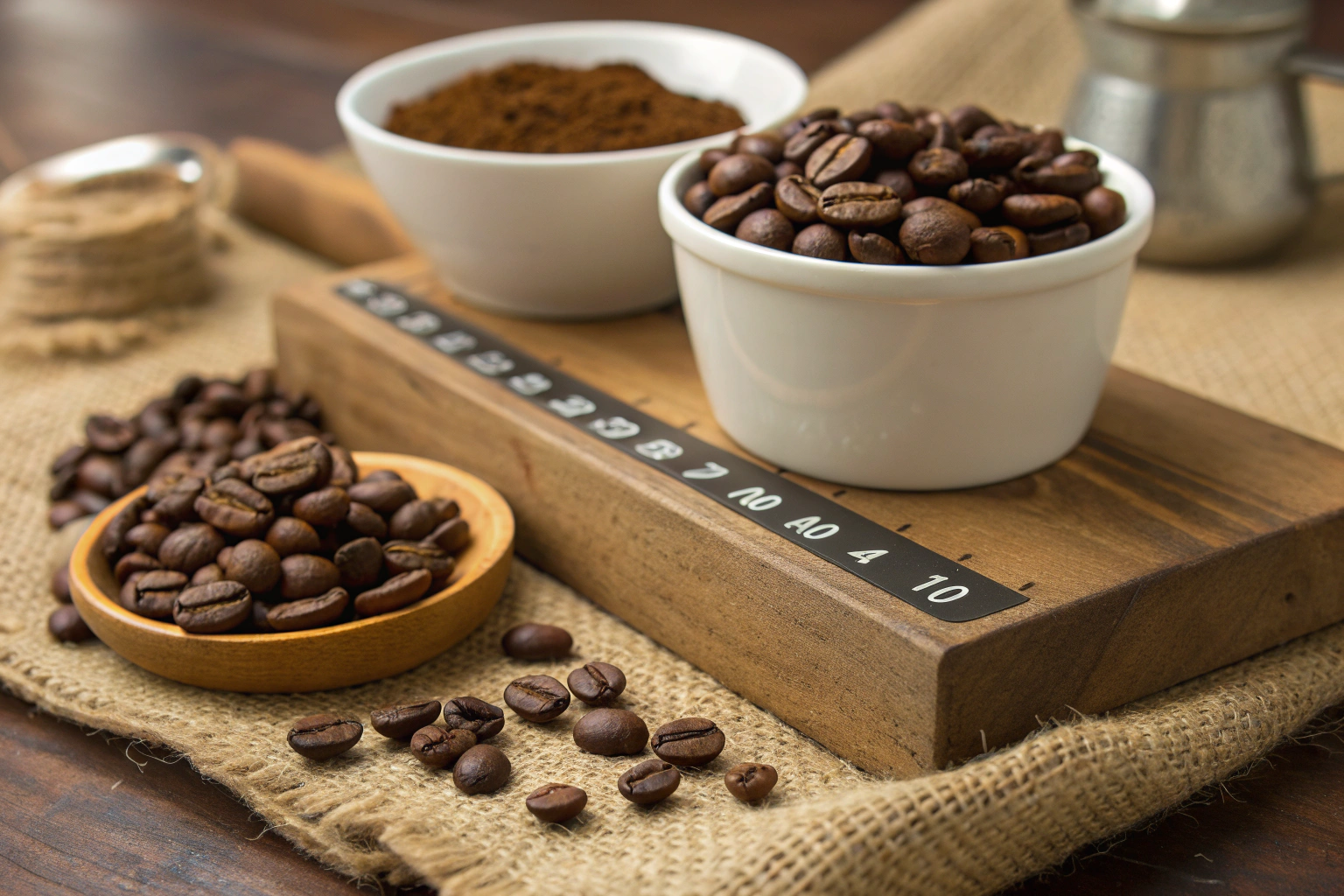
You've cupped two coffees from the same farm. They taste different. You check the roast—it's the same. The processing method? Identical. What's the hidden variable? Often, it's bean density. This physical property is a silent quality signal, whispering secrets about the bean's life and its potential in your roaster.
In coffee, density refers to the mass of a bean relative to its volume, often measured in grams per liter (g/L) or simply categorized as "hard" or "soft." It's a direct reflection of the bean's growing conditions. High-density (hard) beans typically come from high-altitude farms with cooler temperatures and slower maturation, leading to a more concentrated, complex sugar structure. Low-density (soft) beans from lower, warmer farms mature faster, often resulting in a simpler, softer cup. Understanding this difference helps you predict flavor, plan your roast profile, and ensure consistency in your wholesale purchases.
So, why should this matter to a roaster or buyer? Because density isn't just a number. It's a practical guide. It affects how beans absorb heat, how they develop flavor during roasting, and ultimately, how uniform your final product will be. Let's crack open this topic and see what's inside.
What Factors Determine Coffee Bean Density?
Think of a coffee cherry as a tiny factory. The sugars and compounds it builds are packed into the seed—the bean we roast. How tightly those compounds are packed is the density. The factory's efficiency is controlled by its environment. A bean's density is set on the tree, long before it's processed.
A concrete example from our farms in Yunnan: We grow Catimor on slopes at 1,600 meters and in valleys at 1,200 meters. The same varietal, same harvest season. The high-altitude beans are noticeably harder, like little pebbles. They sound different when poured. The lower-altitude beans are lighter. This physical difference is your first clue about their potential.
How Do Altitude and Climate Influence Density?
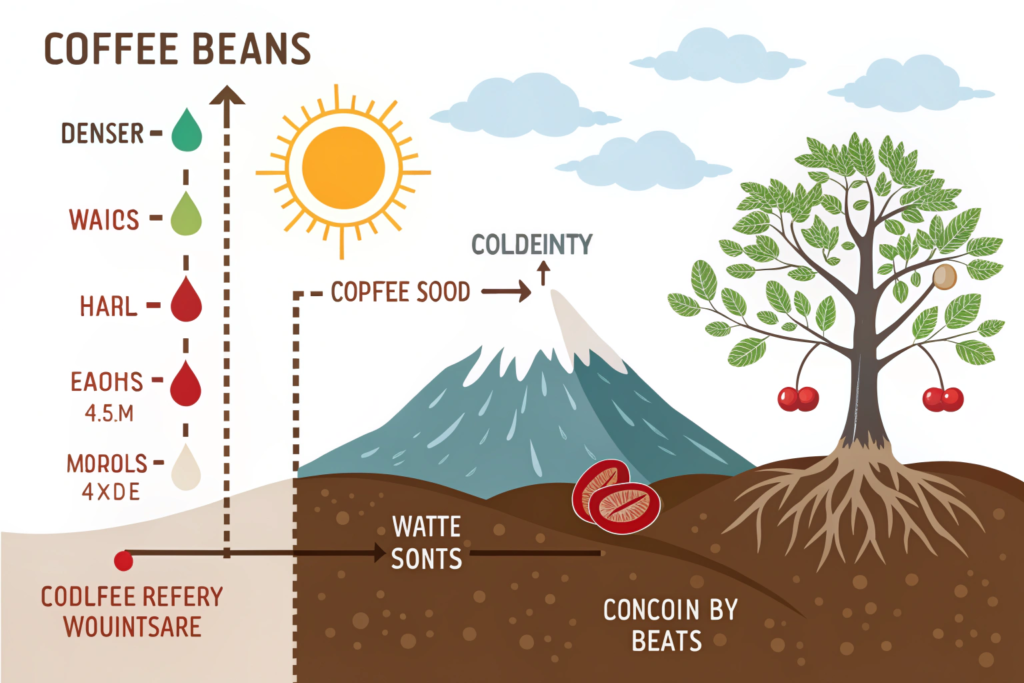
Altitude is the superstar here, but temperature is the real manager. Higher altitudes mean cooler average temperatures. Cooler temps slow down the cherry's maturation process. The bean has more time to develop complex carbohydrates and sugars, packing more solid material into its cellular structure. It's like letting a sauce reduce slowly—it becomes more concentrated. Conversely, lower, warmer farms speed up growth. The beans grow larger in volume, but the cellular structure is more porous, less dense. This is why regions like Colombian Andes or Ethiopian highlands are famous for dense, complex beans. It's not just the altitude; it's the coolness that comes with it.
What is the Role of Varietal, Soil, and Water?
While altitude sets the stage, the actors—the coffee plants—play their part. Some coffee varietals are genetically predisposed to produce denser beans. For instance, Typica and Bourbon often yield denser beans than some robusta hybrids. Then there's the soil. Rich, volcanic soil packed with minerals provides the building blocks for a dense cellular structure. Poor, depleted soil leads to weaker development. Water is a double-edged sword. Adequate water is essential for growth, but excessive water, especially near harvest, can cause the cherry and bean to swell with water, lowering the density. A dry period before harvest is crucial for concentrating sugars. At Shanghai Fumao, we manage soil nutrition and water access carefully across our plots to promote optimal density development.
How Does Bean Density Affect Roasting?
This is where theory meets the flame. You can't change a bean's density, but you must respect it. Ignoring density in your roast profile is like using the same oven time for a steak and a burger—one will be undercooked, the other overdone. Density dictates how energy moves through the bean.
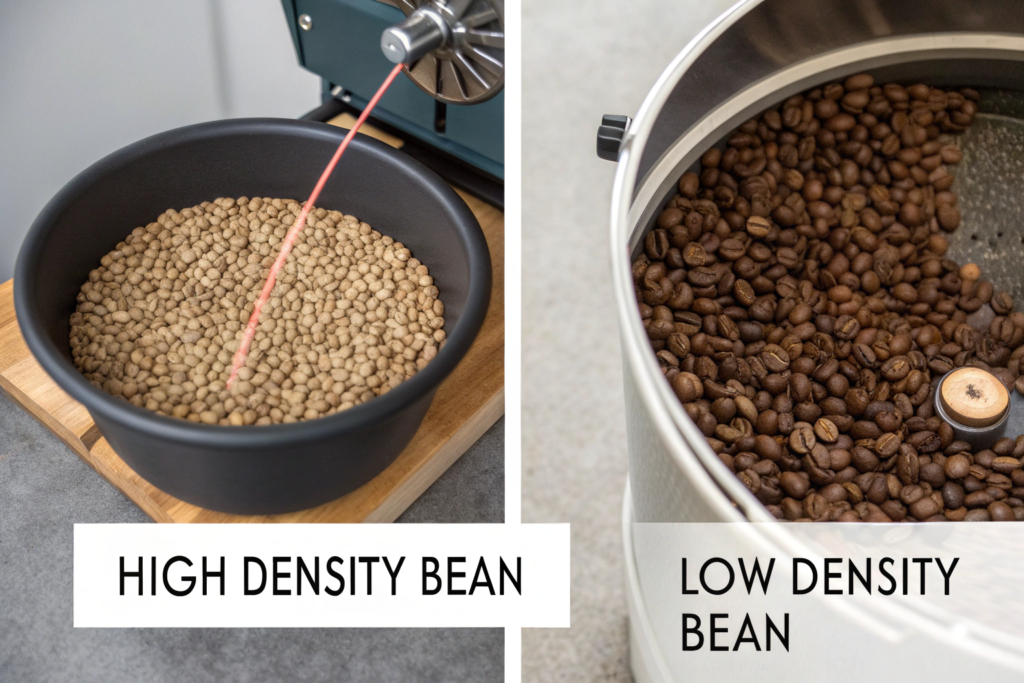
Here's a practical thought: Dense beans are like hard, cold marbles. They take more energy (heat) to get warm. But once they're warm, they hold that heat well. Less dense beans are like sponges. They heat up quickly but can also burn quickly if you're not careful. Knowing this before you roast saves you a batch—or ten.
Why Do Dense Beans Require More Energy and Time?
Let's break down the physics. High-density beans have more solid mass per unit volume. This mass acts as a heat sink. In the early stages of roasting (the drying phase), a lot of energy is spent just heating this mass up to the point where chemical reactions (like Maillard and caramelization) can begin. Therefore, you often need a higher charge temperature or more aggressive heat application in the first few minutes. If you underpower the roast, the beans will stall, tasting baked and flat. They also need a longer development time after first crack to fully develop their complex sugar structures. Rushing this stage leaves acidic, undeveloped flavors locked inside that hard shell.
What are Common Roasting Challenges with Low-Density Beans?
The challenge with low-density beans is control. They are thermally fragile. Because they heat up so fast, they can race through the drying and browning phases, hitting first crack before you've developed enough flavor. This often leads to a sharp, grassy, or overly acidic cup. To combat this, you typically use a lower charge temperature and a gentler heat application. You need to stretch the early phase to allow for flavor development without scorching the outer layer. Another risk is that soft beans are more brittle. They can fracture easily in the roaster, creating fines that burn and give a bitter taste. The key is a gentle roast with careful heat management to highlight the bean's inherent sweetness without exposing its weaknesses.
How Can You Measure and Sort Beans by Density?
"You can't manage what you don't measure." This old business saying applies perfectly to coffee density. Relying on a vague "hard bean" label from a supplier isn't enough for precision roasting. You need your own data. Measuring density gives you an objective number to put in your roast log, right next to temperature and time.
So, how do you get this number? You have options, from simple and affordable to high-tech industrial. At our processing mill, we use electronic sorters. But you can start with basic tools. The goal is consistency. If you buy a "high-density" lot, you want to verify it and then sort out any beans that don't meet the standard, ensuring every bean in your roaster behaves the same way.
What is the Water Displacement Method?
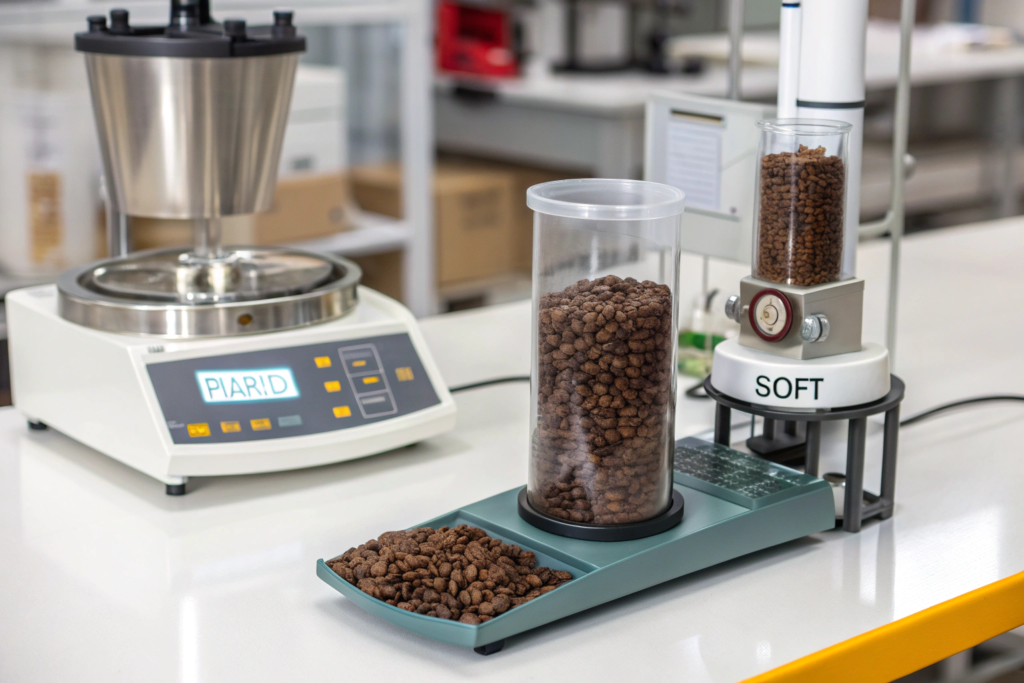
This is a classic, low-tech way to get a good estimate. It's based on Archimedes' principle. You need a precision scale, a graduated cylinder, and water. Weigh a sample of 100 grams of green beans. Note their volume by water displacement. Fill the cylinder partly with water, note the volume. Add the beans (submerging them completely), note the new volume. The difference is the bean volume. Then, density = mass (100g) / volume (in mL). The result is in g/mL. Multiply by 1000 to get g/L. Specialty coffee often ranges from 650-850 g/L. This method is great for small roasters or for checking supplier claims. It gives you a bulk density for the sample.
How Do Commercial Density Sorters Work?
For large-scale quality control, mechanical sorters are essential. The most common type is a pneumatic density sorter or gravity table. It works by blowing air up through a tilted, vibrating table. Lighter, less dense beans are lifted by the air stream and travel down one path. Denser, heavier beans resist the airflow and travel down a different path. This separates beans not just by density, but also by size and weight, as damaged, hollow, or insect-eaten beans are always less dense. The result is a more uniform batch. For buyers of our large wholesale lots, we can provide density distribution charts from our sorters. This level of detail, offered by suppliers like Shanghai Fumao, means you're buying not just coffee, but predictable roasting performance.
Why is Bean Density Critical for Quality and Price?
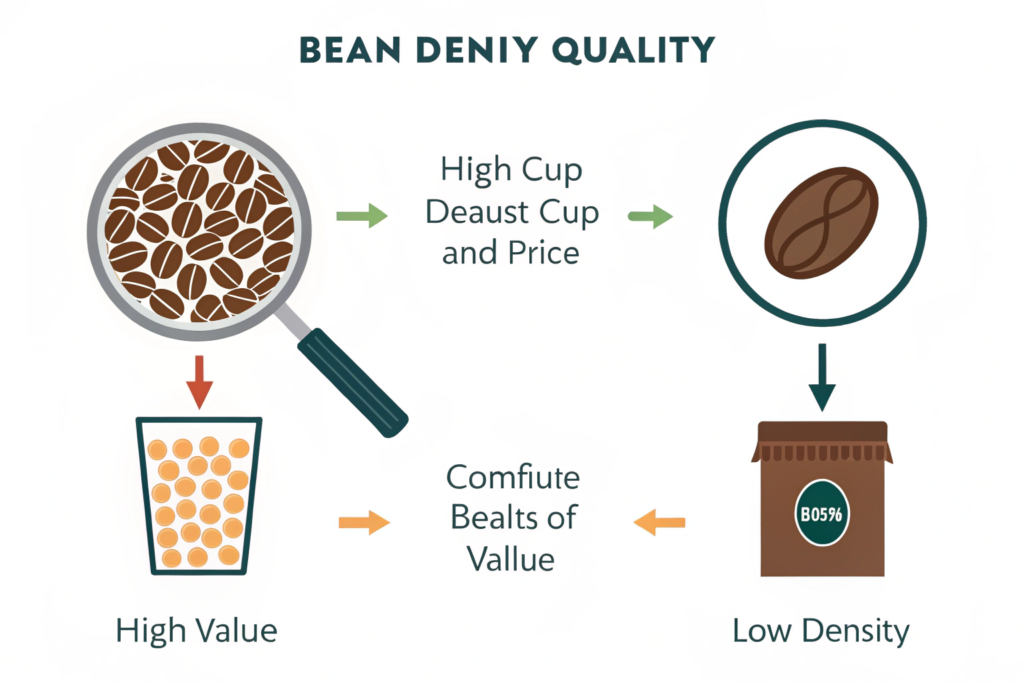
In the wholesale market, density is a key determinant of both quality potential and price. It's a tangible, measurable proxy for the intangible: flavor potential. A bag of high-density beans is a promise of more concentrated flavor compounds. That promise commands a premium. It's as fundamental as octane in gasoline.
Think about it from a buyer's perspective. You're not just paying for weight; you're paying for concentration. A container of high-density beans has more "coffee" per bean than a container of low-density beans. You get more soluble material, which can affect your yield and cost-per-cup. This makes density a crucial part of your cost-benefit analysis.
How Does Density Correlate with Cup Score and Flavor?
The correlation is strong, though not absolute. High density generally supports a higher cup score. Why? The compact cellular structure allows for more complex sugar formation during growth. During roasting, this sugar network undergoes intricate reactions, producing a wider range of desirable flavors—bright acidity, distinct fruity or floral notes, and a heavier body. Low-density beans often have a simpler sugar profile, leading to a softer, milder, sometimes grainier cup with less acidity and complexity. A very low-density bean might taste hollow or papery. It's the difference between a rich, single-origin pour-over and a standard blend base. Roasters seeking distinctive, high-scoring single origins will actively seek out high-density lots.
What is the Market Price Difference for Dense vs. Less Dense Beans?
The market prices this in. In auction systems like Best of Panama or Cup of Excellence, the top lots are invariably high-density beans from high altitudes. The price difference can be exponential. In commercial wholesale, the gradient is clearer. Beans sold as "Hard Bean" (HB) or "Strictly Hard Bean" (SHB) command a price premium over simply "High Grown" (HG) or "Hard Grown." The exact premium varies by origin and year, but it's a standard factor in green coffee price sheets. For a buyer, paying a 10-20% premium for SHB might be worth it if it translates to a more unique, marketable roast and higher customer satisfaction. It's an investment in product differentiation. By understanding this, you can make smarter buying decisions that align with your brand and budget.
Conclusion
Understanding coffee bean density moves you from a passive buyer to an informed partner in the supply chain. It connects the dots between a bean's origin on a misty Yunnan mountainside and its performance in your roaster in the U.S. It's a fundamental piece of data that explains flavor, guides roasting, justifies price, and, ultimately, ensures the consistency your business depends on.
Don't let it be a mystery. Ask your supplier for density information—whether it's a category (SHB), a measured value (g/L), or a sorting method used. This simple question separates casual suppliers from serious partners.
If you are looking for a wholesale supplier who understands and controls for bean density from the farm level, we can help. Our operations in Yunnan's high-altitude regions are geared towards producing dense, high-quality Arabica and Catimor beans, with sorting and grading to match. For samples and detailed spec sheets including density data, contact our sales director, Cathy Cai, at cathy@beanofcoffee.com. Let's talk about how the right density can unlock the flavor profile you're looking for.