You're on Alibaba, ready to place a significant coffee bean order with a new supplier in China. The price is right, the samples are good, but that final click to pay feels like a leap of faith. How do you protect your money and ensure you get what you paid for? This is the exact worry that stops many buyers. The good news is, Alibaba has a built-in solution designed for this moment: Trade Assurance. It's not just a badge on a supplier's profile; it's a structured payment protection program that, when used correctly, can make your first order with a supplier like us at BeanofCoffee much less risky.
Think of Trade Assurance as a secure middleman for your money. It holds your payment until you confirm satisfactory delivery of your goods. For commodity products like green coffee beans, where specifications and timely delivery are crucial, this tool is invaluable. However, simply selecting the "Trade Assurance" option at checkout isn't enough. To truly leverage its power, you need to understand the process, its limits, and how to set up your order for success from the start. Let me walk you through it from an exporter's perspective—what we see, what you should do, and how it builds trust on both sides.
What is Alibaba Trade Assurance and How Does It Work for B2B?
Let's break down the jargon. Alibaba Trade Assurance is a free payment protection service offered by Alibaba.com. Its core promise is simple: if the supplier fails to ship your order according to the key terms you agreed on (primarily around shipping time or product quality), you may be eligible for a refund. Honestly, it's one of the smartest tools for building initial trust between international buyers and suppliers.
So, how does it actually function? It's an escrow service. When you place an order, your payment is not released directly to the supplier. Instead, it is held securely by Alibaba. The supplier only receives the funds after you confirm you have received the goods and they are acceptable. Or, after a pre-agreed "automatic release" period passes after the goods are shipped and proof is provided. This creates a powerful incentive for the supplier to meet their commitments. For a product like coffee, this means we are motivated to ensure the beans match the sample, are packaged correctly, and are shipped on time to trigger the payment release. It levels the playing field.
But—and this is a critical but—Trade Assurance is not a blanket insurance policy for a bad deal. It protects against specific, verifiable breaches of the contractual terms recorded on your Alibaba order page. This is why what you put in that order contract is everything.
What Specific Buyer Protections Does Trade Assurance Offer?
The protections are clear but have specific boundaries. Trade Assurance primarily covers two fundamental breaches:
- On-Time Shipment Protection: This is huge for coffee buyers concerned about timeliness. If the supplier misses the shipped-by date you both agreed upon and recorded in the order contract without a valid reason (like you delaying a deposit), you can file a claim. For example, if the contract says "Ship by October 30" and we haven't provided valid shipping documentation by then, you have a strong case for a full refund. This directly addresses the pain point of unreliable sailing schedules.
- Product Quality Protection: This covers significant deviations from the product description in your order contract. If the green coffee beans you receive are a different grade (e.g., commercial instead of the specified premium), a different variety, or have a defect rate vastly higher than agreed, you can file a claim. It's designed for clear, objective mismatches.
What it typically doesn't cover are subjective issues like "the flavor isn't as good as I hoped" unless you had a specific, measurable spec (like an SCA score) in the contract. It also doesn't cover shipping delays after the goods leave the origin port, or import tariffs. Understanding these limits tells you what details you must nail down in your agreement.
What Are the Step-by-Step Stages of a Trade Assurance Order?
The process follows a clear, digital trail. Here’s what happens from start to finish:
| Stage | What Happens (Buyer) | What Happens (Supplier - Us) | Key Document |
|---|---|---|---|
| 1. Negotiation & Contract | You discuss and agree on specs, price, quantity, and shipment date with the supplier. | We provide a formal proforma invoice (PI) aligning with all terms. | Proforma Invoice (PI) |
| 2. Placing the Order | You create the order on Alibaba, ensuring ALL agreed terms are accurately filled in the order description box. | We review the Alibaba order to confirm it matches our PI. We then accept it. | Alibaba Order Contract |
| 3. Payment | You make payment through Alibaba.com. Funds are held by Alibaba (escrow). | We see the order as "paid" and begin production/preparation. | Payment Gateway |
| 4. Shipping & Proof | You wait for shipping updates. | We ship the goods and upload the Bill of Lading (B/L) or Air Waybill to the Alibaba order page. This is crucial. | Shipping Documents |
| 5. Confirmation & Release | You inspect the goods upon arrival. If satisfied, you confirm receipt on Alibaba. Funds are then released to us. | We receive payment after your confirmation or after the automatic release period. | Buyer Confirmation |
The entire chain is trackable on your Alibaba message center and order management page. This transparency is the system's greatest strength.
How to Set Up Your Coffee Order for Maximum Trade Assurance Protection?
This is the most important part. Using Trade Assurance effectively is 90% about setup. A vague order contract makes protection useless. A detailed one makes it powerful. The goal is to eliminate any room for misunderstanding about what "quality" or "on time" means for your specific coffee shipment.
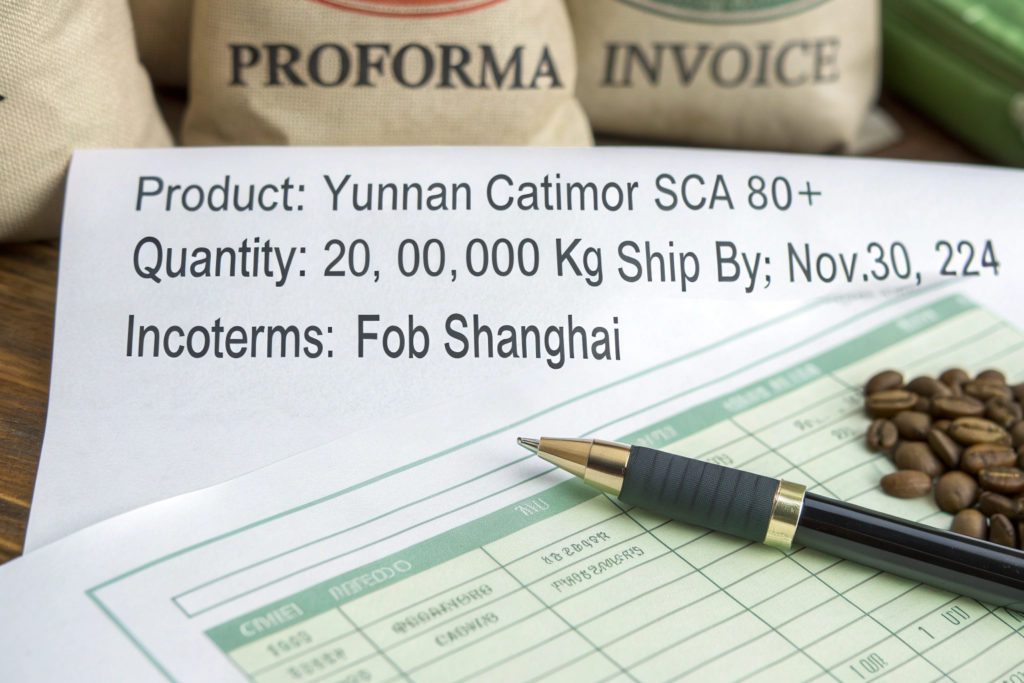
Start with the product description in the Alibaba order. Do not just write "Green Coffee Beans." That's an invitation for dispute. You must be hyper-specific. Copy and paste the exact specifications from the supplier's proforma invoice or your final agreement. For example: "Yunnan Catimor Arabica Green Coffee Beans, Grade SCA 80+, Screen Size 17/18, Moisture Content ≤12%, Defects ≤5 per 300g, Packed in 60kg new jute bags with inner polyethylene liner." Include the exact quantity in kilograms. This text becomes your legally protected specification under Trade Assurance.
Next, the shipping date. Don't use vague phrases like "ASAP" or "within 30 days." Agree on a specific Shipped By Date. This is the date by which the supplier must provide evidence of shipment (like the Bill of Lading date) on the Alibaba platform. This date should account for reasonable production and inland logistics. We always propose a realistic date we are 100% confident we can hit, because missing it triggers a protection claim. This clarity turns timeliness from a worry into a contractual guarantee.
What Key Terms Must Be in Your Alibaba Order Description?
Think of the order description box as your mini-contract. Here is a checklist of what it must contain for a coffee order:
- Coffee Specifics: Variety (Catimor/Arabica/Robusta), Type (Green Bean), Grade (e.g., Premium, SCA 80+).
- Physical Specs: Screen Size, Moisture Content Max, Defect Count Max.
- Packaging Details: Bag type, weight per bag, total quantity.
- Shipment Terms: The agreed Incoterms 2020 (e.g., FOB Shanghai, CIF Los Angeles). This defines cost and risk responsibilities.
- Shipped By Date: The exact date.
- Port of Loading & Destination: e.g., Shanghai, China to Long Beach, USA.
- Reference Documents: State "As per Proforma Invoice #[Number] dated [Date]" and attach the PI to your Alibaba message thread.
By including all this, you turn the Alibaba platform's basic order form into a robust agreement. If the beans that arrive don't match these written specs, you have a solid basis for a quality claim. We at Shanghai Fumao always encourage this level of detail—it protects you and sets clear expectations for us, ensuring a smooth transaction.
How to Negotiate and Document Terms Before Creating the Order?
The negotiation happens before you click "Place Order." Here's the best practice flow:
- Finalize via Message: All terms should be agreed upon in the Alibaba message thread or over email. This creates a written record.
- Request a Proforma Invoice (PI): Ask the supplier to send a formal PI. A professional exporter like us will provide one automatically. This PI should list every single term.
- Cross-Check: Compare the PI with what you will input into the Alibaba order. They must be identical.
- Attach the PI: Upload the final PI to the Alibaba message thread associated with the order. This provides an extra layer of reference.
- Place the Order: Now, create the order on Alibaba, copying the terms from the PI into the description field.
This process ensures there are no surprises. If a supplier is hesitant to provide a detailed PI or to agree on a clear shipped-by date, consider it a red flag. For a trustworthy coffee supplier, this transparency is standard practice because we want our partners to feel secure.
What is the Process for Filing and Managing a Trade Assurance Claim?
Even with the best setup, sometimes things go wrong. Knowing how to file a claim is part of using the system responsibly. The process is structured and evidence-based. It's not about yelling; it's about presenting facts.
First, don't panic. Communicate with your supplier immediately through Alibaba's message system. Most reputable suppliers, including us at BeanofCoffee, want to solve problems quickly to maintain our platform reputation and our relationship with you. Often, issues like a minor shipping delay can be resolved with a new, agreed-upon timeline. However, if the supplier is unresponsive or the breach is serious (like wrong product), you move to a formal claim.
You start the claim directly from your order management page on Alibaba.com. You'll need to select the reason (On-time Shipment or Product Quality) and provide evidence. This is where your detailed order contract pays off. For a shipment delay claim, your evidence is simple: the order contract page showing the "Shipped By" date, and the current date showing it has passed with no shipping proof uploaded. For a quality claim, you will need to provide photos and videos of the received goods that clearly show the problem (e.g., different bean size, mold, incorrect packaging), and ideally, a report from a third-party inspector. Alibaba's dispute team will review the evidence from both sides and make a judgment.
What Evidence Do You Need to Support a Quality or Shipping Claim?
Gather your evidence methodically. For Quality Disputes:
- Visual Proof: Take clear, time-stamped photos and videos of the unopened container, the bags, and then the beans. Show comparisons to the original sample or to a measurement tool (like a screen sizer).
- Inspection Report: If possible, get a report from a neutral inspection company at the destination port. This is the strongest evidence.
- Communication Records: Screenshots of your messages discussing the specifications.
For Shipping Delay Disputes:
- Order Contract Screenshot: Showing the agreed "Shipped By" date.
- Platform Proof: Screenshot of the Alibaba order page showing no shipping documents have been uploaded by that date.
- Supplier Communication: Any messages where the supplier admits to the delay or fails to provide a valid reason.
The principle is: the more objective and documented your evidence, the stronger your claim. Alibaba's mediators look for clear breaches of the written agreement.
How Does Alibaba Mediate Disputes and What Are the Possible Outcomes?
Once a claim is filed, Alibaba's team steps in as a mediator. They will review all evidence uploaded by both you and the supplier. They may ask clarifying questions through the platform. The process is designed to be fair and based on the documented contract.
The possible outcomes are:
- Full Refund to Buyer: If Alibaba finds the supplier clearly violated the terms (e.g., never shipped, shipped completely wrong goods).
- Partial Refund to Buyer: If there is a partial issue (e.g., a percentage of the goods are defective, or there was a minor but impactful delay). The amount may be negotiated.
- Release Payment to Supplier: If Alibaba finds the supplier has met the core terms (e.g., shipped on time with correct documents, or the buyer's quality complaint isn't supported by the contract specs).
- Mutual Agreement Settlement: Alibaba often encourages both parties to negotiate a settlement (e.g., a discount on the order or on the next order). This can be a faster solution.
Throughout this, keep all communication on the Alibaba platform. This ensures the mediation team can see the full history.
What Are the Limitations and Best Practices Beyond Trade Assurance?
Trade Assurance is an excellent tool for mitigating risk on a single transaction, but it is not a substitute for due diligence or a strategy for building a long-term supply partnership. Think of it as training wheels—great for getting started securely, but you'll eventually want to ride on the strength of the relationship itself.
Its main limitations are scope and scale. It doesn't cover logistical problems after shipment (like port strikes), tariff costs, or subjective quality preferences. For very large orders, the protection amount may have a cap. Also, the process can be time-consuming if a dispute arises. Therefore, the ultimate goal is to graduate from needing Trade Assurance for every order by developing trust with a stable coffee supplier.
The best practice is to use Trade Assurance for your first one or two trial orders. This tests the supplier's reliability with a safety net. Once they have proven themselves—by meeting specs, delivering on time, and communicating well—you can discuss moving to more efficient payment terms for subsequent, larger orders. These could be via T/T bank transfer with a deposit, which is faster and has lower fees, or even using a Letter of Credit (L/C) for major shipments. This transition is based on earned trust.

When Should You Consider Moving Beyond Trade Assurance to Other Payment Methods?
Consider transitioning your payment method when:
- Successful History: You have completed 1-2 Trade Assurance orders without any issues or disputes.
- Larger Order Volumes: The order value is high, and the fixed fees or process of Trade Assurance/L/C become less efficient.
- Established Trust: You have developed a direct communication line, perhaps with weekly updates, and have verified the supplier's operations through a virtual audit or visit.
- Need for Speed: For urgent orders, the extra steps in Trade Assurance or L/C can slow down production initiation. A simple T/T deposit can get things moving faster.
We often suggest this progression to our long-term clients. It reduces transaction costs and administrative work for both sides, streamlining the process. It's a sign the partnership has matured.
How Does Trade Assurance Fit into a Long-Term Supplier Relationship Strategy?
Trade Assurance is the starting block, not the finish line. Your strategy should be:
- Discovery & Trial: Use Alibaba search and filters to find suppliers with Trade Assurance, good reviews, and a professional presence like Shanghai Fumao. Use TA for your first, smaller "test" order.
- Verification & Trust Building: If the test order goes perfectly, use the next order to deepen the relationship. Maybe use TA again, but also request more direct communication, like a video call to tour our facilities.
- Partnership Development: After consistent performance, propose moving to standard international payment terms (T/T). Discuss annual contracts, stable pricing, and dedicated logistics planning. This is where you gain true advantages like priority treatment and better pricing.
In this strategy, Trade Assurance is the secure gateway that allows you to confidently take the first step with a new overseas partner. It enables you to verify a supplier's claims with minimal risk, paving the way for a strong, direct, and cost-effective long-term partnership that secures your coffee supply chain.
Conclusion
Using Alibaba Trade Assurance effectively for coffee orders is a smart, structured approach to de-risking your initial purchases from China. It transforms uncertainty into a managed process by securing your payment, enforcing clear contractual terms, and providing a mediation path if things go wrong. The key to unlocking its full potential lies in meticulous setup—embedding detailed product specifications, exact shipment dates, and clear Incoterms directly into your Alibaba order contract.
Remember, this tool is your foundation for building trust. Start with a well-protected trial order to verify the supplier's claims on quality and timeliness. Once that trust is earned, you can confidently explore more efficient payment and partnership models that offer greater flexibility and cost savings for the long haul. It’s a step-by-step journey toward securing a reliable, high-quality coffee supply.
If you are looking for a Yunnan coffee supplier that welcomes the transparency and security of Trade Assurance for your first order, and has the scale and expertise to become your long-term partner, we at BeanofCoffee are ready to connect. Let's discuss your specifications and create a detailed, protected order on Alibaba. Contact our export manager, Cathy Cai, to get started. You can reach her at cathy@beanofcoffee.com for samples and a formal quotation.