You're a buyer. You get a bag of coffee labeled "Single Origin, Ethically Sourced." But what does that really mean? Can you prove it? For someone like Ron, focused on security and reliability, traditional paper trails and certificates are fragile. They can be lost, forged, or simply not tell the full story. The distance between a coffee farm in Yunnan and a roaster in California is filled with information gaps—gaps where quality can drop, claims can be exaggerated, and value can be lost. How do you bridge that gap with unbreakable trust?
Blockchain technology is the answer. It's not just a buzzword; it's a practical tool to build an immutable, shared ledger for your coffee's journey. Using blockchain for supply chain transparency means creating a digital, tamper-proof passport for every bag or lot of coffee, from the seedling to your shelf. For an exporter like BeanofCoffee, it's a way to prove our claims of direct ownership, ethical practices, and quality control in a language everyone can verify. It turns "trust us" into "here's the proof."
So, if you're tired of opaque supply chains and want to offer your customers undeniable proof of origin and quality, blockchain is the system you need. Let's break down how it actually works in the real world of coffee.
What is the Basic Architecture of a Coffee Blockchain?
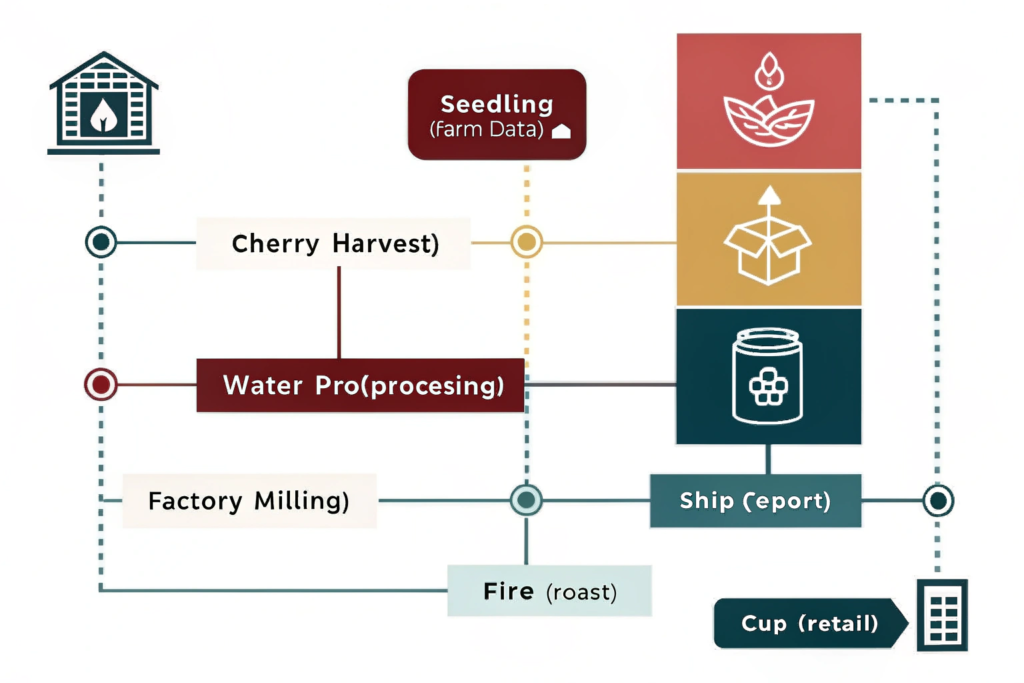
Think of a blockchain as a digital ledger, like a shared Google Sheet, but with superpowers. Once data is entered into a "block," it is cryptographically sealed and linked to the previous block, forming a chain. No one can alter a past entry without changing every subsequent block, which is practically impossible across a distributed network. For coffee, each major event in the bean's life becomes a block.
Here’s a simplified architecture for a coffee supply chain blockchain:
- The Network: A permissioned blockchain (like Hyperledger Fabric) is often used, where participants (Farmer, Exporter, Shipper, Importer, Roaster, Retailer) are known and vetted. This is faster and more private than public chains like Bitcoin.
- The Assets & Transactions: The physical coffee lot is the "asset." Key events are "transactions" recorded on the chain:
- Block 1: Farm Registration - GPS coordinates, farm name, owner (BeanofCoffee Plantation #5, Yunnan).
- Block 2: Harvest - Date, lot ID, picker group ID.
- Block 3: Processing - Method (washed/natural), dates, moisture content post-drying.
- Block 4: Milling & Grading - Lot ID, screen size, density, defect count.
- Block 5: Export Documentation - Bill of Lading, container number, OTA test certificate hash.
- Block 6: Roasting - Roaster ID, roast date, profile.
- Block 7: Retail - Final bag ID, sale location.
Each participant adds their data via a simple app, often scanning a QR code from the previous step to link the physical goods to the digital record. The result is a complete, unchangeable story.
How is the physical coffee linked to the digital block?
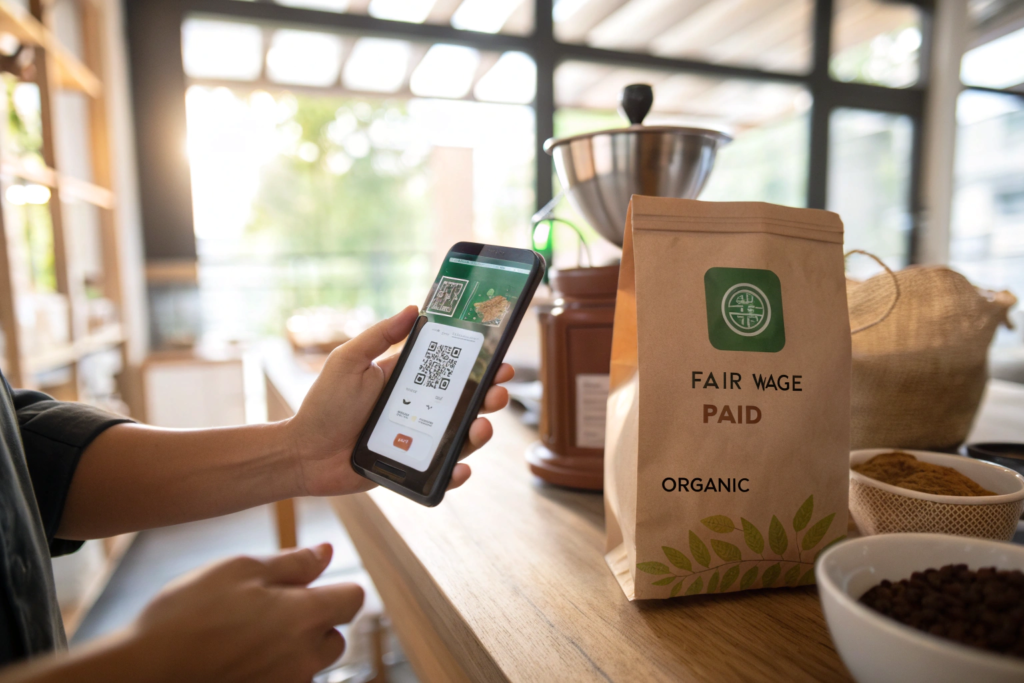
This is done through unique identifiers. When we create a harvest lot at our farm, we generate a QR code or NFC tag for that lot. This code is printed on the physical bags (of parchment, then green beans). At each handoff point, the next actor scans the code to "claim" the lot and then scans it again to add new data (e.g., "received for milling," "shipped in container XYZ"). This creates an auditable chain of custody. For consumers, a final QR code on the retail bag lets them see the entire journey.
What's the difference between a public and a private (permissioned) blockchain for coffee?
A public blockchain (e.g., Ethereum) is completely open and decentralized. It's more transparent but slower, more expensive (due to "gas fees"), and exposes potentially sensitive business data (like exact volumes and prices). A permissioned blockchain is a private network where only approved supply chain partners can participate and view data. This is far more suitable for B2B coffee trade. It protects commercial details while still providing the end consumer with a verified, simplified story. Our approach is to implement a permissioned system with our key partners.
How Does Blockchain Verify Origin and Ethical Claims?
"Direct Trade," "Single Origin," "Fair Wage"—these are powerful marketing terms, but they are often just labels. Blockchain provides the verification layer. It doesn't just record that a payment was made; it can record proof of the payment and the conditions under which the coffee was grown.
Proving Origin & Single-Estate Claims:
For a buyer of our Yunnan coffee, the blockchain record starts with us, the plantation owner. We record the exact GPS polygon of the harvest plot. This is immutable. When the coffee is later sold as "Single-Origin Yunnan from BeanofCoffee Estate," the consumer can scan the code and see the map—proof that it's not a blend from multiple unknown farms. This is a game-changer for fighting fraud and adding real value to terroir.
Verifying Ethical & Sustainability Practices:
How do you prove fair wages or organic farming? On the blockchain, we can record:
- Digitized Certificates: The hash (digital fingerprint) of an organic or Fair Trade certificate issued by a third party.
- Payment Transactions: Smart contracts can be programmed to automatically trigger a payment to a farmer cooperative's digital wallet upon verification of delivery, with the transaction recorded on-chain. This proves timely payment.
- Field Data Logs: Data from IoT sensors (e.g., soil moisture, satellite imagery of shade cover) can be fed to the blockchain, providing environmental proof.
This moves sustainability from a marketing story to a set of auditable, data-backed facts. It directly addresses the sourcing key point of certification and quality control with unprecedented rigor.
Can blockchain prove quality metrics like cupping scores and moisture content?
Absolutely. These are simply data points. Our QC lab can upload the official cupping score sheet (e.g., 85.5) and moisture content reading (e.g., 10.8%) to the blockchain at the milling stage, signed with a digital signature. The roaster later adds their roast profile and tasting notes. This creates an objective quality history that follows the bean. A buyer can see not just a claim of "high quality," but the exact scores and measurements that support it.
How does it combat fraud in premium markets (e.g., fake Kopi Luwak, misrepresented regions)?
Blockchain is a powerful antifraud tool. For a rare, high-value coffee like Kopi Luwak, each step—from the civet farm to processing—can be recorded. Any bag without a valid, verifiable chain is immediately suspect. Similarly, a coffee fraudulently labeled as "Ethiopian Yirgacheffe" would lack the crucial first blocks from Ethiopian farms and cooperatives. The chain of custody breaks, revealing the fraud. This protects legitimate producers, roasters, and consumers.
What are the Practical Steps for a Buyer to Implement It?
As a buyer or brand, you don't need to build a blockchain from scratch. You can participate in an existing platform or partner with suppliers who are already implementing the technology. Here's your roadmap.
1. Start with Your Key Supply Chains:
Don't try to blockchain everything at once. Identify your flagship, high-value, or most ethically important coffee line. This is where the investment in transparency pays the highest returns in brand value and customer trust.
2. Choose Your Technology Partner:
Several companies now offer turnkey blockchain solutions for supply chains (e.g., IBM Food Trust, Farmer Connect, Bext360). Evaluate them based on cost, ease of use for all partners (including farmers with low tech literacy), and interoperability.
3. Onboard Your Supplier:
This is the most critical step. You need a supplier who is willing and capable to input data at the origin. This is where our role as a tech-forward plantation exporter is key. We are already preparing our systems for this. Present it as a partnership: you gain a marketing edge and supply security; we gain a more loyal, high-value customer and can command a premium for our fully transparent coffee.
4. Define the Data Protocol:
Agree with all partners on what data gets recorded at which steps. Keep it simple at first: location, date, key certifications, quality metrics. Avoid recording sensitive commercial pricing unless all parties agree.
5. Launch and Market the Story:
Once the coffee with a scannable code lands, build your marketing around the "See Your Story" feature. Educate your customers on how to scan and what it means.

What are the costs involved for a buyer/roaster?
Costs vary. They can include:
- Platform Subscription Fee: A monthly or annual fee to use the blockchain service.
- Integration Cost: One-time cost to connect your systems (if needed).
- Tagging/Labeling Cost: The physical QR codes/NFC tags and printing.
- Supplier Onboarding Incentive: You may need to share the cost or pay a small premium to incentivize your supplier (like us) to perform the extra data entry work.
View this not as an expense, but as an investment in brand equity, supply chain risk reduction, and customer loyalty.
How do you handle partners in the chain who are not tech-savvy?
The key is simplicity. Many platforms offer basic smartphone apps where a farmer or warehouse manager can simply scan a code and take a photo to record an event (e.g., "Bagging complete"). Training and support are essential. As a large-scale operator, we can act as the "node" for our region, onboarding smaller local partners we work with and ensuring data integrity from the origin point. We bridge the tech gap.
What are the Tangible Business Benefits and ROI?
Beyond "doing the right thing," blockchain transparency delivers hard business value. It solves real pain points for buyers like Ron and builds competitive advantage.
1. Supply Chain Efficiency & Risk Reduction:
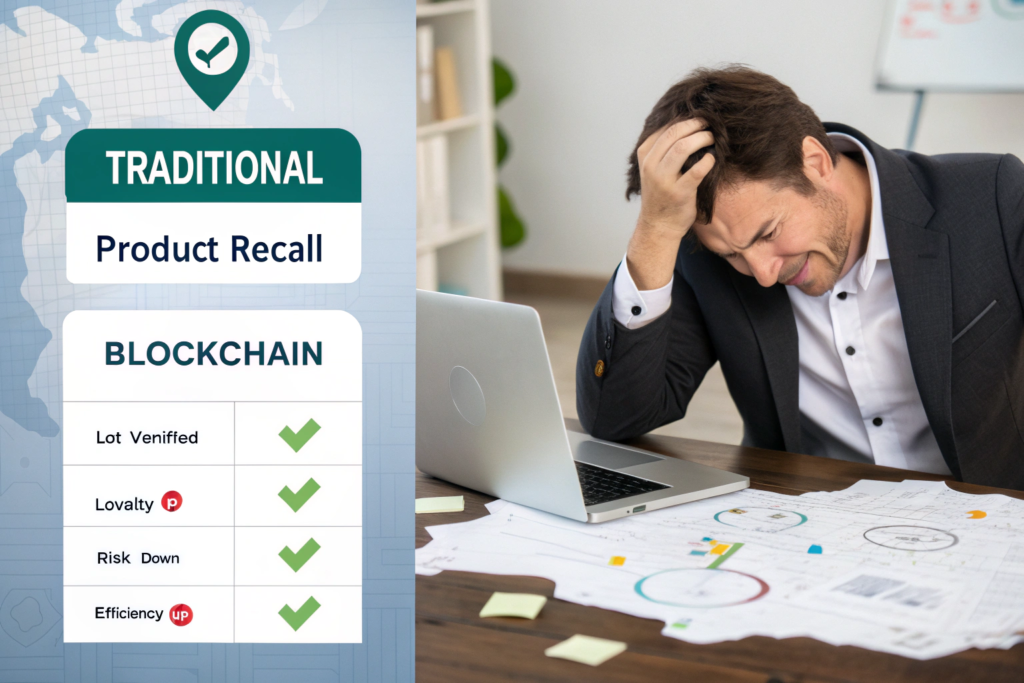
- Traceability in Seconds: If a quality issue arises (e.g., mold, off-flavor), you can pinpoint the exact batch and step in the chain within seconds, not weeks. This enables targeted recalls, saving massive costs and brand damage.
- Reduced Administrative Fraud: Automated documentation reduces paperwork errors and the risk of invoice or certificate fraud.
2. Enhanced Brand Value & Consumer Trust:
- Storytelling Power: You move from generic claims to specific, provable stories. "Meet Zhang, who tended this coffee on slopes overlooking the Salween River."
- Loyalty & Price Premium: Consumers, especially Millennials and Gen Z, show higher loyalty and willingness to pay a premium for transparently sourced products.
3. Access to New Markets & Finance:
- Compliance Simplification: Easily provide verified data for certifications (Organic, Fair Trade) or regulatory requirements.
- Improved Access to Credit: Banks and investors are more likely to finance a business with a transparent, low-risk supply chain. The blockchain record can serve as collateral.
For BeanofCoffee, offering blockchain-verified lots allows us to differentiate in a crowded market. It proves our ownership model, our quality control, and our commitment to sustainability. It makes us a more attractive, lower-risk partner for forward-thinking brands.
How does this impact insurance and liability?
With a verifiable chain of custody, liability for contamination or quality failure can be accurately assigned. This can lead to lower insurance premiums for businesses with blockchain-secured supply chains, as the risk of widespread, untraceable contamination is drastically reduced. Insurance companies are beginning to recognize and incentivize this.
Can blockchain ensure payment to farmers faster (via smart contracts)?
Yes, this is a revolutionary application. A smart contract is code on the blockchain that executes automatically when conditions are met. Imagine: The blockchain records that "Lot 123" was received at the port and the weight was verified. The smart contract then automatically triggers a bank to release payment to the exporter (and potentially, a portion directly to the farmer's digital wallet), eliminating lengthy payment delays. This addresses a fundamental financial pain point in the industry. We are actively exploring this with partners.
Conclusion
Using blockchain for coffee supply chain transparency is about building a new infrastructure of trust. It replaces fragile paper and promises with resilient digital proof. For buyers, it mitigates risk, empowers marketing, and secures quality. For suppliers like us, it validates our practices and creates a direct, value-based connection with the end consumer.
The future of coffee trade is traceable. The technology is ready, and the market demand is clear. The question is not if you will adopt it, but when and with which forward-thinking partners.
Ready to offer your customers the world's most transparent cup? Partner with BeanofCoffee to pilot a blockchain-verified coffee lot from our Yunnan estate. We provide the origin data, you tell the undeniable story. Contact Cathy Cai to initiate a pilot project: cathy@beanofcoffee.com. Let's build trust, one block at a time.