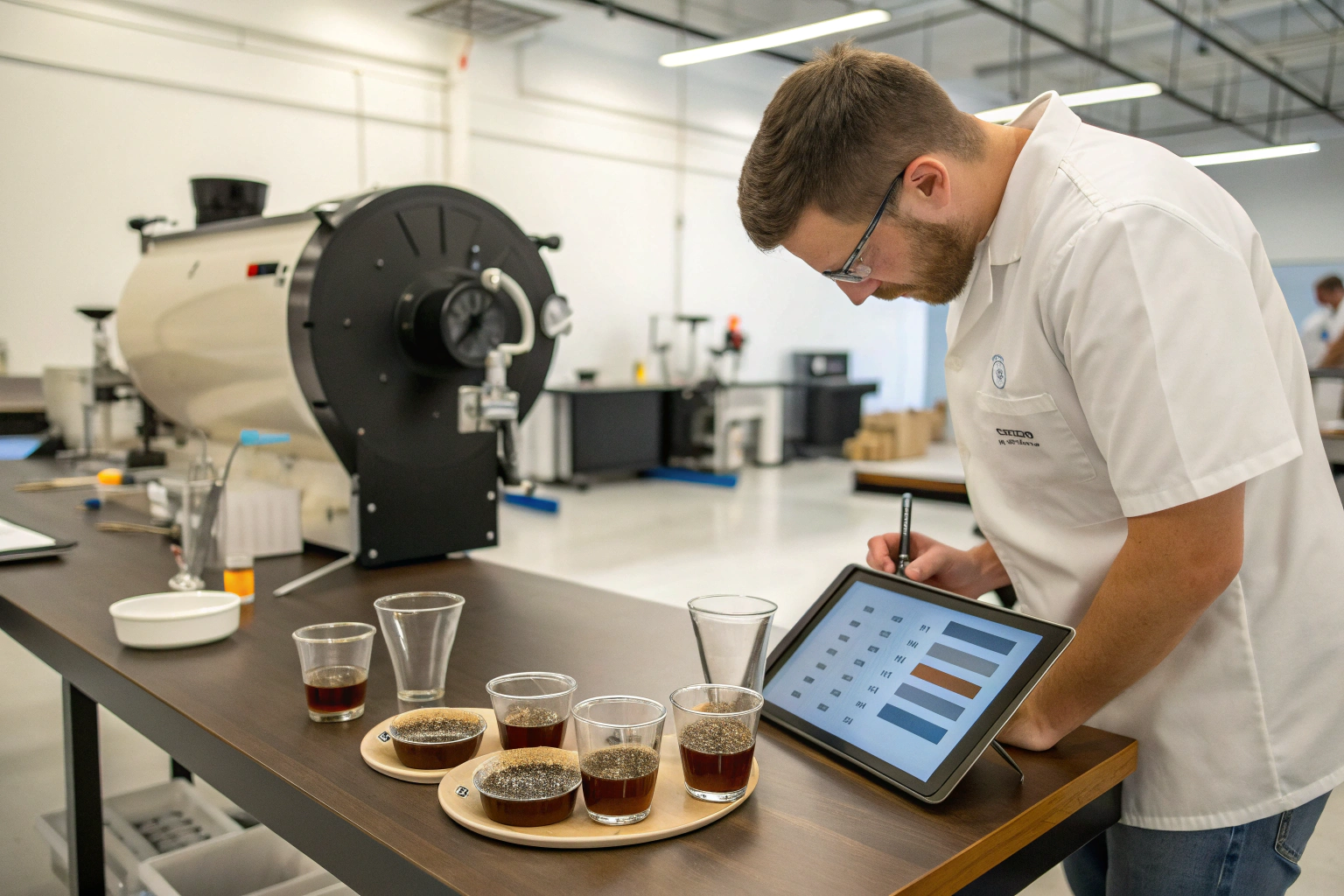
You are looking at a green coffee shipment. The price is competitive. The seller's description is compelling. But you have 60 seconds and 100 grams to decide if this coffee is worthy of your production roaster—and your customers' loyalty. How do you make that call with confidence, not guesswork?
Using sample roasters for quality assessment is a structured forensic process, not casual experimentation. It requires: 1) a standardized roasting protocol (SCAA: 8-12 minutes, Agtron 58/63, post-roast rest 8-24 hours); 2) a deliberate profile selection strategy that matches the coffee's origin, density, and processing method; 3) strict control of grinding, water chemistry, and cupping timing to eliminate confounding variables; and 4) systematic sensory evaluation using the SCAA cupping form, with particular attention to flavor and aftertaste as the primary economic differentiators. The sample roaster is not the end of quality assessment—it is the controlled laboratory instrument that enables assessment to begin.
I've been where you are. Early in my career, I roasted samples the way I roasted production batches. The results were inconsistent, and I blamed the coffee. The problem was me. At Shanghai Fumao, we now treat sample roasting as a separate discipline. The machines are different. The goals are different. The metrics are different. Let me walk you through what we have learned—from the roaster's drum to the cupping spoon.
What Is a Sample Roaster and Why Can't You Use a Production Roaster?
Before we discuss how, we must establish what. A sample roaster is not a small production roaster. It is a fundamentally different tool designed for a fundamentally different job.
A sample roaster is a small-batch machine (typically 50-120g capacity) engineered specifically for green coffee evaluation, profile development, and sensory training—distinct from production roasters in its batch size, thermal dynamics, and data granularity. Professionals use sample roasters to evaluate coffee before purchasing, compare lots or processing methods, develop roast profiles at micro-scale, conduct QC checks, and train sensory teams in consistent environments.
Why not use a mini production roaster? Because production roasters are optimized for throughput and consistency across large volumes. Sample roasters are optimized for control and observation at small scales. A 500g sample roast on a 15kg production machine behaves differently than a 100g roast on a purpose-built sample roaster. The thermal mass, airflow, and bean-to-drum ratio are not linear scalars.
At Shanghai Fumao, we maintain dedicated sample roasting equipment separate from our production floor. This is not luxury. It is methodological necessity.
What Are the Key Specifications of Professional Sample Roasters?
The market offers several validated platforms. Understanding their capabilities helps you select the right tool for your workflow.
| Roaster Model | Batch Size | Heating System | Key Feature | Best For |
|---|---|---|---|---|
| Sample Pro 100 | 80-120g | Gas or electric | 1-6 drum config; K-type thermocouple | Exporters, importers, Q-Grader labs |
| ROEST L100 Plus | 50-200g | Convection | Auto first crack detection; cloud profiles | Roasters, importers, competitions |
| Ikawa Pro V3 | 50-100g | Fluid bed air | Profile reproducibility; app control | R&D, multi-sample comparison |
| Nucleus Link | 90-120g | Ambient-start IR | 205 core profiles; altitude calibration | Portable labs; density-based profiling |
The trend is clear: data integration is now standard. Modern sample roasters do not just roast beans; they record temperature curves, airflow rates, and development time ratios. Some, like the ROEST, use adaptive algorithms to detect first crack automatically and adjust development accordingly. The Nucleus Link even predicts the optimal profile based on green bean density input. The Specialty Coffee Association provides equipment certification standards for sample roasting.
For a buyer like Ron, this means: sample roasting is now a quantitative science, not an artisanal craft. You can demand data, not just subjective opinions.
How Do Sample Roasters Differ from Home Roasters?
This distinction matters because some buyers attempt to cut costs by using modified popcorn poppers or home-drum roasters. The results are not comparable.
| Feature | Professional Sample Roaster | Home/Consumer Roaster |
|---|---|---|
| Batch Size Precision | ±1g programmability | Approximate |
| Temperature Control | Real-time bean probe + environment | Often air temp only |
| Profile Reproducibility | ±0.5°C across batches | High variability |
| Data Output | CSV, cloud storage, shareable curves | None or basic |
| SCAA/Q Compliance | Designed for certification labs | Not certifiable |
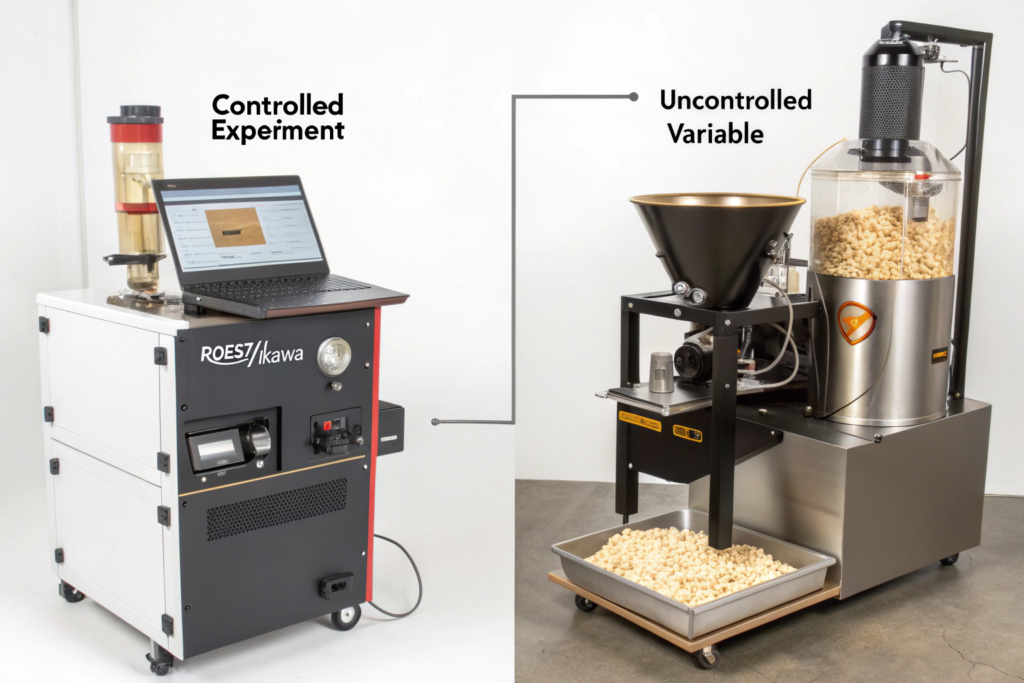
Home roasters introduce uncontrolled variables that invalidate the sample as a proxy for production potential. A sample that tastes great from a hot-air popper may roast terribly in your 60kg Probat. The sample roast must be a controlled experiment, not a craft project.
What Standardized Roasting Protocol Ensures Valid Quality Assessment?
This is the most frequently violated principle in coffee sourcing. Professionals roast samples according to a protocol, not a whim. The protocol exists to eliminate the roaster as a variable.
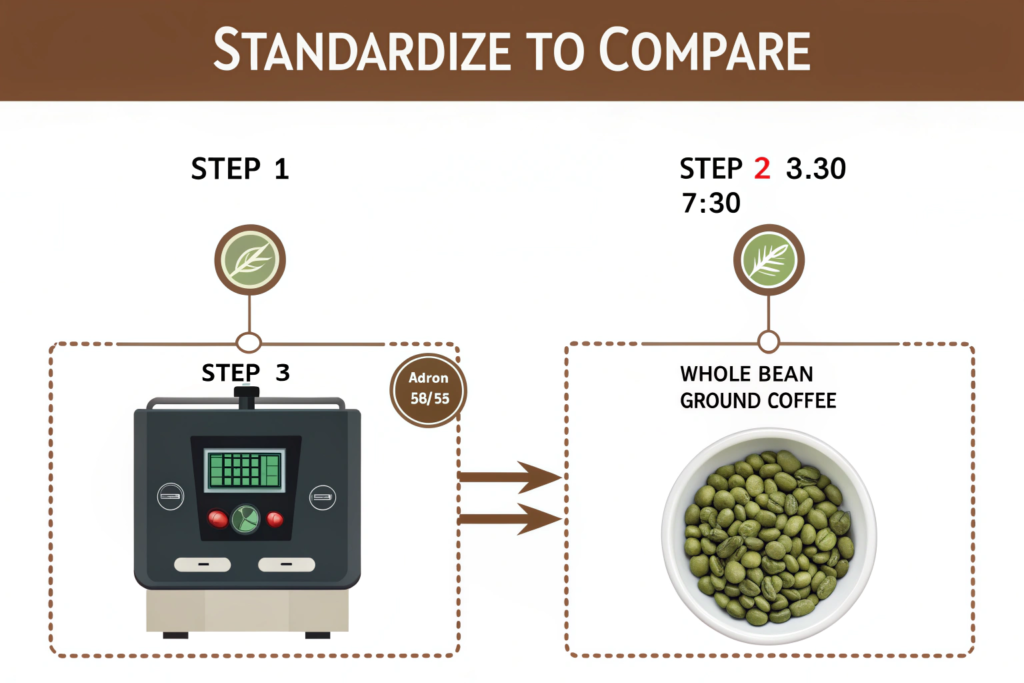
The SCAA-approved sample roasting standard requires: roasting within 24 hours of cupping, a minimum 8-hour rest post-roast, roast time of 8-12 minutes, Agtron color value of 58 for whole bean and 63 for ground (SCAA #55), no tipped or scorched beans, and rapid air-cooling without water quench. This is not a suggestion. It is the documented standard that enables valid comparison across origins, producers, and evaluators.
Why such narrow parameters? The sensory characteristics of coffee change dramatically with roast degree. A dark-roasted Yunnan Catimor tastes like chocolate and low acidity. A light-roasted Yunnan Catimor tastes like citrus and tea. Both are valid flavor profiles, but they are not comparable assessments of the same green coffee. If you roast your supplier's sample darker than your competitor's, you are not evaluating the bean; you are evaluating your roasting decision.
What Is the Correct Roast Color Target?
The SCAA standard is specific: Agtron 58/63 (whole bean/ground) , which corresponds to a light-medium roast. This is not arbitrary. This roast level:
- Develops the bean sufficiently to eliminate "grassy" underdeveloped flavors
- Preserves origin-characteristic acidity and aromatic compounds
- Provides sufficient contrast for defect identification
- Falls within the "Gold Cup" extraction sweet spot
For labs without an Agtron, visual reference tiles are available. However, the instrumented measurement is strongly preferred. Human color perception varies with lighting, fatigue, and individual physiology. The Agtron does not. The SCAA Roast Color Classification System is the definitive reference.
How Long Should the Roast Take—and Why Does It Matter?
The SCAA window is 8-12 minutes from charge to drop. This is not a production roast speed (often 12-15 minutes for large drums). It is deliberately faster.
Why? Longer roasts allow more moisture loss and drive more development, which can mask defects and flatten acidity. A 15-minute sample roast may produce a sweet, smooth cup—but it will not predict how that coffee performs in your 9-minute production roast. The sample roast must approximate the thermal energy application rate of your target production profile.
Sucafina's lab protocol specifies first crack occurring between 6:00 and 7:00 minutes, with drop occurring 40 seconds to 1:10 minutes into the crack. This yields a total roast time of approximately 7:30 minutes for most microlots and high-commercial coffees.
At Shanghai Fumao, we calibrate our sample roaster monthly against a reference coffee with known Agtron value. We record drop temperature, development time ratio (DTR), and final color for every sample. If a client requests a specific roast degree for their evaluation, we adjust—and document the adjustment. Transparency in sample roasting methodology is part of supply chain transparency.
How Do You Select the Right Roast Profile for Different Coffees?
Here is where the art meets the science—but the art is now codified. Not all coffees should be roasted the same way, even for sample evaluation.
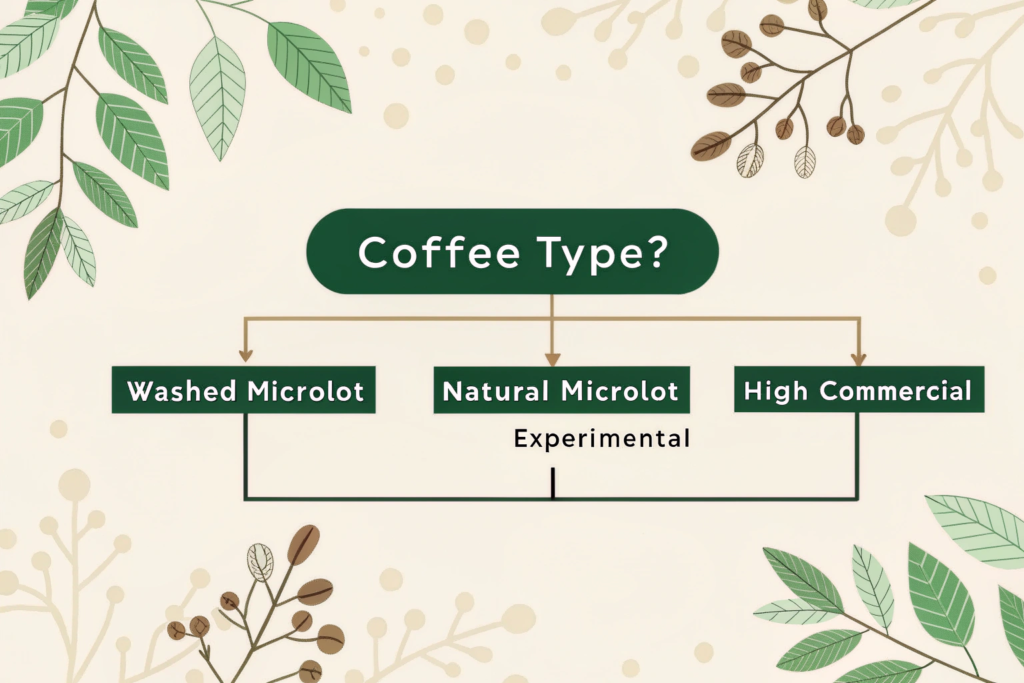
The optimal sample roast profile varies systematically by coffee type: microlots (SCA 85+) require faster, higher-energy roasts; high-commercial specialty requires slower, gentler development to ensure evenness; naturals require lower energy through first crack to prevent scorching; and experimentally-processed (EP) coffees demand extended Maillard phases and careful airflow management to avoid tipping.
This is not guesswork. This is the documented protocol of a major international coffee trader, validated across thousands of samples.
What Profiles Match Which Coffees?
Sucafina's 2021 updated protocol defines five distinct sample roasting profiles:
| Coffee Category | Charge Temp | Gas/Energy | Airflow | Development Time | Total Time | Rationale |
|---|---|---|---|---|---|---|
| Fully Washed Microlot | Medium | High | Moderate | 50-55 sec | ~7:30 | Dense beans; faster heat transfer |
| Natural Microlot | Medium-High | Slightly lower | Moderate | 45 sec | ~7:30 | Preserve fruit; avoid scorch |
| Fully Washed High Commercial | High | Lower | Moderate | 1:10 min | ~7:30 | Even development; avoid under-roast |
| Natural High Commercial | Higher | Lower | Gentle | 1:00-1:20 | ~8:00 | Low density; gentle approach |
| Experimental Processed | Lower | Medium | Gradually open | 40-45 sec | 7:30-8:00 | High sugar; extreme scorch risk |
The experimental processed (EP) category includes anaerobic fermentation, carbonic maceration, extended fermentation, and yeast-inoculated lots. These coffees absorb heat more readily and burn easily. The protocol specifies starting with lower charge temperature, gradually opening airflow after color change, and reducing gas to zero approximately 20 seconds into development time.
This is the single most important adaptation for modern specialty coffee buying. If you roast an anaerobic Geisha the same way you roast a washed Bourbon, you will scorch it, blame the producer, and miss a world-class coffee.
How Do You React When the Roast Deviates?
Even with perfect profile selection, individual lots behave differently. The professional sample roaster monitors and intervenes.
Visual assessment triggers corrective action:
- Color should turn yellow between 3:30-4:30. Faster? Too hot; open airflow. Slower? Too cool; increase energy.
- First crack should occur between 6:00-7:00. If delayed, the coffee may bake.
- Post-crack darkening rate. If beans darken too fast, open airflow fully and reduce gas immediately.
Crucially, Sucafina's protocol emphasizes airflow adjustment over gas adjustment for minor corrections. Changing gas settings alters the entire thermal trajectory. Adjusting airflow allows finer control, particularly on machines where increased airflow introduces cooling air.
For the buyer: ask your supplier for their sample roasting logs. Do they record first crack time? Drop temperature? Development time ratio? If not, they are not controlling their variables—and you cannot trust their quality assessments. The Coffee Quality Institute provides training on standardized sample roasting protocols.
What Happens After the Roast: Grinding, Brewing, and Cupping Standards?
The sample roaster produces the material. The cupping lab produces the decision. The link between them is strict protocol.
The SCAA cupping protocol requires: grinding immediately before cupping, grind size with 70-75% passing US #20 sieve, 8.25g coffee : 150ml water (Golden Cup ratio), water TDS 125-175ppm, brew temperature 93°C (200°F), steep time 3-5 minutes, and sensory evaluation using the standardized SCAA cupping form.
Every parameter is specified because every parameter influences sensory perception. A 2°C temperature difference or 50ppm TDS shift can change a coffee's score by 2-3 points.
Why Is Post-Roast Resting Time Non-Negotiable?
SCAA requires roasting 8-24 hours prior to cupping, with a minimum 8-hour rest. Sucafina's lab standardizes on roasting in the afternoon, cupping the next morning.
Why? Freshly roasted coffee degasses CO₂ aggressively, which suppresses volatile aromatic compounds and creates perceived acidity suppression. A coffee cupped 2 hours post-roast tastes flatter, more bitter, and less expressive than the same coffee cupped at 24 hours.
Crucially: the goal of sample roasting is not to find the "best" way to drink the coffee. The goal is to evaluate the green coffee's potential under standardized conditions. Consistency of resting time is more important than the specific duration. Sucafina explicitly states: "We always cup the coffees the day after roasting. Not because this is necessarily the best practice but because this is the most consistent way of evaluating our samples."
How Do You Translate Sample Roast Data to Production Decisions?
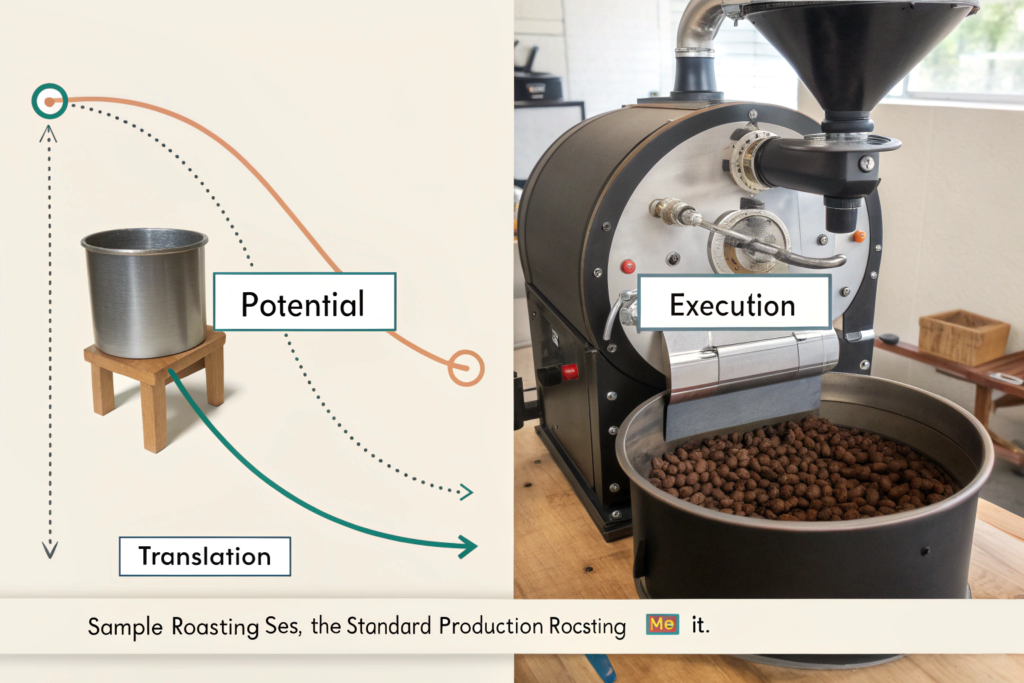
This is the ultimate purpose of the exercise. A perfect sample roast tells you how the coffee can perform. Your production roaster must deliver that performance at scale.
Recent research confirms that the type of roaster (drum vs. fluid bed) and roast profile produce measurable differences in chemical composition (infrared spectra), but these differences do not necessarily produce statistically significant differences in final sensory scores. This is a critical finding: you can achieve equivalent sensory quality on different roasters if you control the profile appropriately.
What this means for you:
- The sample roast establishes the coffee's potential ceiling.
- Your production roaster's job is to hit that ceiling, not to set it.
- If your production coffee consistently underperforms your samples, the problem is your production roasting, not your sample roasting.
At Shanghai Fumao, we provide our production buyers with both the sample roast data and the recommended production roast parameters (charge temperature, development time, drop temperature) based on our trials. We do not gatekeep this information. It is part of the partnership. The Roasters Guild offers extensive resources on scaling sample profiles to production.
What Are the Common Mistakes That Invalidate Sample Roast Assessments?
I have made all of these errors. So have most buyers. Identifying them is the first step to eliminating them.
The most frequent sample roasting errors include: using uncontrolled or uncalibrated equipment, roasting outside the 8-12 minute window, failing to standardize post-roast rest time, cupping at inconsistent intervals, applying the same profile to all coffees regardless of density or process, and failing to document roast parameters.
Mistake 1: Equipment Drift
Temperature sensors drift over time. A thermocouple reading 200°C may actually be 195°C or 205°C. This error propagates through every roast. Calibrate against a reference source quarterly.
Mistake 2: Ignoring Density
Low-density beans (often from lower altitudes or high-yield varieties) require gentler heat application. Applying a dense-bean microlot profile to a soft Brazilian commercial lot will produce scorching and tipping. Measure density. Adjust profile accordingly. The Nucleus Link's "Density Roast Prediction" feature formalizes this principle.
Mistake 3: Inconsistent Cupping Timing
Cupping some samples at 8 hours and others at 24 hours introduces an uncontrolled variable. Standardize your schedule. If you must cup earlier or later, document it and interpret scores with appropriate caution.
Mistake 4: Over-Reliance on Total Score
A coffee that scores 86 on your cupping table and a coffee that scores 86 on your competitor's table are not necessarily equivalent unless roasting and cupping protocols were identical. The SCAA system is standardized, but execution varies. Use sample roasting to inform your own decisions, not to validate external scores.**
Conclusion
Using sample roasters for quality assessment is not about mastering a machine. It is about mastering a methodology. The sample roaster is your laboratory instrument, and the protocol is your experimental method.
The essential framework is this:
-
Equip yourself with a purpose-built sample roaster that provides data logging and profile control. Consumer-grade equipment introduces uncontrolled variables.
-
Standardize your roast protocol to SCAA parameters (8-12 minutes, Agtron 58/63, 8-24 hour rest). This enables valid comparison across time and origin.
-
Select profiles deliberately based on coffee type, density, and processing method. Washed microlots, natural high-commercial, and anaerobic experimental lots require distinct approaches.
-
Control cupping variables rigorously: grind size, water chemistry, temperature, steep time, and evaluation timing.
-
Document everything. Roast curves, drop temperatures, development times, and Agtron values are not optional. They are your evidence base for purchasing decisions.
-
Translate, don't replicate. The sample roast establishes potential. Your production roast must realize that potential with your equipment, your water, and your market's preferences.
At Shanghai Fumao, we treat sample roasting as a core competency, not an ancillary task. Our lab is equipped with calibrated sample roasters, Agtron spectrophotometers, and trained cuppers. When we send you a sample, we send you the roast data, the cupping scores, and the recommended production parameters. We do not hide our methodology—we share it, because your success in evaluating our coffee is the foundation of our partnership.
If you are building your own quality assessment protocols and need a supplier who can provide documented, standardized sample roasts with full transparency, let's talk. Contact our Sales Director, Cathy Cai. She can arrange for sample shipments roasted to your specified profile, complete with full roast data and cupping analysis. Email Cathy at cathy@beanofcoffee.com. Let's evaluate coffee on the same page, with the same standards.