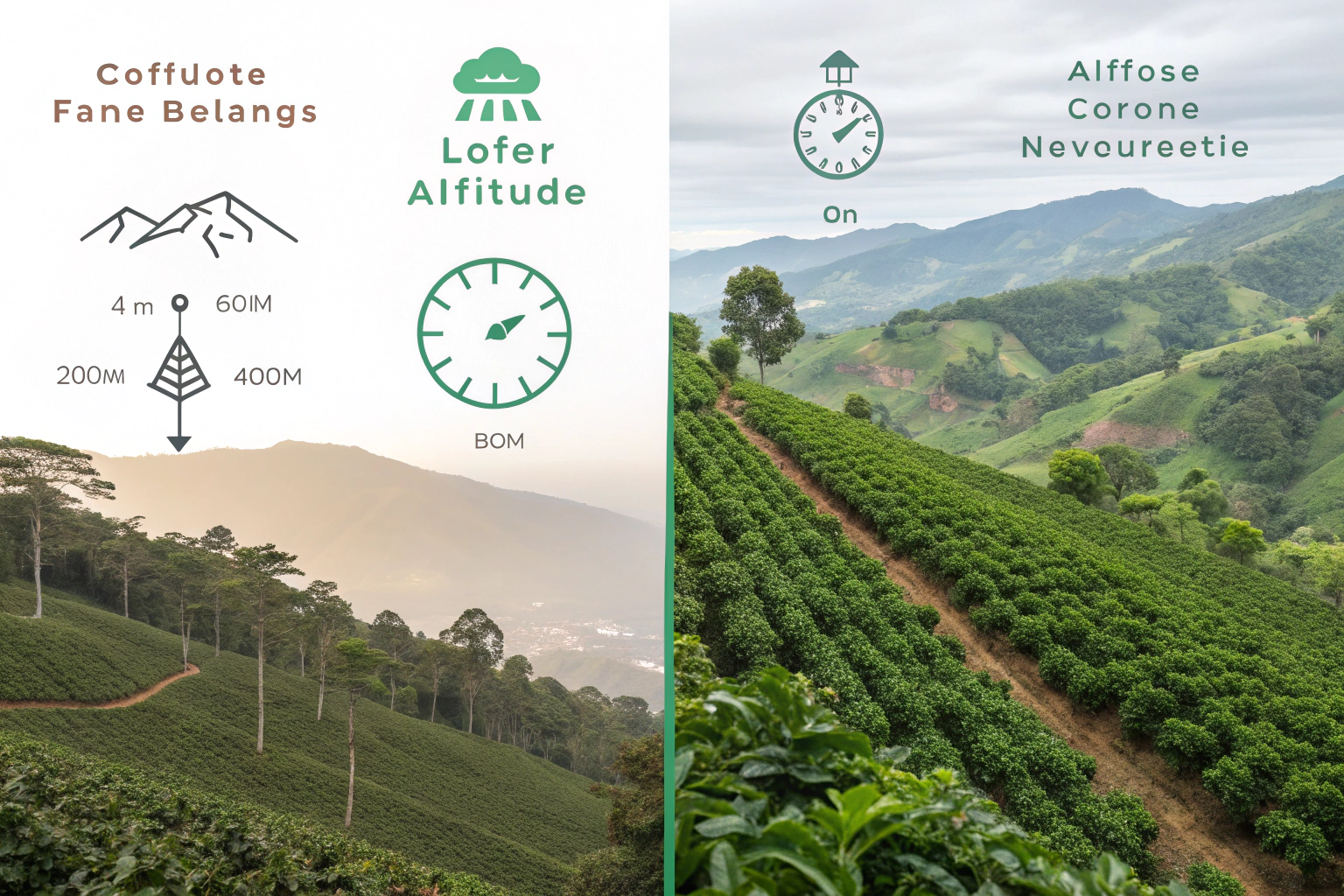
You see "SHB" (Strictly Hard Bean) or "High Grown" on a spec sheet, and the price jumps 30%. Is this real value, or just marketing elevation—pun intended? Your customers ask why Ethiopian beans cost more than Brazilian. Your roastery wants consistent flavor. Your margin depends on buying right. So, what does altitude actually do to the bean?
Sourcing coffee from high altitude (typically above 1,200m) delivers four distinct, scientifically-validated benefits: 1) Superior physical quality—denser, larger, more homogeneous beans with fewer defects; 2) Enhanced flavor potential—higher concentrations of sugars, acids, and aromatic precursors that develop into complex cup profiles; 3) Greater chemical consistency—favorable shifts in trigonelline, chlorogenic acids, and fatty acids linked to sensory quality; and 4) Extended maturation time—slower cherry development that concentrates soluble solids and allows nuanced flavor compounds to accumulate. This is not folklore. It is now documented agronomy.
I have walked our Yunnan fields at 1,200m and at 1,600m. The difference is not subtle. The higher block produces smaller cherry yields—but the beans inside are visibly denser, greener, and more uniform. The cupping scores confirm what our eyes see. At BeanofCoffee, we designate specific high-altitude micro-lots precisely because they deliver predictable, premium quality for buyers who need it. Let me show you the data behind the decision.
How Does High Altitude Physically Transform the Coffee Bean?
Before flavor, there is form. High altitude changes the bean's fundamental structure. These physical changes are not decorative—they are functional and measurable.
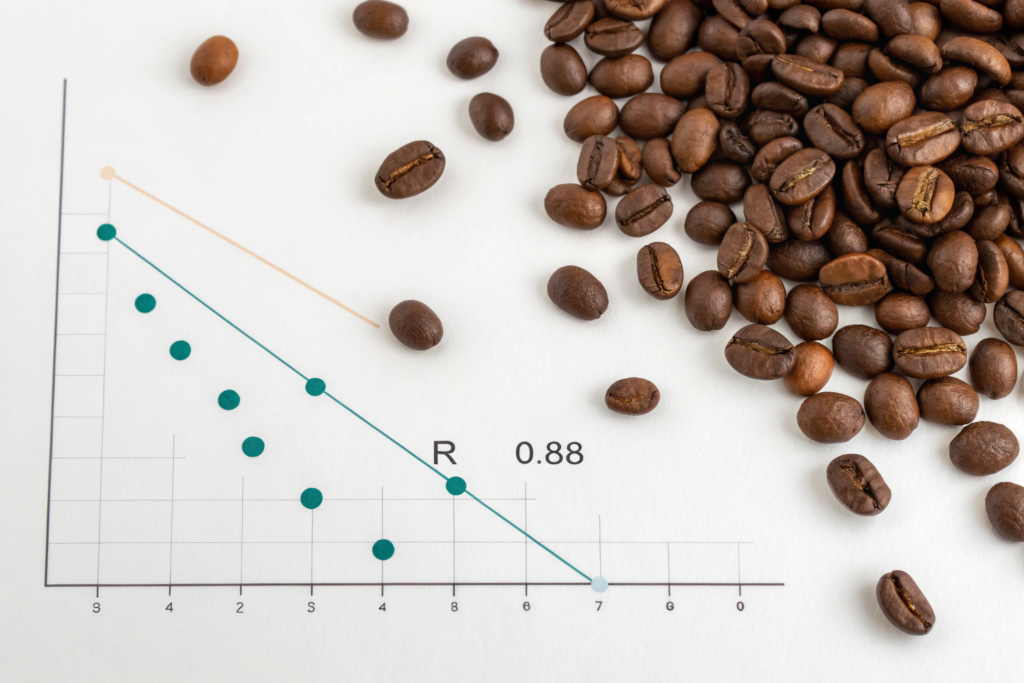
High altitude coffee beans exhibit statistically significant improvements in physical quality attributes: bulk density (r = 0.88 correlation with elevation), bean size (r = 0.62), and commercial homogeneity increase, while defective bean rates decline sharply (r = -0.75 with elevation). Furthermore, extended maturation at higher elevations—documented as a four-week lengthening of the fruit ripening period from 650m to 935m—produces beans with greater mass and brighter, less yellowish color, all indicators of superior trade quality.
The mechanism is not mysterious. Cooler temperatures slow the plant's metabolism. The cherry takes longer to ripen. This extended timeline allows the bean inside to pack more dry matter—sugars, acids, lipids—into the same physical space. The result is a denser seed that roasts more evenly and grinds more consistently.
What Do the Correlation Numbers Actually Mean for a Buyer?
Statistics can feel abstract. Let me translate.
| Physical Attribute | Correlation with Altitude (r) | Practical Meaning |
|---|---|---|
| Bulk Density | +0.88 (very strong) | Heavier beans per container; better heat transfer during roasting; lower defect incidence |
| Bean Size (Screen) | +0.62 (strong) | More uniform particle size; fewer broken or "elephant" beans; higher commercial grade |
| Defective Beans | -0.75 (strong negative) | Dramatically fewer insect-damaged, black, or sour beans; higher usable yield |
A correlation of 0.88 is exceptionally high in agricultural research. It means that if you want dense beans, altitude is one of the most powerful levers you can pull. Dense beans are not just a quality marker—they are a roasting predictability marker. They absorb heat at a consistent rate. They resist scorching. They grind without shattering into fines. The Specialty Coffee Association density grading protocols establish clear thresholds for high-density classification.
At Shanghai Fumao, we use density as a gatekeeping metric for our premium lots. If the beans don't hit our minimum bulk density threshold, they don't get the high-altitude designation—regardless of what the farm's GPS says.
How Does Altitude Reduce Defects?
The inverse correlation is equally important. Higher altitude = fewer defects. Why?
- Pest pressure: Many coffee pests (broca beetle, leaf rust) thrive in warmer, humid lowlands. Cooler temperatures at elevation suppress their life cycles.
- Fungal risk: Slower drying and higher humidity at low altitudes create conditions for mold development during processing.
- Physiological defects: "Bitter beans" and "sour beans" are more common in coffee that ripens too quickly under heat stress.
The Gayo highland study found that both elevation and processing method significantly influenced defective bean values (P<0.05), with both factors greatly impacting defect percentages (P<0.01). For a buyer, this means high altitude is a form of pre-shipment quality insurance. You pay more upfront; you reject less upon arrival.
What Happens to Flavor and Aroma at Higher Elevations?
This is the question that matters to your customers. Does altitude actually make coffee taste better, or is this collective confirmation bias?
Yes, altitude directly and measurably influences flavor chemistry. Recent studies confirm that high-elevation coffees contain higher levels of desirable phenolic compounds (chlorogenic acids) and demonstrate stronger, more diverse aroma characteristics as measured by electronic nose analysis. The highest-elevation coffee in one study (Ethiopia, 2,065m) exhibited the "most intense" aroma strength and the greatest total phenolic content.
However—and this is critical—the relationship is not linear for all compounds. The Pu'er coffee study (930–1,520m) found that fatty acid contents increased with altitude, whereas alkaloid and chlorogenic acids contents decreased. Volatile profiles shifted significantly for 11 of 112 detected compounds: pyrazines and alcohols decreased (reducing nutty/roasted notes), while aldehydes increased (enhancing sweet sugar and caramel aromas).
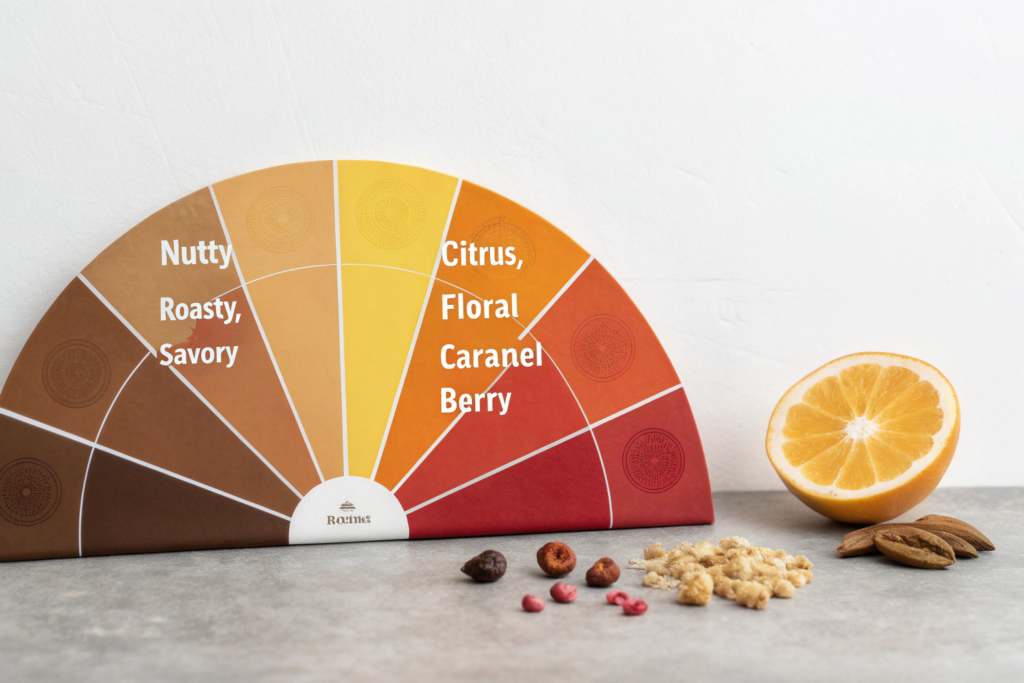
What does this mean? High altitude does not simply "make coffee taste stronger." It shifts the entire flavor spectrum away from roasty, savory notes and toward sweet, fruity, floral complexity.
Which Flavor Attributes Actually Improve?
Let's separate the signal from the noise.
| Flavor Dimension | Altitude Effect | Mechanism |
|---|---|---|
| Aroma Intensity | Increases | Higher diversity of volatile organic compounds; Ethiopian coffee at 2,065m ranked highest |
| Sweetness | Increases | Aldehyde compounds rise; pyrazines fall; cup evaluation shows upward trend in aroma/flavor scores |
| Acidity | Variable (context-dependent) | Not consistently correlated in Pu'er study; highly dependent on variety and processing |
| Bitterness/Roasted notes | Decreases | Reduced pyrazines and alkaloids |
| Body | Complex | Denser beans can produce heavier body, but processing is confounder |
Crucially, the Gorongosa Mountain study found that altitude (935m vs. 650m) triggered rises in trigonelline and 5-CQA (moderate shade), declines in FQAs and diCQAs isomers, and concluded these changes "likely contributed to improve the sensory cup quality."
For a buyer, the actionable insight is this: high-altitude coffee is not universally "better" in a brute-force sense. It is differently flavored—and that difference aligns with modern specialty coffee preferences for sweetness, fruit, and floral character over roast-dominant profiles. The Coffee Quality Institute cupping protocols are designed to capture these nuanced differences.
Why Did the Pu'er Coffee Show Decreased Chlorogenic Acids?
This is a critical nuance. The Polish study found increased phenolic compounds with altitude. The Pu'er study found decreased chlorogenic acids.
Are they contradictory? Not necessarily.
Chlorogenic acids (CGAs) are not a single compound. They are a family. Some CGAs (like 5-CQA) are associated with desirable astringency and health benefits. Others (diCQAs, FQAs) can contribute negative flavor attributes. The Gorongosa study found that at 935m, 5-CQA increased while FQAs and diCQAs declined—a net positive shift.**
Furthermore, total phenolic content is influenced by many factors: variety, shade management, soil composition, processing, and ripeness at harvest. The Ethiopian coffee's phenolic richness may reflect genetics and terroir, not altitude alone.
Takeaway: Do not fixate on a single chemical. Look at the holistic sensory outcome. Every peer-reviewed study that has cupped high vs. low altitude coffee concludes that altitude is a "major driver for bean changes and improved quality."
How Does Altitude Interact with Other Quality Factors?
Here is where sourcing decisions get complicated—and where professional buyers separate themselves from amateurs.
Altitude does not operate in a vacuum. Its effects are modulated by processing method, shade management, genetic variety, and harvest timing. However, recent research consistently demonstrates that altitude is a "major driver" of quality, while other factors (like light conditions) show "sporadic" and "inconsistent" effects.
The Gorongosa Mountain study is particularly instructive. Researchers examined three altitudes (650, 825, 935m) and three light conditions (deep shade, moderate shade, full sun). Their finding? "Light conditions...scarcely affected most of the studied physical and chemical attributes...whereas altitude was a major driver for bean changes and improved quality."
This is enormously important for buyers. It means that if you have to choose between a high-altitude farm with suboptimal shade management and a low-altitude farm with perfect agroforestry, the high-altitude coffee is more likely to deliver superior cup quality.
Does Processing Method Overwhelm Altitude Effects?
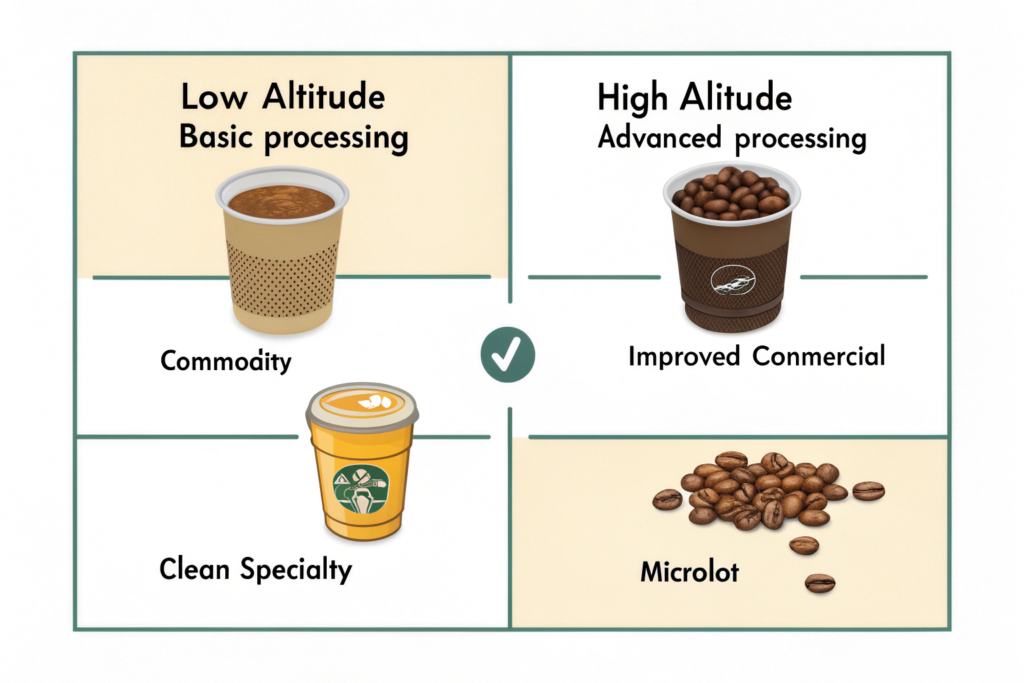
The Gayo highland study provides clarity: both elevation and processing methods significantly influenced defective bean values and defect percentages. They are additive, not substitutable.
| Factor | Impact on Defects | Impact on Density | Impact on Caffeine |
|---|---|---|---|
| Elevation | Strong (P<0.01) | Strong (P<0.01) | Not significant |
| Processing Method | Strong (P<0.01) | Not significant | Significant (P<0.05) |
You cannot "process your way out" of low-altitude defects. A low-grown coffee, no matter how carefully honey-processed, will still have lower density and higher defect potential than a high-grown washed coffee. Conversely, caffeine content is more influenced by processing than altitude—so high-altitude does not necessarily mean "more stimulating."
For a buyer: use altitude as your primary quality filter, then use processing to fine-tune flavor profile.
What About Variety? Isn't Geisha the Real Story?
Variety matters enormously. But altitude and variety are not substitutes; they are multipliers.
A high-altitude Geisha is exponentially more valuable than a low-altitude Geisha. The slow maturation amplifies the variety's genetic potential for floral, tea-like complexity. A low-altitude Geisha, picked under heat stress, often tastes disappointingly flat. The World Coffee Research variety catalog provides detailed elevation suitability guidelines for each cultivar.
At BeanofCoffee, we grow both Catimor and Typica at varying elevations. Our 1,600m Typica lot consistently outscores our 1,200m Catimor—but our 1,200m Catimor is still a clean, reliable commercial coffee. Altitude sets the ceiling. Variety and processing determine how close you get to it.
What Are the Commercial and Sourcing Implications?
You are not a scientist. You are a buyer. What does this mean for your purchase orders, your supplier relationships, and your customer's satisfaction?
Sourcing high-altitude coffee requires accepting three commercial realities: 1) Lower physical yield per hectare means higher base price; 2) Supply is constrained and often pre-contracted; 3) Verification requires transparency—"mountain grown" is not a legal classification.
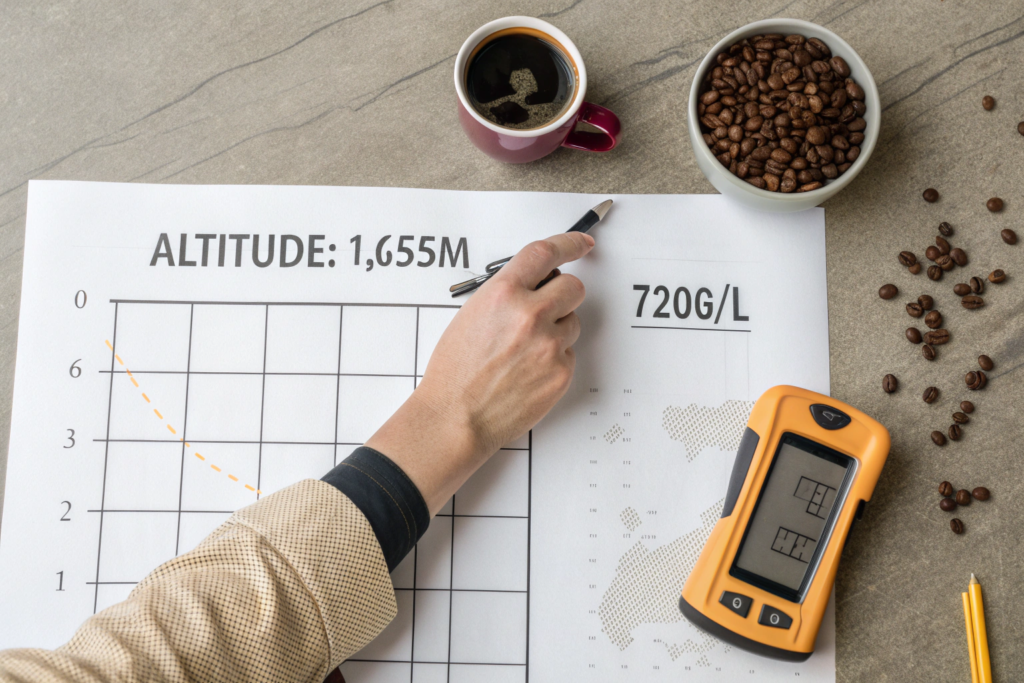
How Much More Should You Pay for Altitude?
There is no universal formula. However, the specialty coffee market has developed de facto tiers:
| Altitude Range (masl) | Common Designation | Typical Price Premium (vs. Baseline) |
|---|---|---|
| 900-1,200 | Medium Grown / Commercial | Baseline |
| 1,200-1,500 | High Grown / Hard Bean | +15-30% |
| 1,500-1,800 | Strictly Hard Bean (SHB) | +30-60% |
| 1,800+ | Super High Altitude / Microlot | +60-200%+ |
These premiums reflect agronomic reality, not supplier greed. A farm at 1,800m produces significantly less coffee per hectare than a farm at 1,200m. The fixed costs (land, labor, processing) are similar. The yield is lower. The price must be higher for the farmer to remain viable.
How Do You Verify Altitude Claims?
This is the hard part. "High altitude" on a bag is not regulated. You need:
-
Farm-level GPS data, not regional averages. A cooperative claiming "1,400-1,800m" may have 90% of its volume at 1,400m and 10% at 1,800m. You want the 10%.
-
Density testing as a proxy. If a supplier claims 1,800m but the beans float in your density separator, something is wrong. The SCA density grading standards provide clear thresholds.
-
Long-term relationships. We at Shanghai Fumao do not sell our highest-altitude micro-lots on the spot market. They are pre-allocated to buyers who commit annually. If you want the best elevation, you must invest in the partnership.
For a buyer like Ron, this is the critical pivot: high-altitude sourcing is not a transactional decision. It is a supply chain strategy.
Conclusion
The benefits of sourcing coffee from high altitude are now supported by a robust and growing body of peer-reviewed science. They are not marketing mythology.
High altitude delivers:
- Superior physical quality: Denser, larger, more uniform beans with dramatically fewer defects.
- Enhanced flavor chemistry: Shifts in volatile and non-volatile compounds that favor sweetness, fruit, and floral aromatics over roast-dominant, nutty profiles.
- Extended maturation: Slower cherry development concentrates soluble solids and allows nuanced flavor precursors to accumulate.
- Predictable quality improvement: While variety and processing matter, altitude is the most consistent, reliable driver of positive bean attributes across multiple origins and studies.
However, altitude is not a magic wand. It interacts with genetics, agronomy, and post-harvest handling. A poorly processed high-altitude coffee will still taste bad. But a well-processed high-altitude coffee has a ceiling that low-altitude coffee, no matter how skillfully handled, cannot reach.
For the professional buyer, the implication is clear:
- Prioritize altitude in your sourcing criteria. Use it as a primary filter, not a secondary descriptor.
- Verify claims with density data and GPS traceability. Do not pay premiums for unsubstantiated marketing.
- Build partnerships to secure access. The best high-altitude lots do not appear on price lists; they are allocated to trusted buyers.
- Adjust your roasting to preserve the delicate flavors that high altitude provides. Dark roasting destroys the very attributes you paid to acquire.
At BeanofCoffee, our high-altitude program is not our largest volume—but it is our most carefully managed. We map each block by elevation, process micro-lots separately, and cup every batch against our own density and flavor standards. We do this because our buyers in North America, Europe, and Australia have taught us that consistent quality is not an accident. It is a system, and altitude is one of its most important components.
If you are seeking verified high-altitude Yunnan coffees—with documented elevation data, density measurements, and cupping scores—contact our Sales Director, Cathy Cai. She can provide current availability for our SHB-designated micro-lots and discuss multi-year contracting for supply security. Email Cathy at cathy@beanofcoffee.com. Let's put the science of elevation to work for your business.