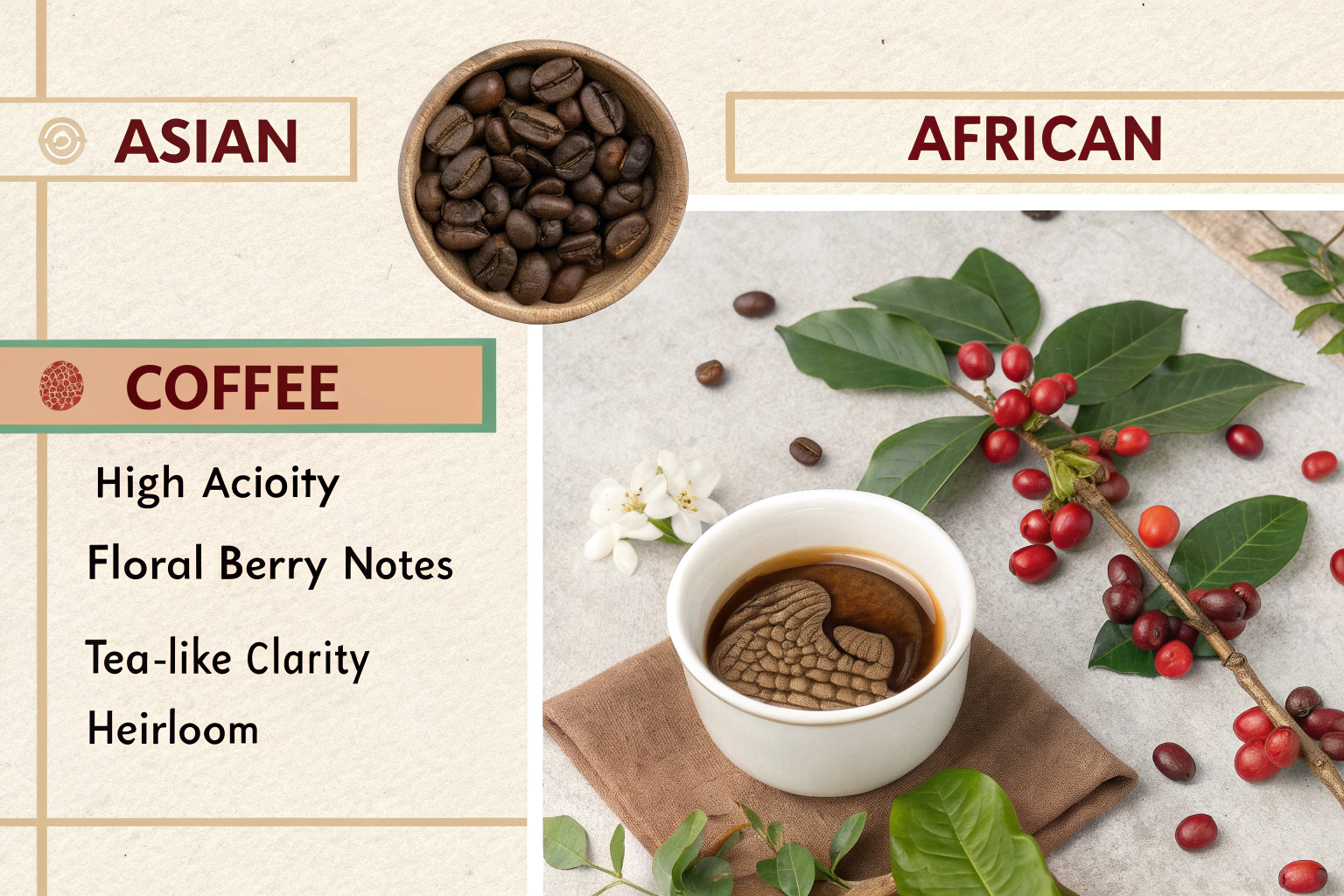
You're building a blend or curating a single-origin menu. You taste a coffee from Ethiopia—it's explosively floral and tea-like. Then you try one from Sumatra—it's earthy, spicy, and heavy. Both are incredible, but they seem to come from different planets. As an exporter based in Yunnan, at the heart of Asian coffee, and a regular buyer of African beans for our own blends, I live in both worlds. The differences aren't just about taste; they're about history, culture, processing traditions, and the very structure of the trade.
The key differences between Asian and African coffee lie in their dominant flavor profiles, primary processing methods, genetic varieties, and market structures. African coffees (especially East African) are celebrated for their high acidity, floral/berry notes, and tea-like clarity, often from heirloom varieties processed as washed. Asian coffees are known for their heavy body, low acidity, and earthy/spicy/chocolatey notes, often from Robusta or hardier Arabica varieties, frequently processed using natural or semi-washed methods. Africa is the birthplace of Arabica, while Asia is the powerhouse of volume and Robusta production.
That's the broad brushstroke. But to truly appreciate the divide, you need to understand why these profiles exist. It's not an accident. It's the result of centuries of separate agricultural evolution, driven by climate, colonialism, and commerce. For a buyer, these aren't just academic distinctions; they are the fundamental building blocks for creating blends, meeting market demand, and ensuring supply stability. Let's explore the layers behind the cup.
How Do Core Flavor Profiles Define Each Continent?
When you cup coffees side by side, the continental identities become unmistakable. Think of it as a sensory map.
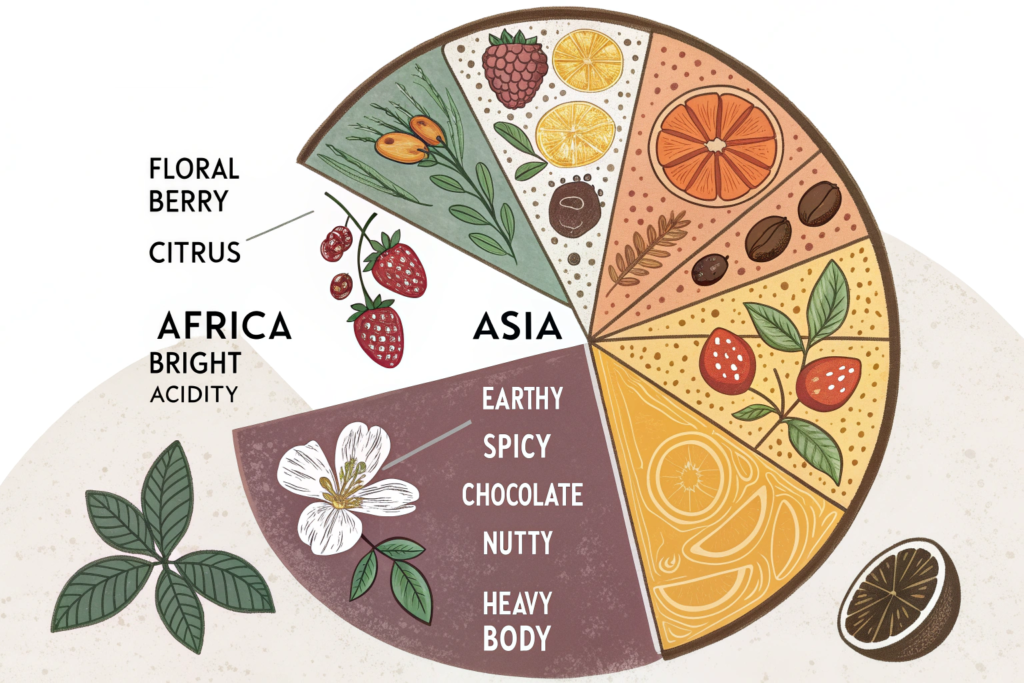
African Coffee Flavor Hallmarks (especially Ethiopia, Kenya, Rwanda):
- Acidity: Bright, vibrant, often wine-like or citric. This is their signature.
- Body: Generally lighter, more tea-like or silky.
- Flavors: Floral (jasmine, bergamot), berry (blueberry, raspberry), stone fruit, and complex, sparkling notes. They are often described as "zesty" or "juicy."
- Overall Impression: High complexity, aromatic, and expressive. They shout their origin from the rooftops.
Asian Coffee Flavor Hallmarks (e.g., Sumatra, Vietnam, Yunnan, India):
- Acidity: Low to muted. Often described as smooth, soft, or absent.
- Body: Heavy, syrupy, creamy. A defining characteristic.
- Flavors: Earthy, woody, spicy (cedar, clove, pepper), dark chocolate, nutty (peanut, almond), and often herbal or tobacco-like.
- Overall Impression: Grounded, hearty, and foundational. They provide the bass notes in the global coffee symphony.
Why Is Acidity So Pronounced in Africa but Muted in Asia?
The answer is a combination of altitude, variety, and processing. East Africa's high-altitude Great Rift Valley provides the cool, slow-growing conditions perfect for developing complex sugars and acids in delicate heirloom Arabica varieties. They are almost exclusively washed (wet-processed), which highlights this inherent acidity. In contrast, much of Asia's Arabica grows at lower altitudes (with exceptions like Papua New Guinea or parts of Yunnan) and includes harder, often hybrid varieties like Catimor that are naturally less acidic. Furthermore, the widespread use of natural (dry) processing or Giling Basah (wet-hulling) in places like Sumatra mutes acidity and emphasizes body and earthy flavors. As a Yunnan grower, we can produce washed coffees with brighter acidity, but our regional profile tends naturally toward a balanced, nutty-cocoa cup rather than a floral explosion.
How Should Blenders Use These Contrasting Profiles?
These profiles are complementary tools. A skilled blender uses African coffees to provide the high notes, complexity, and aroma in a blend. They are the sparkle. Asian coffees, like our Yunnan Arabica or a Sumatran, provide the foundation: the body, the sweetness, the bass notes that carry the blend and make it feel substantial, especially in milk-based drinks. For a commercial buyer, using a clean, low-acid Asian coffee as a base provides stability and cost-effectiveness, while a smaller percentage of African coffee can add the distinctive top notes that make a blend memorable. This is the practical art of sourcing.
What Are the Historical and Agricultural Roots of the Divide?
The coffee plant's journey from Africa to Asia set the stage for these diverging identities. It's a story of colonization, adaptation, and different economic drivers.
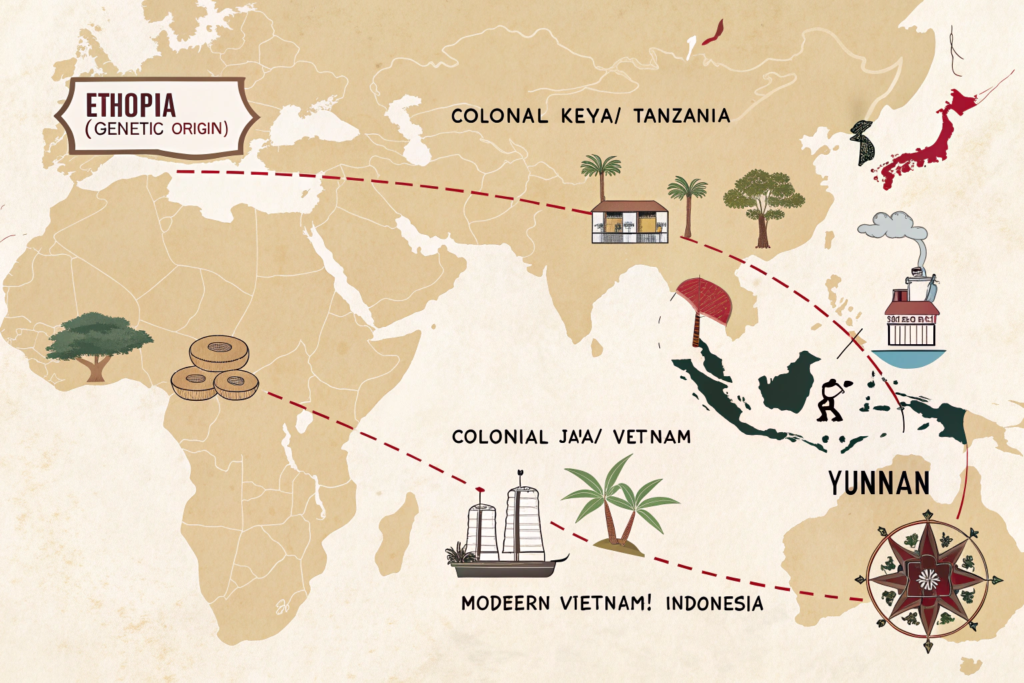
Africa: The Genetic Homeland. Coffee Arabica evolved in the highland forests of Ethiopia. The genetic diversity here is staggering, with thousands of heirloom varieties growing wild or in traditional "garden coffee" systems. This biodiversity is the source of its incredible flavor potential. Colonial systems (like in Kenya) later established structured cooperatives and auction systems focused on grading and quality for export, reinforcing the value of distinct, high-acid profiles.
Asia: The Colonial Plantation Frontier. Coffee came to Asia via colonial expansion (Dutch to Indonesia, French to Vietnam). The goal was volume production for the European market. In Indonesia, this led to the vast estates producing for commodity trade. In Vietnam, following the war, the government pushed Robusta production on an immense scale to drive exports, making it the world's #1 Robusta producer. This history prioritized yield, disease resistance, and volume over delicate heirloom flavors. In China (Yunnan), coffee was introduced more recently (late 19th century) as a cash crop, often focusing on commercial varieties suited to the local climate. The agricultural mindset was shaped by volume and efficiency, which influences the profile to this day.
How Have Processing Traditions Evolved Separately?
Processing methods are cultural signatures. In Africa, the washed process dominates in key exporting nations. It requires ample water and infrastructure but aligns with the goal of highlighting clean, terroir-driven acidity. The famed Kenyan washing stations are central to their quality model. In Asia, water was often less accessible, and the climate (humid) favored faster drying methods. This gave rise to iconic techniques like:
- Indonesia's Giling Basah (Wet-Hulling): Beans are hulled while still at high moisture (30-50%), then sun-dried. This creates the classic earthy, woody, and spicy profile of Sumatras.
- Natural Processing: Used widely in Vietnam, India, and parts of Yunnan. It emphasizes body and fruitiness (in Arabica) or deep, chocolatey notes (in Robusta).
These methods are not "worse"; they are different tools that create a different product, one that is often more stable for shipping and storage due to lower moisture activity.
Why Is Africa Associated with "Heirloom" and Asia with "Hybrids"?
This ties back to origin and purpose. Africa's heirloom varieties are the native, wild genetic stock. Asia's coffee landscape is built on transplanted varieties selected for productivity and resilience in a new environment. Robusta is native to Central Africa but found its commercial epicenter in Vietnam. Catimor (a Timor hybrid x Caturra) is planted widely across Asia for its leaf rust resistance. At Shanghai Fumao, we grow both heirloom Typica/Bourbon and Catimor, giving us a range of flavor tools. This practical approach is typical of Asia: balancing quality potential with agricultural security.
How Do Market Structures and Export Models Differ?
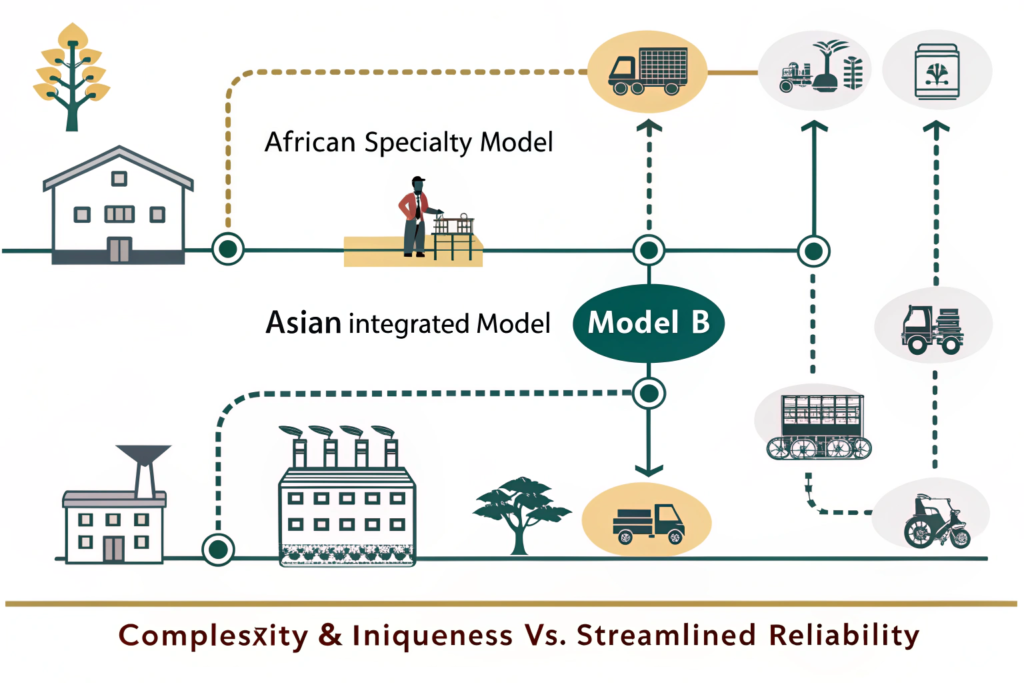
The way coffee is traded from these continents reflects their history and shapes the buyer's experience. Africa's model is often fragmented and terroir-focused; Asia's is often consolidated and volume-driven.
African Model (e.g., Ethiopia, Kenya):
- Fragmentation: Thousands of smallholders deliver to cooperative washing stations or private mills.
- Auction & Direct Trade: Kenya's weekly auction is famous. Ethiopia has both the ECX (Ethiopia Commodity Exchange) and direct trade from larger estates or cooperatives.
- Focus on Lot Separation: Microlots, single cooperatives, and specific washing stations are marketed separately. Traceability to a specific farm or station is a key value driver.
- Challenges: Inconsistency can be higher due to the mix of many smallholder inputs, and logistics can be complex.
Asian Model (e.g., Vietnam, Indonesia, our model in China):
- Consolidation & Plantations: Large-scale plantations (like ours in Yunnan) or networks of smallholders selling to large central processing units are common.
- Direct Contracting: Buyers often contract directly with large exporters or plantation groups. Vietnam's trade is heavily focused on futures and large commodity contracts.
- Focus on Consistency & Volume: The goal is often to produce large, consistent lots that meet a specific grade or profile. Traceability is often to a region or a large estate rather than a micro-plot.
- Advantages: Better suited for reliable, large-volume contracts. Offers supply security and price stability for commercial buyers. Our integrated model at Shanghai Fumao—controlling from farm to export—is a classic Asian strength, providing buyers with a reliable, single point of contact for significant volume.
What Does This Mean for a Buyer's Sourcing Strategy?
Your sourcing strategy must adapt to the model. Sourcing from Africa often requires more hands-on quality curation, relationship-building with importers who specialize in lots, and acceptance of more lot-to-lot variation. It's for the specialty roaster seeking uniqueness. Sourcing from Asia (like from us) can simplify procurement for core blends or large-scale products. You get a consistent, dependable supply of coffee with a known profile, which is crucial for private label or brand buyers who need to guarantee a stable product year-round. Many savvy buyers use both: African coffees for limited offerings and Asian coffees for their stable core lineup.
How Do Pricing and Quality Tiers Compare?
Africa produces some of the world's most expensive auction lots (e.g., Gesha from Panama has African roots). Its top-tier specialty coffees command extreme premiums. Asia's premium is often on value and consistency. A high-quality, clean Yunnan Arabica or a well-processed Sumatra Mandheling offers tremendous cup quality at a often more accessible price point than a comparable African coffee. Asia is also the undisputed source for affordable, clean Robusta for espresso blends. This diversity makes Asia a pragmatic cornerstone of a global sourcing portfolio.
Why Is Robusta Dominant in Asia, and What Does That Mean?
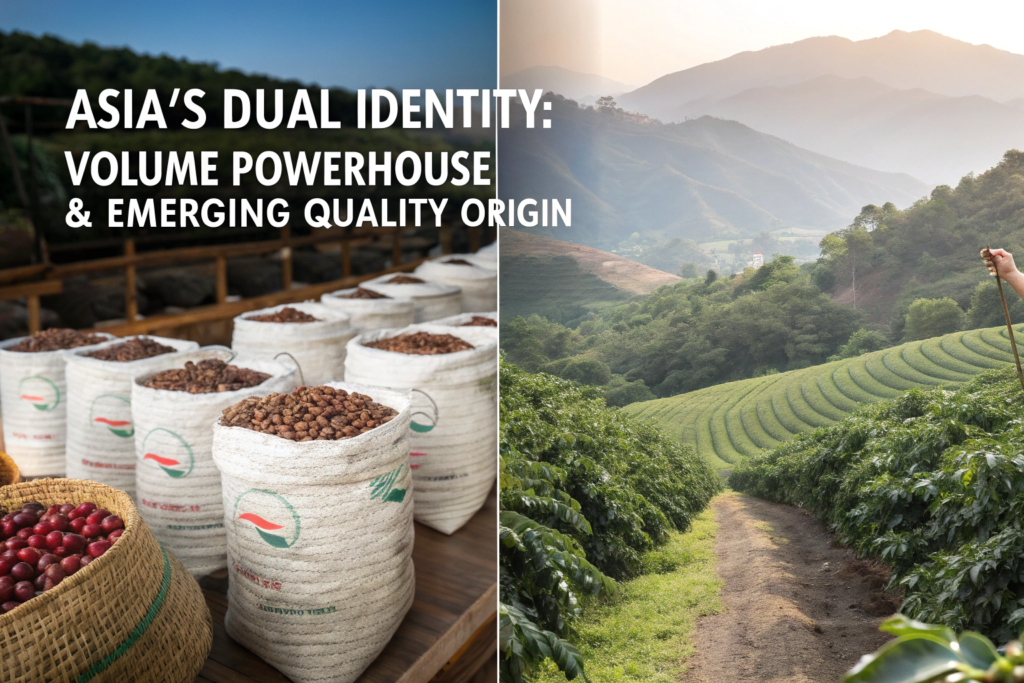
This is perhaps the most stark continental divide. Over 90% of Vietnam's output is Robusta, and Indonesia is a major producer. This fundamentally shapes Asia's role in the global market.
Robusta is dominant in Asia because it was chosen for economic survival. It yields more, is more resistant to pests and disease, grows at lower altitudes, and tolerates hotter climates. After the wars in Vietnam, Robusta was the engine for rapid economic recovery through export. This decision made Asia the anchor of the global commercial coffee industry. The flavor profile of Asian Robusta—strong, bitter, with woody or peanutty notes—defines the taste of instant coffee and countless commercial espresso blends worldwide. For buyers, Asia is the unavoidable source for cost-effective, high-caffeine, crema-rich coffee base. A quality-focused Asian exporter like us works to produce "clean" Robusta—free of harsh defects—which is a valuable tool for blenders.
Is Asian Arabica Overshadowed by Robusta?
It can be, but that's changing. Asian Arabica from regions like Sumatra (Indonesia), Yunnan (China), and Araku (India) is gaining recognition. It offers a distinct alternative: all the body and earthy-spicy character of the region, but with more sweetness and complexity than Robusta. At Shanghai Fumao, we specialize in promoting our Yunnan Arabica and Catimor, showing the world that Asian coffee is not a monolith of Robusta. We offer the full spectrum, from premium washed Arabica for specialty roasters to consistent commercial Robusta for large blenders. This versatility is a key strength.
How Should Buyers Approach Quality Robusta Sourcing from Asia?
Don't treat Robusta as a mere cheap filler. Source it with the same care as Arabica. Look for exporters who:
- Specify the variety and region.
- Practice careful processing and drying (e.g., washed Robusta can be surprisingly clean).
- Provide cupping notes and defect counts.
- Understand its role in espresso blends for crema and body.
A professional supplier will help you select the right Robusta grade for your application, ensuring it contributes positively to your blend without introducing off-flavors. This elevates your end product.
Conclusion
The differences between Asian and African coffee are profound, spanning flavor, genetics, history, and commerce. Africa is the lyrical poet of coffee—expressive, complex, and bright. Asia is the pragmatic engineer—grounded, substantial, and reliable. One is not better than the other; they are essential, complementary halves of the global coffee ecosystem.
For the modern buyer, understanding this dichotomy is power. It allows you to build smarter blends, curate more educational single-origin offerings, and construct a resilient supply chain. By leveraging Africa's brilliance and Asia's stability, you can create products that excite the palate while ensuring business continuity.
At Shanghai Fumao, we embody the modern Asian coffee story: one of quality, consistency, and vertical integration. We offer the body and foundational character of our terroir, with the professionalism and scale that global trade demands.
If you are looking to balance your sourcing portfolio with a reliable, high-quality Asian origin partner, let us show you what Yunnan can do. We provide the stable base that allows your African selections to truly shine.
To explore samples and see how our Asian coffees can anchor your blend or stand on their own, contact Cathy Cai at cathy@beanofcoffee.com. Taste the other half of the coffee world.