You've just landed your first container of green beans from a trusted supplier like Bean of Coffee. The quality is perfect, the roast profile is dialed in, and you're ready to launch. But wait—can you legally sell that coffee in the United States? The excitement of a new product can quickly turn to anxiety when facing the maze of FDA regulations, state-level rules, and labeling requirements. One oversight can lead to costly delays, rejected shipments, or even forced recalls.
So, what are the legal requirements for selling coffee in the US? In short, you need to comply with federal food facility registration, adhere to the Food Safety Modernization Act (FSMA), and create labels that meet the Fair Packaging and Labeling Act (FPLA) standards. It’s a three-legged stool: facility safety, preventative controls, and truthful labeling. From my perspective as an exporter who helps clients navigate this daily, understanding these rules isn't just about compliance; it's about building a foundation of trust and safety for your brand.
Let's demystify the process and break it down into actionable steps, from the importer of record to the final product on the shelf.
What are the FDA registration and FSMA requirements?
This is the first and most fundamental federal hurdle. The U.S. Food and Drug Administration (FDA) oversees the safety of all food products, including coffee. The rules apply whether you're importing green beans, roasting them in the US, or both.
The Food Safety Modernization Act (FSMA) shifted the focus from responding to contamination to preventing it. This means you, as a “food facility owner,” must prove you’re actively managing risks. For a coffee roaster or importer, this isn't about extreme hazard analysis—coffee is a low-risk product—but it’s about having a documented, systematic plan. This directly addresses the pain points of security and reliability that buyers like Ron care about deeply.
Who needs to register with the FDA?
If your company manufactures, processes, packs, or holds food for consumption in the US, you must register your facility with the FDA. This is a non-negotiable first step.
Here’s the breakdown:
- Importers of Green Coffee: If your business is the "Importer of Record" bringing beans into the US, your US-based business address must be registered as a food facility.
- Roasters: Your roasting facility must be registered, whether you own it or use a co-packer (contract roaster).
- Foreign Suppliers: The foreign facility (like our processing and packaging plant in Yunnan) that manufactures/processes the coffee for export to the US must also register with the FDA. A reliable exporter like Bean of Coffee will already have this registration in place and be able to provide our FDA registration number. This is a key question to ask any international supplier. You can verify a facility's registration status on the FDA's FURLS website.
What does a FSMA Preventive Controls plan involve?
For most coffee companies, you’ll fall under the FSMA rule for “Human Food.” This requires you to have a written Food Safety Plan. Honestly, this sounds more daunting than it is for coffee.
Your plan must include:
- Hazard Analysis: What could go wrong? For coffee, biological hazards (like mold) are the primary concern. You must identify where in your process (receiving, storage, roasting) these hazards could occur.
- Preventive Controls: These are the steps you take to minimize hazards. For example, your preventive control for mold might be: “Verify supplier’s certificate of analysis showing moisture content <12%” and “Store green beans in a climate-controlled warehouse.”
- Monitoring and Records: You must document that you’re doing what you said you’d do. Keep records of moisture tests, warehouse temperature logs, and roast temperatures (which eliminate biological hazards).
- Recall Plan: Have a written plan outlining how you would recall your product if needed.
The Food Safety Preventive Controls Alliance (FSPCA) provides the standard training for this rule. Having this plan isn't just about legality; it shows your buyers you’re a serious, secure partner.
What are the mandatory US coffee labeling rules?
Your packaging is your billboard to consumers and a legal document to regulators. The Fair Packaging and Labeling Act (FPLA) and FDA regulations dictate exactly what must be on your label. Getting this wrong is a fast track to an FDA warning letter, even if your coffee is the best in the world.
The label’s purpose is truth and transparency. It must not mislead. This aligns perfectly with the product features we champion: safe, reliable, and trustworthy. A compliant label is a visual promise of those qualities.
What are the "Principal Display Panel" requirements?
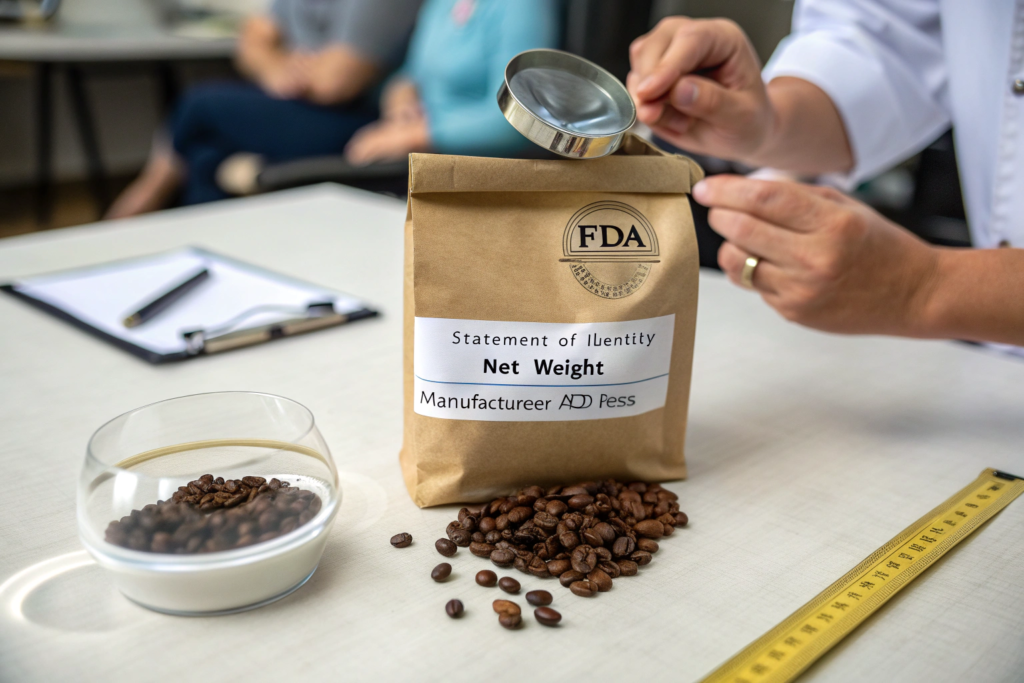
The PDP is the part of the label most likely to be seen by the consumer at retail. It must contain two things, in a clear and prominent way:
- Statement of Identity: This is simply the name of the food. “Coffee,” “Roasted Coffee,” “Dark Roast Coffee,” or “Whole Bean Arabica Coffee” are all acceptable.
- Net Quantity of Contents: This is the weight. It must be in both US customary units (e.g., “12 oz”) and metric (“340 g”). The font size is regulated based on the area of the PDP. It must be placed in the bottom 30% of the PDP, generally parallel to the base of the package.
What must be on the "Information Panel"?
Typically located to the right of the PDP, this panel must include:
- Manufacturer/Packer/Distributor Name and Address: The street address, city, state, and ZIP code of the responsible party. A PO Box is not sufficient unless the street address is listed in a public directory. Using “Distributed by…” or “Roasted for…” is common.
- Ingredient List: For plain roasted coffee, the ingredient is just “coffee.” For flavored coffees, every component of the flavoring must be listed.
- Allergen Declaration: Coffee beans are not a major allergen. However, if your product contains, or is processed on equipment that processes, major allergens like milk or nuts, you must declare it. A statement like “May contain traces of nuts” or “Processed in a facility that also handles milk” is a preventative measure for liability and safety.
- Nutrition Facts Panel: Roasted, ground coffee that is a pure, single-ingredient product is exempt from the Nutrition Facts Label requirement. This is a critical exception that many new roasters miss. However, if you make any nutrient content claims (like “High in Antioxidants”) or add anything (like flavorings), you lose this exemption and must have a panel. The FDA's Nutrition Facts Label guide is the definitive resource.
How do state and local regulations differ?
Federal rules are just the floor. States, counties, and cities can add their own requirements on top. This is where it gets tricky, especially if you plan to sell across state lines. A common mistake is assuming FDA approval is all you need.
These local rules often focus on business licensing, sales tax, and specific food handler permits. They impact your operational setup just as much as federal rules.

What business licenses and tax IDs are required?
Before you sell your first bag, you need the proper business infrastructure.
- State Business License: Almost every state requires a general business license to operate.
- Seller’s Permit/Sales Tax ID: This allows you to collect sales tax from customers within your state. If you have a physical presence (like a warehouse or employee) in another state, you may need to register there too—this is called “nexus.”
- Employer Identification Number (EIN): This is your federal tax ID from the IRS, necessary for hiring employees and opening business bank accounts.
Are there specific food handler or health department permits?
Yes, and they are locally enforced.
- Food Establishment Permit: Your local county health department will inspect your roasting or warehouse facility and issue an annual permit. They will check for sanitation, pest control, and general food safety practices—which should already be part of your FSMA plan.
- Food Handler Cards: Some jurisdictions require that any employee handling unpackaged food complete a basic food safety training course.
If you use a co-packer (contract manufacturer), they should already possess all necessary local and state permits for their facility. It’s your responsibility to verify this. Their permits effectively cover the manufacturing of your product.
What about organic and fair trade certifications?
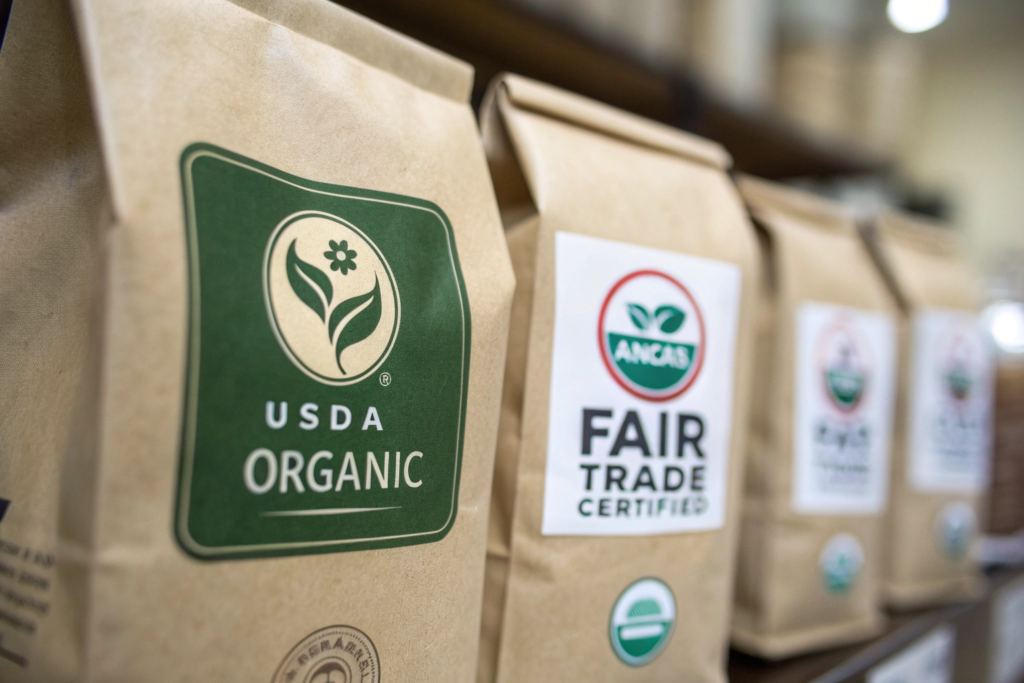
These are voluntary certifications, but they come with strict legal requirements for labeling. You cannot use the USDA Organic seal or the words “Fair Trade” on your package unless you are certified through an accredited program. Making a false claim is illegal and considered consumer fraud.
For buyers sourcing from abroad, this means your supplier must also be certified. We maintain specific certified organic lots at Bean of Coffee to support our clients who need this for their market.
What are the rules for using "USDA Organic"?
To use the USDA Organic seal, your product must be certified by a USDA-accredited agent. The entire supply chain is audited:
- Farm Level: The coffee must be grown on land that has had no prohibited substances (synthetic pesticides, fertilizers) applied for at least 3 years.
- Processing & Handling: Our facility in Yunnan must keep organic beans separate from conventional beans, clean equipment between runs, and be certified.
- Import/Export: Documentation like the USDA Organic Import Certificate is required for customs.
- Roasting: Your US roasting facility must also be certified organic to handle and roast the beans.
There are three label categories:
- “100% Organic”: May use the USDA seal.
- “Organic” (95%+ organic ingredients): May use the USDA seal.
- “Made with Organic…” (70%+): Cannot use the USDA seal but can list the certified ingredients.
How does Fair Trade certification work?
Fair Trade is primarily an ethical sourcing claim managed by organizations like Fair Trade USA. The certification ensures farmers receive a minimum price and community premium.
To use the Fair Trade mark on your product, you, the roaster/importer, must be a certified Fair Trade licensee. You must purchase coffee from certified producer groups (like our cooperative partners in Yunnan) through Fair Trade supply chains and pay the associated premiums. The rules are administered by the certifying body, not the USDA, but the FTC will act on false advertising claims. It’s a B2B contract with legal implications for labeling.
Conclusion
Navigating the legal requirements for selling coffee in the US is a multi-stage process: securing FDA and FSMA compliance for safety, crafting accurate labels governed by the FPLA, registering for state and local business operations, and truthfully managing any voluntary certifications. While it seems complex, each step builds the credibility and operational resilience of your brand.
The key is to view compliance not as a barrier, but as the blueprint for a reputable, scalable business. It turns the abstract values of safety and reliability into a documented reality for your customers and partners.
If you're sourcing high-quality coffee and want a supplier who understands this compliance journey from origin to shelf, we can help. At Bean of Coffee, we maintain the necessary FDA registrations and certifications at our origin facilities to make your import process smoother. For a conversation about how our beans from Yunnan can fit into your compliant US business, please contact our export manager, Cathy Cai. Her email is cathy@beanofcoffee.com. Let's build your brand on a solid foundation.