You're scaling your coffee business. The heart of your operation is no longer just the bean; it's the machine that transforms it. Choosing a commercial coffee roaster is a six-figure decision that will define your product's quality, your production capacity, and your brand's identity for a decade. As an exporter who works with roasters worldwide and runs our own roasting line in Yunnan, I've seen the direct link between the roaster on the floor and the coffee in the cup. The "top" machine isn't a single brand—it's the one that best aligns with your specific commercial goals, volume, and level of control.
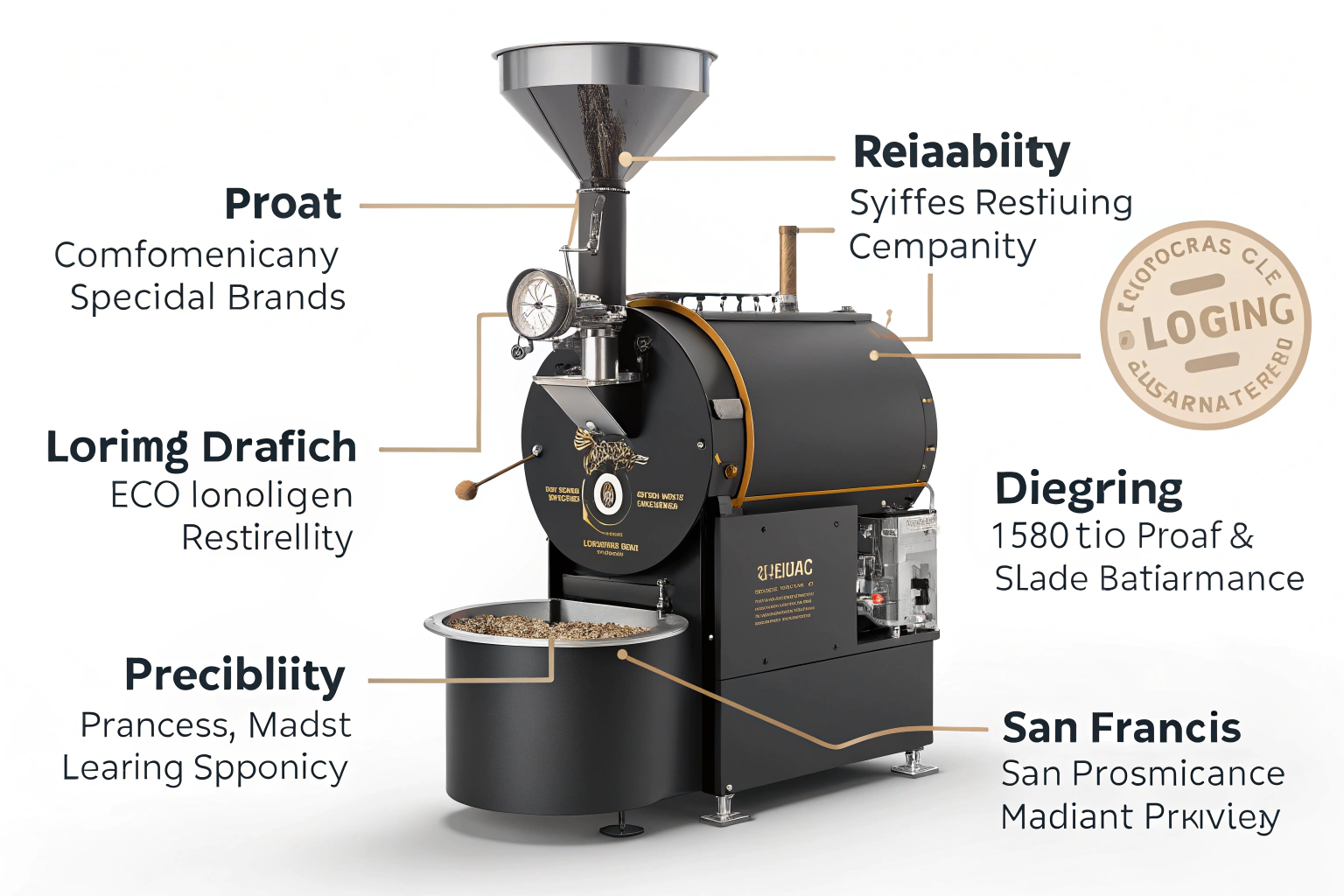
The top commercial coffee roaster machines are defined by their reliability, precision, capacity, and support. Leading contenders include Probat, Loring, Diedrich, Giesen, and San Franciscan (SF). Probat is the historic industry benchmark known for unparalleled durability. Loring leads in efficiency and eco-friendliness with its clean-air technology. Diedrich is revered for its craftsmanship and intuitive roast profiling. Giesen offers high-tech customization for data-driven roasters. San Franciscan provides classic American-built reliability and simplicity.
That's the shortlist. But the real question is: which one is right for your commercial venture? A 5kg roaster perfect for a boutique micro-roastery will drown in the demands of a national brand. A 60kg beast designed for commodity coffee lacks the finesse for a high-end single-origin program. Your choice must balance throughput, control, energy costs, and the skill of your roasting team. Let's analyze the key players and the factors that should guide your investment.
How Do You Define "Commercial Use" for a Roaster?
"Commercial" covers a vast spectrum. The right machine for a local cafe roasting for its own shops is different from one supplying a supermarket chain.
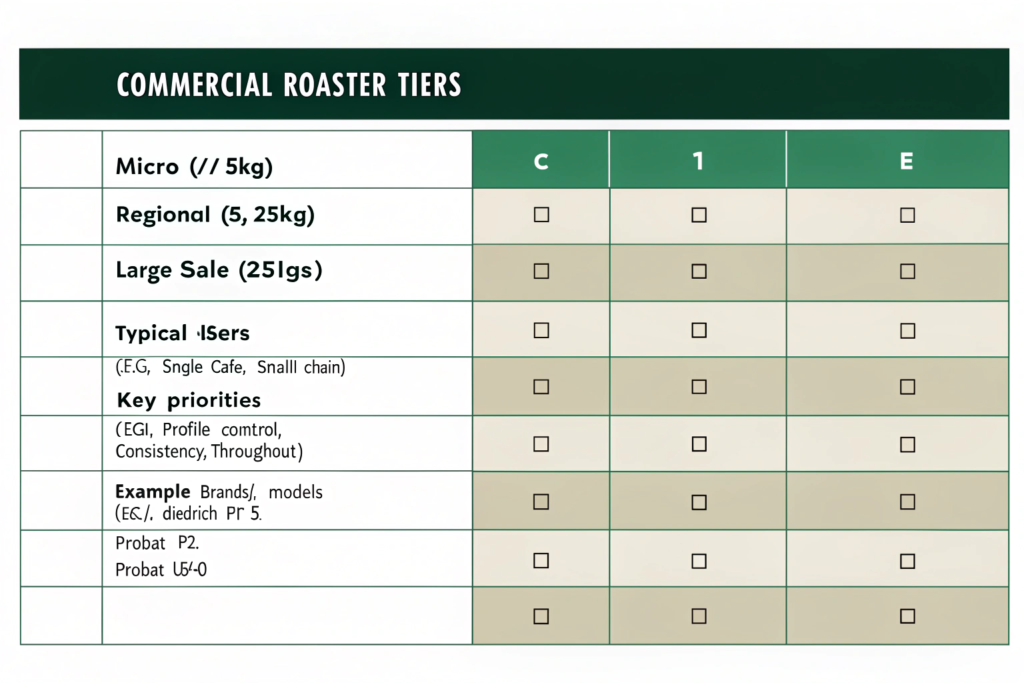
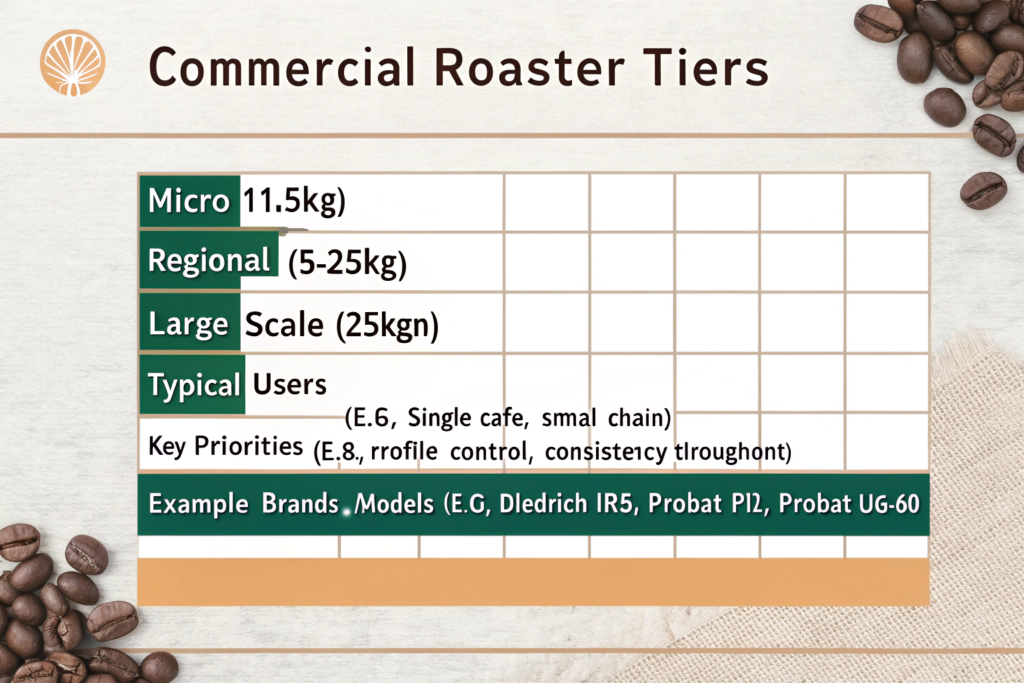
Key Commercial Tiers:
- Micro-Roastery / Single Cafe (1-5 kg Batch): Focus on flexibility, ease of use, and exceptional quality for small batches. Capacity: 10-50 kg per day.
- Regional Roastery / Small Chain (5-25 kg Batch): Needs robust consistency, better automation, and higher throughput. Capacity: 50-500 kg per day.
- Large Scale / Wholesale (25-60+ kg Batch): Demands maximum uptime, industrial durability, high efficiency, and often continuous roasting capability. Capacity: 500-5000+ kg per day.
For each tier, the priorities shift. A micro-roaster values profile artistry; a large-scale operator values kilograms-per-hour and energy cost. At Shanghai Fumao, our roasting operation for our export lines falls into the large-scale category, where Probat's legendary reliability is non-negotiable for meeting container-sized orders on time. However, for our small-batch specialty lots, we might use a more agile machine.
Why Is After-Sales Support as Important as the Machine Itself?
A commercial roaster is a complex piece of thermal-mechanical equipment. It will need maintenance, parts, and technical support. The "top" brands distinguish themselves with a global support network. Probat, for instance, has service centers worldwide. Loring offers extensive remote diagnostics. When a bearing fails or a burner needs adjustment during peak season, the speed and expertise of the response are critical. This support is a core part of the machine's reliability and your operational security. A cheaper, unsupported machine can become a very expensive paperweight.
How Does Fuel Type (Gas vs. Electric) Impact the Decision?
This is a major operational and ethical consideration.
- Traditional Gas (Natural Gas, LPG): The standard for decades. Offers rapid, responsive heat but produces significant emissions (CO₂, NOx). Operating costs depend on local gas prices.
- Electric (Full or Hybrid): The rising star, led by Loring's fully electric models and others. Offers incredible precision, cleaner operation (zero direct emissions), and often lower energy costs in regions with cheap/renewable electricity. It also simplifies facility setup (no gas line needed).
For cafes and roasteries in urban areas with sustainability goals, electric roasters are increasingly the top choice. For large-scale operations in regions with cheap gas, traditional fuel may still dominate.
What Are the Strengths of the Leading Brands?
Each top brand has carved its niche by excelling in specific areas. Understanding these core competencies is key.
Probat (Germany): The Industrial Standard.
- Strengths: Unmatched build quality, legendary durability, and a model for every scale (from the P series to giant continuous roasters). Their after-sales network is global. The control systems (like Probatone) are highly refined.
- Best For: Roasters who prioritize lifetime reliability, high-volume consistency, and brand prestige. It's the "Mercedes-Benz" of roasters—a safe, premium investment.
- Consideration: Higher initial cost. Can be seen as less "agile" for experimental roasting compared to some newer brands.
Loring (USA): The Efficiency & Innovation Leader.
- Strengths: Patented clean-air technology (recycles hot air) slashes fuel use and nearly eliminates pollutant emissions (roasting is over 80% cleaner). Offers unparalleled environmental control and repeatability. Fully electric models are available.
- Best For: Sustainability-focused roasters, those in emission-regulated areas, and anyone wanting to minimize their carbon footprint without sacrificing quality. Ideal for consistent, high-volume specialty roasting.
- Consideration: The closed-loop system can feel different for roasters trained on traditional machines. Higher upfront cost offset by operational savings.
Diedrich (USA): The Artisan's Power Tool.
- Strengths: Renowned for exceptional craftsmanship, intuitive controls, and beautiful, even roasting. Their Infrared (IR) series offers very responsive, radiant heat for great clarity in the cup. Excellent customer service.
- Best For: Roasteries where the craft and nuance of each batch are paramount. Perfect for specialty roasters, cafes roasting in-house, and those who value hands-on, tactile control.
- Consideration: May have lower maximum throughput compared to similarly sized competitors focused on pure volume.
What About Giesen and San Franciscan?
- Giesen (Netherlands): The high-tech customizer. Known for extensive customization options, advanced data logging/control (Giesen Control System), and sleek design. You can tailor almost every aspect. Great for roasters who want a machine built to their exact workflow.
- San Franciscan (USA): The classic workhorse. Simple, robust, and easy to maintain. Their drum roaster design is time-tested. Offers excellent value and is a favorite among roasters who prefer a more traditional, mechanical feel without overly complex automation.
The "top" choice among these often comes down to company culture and roasting philosophy. We partner with many clients who swear by each of these brands for different reasons.
Why Does Probat Dominate High-Volume Specialty Coffee Roasting?
In the heart of specialty coffee production, where precision meets passion and tradition collides with innovation, one name stands tall as a paragon of excellence: Probat. For decades, this German engineering giant has reigned supreme in the realm of high-volume specialty coffee roasting, a domain where the demands of scale do not compromise the pursuit of flavor, aroma, and quality. What sets Probat apart? It is a symphony of cutting-edge technology, unwavering commitment to craftsmanship, and an intimate understanding of the delicate dance between heat, time, and bean.
Imagine stepping into a state-of-the-art roastery, where the air hums with the rhythmic thump of rotating drums and the rich, earthy scent of freshly roasted coffee fills the space, mingling with the faint tang of caramelized sugars and toasted nuts. Here, Probat roasters stand like silent sentinels, their sleek, stainless-steel exteriors gleaming under industrial lights, yet within lies a world of controlled chaos—a carefully orchestrated process that transforms humble green coffee beans into aromatic treasures. Unlike lesser machines that struggle to balance efficiency with nuance, Probat roasters are engineered to handle massive volumes—tons of beans per hour—without sacrificing the intricate details that define specialty coffee.
At the core of their dominance lies Probat’s mastery of thermal dynamics. Their roasters feature advanced heat distribution systems, ensuring that every bean receives uniform exposure to heat, eliminating the risk of scorching or under-roasting that plagues cheaper alternatives. The rotating drum, a marvel of mechanical design, gently tumbles the beans, promoting even browning and the development of complex flavor compounds. Whether it’s a light roast highlighting bright citrus notes and floral undertones, or a dark roast with bold chocolate and smoky depth, Probat machines adapt seamlessly, thanks to their intuitive control panels and customizable profiles.
How Do Control Systems and Automation Affect Quality?
The brain of the roaster is its control system. For commercial use, you need a system that ensures repeatability while allowing for creative freedom.
Three Levels of Control:
- Manual / Basic PID: You control gas, air, drum speed directly. Requires high skill but offers total control. Found on smaller Diedrich or San Franciscan models.
- Profile Automation / Replay: You create a roast profile (time-temperature curve), and the machine automatically executes it for subsequent batches. This is the commercial standard for consistency. Probat's Probatone, Loring's C.O.R.E., and Giesen's systems excel here.
- Advanced AI / Predictive Systems: The newest frontier. Systems like Cropster Roast or RoastTime integrate with the machine, using algorithms to predict and adjust the roast in real-time for even greater consistency and development control.
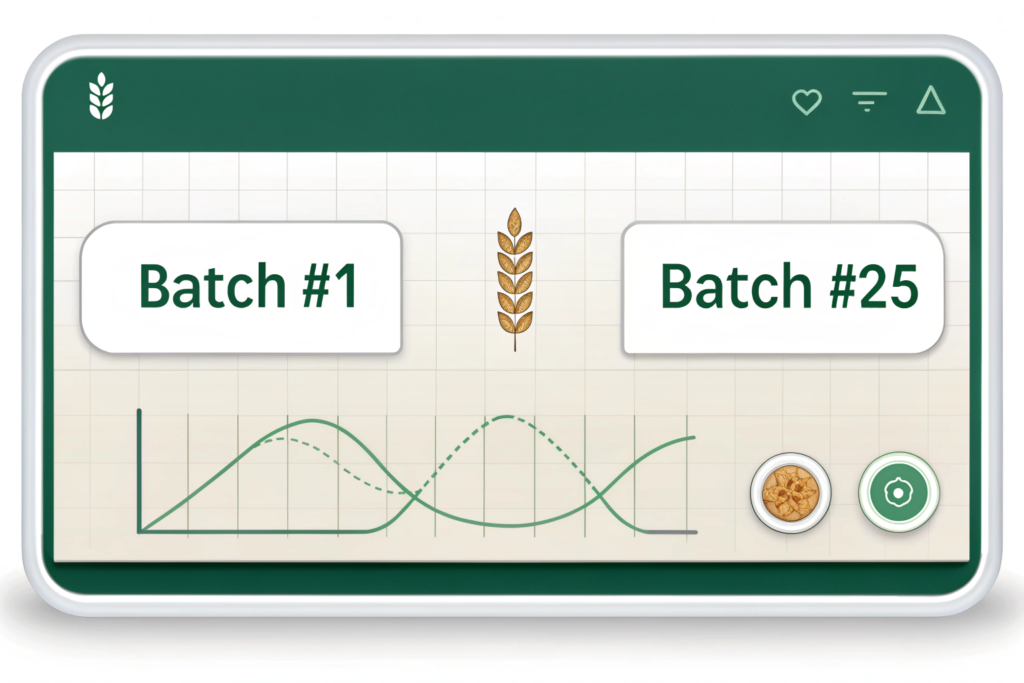
For a commercial operation, profile automation is non-negotiable. It allows a head roaster to design a perfect profile for a Yunnan Catimor and have any trained operator reproduce it perfectly 50 times, ensuring every bag of that product tastes identical. This is the foundation of brand consistency and quality control.
Why Is Data Logging Crucial for Commercial Roasters?
Every roast should generate a data file: bean temperature, environmental temperature, gas pressure, air flow, etc. This data is vital for:
- Troubleshooting: If a batch tastes off, you can review the curve to diagnose the issue (e.g., "The Rate of Rise crashed at 150°C").
- Quality Assurance: Providing roast data to large B2B clients (like us when we supply roasted coffee) as proof of process control.
- Continuous Improvement: Analyzing data to refine profiles and efficiency.
Top machines seamlessly integrate with industry-standard software like Cropster or Artisan, making this data flow effortless.
How Much Automation Is Too Much?
Full automation can distance the roaster from the process. The best commercial setups blend automation with human oversight. The machine handles the precise execution of the curve, while the roaster monitors color, smell, and sound, making the final call on the drop. This balances efficiency with craftsmanship.
What Are the Hidden Costs and Facility Requirements?
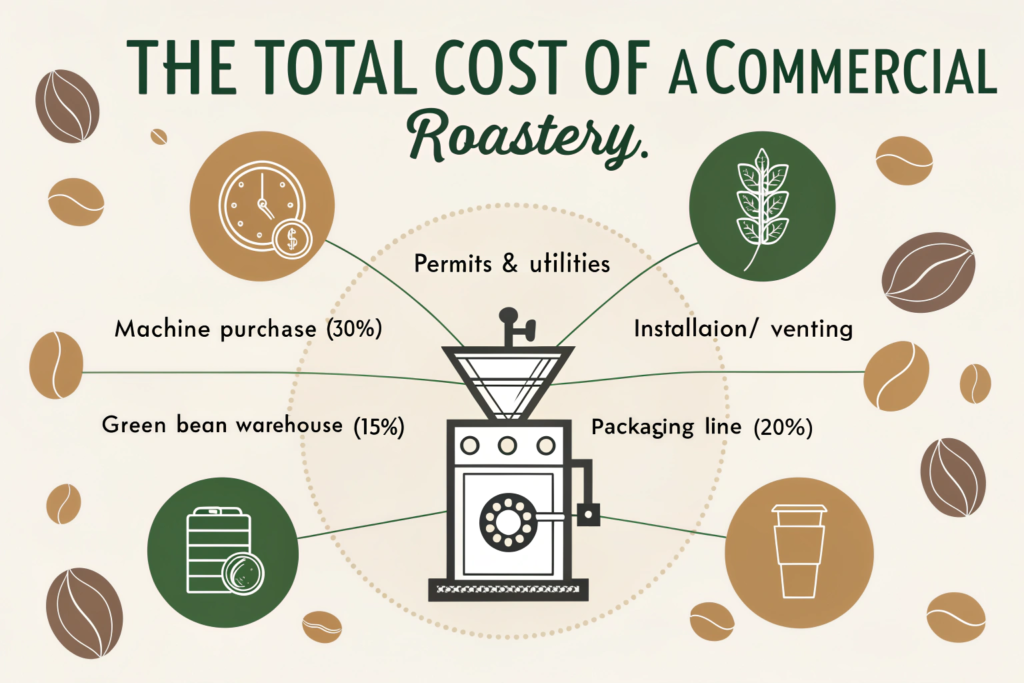
The roaster's price tag is just the beginning. A successful installation requires significant ancillary investment.
Major Hidden Costs:
- Installation & Ventilation: Requires professional HVAC work, ducting, and often a costly afterburner or catalytic converter (for traditional gas roasters) to meet air quality regulations. Loring machines dramatically reduce or eliminate this need.
- Electrical/Gas Upgrades: A 15kg electric roaster may require a 3-phase, 400V connection. A gas roaster needs a sufficient gas line capacity.
- Cooling & Exhaust Systems: A dedicated cooling tray (often integrated) and powerful exhaust are mandatory.
- Green Bean Handling & Storage: You'll need a destoner, loader, and proper warehouse space for pallets of green coffee.
- Packaging Line: Scales, baggers, sealers, and potentially a nitrogen flush system.
Facility Must-Haves: - High Ceilings: For ductwork and clearance.
- Robust Flooring: Concrete slab capable of supporting several tons.
- Ample Power & Water: Access to water for cooling (closed-loop systems are better).
- Permits: Fire department, environmental, and health department permits can be complex and time-consuming.
Underestimating these factors is the most common mistake new commercial roasters make. Your total project cost can be 2-3 times the price of the roaster itself.
How to Calculate True ROI (Return on Investment)?
Don't just look at kg-per-hour. Calculate:
- Cost Per Kg: Include capital depreciation, energy, labor, maintenance, and facility costs over 5 years.
- Waste Reduction: A more precise roaster reduces under/over-roasted batches.
- Quality Premium: Can you charge more for consistently better coffee?
- Labor Efficiency: How many kg can one roaster produce per shift?
A Loring, while expensive upfront, may have a lower cost-per-kg over 5 years due to 80% lower fuel use and reduced maintenance. This kind of analysis is essential for a commercial decision.
Should You Buy New or Used?
For a first commercial venture, a quality used roaster from a reputable brand can be an excellent way to enter the market with lower capital outlay. However, it requires a thorough inspection by a technician, and you may inherit outdated controls or looming maintenance issues. For a core production machine where uptime is critical, new is often the safer, if more expensive, path.
Conclusion
Selecting a top commercial coffee roaster is a strategic decision that defines your business's capabilities and ceiling. The leaders—Probat, Loring, Diedrich, Giesen, San Franciscan—each offer a different path to excellence: unwavering durability, sustainable efficiency, artisan craftsmanship, high-tech customization, or classic simplicity.
Your choice must be rooted in a clear understanding of your target volume, desired level of control, operational values (like sustainability), and total cost of ownership. There is no single "best" roaster, only the best roaster for your specific commercial vision.
At Shanghai Fumao, our experience with the full spectrum of roasting, from our own large-scale Probat lines to collaborating with boutique Loring and Diedrich clients, gives us a unique perspective. We understand the machine's profound impact on the final product we export.
If you are scaling your roasting operation and want a partner who understands both the beans and the machinery that unlocks their potential, let's connect. We can help you think through this critical decision.
To discuss commercial roasting or source premium green coffee ready for your new roaster, contact Cathy Cai at cathy@beanofcoffee.com. Let's build the foundation for your roasting success.