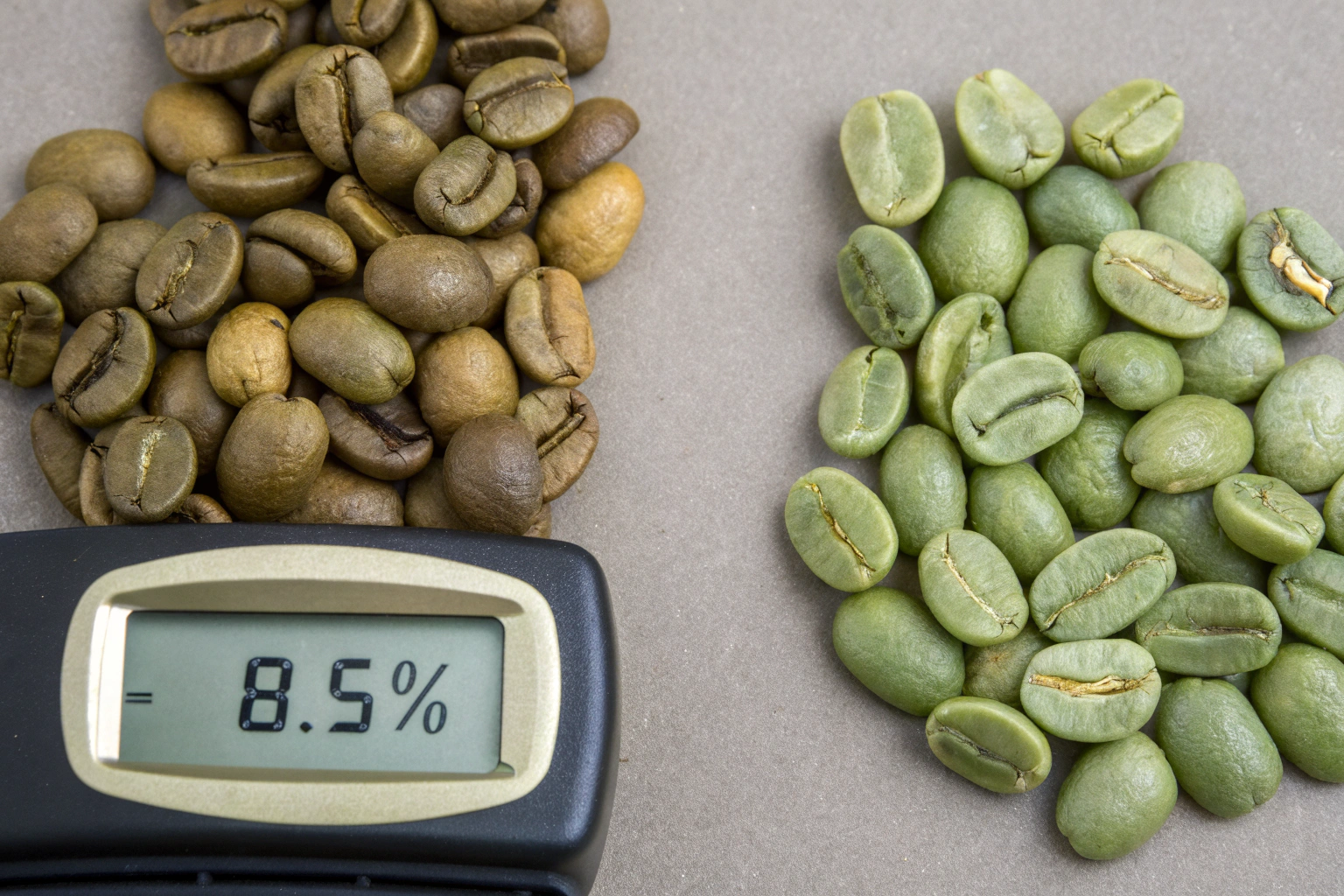
You open a forgotten bag of green coffee beans from last year's harvest. They look pale, feel brittle, and you worry they've lost their soul. Or worse, you're a roaster who just received a shipment of beans that feel too dry, threatening to roast too fast and taste flat. The instinct to add moisture back is strong, but the wrong move can ruin the beans forever. So, is rehydrating old coffee beans even possible? And if so, what's the method that actually works without causing damage? The short answer is nuanced: rehydration is a high-risk technical process for professionals, not a simple fix for home enthusiasts. For commercial buyers, preventing dryness through proper storage is always infinitely better than trying to cure it.
The core issue is that coffee is hygroscopic—it absorbs and releases moisture. When beans lose too much moisture (below 9-10%), they become porous and brittle. Their cellular structure is compromised. Adding water back isn't like refilling a sponge; it's trying to reverse-engineer a complex organic material. The goal isn't just to hit a target moisture percentage, but to have that moisture integrated evenly without starting mold growth or chemical degradation. At BeanofCoffee, our focus is on shipping beans at the ideal 10.5-11.5% moisture from our climate-controlled warehouses to make rehydration unnecessary. But for dealing with problematic lots, let's explore the controlled methods that exist at an industrial level.
Can You Actually Restore Flavor to Old, Dry Coffee Beans?
Let's be brutally honest first. You cannot put flavor back into a bean. The aromatic compounds (volatiles) that create flavor degrade over time, especially in low-moisture conditions. Rehydration can only adjust the physical properties of the bean to make it roast more evenly. It aims to prevent a harsh, baked, or grassy taste caused by an excessively fast roast of dry beans. Think of it like this: rehydration might allow the remaining good flavors to express themselves better, but it won't resurrect lost ones. The process is about damage control, not resurrection.
For a specialty roaster, the decision to attempt rehydration comes down to economics and the severity of the problem. If you have a 60kg bag of premium, slightly dry Geisha, it might be worth the attempt. For old, commodity-grade beans, it's rarely cost-effective. The first step is always a thorough evaluation. You must measure the current moisture content precisely with a calibrated moisture meter. Then, you must cup the coffee. If it already tastes of cardboard, straw, or has no acidity, rehydration will not help—those flavors are gone. If the flavor is merely muted or "baked" but the structure is there, then a controlled rehydration might salvage the lot for acceptable use, perhaps in a blend.
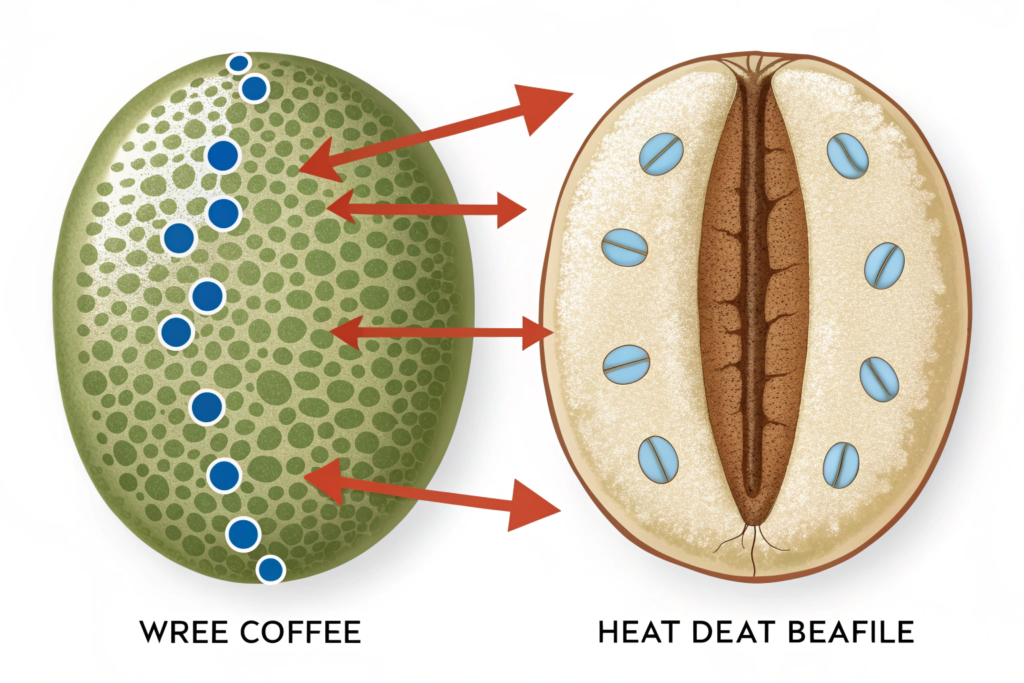
What are the Clear Signs That Beans Are Too Dry for Good Roasting?
Visually and physically, dry beans tell a story. Look and feel for these signs:
- Color: They lose their green/blue hue and turn a pale, yellowish, or grayish tan.
- Texture & Sound: They feel extremely hard and brittle. When you shake a handful, they make a loud, sharp, clattering sound—like small stones. Well-hydrated beans have a softer, duller sound.
- Weight: They feel noticeably lighter for their volume.
- Roast Behavior: This is the final proof. In the roaster, dry beans will go through stages too quickly. They may yellow early, skip first crack, or have an extremely short gap between first and second crack. The result is often a roasty, flat cup with little sweetness or complexity.
These beans have lost the water content that acts as a heat transfer medium and internal pressure regulator during roasting. The roast becomes a surface-level scorch instead of a developed transformation.
How Does Low Moisture Affect the Roasting Chemistry?
Understanding the chemistry explains why you can't just add water and hope. During roasting, water inside the bean does critical jobs:
- Heat Conduction: Water distributes heat evenly from the outside of the bean to the inside.
- Steam Pressure: As water turns to steam, it builds pressure that helps break down cellulose structures (making the bean porous) and drives the Maillard reactions and caramelization that develop flavor.
- Cooling Agent: Water evaporation at first crack absorbs energy, helping to moderate the roast temperature rise.
Without sufficient moisture, heat rushes in, burning the outside before the inside develops. The Maillard reactions happen too fast and in an unbalanced way, producing bitter, baked, or grassy compounds instead of sweet, complex ones. Rehydration attempts to reintroduce the medium for these processes, but the pre-existing chemical degradation from age remains.
What is the Controlled Industrial Rehydration Process?
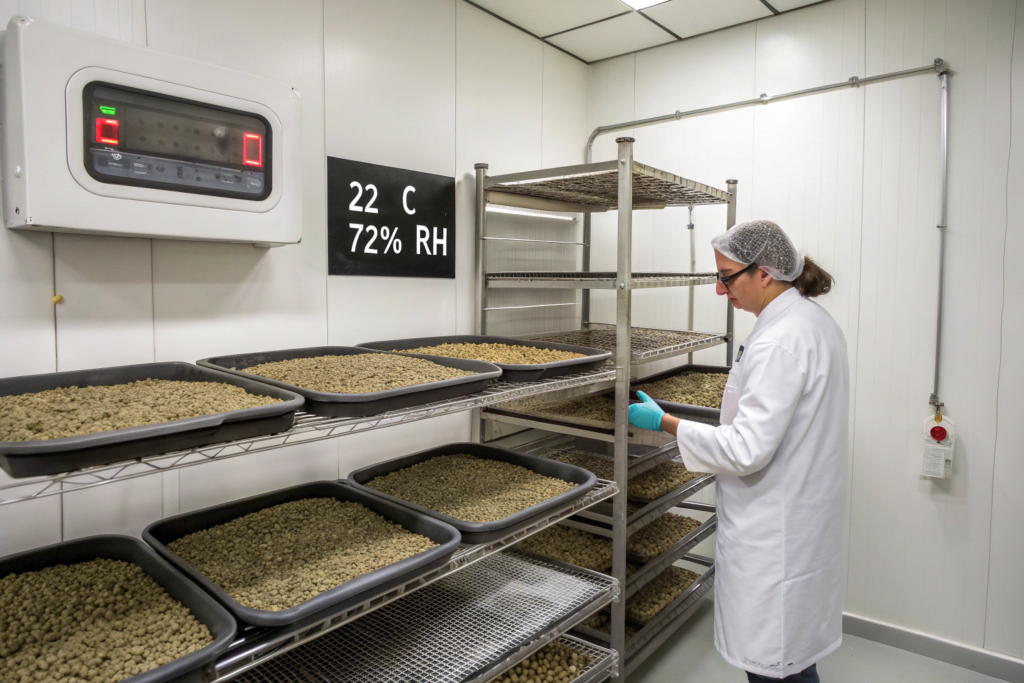
This is not a "spritz and pray" method. Professional rehydration is a slow, controlled process of equilibration. The principle is to expose very dry beans to an environment with a specific, controlled Relative Humidity (RH) and temperature, allowing them to absorb moisture gradually and evenly over days—not hours.
The tool for this is a climate-controlled conditioning room or a specially designed humidification cabinet. The process looks like this:
- Preparation: Beans are spread in a single layer on mesh trays to allow full air circulation. They are not piled deep.
- Environment Setting: The room is set to a stable temperature (around 20-22°C / 68-72°F) and a target RH. The RH target is calculated based on the starting moisture and the desired end moisture, using a coffee moisture equilibrium chart. For example, to bring beans from 8% to 11%, you might target a 70-75% RH environment.
- Gradual Absorption: Beans are left in this environment for 4 to 7 days. They are gently stirred or the trays are rotated periodically to ensure even exposure.
- Monitoring: Moisture content is measured daily in multiple samples using a precise moisture meter. The process stops when the moisture is uniform and has reached the target (usually 10.5-11.5%).
- Stabilization: After reaching the target, beans may be held in a stable, slightly drier environment (~50-55% RH) for another day to allow surface moisture to equalize with internal moisture.
The key is SLOW. Adding moisture too fast causes the outer layer of the bean to swell while the core remains dry, creating internal stresses that can crack the bean. It also drastically increases the risk of mold.
Why is a Climate-Controlled Environment Non-Negotiable?
Without control, you are gambling. Ambient room humidity fluctuates. On a humid day, beans might absorb too much moisture on the surface, leading to immediate mold growth (visible as white or blue fuzzy patches). On a dry day, nothing happens. A controlled environment provides a consistent vapor pressure, allowing water molecules to gently migrate into the bean's cellular structure without causing surface wetness.
For an exporter like Shanghai Fumao, such conditioning rooms are part of our quality infrastructure, used not for rehydrating old beans, but for standardizing moisture across different lots before shipment to ensure uniform roasting behavior for our clients. This proactive approach is far superior to reactive rehydration.
What Equipment is Used for Precise Moisture Management?
- Precision Moisture Meters: Devices like the DICKEY-john GAC or similar, which use calibrated capacitance to give a digital readout. Pin-type meters are less reliable for green coffee.
- Hygrometers & Data Loggers: To constantly monitor and record the Temperature and RH of the conditioning environment.
- Humidification/Dehumidification System: A dedicated HVAC system to maintain the exact RH setpoint.
- Mesh Trays and Rolling Racks: For maximizing air contact and allowing easy rotation.
This is capital-intensive equipment, underscoring that true rehydration is an industrial process.
What are the High-Risk Home Methods and Why Do They Fail?
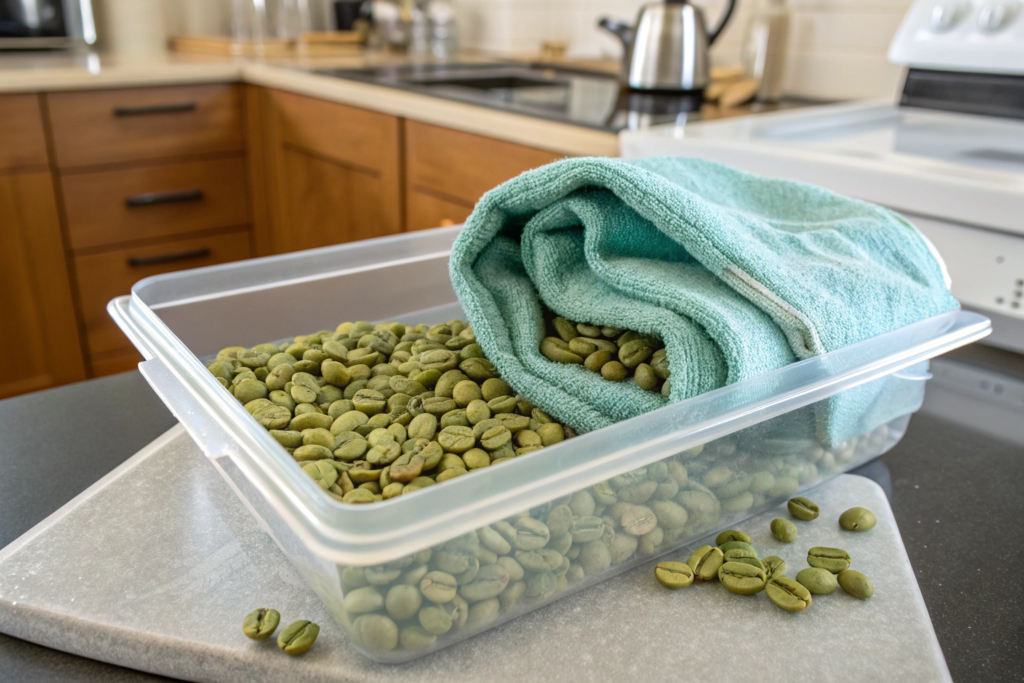
The internet is full of bad advice: "Put a damp towel in the bag," "Add a slice of bread," "Use a water spray bottle." These methods are dangerous and will almost certainly ruin your beans. They create severe moisture gradients and invite microbial disaster.
The "Damp Towel" or "Bread Slice" method places a wet object in a closed container with beans. The localized humidity is extremely high, causing beans nearest the source to become wet, while those further away stay dry. This leads to:
- Mold Growth: Within 24-48 hours, you will likely see mold on the beans touching the towel.
- Uneven Swelling: Beans absorb moisture in patches, causing physical stress and cracks.
- Off-Flavors: Beans will develop musty, fermented, or rotten flavors as microbes grow.
The "Spray Bottle" method is perhaps the worst. You directly wet the surface of the beans. This causes immediate, severe localized swelling. The outer cell structure is damaged, and the water does not have time to migrate inward before roasting. The result is a bean that's wet on the outside, bone-dry inside. When roasted, the wet surface steams and stews, while the inside burns. The cup will taste of sour fermentation, grass, and ash.
What are the Dangers of Mold and Chemical Degradation?
Introducing moisture incorrectly doesn't just affect taste; it creates health and safety risks.
- Mycotoxins: Certain molds (like some Aspergillus species) can produce mycotoxins, which are harmful chemical compounds that are not destroyed by roasting temperatures. Consuming coffee from moldy beans is a health risk.
- Fermentation & Rot: In a warm, moist environment, bacteria and yeast begin uncontrolled fermentation, producing acetic acid (vinegar), butyric acid (vomit), and other foul compounds.
- Bean Death: The embryo inside the green bean can actually start to germinate if conditions are right, using up the bean's remaining sugars and ruining it for roasting.
These risks make amateur rehydration not just ineffective, but potentially hazardous. It turns a batch of merely stale beans into actively toxic waste.
Why Can't You Just Add Water Before Roasting?
Some think, "I'll just account for the extra weight from water in the roaster." This misunderstands the roasting process. As stated, roasting requires moisture to be inside the bean's structure. Surface water will evaporate in the first minute of roasting, cooling the drum and creating steam that can actually stall the roast. It does not fix the internal dryness problem. The bean will still roast poorly, and you've added the complication of wet beans sticking to the drum or causing temperature fluctuations. Professional roasters never add liquid water directly to beans before or during roasting.
How to Prevent Green Coffee from Drying Out in the First Place?
Prevention is 100% more effective than any cure. For roasters and importers, proper storage is your frontline defense. The enemies are air, heat, light, and moisture fluctuation.
The golden rules for green coffee storage are:
- Cool Temperature: Ideal is 15-20°C (59-68°F). Avoid heat sources.
- Stable, Moderate Humidity: Aim for 50-60% Relative Humidity (RH). This environment maintains bean moisture between 10-12% without adding or subtracting.
- Darkness: Light accelerates staling reactions.
- Airtight or Breathable? This is key. Beans in GrainPro bags (hermetic sealed liners) are protected from external humidity swings and can be stored for over a year with minimal quality loss. Beans in standard jute bags will slowly equilibrate with the room's humidity. If your warehouse is humid, they gain moisture; if dry, they lose it.
Therefore, the best practice is to store coffee in its original GrainPro-lined bags, placed on pallets in a dedicated, climate-controlled warehouse. Do not break the seal until you are ready to roast that lot. This is how we, at Shanghai Fumao, store all coffee before shipment, ensuring it arrives at the perfect moisture content for you, our client.
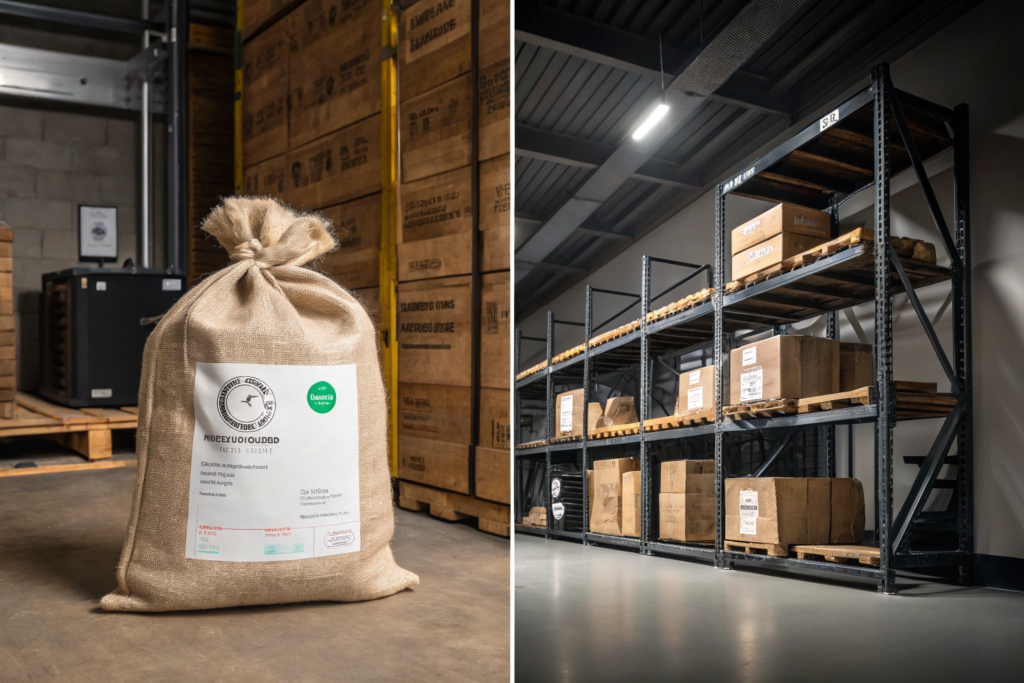
What is the Ideal Long-Term Storage Environment for Green Coffee?
For a roasting business, your storage area should be treated like a wine cellar. Invest in:
- Insulation and HVAC: To maintain a constant temperature and dehumidify/humidify as needed.
- Hygrometers: Place several around the room to monitor RH.
- Pallet Racking: Keep bags off the floor on pallets for air circulation and to prevent moisture wicking.
- First-In, First-Out (FIFO) Inventory: Use a system to rotate stock and prevent beans from sitting for excessive periods.
- Sealed Containers: For open partial bags, transfer the beans to an airtight, food-grade container like a Vittles Vault or a sealed bin.
By controlling the environment, you control the bean's moisture. This eliminates the entire problem.
How Does Packaging (Jute vs. GrainPro) Dictate Shelf Life?
This is a critical decision point that impacts your entire inventory.
- Standard Jute/Sisal Bag: Permeable. Shelf life is 6-9 months in a perfectly stable environment. In reality, beans lose 1-3% moisture per month in a dry climate. Not suitable for long-term storage of specialty coffee.
- Jute Bag with Plastic Liner: Better, but liners can tear. Moderate barrier.
- GrainPro (Hermetic) Bag: A high-barrier, sealed plastic liner inside a woven outer bag. It locks in the coffee's original moisture and gases, and locks out pests and odors. Properly stored GrainPro coffee can maintain quality for 12-18 months or more with minimal degradation.
When sourcing, specify GrainPro packaging for any coffee you plan to store or that will have a long transit time. It is a small cost for massive quality insurance. As a stable coffee supplier, we offer GrainPro as standard for all our shipments because we understand its value in preserving the quality we worked so hard to cultivate.
Conclusion
The "best" way to rehydrate old coffee beans is to prioritize prevention through professional, climate-controlled storage in hermetic packaging. True rehydration is a slow, industrial process of equilibration in a precise humidity-controlled environment—a tool for roasters to salvage valuable but slightly dry lots, not a method to revive dead coffee. For the vast majority, especially home roasters or small businesses, attempting rehydration with home methods is a high-risk path that leads to mold, uneven roasting, and ruined coffee.
The key takeaway is to invest your energy in sourcing from exporters who prioritize proper moisture management at origin and in maintaining impeccable storage conditions upon arrival. This proactive approach safeguards the intrinsic flavor and roasting potential of your green coffee, making the desperate act of rehydration unnecessary.
If you are a roaster concerned about coffee bean moisture stability and shelf life, partner with an exporter who controls the process from start to finish. We at BeanofCoffee ensure our beans are shipped at optimal moisture in GrainPro packaging for maximum freshness. To discuss our quality control and storage standards, contact our quality assurance manager, Cathy Cai. She can provide detailed information on our moisture specifications and packaging options. Reach her at cathy@beanofcoffee.com.