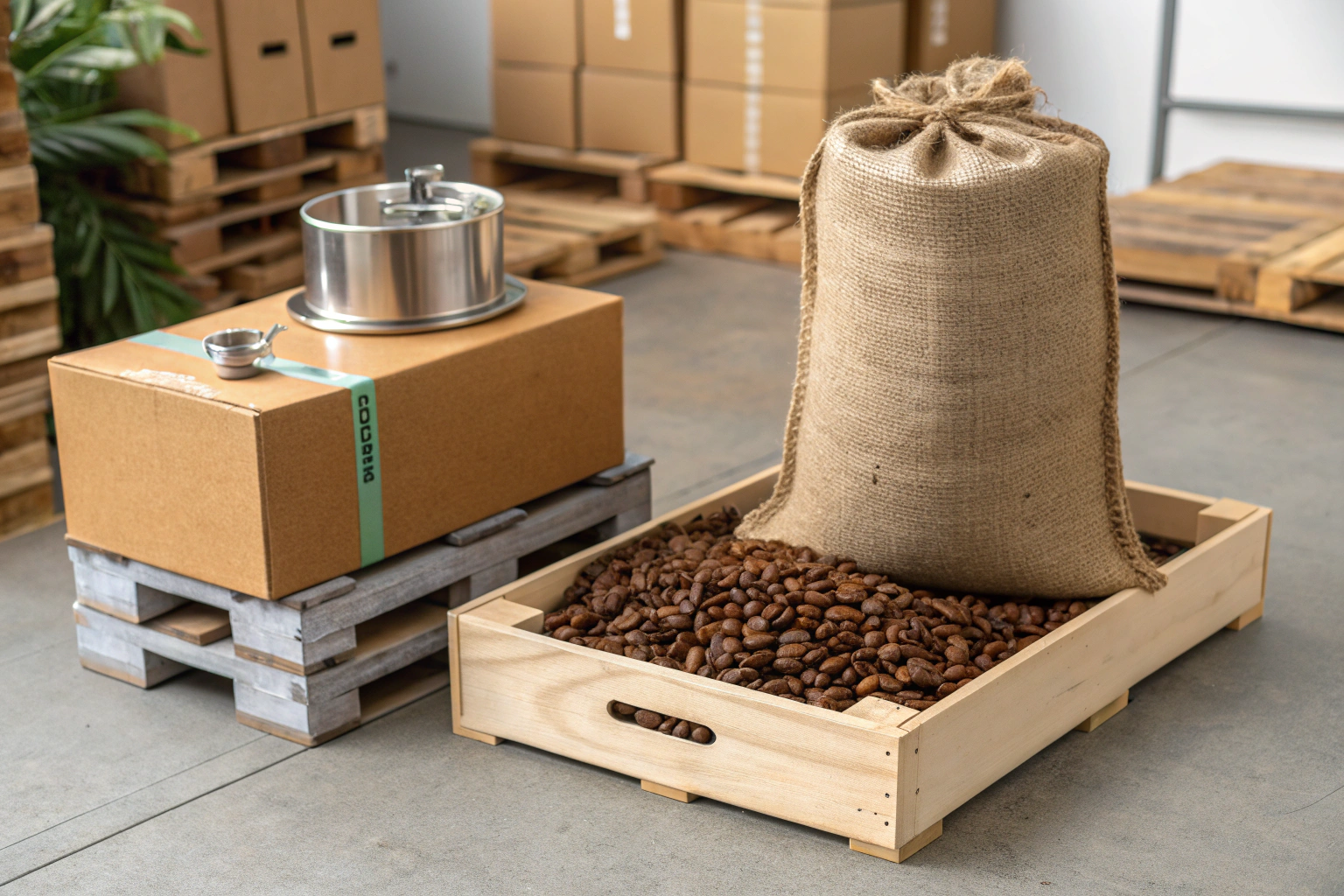
You've sourced exceptional beans, roasted them to a perfect profile, and now you need to get them to your customer—whether that's a distributor in Rotterdam or a roastery in Melbourne. But roasted coffee is vulnerable. Oxygen, light, heat, and rough handling can undo weeks of careful work in just a few days. So, what actually works?
The best way to transport roasted coffee combines three essential elements: primary packaging that uses airtight, high-barrier bags with one-way degassing valves; secondary protection with cushioned, rigid outer boxes; and strict compliance with international HS coding (0901.21) and regional customs rules to prevent costly delays. There is no single magic bullet. It is a system. And when one part fails, the entire shipment's quality—and your reputation—is at risk.
Honestly, this is where I see even experienced buyers stumble. They focus on the green bean sourcing, negotiate hard on price, and then treat the final transport of roasted coffee as an afterthought. It's not. From our perspective at Shanghai Fumao, we've learned that how you deliver the roasted product is as much a statement of your brand as the roast profile itself. Let's break down the system that works.
What Primary Packaging Actually Preserves Roasted Coffee During Transit?
This is your first and most critical line of defense. You cannot fix stale coffee with fast shipping. The bag itself must work as a preservation chamber.
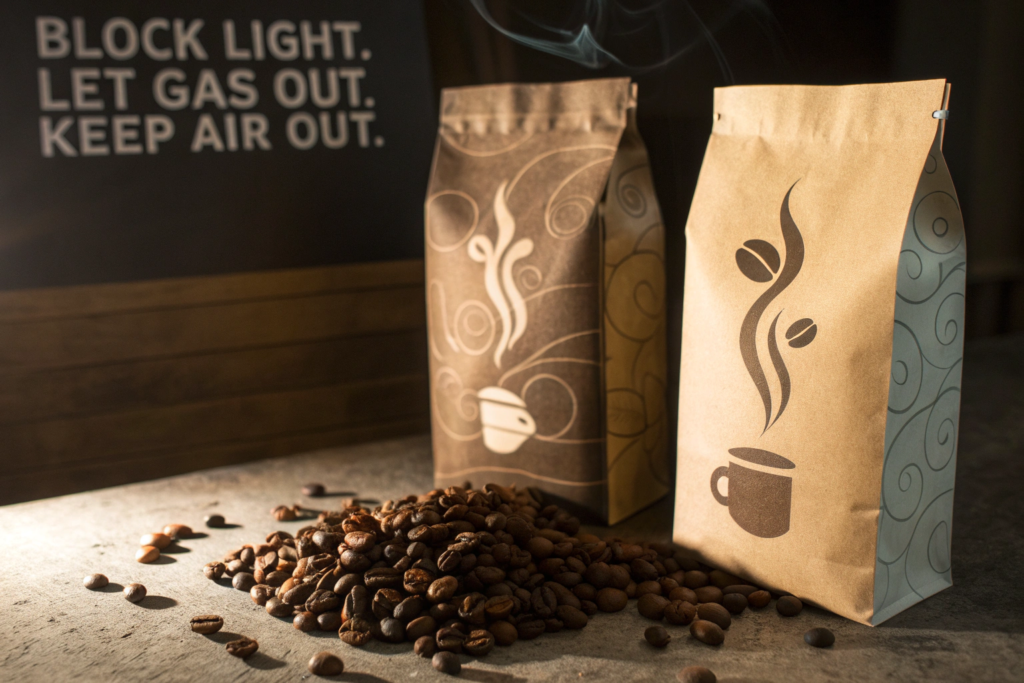
The undisputed best primary packaging for transporting roasted coffee is an airtight, high-barrier flexible pouch equipped with a one-way degassing valve. This combination achieves two opposing goals simultaneously: it keeps oxygen out (which destroys aromatic compounds and causes staleness) while letting carbon dioxide escape (which freshly roasted coffee continues to release for days). Without the valve, pressure builds up and seals burst. Without the barrier, oxygen creeps in and your "fresh roast" arrives tasting like cardboard.
I spoke recently with a roaster who lost an entire container to the US because he used beautiful vintage-look paper bags with no liner. They looked amazing on Instagram. They arrived flat and lifeless. The valve isn't a cost to cut.
Why Can't I Just Vacuum Seal Roasted Coffee for Transport?
This is a common misconception. Vacuum sealing seems logical—remove all air, problem solved. But for freshly roasted coffee, it often backfires. The beans are still degassing CO₂. If you vacuum seal too soon, the trapped gas has nowhere to go. The bag swells, the seal can fail, and the pressure can actually force staling compounds into the bean structure faster. As one expert roaster put it, "Freshly roasted beans degas CO₂ for a while, so vacuum sealing too soon can cause problems." Vacuum sealing works for green beans or for coffee that has fully degassed (weeks old), but for the fresh, high-turnover product your customers expect, a valve bag is superior.
What Materials Actually Count as "High-Barrier"?
Not all plastic is equal. Standard poly bags are nearly useless for international transport. You need multi-layer laminates: typically aluminum foil or metallized polyester sandwiched between food-grade polyethylene. These materials block oxygen transmission rates to near zero and also provide UV protection. Light exposure degrades coffee oils, causing rancidity. A bag that looks opaque from the outside but lets light through is still damaging the product. At Shanghai Fumao, when we handle roasted exports for partners, we always verify the barrier spec. It's a non-negotiable quality checkpoint.
How Do I Protect Roasted Coffee from Physical Damage and Climate?
The bag protects the bean from chemistry. The box protects the bag from physics. Underestimating the violence of the logistics chain is a beginner's mistake.
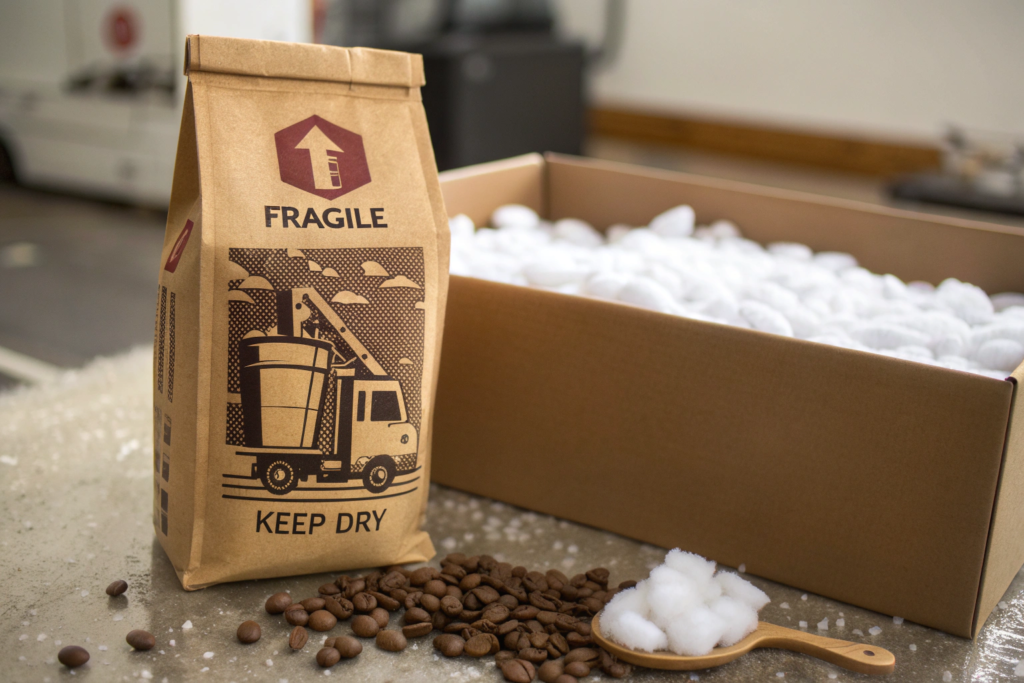
Roasted beans are brittle. They crack, shatter, and create fines (dust) under sustained vibration and impact. The standard for protection is a rigid, double-walled corrugated box with 100% void fill using air pillows, foam, or recycled paper. Every empty space inside the outer carton is an opportunity for the inner bag to slam against a wall during a 14-day sea voyage.
We once audited a returned shipment. The outer box was beautiful. Inside, two bags had been placed with no cushioning. After crossing the Pacific, the bags looked fine, but the bottom layer of beans was crushed into powder. The customer thought they'd received old, broken inventory. They hadn't. It was just poor packing.
What Temperature and Humidity Is Safe for Roasted Coffee in Transit?
Roasted coffee is more forgiving than green beans, but it has limits. The target environment is 15-25°C with 50-70% relative humidity. Condensation is the enemy. When a cold container hits tropical air, moisture forms inside the packaging. This doesn't just risk mold; it triggers staling reactions. For long-haul or routes through extreme climates, consider temperature-indicating labels on the outer cartons and desiccant packs inside the secondary packaging. For air freight, IATA regulations on lithium batteries don't apply, but you must declare "Food - Perishable" and avoid unpressurized cargo holds if possible.
What Box Size and Strength Is Optimal?
Oversized boxes are expensive and increase damage risk. Undersized boxes risk compression. For 1kg retail bags, a 10x8x6 inch box is a standard starting point. More critically, the box must have adequate Edge Crush Test (ECT) rating for stacking. For international consolidated shipments, your box may sit at the bottom of a pallet with 500kg on top. A standard single-wall carton will collapse. Use double-wall corrugated (E flute or BC flute) with an internal crush strength exceeding 500kg/m². This isn't overpacking; it's insurance.
What Are the 2025 Customs and Compliance Rules I Cannot Ignore?
You can pack the perfect bean in the perfect box, but if the paperwork is wrong, the shipment stops. And stopped coffee dies.
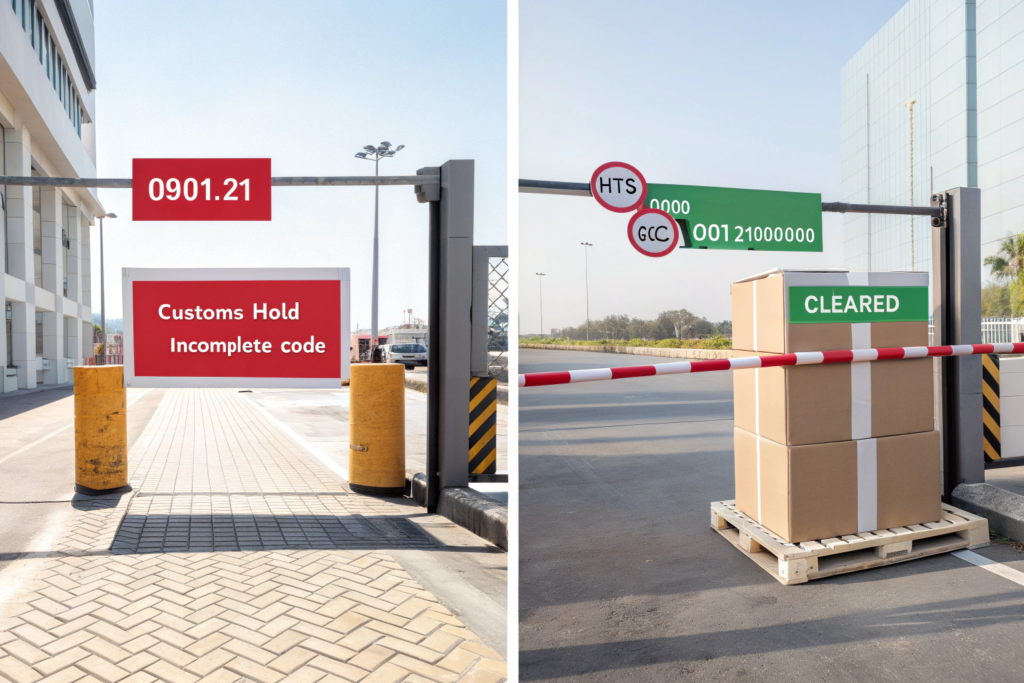
For roasted coffee, the global Harmonized System (HS) code is 0901.21. However, 2025 introduced critical regional expansions: the U.S. now requires full 10-digit HTS filing for all shipments (de minimis ended August 29, 2025), and GCC countries mandate a 12-digit code. Using only the 6-digit base code is now insufficient for these major markets. Customs delays of even 3-5 days can render roasted coffee unsellable, especially if held in non-climate-controlled warehouses.
This is a massive pain point. One of our clients in Dubai had a roasted shipment held because the HS code on the label was 0901.21 (correct globally) but lacked the mandated 12-digit GCC extension. The fine wasn't huge, but the delay was. By the time it cleared, the coffee was past its recommended "roasted-on" window for that distributor.
What Specific Documentation Must Accompany Roasted Coffee?
Beyond the commercial invoice and packing list, roasted coffee exports often require:
- Certificate of Analysis (COA) confirming moisture content and absence of defects
- Phytosanitary Certificate (even for roasted, some countries require it)
- FDA Prior Notice for U.S. shipments (mandatory, even for small parcels)
- Valve function note: Not a legal document, but we include a spec sheet showing the degassing valve is one-way to reassure customs that the bag isn't "swollen with contamination"
The labeling on the outer box must be precise: HS 0901.21, "Roasted Coffee, Whole Bean/Ground," net weight in kg, and country of origin. Ambiguity here is an invitation for inspection.
Is Air Freight or Sea Freight Better for Roasted Coffee?
There is no universal "better," only "appropriate."
| Freight Method | Transit Time | Approx. Cost (China-USA) | Best For |
|---|---|---|---|
| Air Freight | 3-5 days | ~$3.50/kg | Premium, high-turnover roasted coffee; roasted-to-order models |
| Sea Freight (FCL) | 14-30 days | ~$0.50-1.00/kg | Bulk shipments; nitrogen-flushed, foil-sealed bags required |
For a business like ours, we advise clients: if the landed cost per kg of roasted coffee exceeds $40, air freight justifies its premium. If you are shipping commodity-grade roasted coffee, sea freight with nitrogen-flushed, foil-sealed bags is the economic reality.
What About the Customer After Delivery?
The journey doesn't end when the box is opened. How the consumer handles the coffee after receiving it determines whether your brand delivers a great experience or a mediocre one.
The best roasters extend their quality control to the end user by using resealable packaging (tin ties or zippers) and providing clear storage instructions. You cannot control whether a customer leaves the bag open on the counter, but you can make it easy for them to do the right thing.
A roaster in California told me, "We tell customers to fold the bag down tight and use the tin tie after each use, or transfer the coffee into an airtight container." This simple instruction, printed on the bag, reduces complaints and increases reorder rates. It's not just about transporting coffee; it's about preserving the experience you sold.
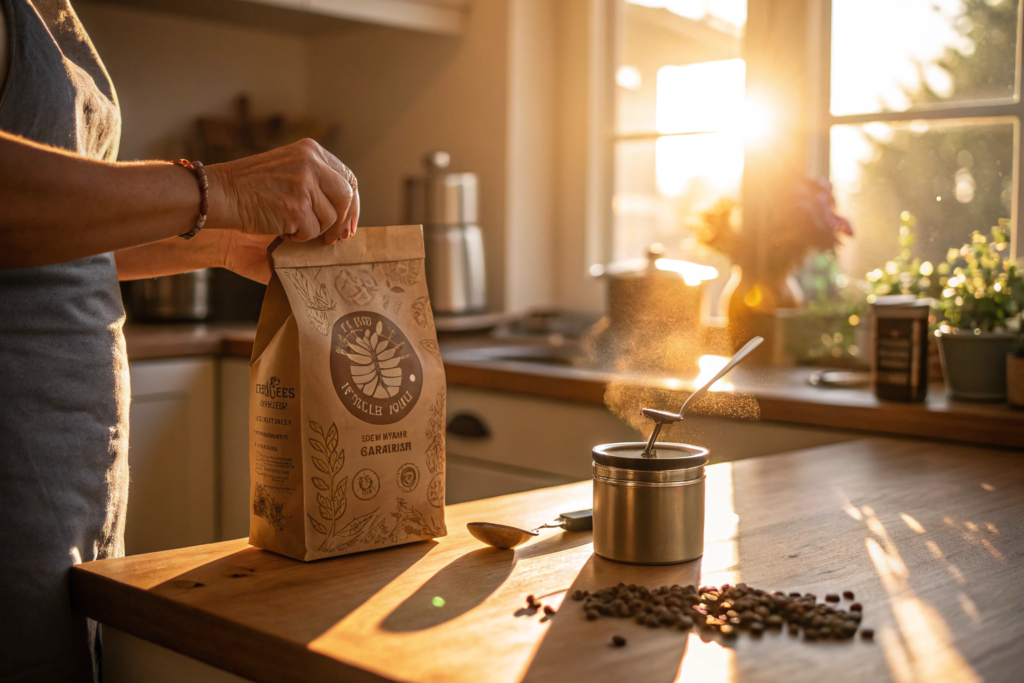
Are Tin Ties or Zipper Closures Better for Resealing?
It depends on usage. Tin ties are simple, cost-effective, and work well for coffee consumed within 1-2 weeks. They are not fully airtight. Resealable zippers provide a better oxygen barrier and are preferred for larger bags or slower-moving retail channels. For wholesale partners, we often recommend zipper-equipped valve bags. For pop-ups or farmers' markets where coffee moves instantly, tin ties are sufficient. This isn't a minor detail. It's the last step in the transport chain, controlled by the consumer.
Should I Recommend Freezing Roasted Coffee?
For long-term storage by consumers, freezing in an airtight container is effective. However, for the immediate post-transport phase, we advise against it. Coffee taken in and out of the freezer accumulates condensation, which is worse than stable room-temperature storage. The best instruction is simple: keep it cool, dark, and dry; use it within 2-4 weeks of opening. This manages expectations and protects your product's reputation. For deeper guidance, the National Coffee Association offers excellent consumer-facing storage advice.
Conclusion
The best way to transport roasted coffee is not a single method—it is a disciplined system. It begins with high-barrier, one-way valve bags that protect the bean from oxygen while allowing it to breathe. It continues with robust, well-cushioned outer packaging that absorbs the shocks of global logistics. It depends on absolute precision in customs documentation, using the full, region-specific HS codes that 2025 regulations demand. And it ends with thoughtful design that helps the customer keep the coffee fresh after the bag is opened.
Mastering this system transforms transport from a risk into a competitive advantage. Your coffee arrives fresh, intact, and compliant. Your customer trusts you more.
If you are sourcing roasted coffee—or planning to expand your roasted product line with a reliable partner—get the details right from the start. At Shanghai Fumao, we work with buyers to ensure every link in this chain is secure, from the Yunnan plantation to the export documentation. To discuss your roasted coffee transport strategy or request a sample shipment protocol, contact our Sales Director, Cathy Cai. She can align our packaging and compliance processes with your market requirements. Email Cathy at cathy@beanofcoffee.com. Let's move your coffee, and your business, forward.