You want to do the right thing. You see labels like "Fair Trade" and "Rainforest Alliance" on coffee bags, and you know they represent a better, more ethical choice. But what's the actual difference? You're worried about "label fatigue" and whether you're truly supporting the causes you care about. Is one better than the other? Does one focus more on people and the other on the planet? It's a common pain point: wanting to make a responsible sourcing decision but being confused by the nuances of the certifications.
Honestly, the fundamental difference is their primary focus: Fair Trade was founded with a core mission of economic justice for farmers, guaranteeing a minimum price and a social premium to empower communities. The Rainforest Alliance, on the other hand, was founded with a core mission of environmental conservation, focusing on sustainable farming practices, biodiversity, and ecosystem health, while also including social and economic criteria. Think of it as People-First vs. Planet-First, although both now cover all three pillars of sustainability.
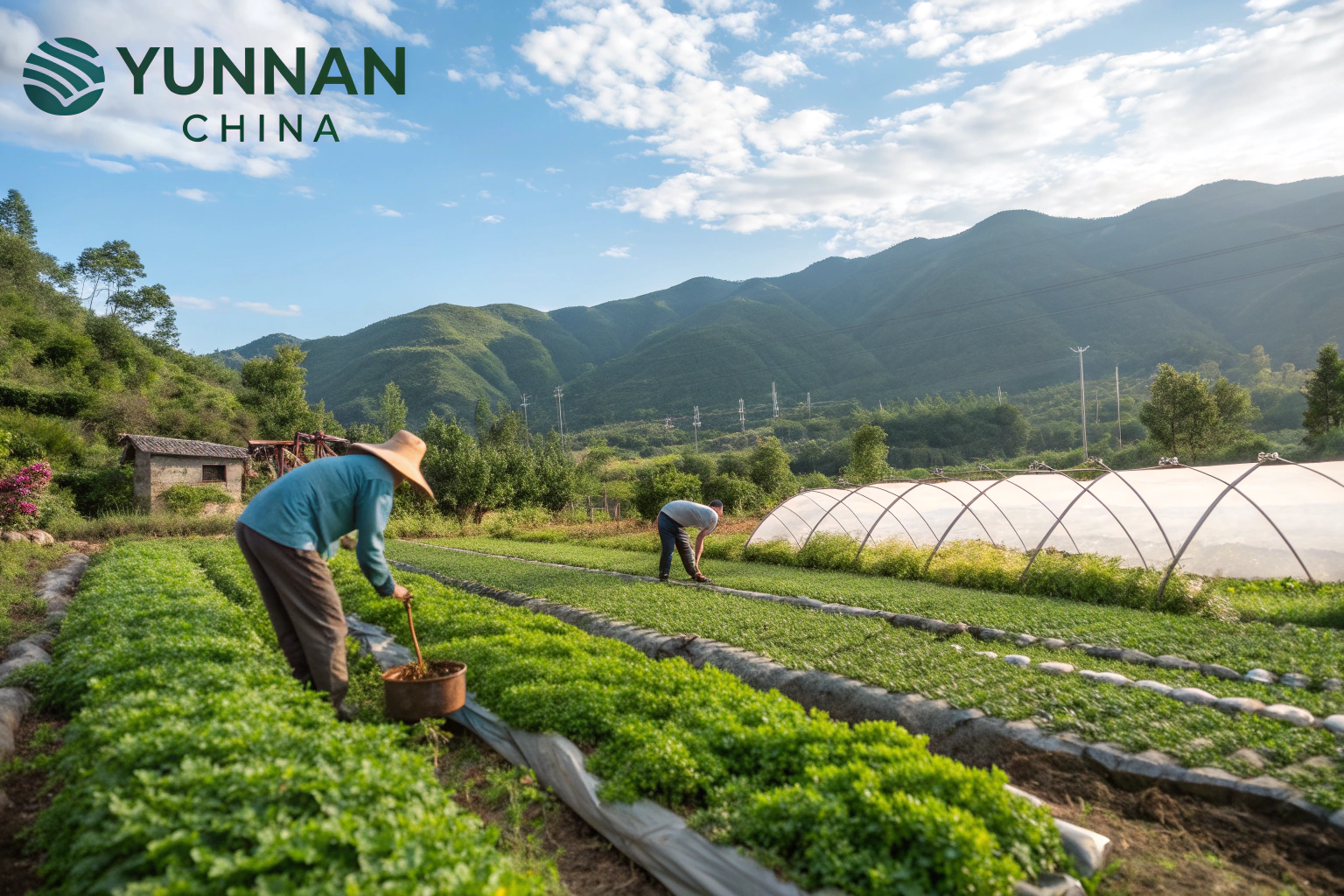
I've walked our farms in Yunnan and seen firsthand the delicate balance between running a sustainable business, caring for our workers, and protecting the beautiful land we depend on. These certifications aren't just logos; they are frameworks for a better way of farming. Let's break down what each certification really means for the farmer, the environment, and for you, the buyer.
What Is the Core Mission of Fair Trade?
To understand Fair Trade, you have to go back to its origins. It was created as a direct response to the volatile and often cripplingly low prices of the commodity coffee market, which left small farmers in a constant state of financial insecurity.
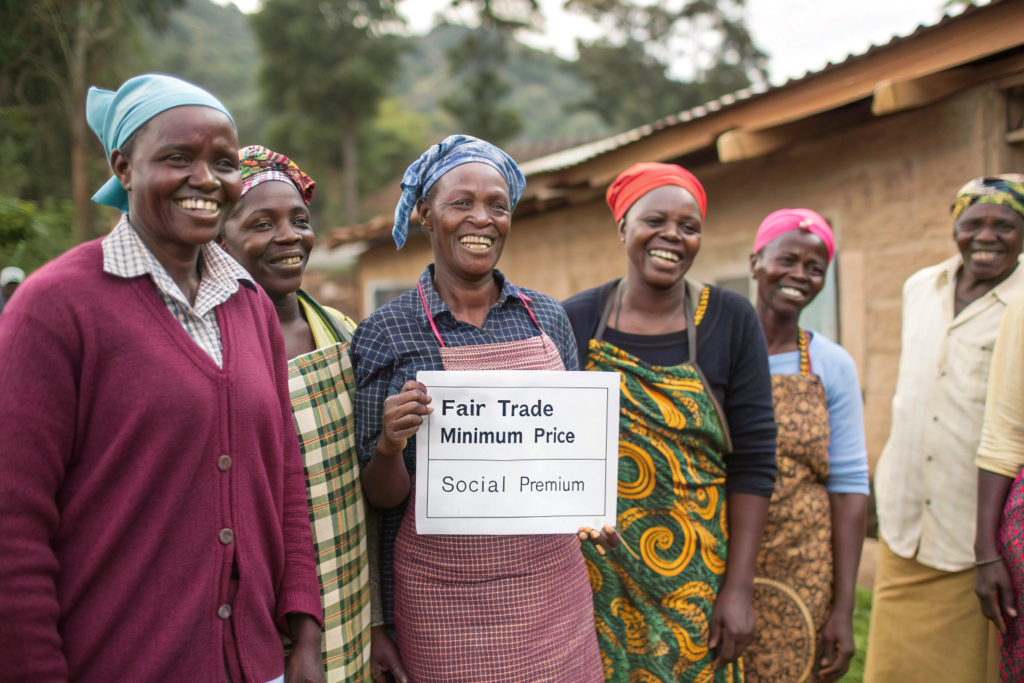
Isn't Fair Trade's main goal to ensure farmers get a fair price? Yes, precisely. The cornerstone of the Fair Trade model is the Fair Trade Minimum Price, which acts as a safety net, guaranteeing that farmers receive a price that covers their average cost of sustainable production, even if the world market price collapses. On top of this, it includes a Fair Trade Premium—an additional sum of money paid directly to the farmer cooperative to invest in community projects of their choosing.
This model is fundamentally about economic empowerment. It's designed to give small, organized farmers more control over their lives. That premium money isn't just extra profit; it's democratically invested by the cooperative into projects like building schools, funding clinics, improving water access, or investing in better processing equipment. It's a tool for community development, decided by the community itself.
Who is eligible for Fair Trade certification?
A key aspect of Fair Trade is its focus on small-scale producers. The certification is primarily designed for small family farms that are organized into democratic cooperatives or associations. Large, independently owned estates or plantations are generally not eligible for Fair Trade certification for coffee, as the model is built to empower the most vulnerable producers.
How does the Minimum Price work?
Let's say the Fair Trade Minimum Price for coffee is $1.40 per pound. If the global market price (the 'C' price) drops to $1.10, a Fair Trade buyer is still obligated to pay at least $1.40. If the market price soars to $2.00, the buyer must pay the market price (or higher). It's a safety net, not a price cap. This provides a level of financial stability that is almost unheard of in conventional commodity agriculture.
What Is the Primary Focus of the Rainforest Alliance?
The Rainforest Alliance was born from a different crisis: the alarming rate of deforestation in tropical regions, often to clear land for agriculture. Its starting point was the environment and the preservation of ecosystems.
Isn't the Rainforest Alliance's main focus on environmental sustainability? Yes, that's its origin and its strength. The Rainforest Alliance certification is built around a comprehensive standard for sustainable agriculture that heavily emphasizes protecting biodiversity, conserving natural resources like water and soil, and promoting the well-being of workers and communities. Their iconic frog logo signifies a healthy ecosystem.
The Rainforest Alliance standard is a detailed checklist of best practices. It requires farms to protect wildlife habitats, prevent deforestation, reduce the use of pesticides, manage waste responsibly, and ensure fair and safe working conditions for their employees. While it includes social and economic criteria, its historical DNA is rooted in conservation biology.
Who is eligible for Rainforest Alliance certification?
Unlike Fair Trade, the Rainforest Alliance certifies farms of all sizes, from small family plots to large corporate-owned plantations. Their model is about promoting sustainable practices across the entire industry, regardless of the farm's size or ownership structure. This is a key difference. A large, well-managed estate like ours at Shanghai Fumao could become Rainforest Alliance certified if we meet the rigorous environmental and social standards.
What are some examples of their requirements?
The standard is extensive, but some key requirements include:
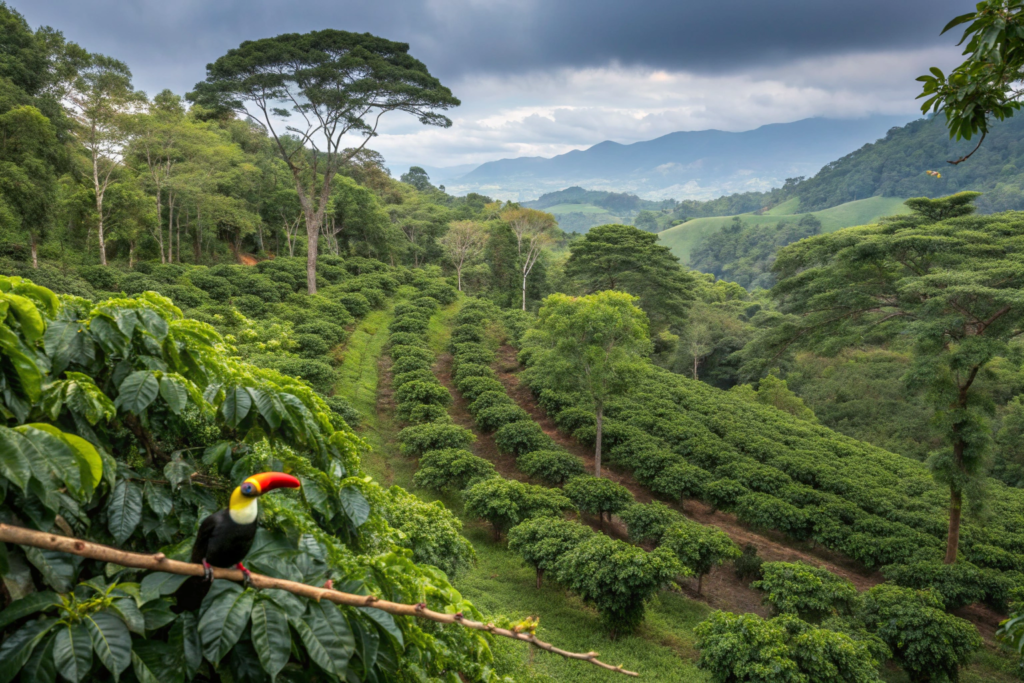
- Shade Cover: Promoting the use of native shade trees to provide habitat for birds and other animals.
- Water Conservation: Implementing measures to reduce water use in coffee processing and preventing wastewater from contaminating rivers.
- No Deforestation: A strict prohibition on clearing forests to expand agricultural land.
- Worker Protections: Ensuring workers receive at least the national minimum wage, have access to safe housing and healthcare, and are provided with proper safety equipment.
How Do They Approach Pricing and Premiums?
This is one of the most significant practical differences between the two certifications and a common point of confusion for buyers. Their philosophies on how to best reward farmers are different.
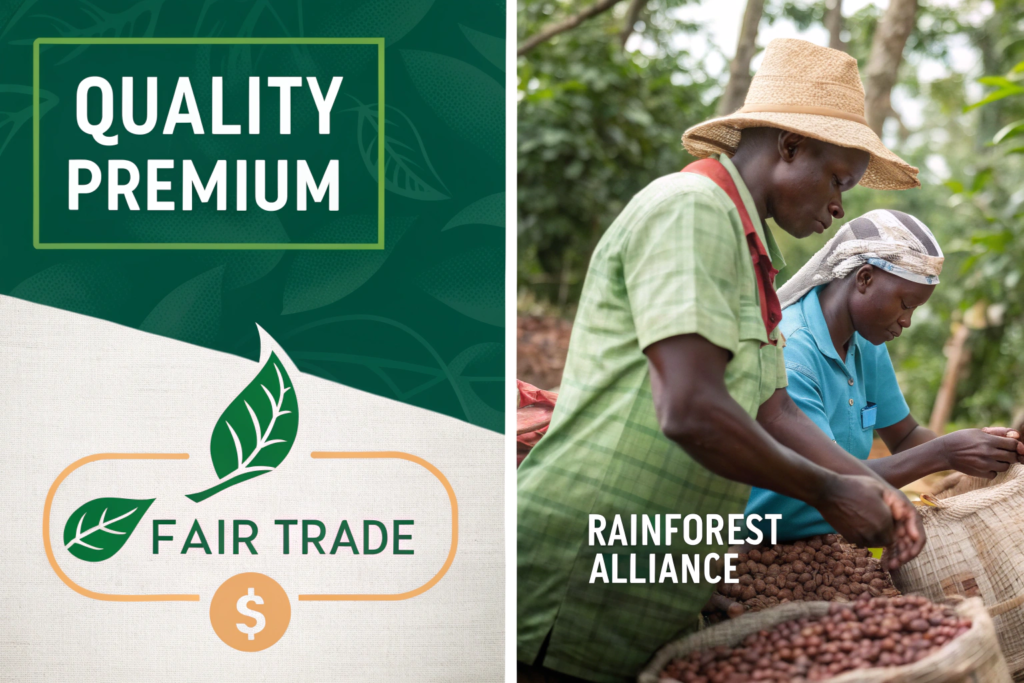
Does Fair Trade guarantee a price while Rainforest Alliance doesn't? Yes, that's correct. Fair Trade uses a mandatory Minimum Price and a fixed Social Premium. The Rainforest Alliance, however, does not set a minimum price. Instead, their model focuses on helping farmers improve their quality and efficiency, which should enable them to negotiate a higher price (a "quality premium") on the open market. They do require a "sustainability differential," an additional cash payment to farmers, but it is not a fixed price floor.
Fair Trade's approach is a direct market intervention designed to provide a financial safety net. The Rainforest Alliance's approach is based on the principle that sustainable practices lead to better, more valuable coffee and more professional farm management, which in turn commands a better price. It's a market-based incentive model rather than a price-floor model.
Which model provides more money to farmers?
There is no simple answer, as it depends entirely on the market conditions.
- In a low market: A Fair Trade farmer is guaranteed to receive more than a non-certified farmer, thanks to the Minimum Price.
- In a high market: A Rainforest Alliance certified farmer who has produced an exceptional quality coffee might negotiate a very high quality premium, potentially earning more than a Fair Trade farmer whose coffee is of a standard quality.
What is the "Sustainability Differential"?
This is a mandatory cash payment made to certified farmers in addition to the negotiated market price. Unlike the Fair Trade premium, the amount is not fixed by the organization; it is determined through negotiation between the buyer and seller. It serves as a direct financial reward for the farmer's investment in sustainable practices and helps cover the costs of maintaining certification compliance.
Which Certification Should You Choose?
So, as a buyer, which label should you prioritize? There is no single "best" certification. The right choice depends entirely on your brand's values and the story you want to tell your customers.
Should your choice depend on your brand's core story? Absolutely. If your brand's primary mission is to support smallholder farmers and tell a story of economic justice and community development, Fair Trade is a perfect fit. If your brand is built around environmentalism, conservation, and protecting biodiversity, the Rainforest Alliance logo powerfully communicates that message. Both are excellent, credible certifications that drive positive impact.
Many in the industry see them as complementary, not competitive. They tackle the challenges of sustainable coffee from different but equally important angles. In fact, it's not uncommon to find a coffee that is "dual-certified" with both labels, indicating that the cooperative of small farmers meets both the economic standards of Fair Trade and the environmental standards of the Rainforest Alliance. This often represents the gold standard of ethical sourcing.
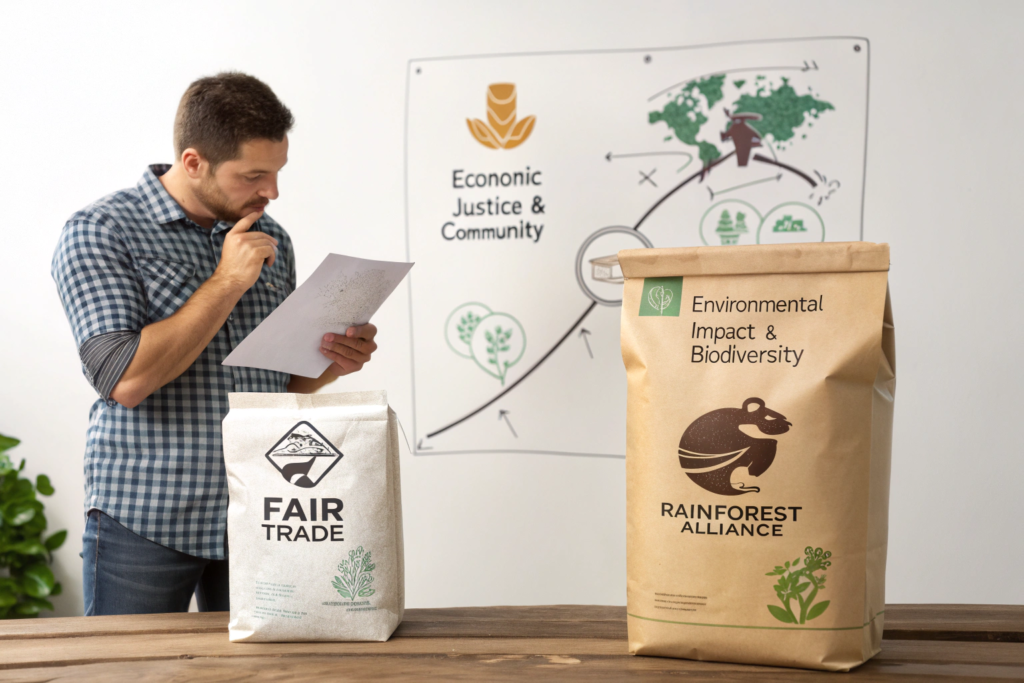
Can you summarize the key differences in a table?
Certainly. Here is a simple breakdown:
| Feature | Fair Trade | Rainforest Alliance |
|---|---|---|
| Primary Focus | Economic Justice & Farmer Empowerment | Environmental Conservation & Biodiversity |
| Eligible Farms | Small-scale farmers in cooperatives | Farms of all sizes (small, medium, large) |
| Pricing Model | Mandatory Minimum Price & Social Premium | No minimum price; requires a "Sustainability Differential" |
| Key Strength | Strong financial safety net for farmers | Comprehensive environmental standards |
| Logo | Figure with a raised arm | Green Frog |
How do you communicate the value to your customers?
Regardless of which you choose, education is key. Use your packaging, website, and social media to explain what the logo means. For Fair Trade, tell the story of the cooperative and the community projects they've funded. For Rainforest Alliance, share images of the shade-grown farms and talk about protecting wildlife habitats. Connecting the logo to a tangible, positive impact helps customers understand the value behind the premium price they are paying.
Conclusion
The choice between Fair Trade and Rainforest Alliance is not a choice between "good" and "bad." It's a choice between two different, powerful theories of change. Fair Trade intervenes directly in the market to provide economic stability for the most vulnerable farmers. The Rainforest Alliance works to transform agricultural practices across farms of all sizes to protect our planet's most fragile ecosystems. By understanding these fundamental differences, you can make a sourcing decision that aligns authentically with your brand's values and clearly communicates your commitment to a better, more sustainable coffee world to your customers.
We believe that sustainable practices are simply good business. We are committed to methods that protect our land and support our workers, and we are proud to work with partners who value the certifications that prove this commitment. If you are looking for a supplier who can provide traceable, high-quality coffee and help you navigate the world of certifications, we are here to help. Contact our coffee specialist at cathy@beanofcoffee.com to learn more.