
If you've ever reviewed a coffee spec sheet and seen the terms "HB" or "SHB," you might have wondered what they really mean. Are they just marketing terms, or do they point to a fundamental difference in the bean itself? Here's the truth: the distinction between hard bean (HB) and soft bean (SB) coffee is one of the most concrete indicators of quality in green coffee buying, directly tied to density, growing altitude, and ultimately, the flavor in your cup.
At its core, the difference is literal. A Hard Bean (HB) is denser, heavier, and more compact. A Soft Bean (SB) is less dense, lighter, and more porous. But this simple physical difference is the result of a complex interplay of climate, altitude, and plant physiology. It's not a difference in varietal; you can have both hard and soft beans from the same plant. The key driver is one factor: altitude.
As a professional buyer, understanding this is not academic—it impacts your cost, your roast profile, and your final product's taste. At BeanofCoffee, we meticulously grade our Yunnan Arabica, and the altitude of our Baoshan plantations is a primary reason why our beans consistently achieve the prized Hard Bean classification.
So, why does altitude create this difference, and what does it mean for you? Let's break it down from the farm to the roaster.
How Does Altitude Create Hard Beans?
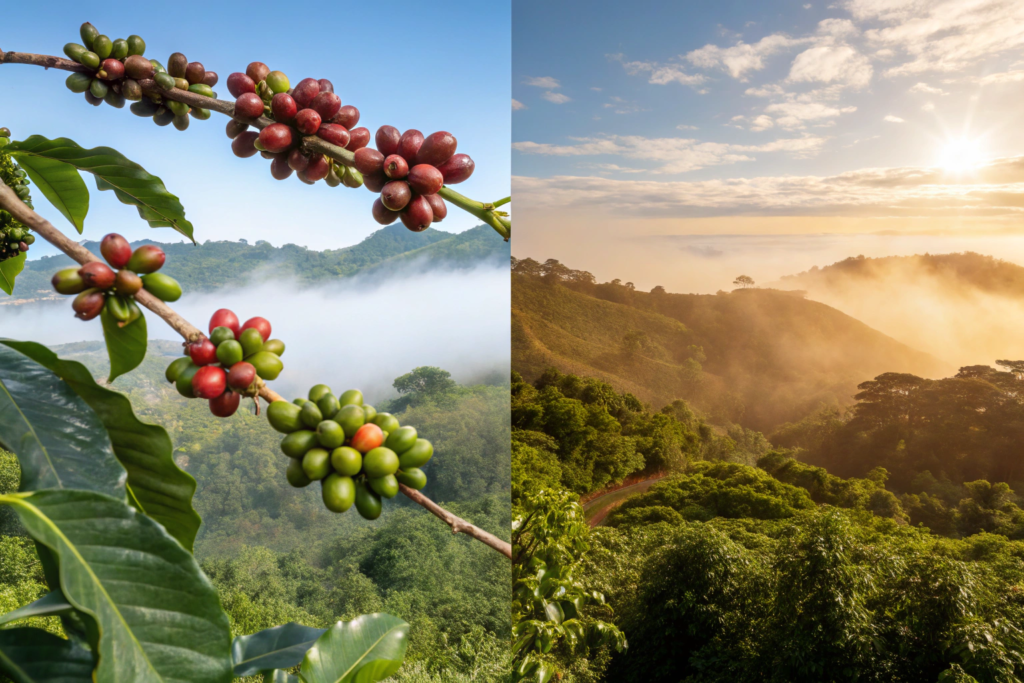
It all starts with a slower, more stressful growth cycle. At higher altitudes (typically above 1,200 meters / 4,000 feet), the climate is cooler. Nights are colder. This cooler environment forces the coffee cherry to mature much more slowly. Think of it like a grape for fine wine growing in a cool climate versus a hot one. The extended maturation period allows the seed (the coffee bean) inside the cherry to develop more complex sugars and structural compounds. The plant packs more resources into each bean to survive the harsher conditions, resulting in a denser, harder seed.
In contrast, coffee grown at lower, warmer elevations matures faster. The growth cycle is accelerated, leading to a bean that is larger in size but less dense in its cellular structure—a soft bean. This fundamental difference in growth is why altitude is the single most reliable proxy for bean hardness and, by extension, potential cup quality. It's a natural law of coffee cultivation.
This isn't just theory; it has direct, measurable consequences for every step that follows.
What Happens Inside the Coffee Cherry at High Altitude?
Let's zoom in. At high altitudes, the slower metabolism of the coffee plant changes the biochemistry inside the cherry. Photosynthesis produces sugars, but the cool temperatures slow down the plant's ability to use them for rapid growth. These surplus sugars are stored and concentrated within the bean. Furthermore, the stress from cooler temperatures stimulates the production of certain organic acids, like citric and malic acid, which are precursors to complex flavors. The bean's cellular structure becomes tighter, with thicker cell walls. This dense structure is what we physically feel as "hardness." It's literally a more concentrated package of flavor potential, a direct result of the challenging environment. Understanding this coffee plant physiology helps explain why altitude is so revered.
Why is Altitude a Primary Quality Indicator for Buyers?
For a buyer, altitude is a quick, reliable filter. When a reputable exporter like BeanofCoffee labels a lot as "Strictly Hard Bean (SHB)," you immediately know it was grown at a minimum altitude (often 1,400m+). This gives you a baseline expectation for density and potential cup quality before you even request a sample. It's a safeguard. It means the beans will likely withstand shipping and roasting better, and will have a higher probability of delivering the bright acidity and complex flavor notes associated with premium coffees. While altitude alone doesn't guarantee a perfect cup (processing is crucial), it is the most important foundational factor. Sourcing high-altitude, hard bean coffee is the first step in de-risking your quality investment.
How Does Bean Hardness Affect Roasting and Flavor?
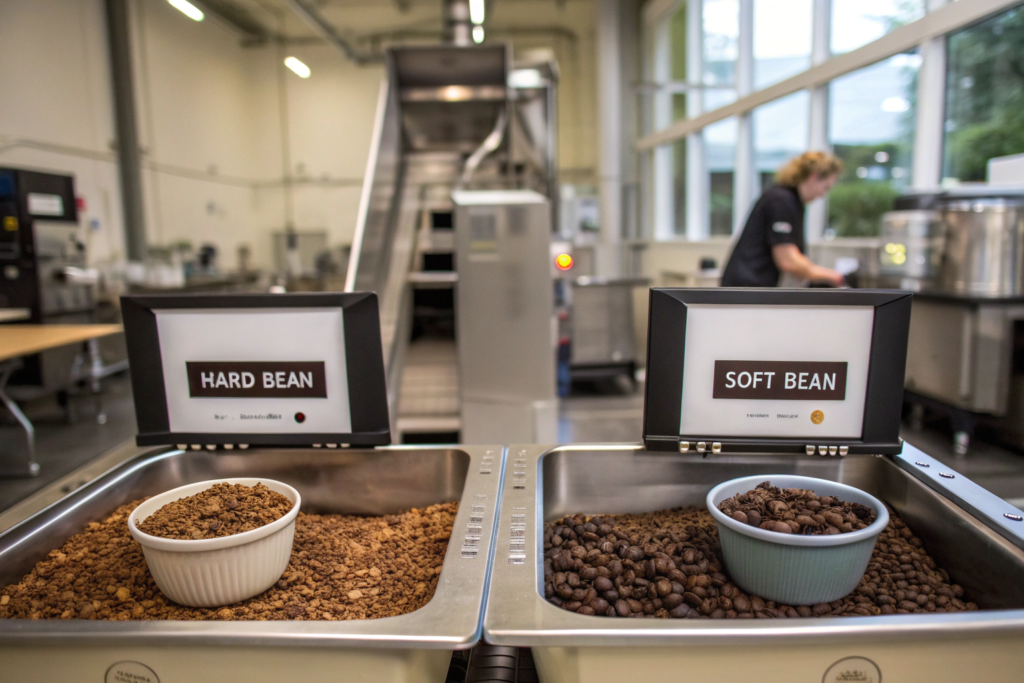
This is where the rubber meets the road. The physical density difference between hard and soft beans dictates how you must roast them and fundamentally shapes the flavor profile you can extract. Hard beans are like dense, small rocks; soft beans are more like pumice stones. They react to heat entirely differently.
Hard Beans require more energy and a longer roasting time to develop properly. Their dense structure can withstand—and needs—higher heat to penetrate the core and trigger the Maillard and caramelization reactions that develop flavor. When roasted correctly, this process unlocks their high sugar and acid content, yielding a cup known for bright, articulate acidity, complex flavor notes (like berry, citrus, floral), and a clean, lingering finish.
Soft Beans, being less dense, roast much faster. They are more susceptible to scorching and baking if roasted with the same profile as a hard bean. Their flavor profile tends to be softer, with lower acidity, and often emphasizes chocolatey, nutty, or cereal-like notes. They can produce a very pleasant, approachable cup, but generally lack the vibrant complexity and structure of a high-grown hard bean.
Getting the roast wrong for the bean type is one of the most common mistakes—and it starts with understanding density.
Why Do Hard Beans Require a Different Roast Profile?
A roaster's job is to apply energy to transform the bean. A dense hard bean acts as a thermal insulator. If you apply heat too gently, the outside may develop while the inside remains under-roasted ("baked"), leading to a grassy, sour taste. Therefore, a successful hard bean roast often uses a higher charge temperature and a steady, assertive application of heat to ensure the thermal momentum penetrates to the bean's core. The "first crack" will typically occur at a higher temperature and later in the roast timeline. Mastering this profile is key to unlocking the bean's potential. In contrast, a soft bean needs a gentler, shorter roast to avoid tipping or scorching the less resilient bean. Using a professional coffee roaster calibrated for bean density is essential for consistency.
What are the Defining Flavor Characteristics of Each?
Let's talk taste. Think of Hard Bean (SHB) coffees as akin to a bright, high-acid white wine or a crisp apple. You might taste:
- Bright, sparkling acidity (citric, malic)
- Complex fruit notes (berry, stone fruit, citrus)
- Floral aromatics (jasmine, bergamot)
- A defined, clean aftertaste
Now, think of Soft Bean (SB) coffees as more like a mild, low-acid red wine or a piece of toast. You can expect:
- Muted or low acidity
- Dominant base notes (dark chocolate, roasted nuts, caramel, grain)
- A heavier, rounder body
- A simpler, more straightforward flavor profile
This doesn't mean one is objectively "better" than the other. A well-processed soft bean can be delicious and perfect for a balanced espresso blend or a market that prefers low-acidity coffee. However, for the complexity and clarity demanded by the specialty market, hard beans are the undisputed champion. Understanding coffee flavor profiles in this context is vital for product development.
Why Should Buyers Prioritize Hard Bean Classification?
For professional buyers—especially those supplying the specialty market—the hard bean classification is a non-negotiable quality filter. It's your first line of defense against inconsistent, low-scoring coffee. Here's why it matters for your business:
- Quality Consistency: Hard beans are more uniform in size and density. This consistency leads to even roasting, where all beans in a batch develop at the same rate. No more under-roasted quakers or scorched bits spoiling a batch.
- Higher Cup Score Potential: The biochemical composition of hard beans gives them the inherent potential to score 80+ (specialty grade) when processed well. They have the foundational structure for acidity and complexity that Q Graders look for.
- Better Shelf Life & Transport: Dense beans are more resilient. They are less prone to physical damage during milling, sorting, and shipping. They also resist absorbing moisture and off-flavors better than soft beans, maintaining their quality longer in transit and storage.
- Market Value: Hard beans command a premium price because they represent a higher cost of production (yields are lower at high altitudes) and a superior product. Selling a "Strictly Hard Bean" single-origin justifies a higher price point to your end customers.
In short, specifying hard bean is how you buy insurance for your product's quality, consistency, and reputation.
How is Bean Hardness Physically Measured and Graded?
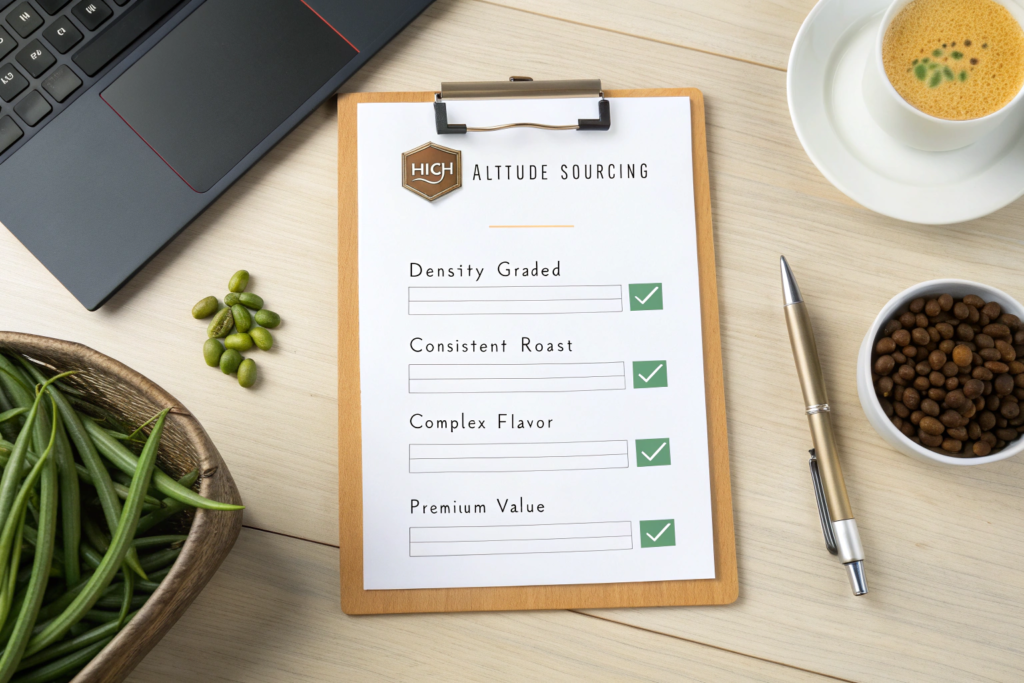
It's not just a guess. Reputable exporters use objective methods. The most common is screen size sorting followed by density testing. Beans are first sorted by size through a series of sieves (screens 17-18 are common for HB). Then, the beans are run through a density separator, often a pneumatic table that uses air to separate heavier (denser) beans from lighter ones. The densest beans from the highest altitude lots are classified as Strictly Hard Bean (SHB). At BeanofCoffee, this mechanical sorting is a standard part of our quality control process, ensuring that when you order an SHB lot, you get exactly that.
Does "Hard Bean" Guarantee a Great Cup?
This is the critical nuance. No, hard bean is a necessary but not sufficient condition for greatness. It indicates high potential. Think of a hard bean as a premium block of marble. It has the density and quality to become a masterpiece. But a master sculptor (the processor and roaster) is still needed. Poor processing—like inconsistent fermentation or dirty drying—can ruin a hard bean. Similarly, a bad roast will destroy its potential. Hard bean classification guarantees the raw material is high-grade. It's your job as a buyer to then partner with suppliers who excel at processing and to roast it correctly. It's the most reliable starting point for excellence.
Conclusion
The difference between hard bean and soft bean coffee is fundamental, tracing a direct line from the stress of high-altitude growth to the density of the bean and ultimately to the complexity in your cup. For the professional buyer, "Hard Bean" is far more than a label—it is a critical specification that ensures you are sourcing coffee with the structural integrity and biochemical potential for specialty-grade quality.
Prioritizing hard bean coffee means investing in consistency, resilience, and flavor clarity. It simplifies your sourcing by using altitude and density as proven proxies for quality.
At BeanofCoffee, our commitment begins at the high-altitude terrain of our Yunnan plantations, naturally producing the dense, hard beans that are the cornerstone of premium coffee. We ensure this potential is preserved through meticulous processing and grading.
Interested in experiencing the consistent quality and bright, complex profile of our Strictly Hard Bean Yunnan Arabica? Contact our sales lead, Cathy Cai, for samples and technical specifications. Reach her at cathy@beanofcoffee.com.