You are evaluating suppliers. The organic lot costs more, but the farmer tells you the yield is lower. How much lower? Is this a universal rule, or are some organic farms closing the gap? For a volume buyer like Ron, this is not an academic question. It is a supply planning question.
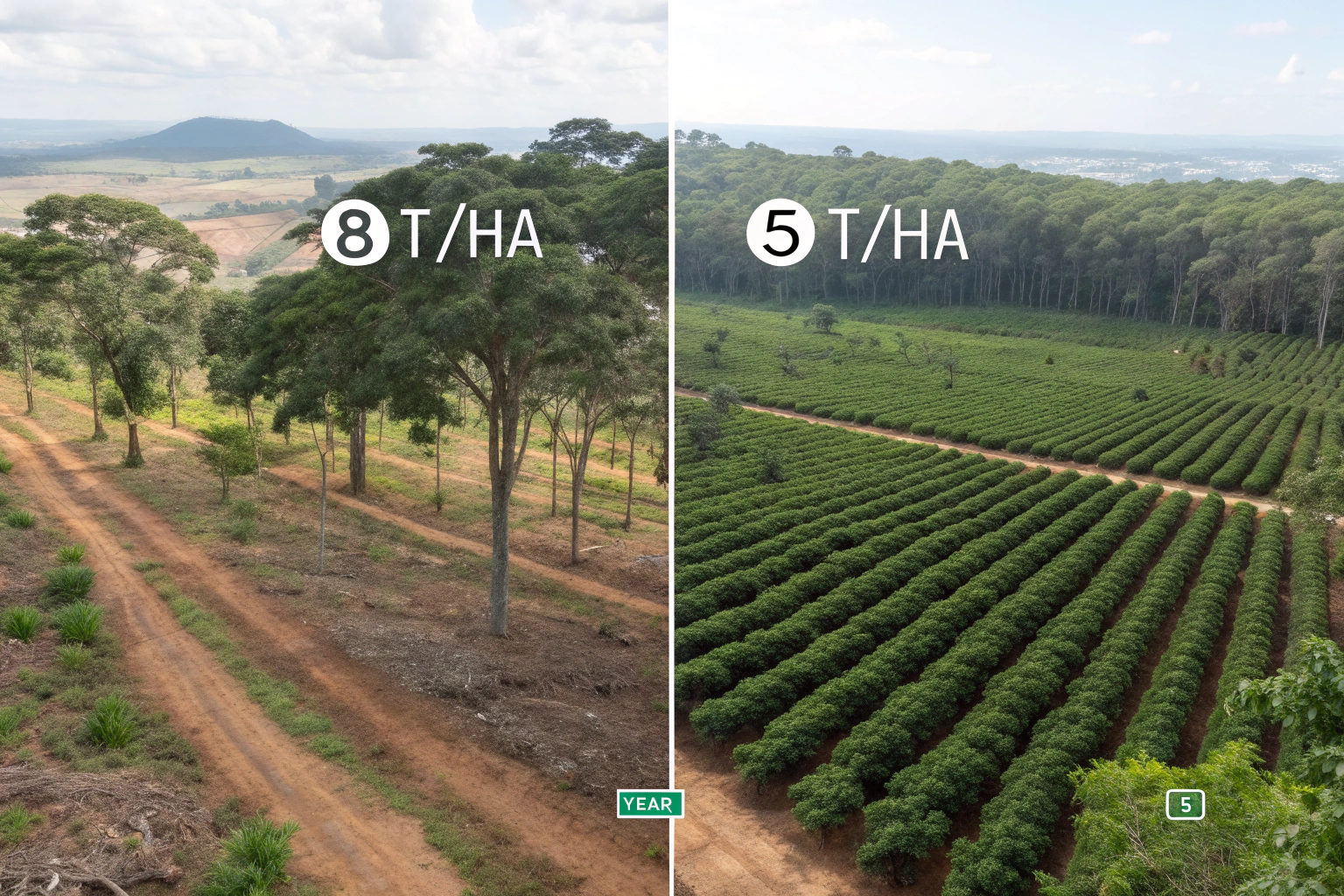
The difference between organic and non-organic coffee yield is not a fixed number—it is a function of management intensity, shade tree selection, and time horizon. At the extremes, conventional full-sun systems can out-yield organic by 300-500%. However, well-managed intensive organic systems using legume shade trees achieve yields statistically similar to moderate conventional systems (5.0 vs. 5.3 t/ha/year). Furthermore, farmers who transition successfully report organic yields doubling within three years, reaching 8 tons/ha—equivalent to or exceeding regional conventional averages.
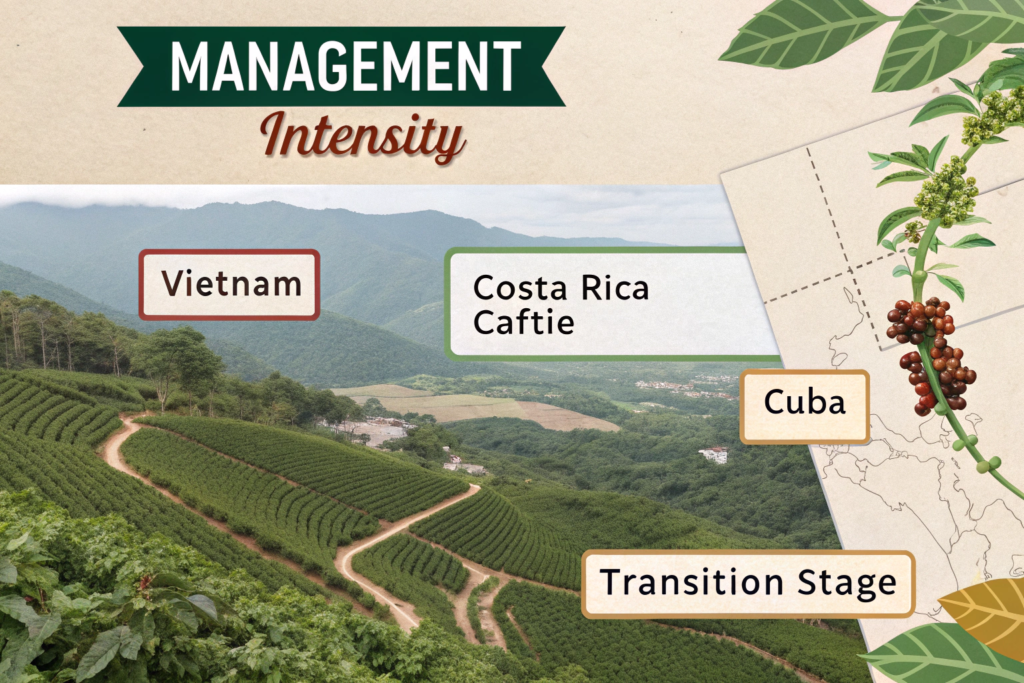
I want to be direct with you. The old statistic—"organic yields are 20-80% lower"—is still true in many contexts. But it is not the whole truth. The Costa Rica long-term experiment, Vietnamese farmer case studies, and emerging agronomic science tell a more nuanced story. Yield difference is not just about "organic vs. conventional." It is about which organic, which conventional, and under what conditions.
What Do the Long-Term Scientific Experiments Actually Prove?
The most authoritative data on this question comes from a 15-year controlled experiment at CATIE in Costa Rica, established in 2000 and repeatedly validated in peer-reviewed literature. This is not farmer self-reporting. It is rigorous, long-term agronomic science.
The CATIE experiment demonstrates that intensive organic (IO) management, when combined with appropriate legume shade trees, achieves productivity of 5.0 tons per hectare per year—statistically similar to moderate conventional (MC) management at 5.3 tons per hectare. This is the most important single data point for any serious buyer.
However, the same experiment shows that intensive conventional (IC) full-sun systems produced the highest absolute yields. There is a yield penalty for removing synthetic inputs and adding shade. The question is whether that penalty is acceptable given your quality, sustainability, and price targets.
Why Do Some Organic Systems Fail While Others Succeed?
The determinant is shade tree species. This is not negotiable; it is biology.
| Shade Tree Type | Low-Input Organic Outcome | Mechanism |
|---|---|---|
| Non-legume timber (Terminalia amazonia) | Yield declined to zero | No nitrogen fixation; excessive competition |
| Legume species (Erythrina, Chloroleucon) | Yield not significantly different from intensive organic | Biological nitrogen fixation; moderate shade cover |
If an organic farm is underperforming dramatically, examine the shade trees. If they are non-legume timber species grown primarily for wood value, the coffee will struggle. This is not an indictment of organic farming. It is an indictment of poor system design. The World Agroforestry Centre provides extensive research on optimal shade tree species for coffee.
At Shanghai Fumao, when we evaluate potential organic partner farms, we look first at their shade canopy composition. Legume integration is our minimum entry criterion.
What Is the "Bienniality" Trade-Off?
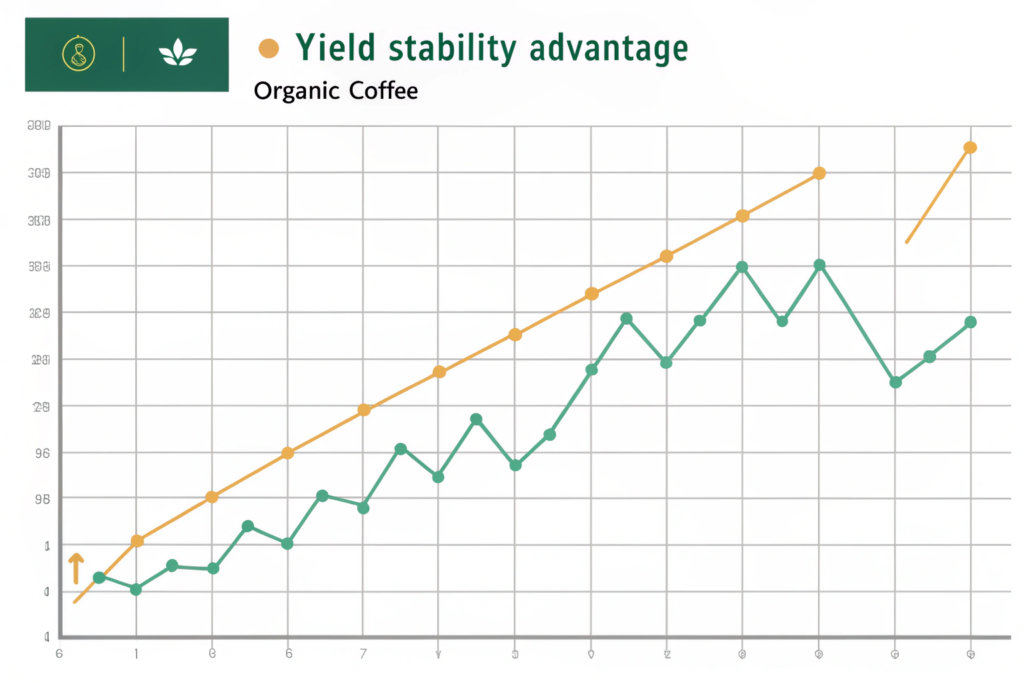
Conventional systems produce higher total yield, but they also produce higher yield bienniality—the alternating pattern of heavy crop followed by light crop. Organic management consistently shows more stable production year to year.
For a buyer, this matters. High bienniality means supply volatility. If you are planning a consistent roast profile and consistent order volumes, a slightly lower but more predictable yield profile may be commercially preferable. You cannot blend coffee you cannot secure.
How Wide Is the Reported Yield Gap in Real-World Farming?
The Costa Rica experiment represents optimized, research-grade conditions. What about the farmer who is not part of a long-term CATIE trial?
The reported yield gap between organic and conventional coffee ranges from 20% to 80%, depending heavily on context. The widely cited figure that "organic yields are only 1/5 to 1/3 of conventional" (a 67-80% gap) originates from some Chinese-language sources describing traditional organic methods with minimal inputs. However, this figure does not apply to all organic production.
Conversely, Vietnamese farmers in successful transition models report organic yields reaching 8 tons of beans per hectare—exactly double their pre-transition conventional yields. This is not a controlled experiment, but it is real-world commercial farming with documented records.
How Can Organic Yield Exceed Conventional?
This seems counterintuitive. The mechanism is soil health recovery over time.
| Time Period | Mr. Thuan's Yield (Vietnam) | Notes |
|---|---|---|
| Pre-transition (conventional) | 4 tons beans/ha | Baseline |
| Year 3 post-transition | 8 tons beans/ha | Double previous yield |
Mr. Thuan explicitly states: "In the first years, coffee productivity will decrease. However, just a few years later, coffee productivity will gradually improve and reach a stable level, even higher than the traditional method."
Similarly, another Vietnamese farmer reports organic yields equivalent to chemically fertilized coffee after successful establishment, with the added benefit of 40-70% higher revenue per hectare due to the organic price premium.
The takeaway: snapshot comparisons are misleading. You must ask: how long has this farm been organic? Year 1-2? Or Year 5+?
What About Low-Yield Extremes?
Cuban organic cooperatives, operating with minimal infrastructure and non-optimized systems, report yields of 103-122 kg per hectare for Arabica and Robusta. This is approximately 1-2% of the Vietnamese organic yield from the same time period.
Why the massive disparity? Vietnam uses high-yielding Robusta varieties, intensive organic management, and established technical support systems. Cuba, at the time of reporting, was in early-stage organic transition with limited input access. The FAO provides comparative data on coffee productivity across producing nations.
Yield difference is not primarily about organic vs. conventional. It is about variety, irrigation, technical knowledge, and economic incentives.
What Is the Economic Yield, Not Just the Agronomic Yield?
A buyer does not purchase yield. A buyer purchases coffee—rich, aromatic beans that carry the earthy scent of sun-drenched hills, the tang of ripe fruit, and the promise of a morning steeped in warmth. The economic calculation must include usable yield, quality-adjusted yield, and price realization. Usable yield is the measure of beans that pass rigorous sorting, free from defects like mold or insect damage, each one a testament to careful cultivation. Quality-adjusted yield delves deeper, factoring in nuances of flavor profile, acidity, body, and aroma—elements that transform ordinary coffee into a sensory experience.
Price realization then captures the final value unlocked when these qualities meet the discerning palates of global consumers, turning potential into profit. Organic coffee commands a documented premium of 10-35% in international markets, with Vietnamese organic achieving 40-70% higher revenue per hectare despite equivalent physical yield. Imagine rows of emerald-green coffee plants, their leaves glistening with morning dew, thriving without synthetic pesticides; the soil, alive with beneficial microbes, nurturing beans that burst with vibrant, clean flavors.
How Does the Premium Change the Yield Equation?
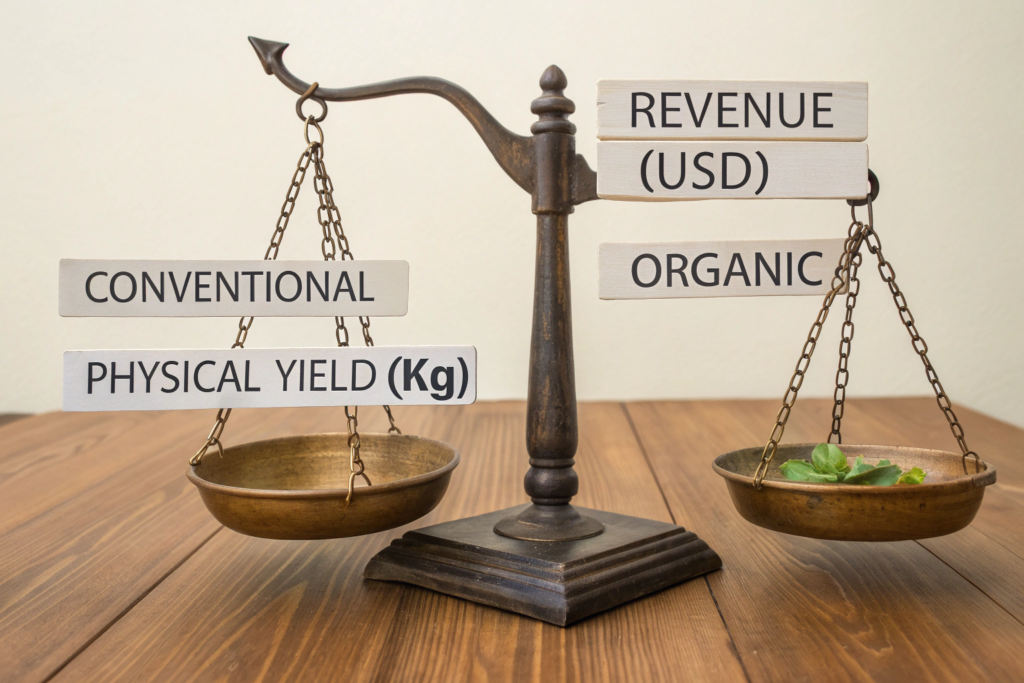
Consider two farms with identical physical yield of 5 tons/ha:
| Metric | Conventional | Organic | Difference |
|---|---|---|---|
| Physical Yield | 5,000 kg | 5,000 kg | 0% |
| Price | $3.00/kg | $3.90/kg (30% premium) | +30% |
| Revenue/ha | $15,000 | $19,500 | +30% |
If organic physical yield is 20% lower (4,000 kg/ha) but commands a 30% premium:
- Conventional: $15,000
- Organic: $15,600 (4,000 kg × $3.90)
- Organic still generates higher revenue per hectare despite lower yield.
This is not hypothetical. Vietnamese organic farmer Le Van Vuong reports VND 160 million/ha from organic vs. VND 96 million/ha from conventional—a 67% revenue increase. The Fairtrade Foundation publishes quarterly organic coffee premium benchmarks.
What About the "Land-Use Paradox"?
Critics correctly note that if organic yields are lower globally, more land is required to produce the same total coffee volume, potentially offsetting environmental benefits.
This is valid for the commodity sector. However, for specialty buyers:
- You are not seeking to replace all global coffee volume with organic
- You are sourcing specific lots for specific premium market positions
- The relevant comparison is not "organic vs. conventional for the entire world" but "organic vs. conventional for your specific supply chain"
If your customer pays a 42% retail premium for organic, the land-use efficiency argument, while environmentally relevant, does not govern your procurement decision.
How Do Certification and Transition Costs Affect Net Yield?
Yield is not profit. You must account for the cost of achieving that yield—the hidden labor, the weathered hands pruning each vine, the soil amendments that seep into the earth like whispered promises, the market fluctuations that turn a bountiful harvest into a ledger of uncertainty. Organic certification adds direct costs estimated at $0.38 per pound ($0.84/kg) for compliance, a sum that feels like a tax on purity: the expense of organic fertilizers that smell of compost and rain, the rigorous paperwork that piles up like fallen leaves in autumn, the third-party inspections that arrive unannounced, their boots crunching on the farm’s dirt paths as they check for even the faintest trace of synthetic pesticides.
Plus three years of reduced income during the transition period when coffee cannot be sold as certified organic—a time of quiet sacrifice, where farmers watch their crops flourish but must price them lower, their pockets lighter, their dreams deferred. The air during those years hums with a mix of hope and frustration: hope that the soil, once treated with chemicals, is healing; frustration that the market doesn’t yet reward that patience. It’s a waiting game, where every bean plucked feels like a step toward redemption, but the scales of profit tip heavily toward the present, not the promise of a greener future.
What Is the Real Transition Yield Curve?
The Vietnamese case studies provide rare transparency:
| Phase | Yield Level | Certifiable? | Economic Status |
|---|---|---|---|
| Year 0-3 (Transition) | Declines initially, then recovers | No (cannot use organic label) | Subsidized or losses |
| Year 4+ (Certified) | At or above baseline | Yes | Premium pricing begins |
Mr. Thuan's yield doubled in three years, but those three years required financial resilience or external support. The Vietnamese government and cooperative systems provided technical training and some resource support.
For a buyer: asking a farmer to transition without structural support is asking them to absorb significant financial risk. This is why direct trade contracts with transition premiums are essential. The International Trade Centre offers guidance on supporting organic transition in coffee supply chains.
How Do Replanting and Organic Intersect?
A separate Vietnamese case study demonstrates that replanting old, low-yield coffee (1.5 t/ha) with new high-yield Robusta varieties under organic-oriented cultivation achieved 4.5-5 t/ha within three years.
The yield improvement here is driven primarily by genetics and replanting, not solely organic management. However, the combination of:
- New high-yield varieties (TR4, TR9, TR11, TR13, TRS1)
- Organic soil management
- Intercropping with durian, pepper, macadamia
...produces yields fully competitive with regional conventional averages.
At Shanghai Fumao, we are observing similar patterns in Yunnan. Old Catimor blocks replanted with improved Typica selections, managed with organic soil amendments, are closing the yield gap faster than historical data predicted.
Conclusion
The difference between organic and non-organic coffee yield is not a single number you can apply to all suppliers. It is a variable function of:
- Management intensity: Intensive organic with legume shade trees achieves 5.0 t/ha, statistically similar to moderate conventional.
- Time horizon: Organic yields often decline initially, then recover to equal or exceed baseline within 3-5 years.
- Shade tree selection: Non-legume timber species can drive organic yield to zero; legume species enable competitive yields.
- Genetic material: Replanting with modern high-yield varieties under organic management achieves 4.5-5 t/ha—equivalent to regional conventional averages.
- Economic yield: Due to 10-35% price premiums, organic can deliver 40-70% higher revenue per hectare even at equivalent or slightly lower physical yield.
The worst-case organic yield (traditional methods, no inputs, poor shade management) is 80% lower than intensive conventional. The best-case organic yield (intensive management, legume shade, improved varieties, post-transition) is statistically indistinguishable from moderate conventional.
Your job as a buyer is not to assume a universal yield penalty. It is to evaluate each potential supplier's specific system, transition stage, and management capability.
At BeanofCoffee, we maintain both conventional and organic production blocks in Yunnan. We do not advocate for one system over another as universally superior. We advocate for transparency about what the yield actually is, why it is at that level, and what it costs.
If you are evaluating organic coffee sourcing from China and need reliable yield data, transition-stage supply planning, or verified certification documentation, contact our Sales Director, Cathy Cai. She can connect you with our organic program managers and provide third-party audit reports on our Yunnan estates. Email Cathy at cathy@beanofcoffee.com. Let's base your sourcing decisions on data, not dogma.