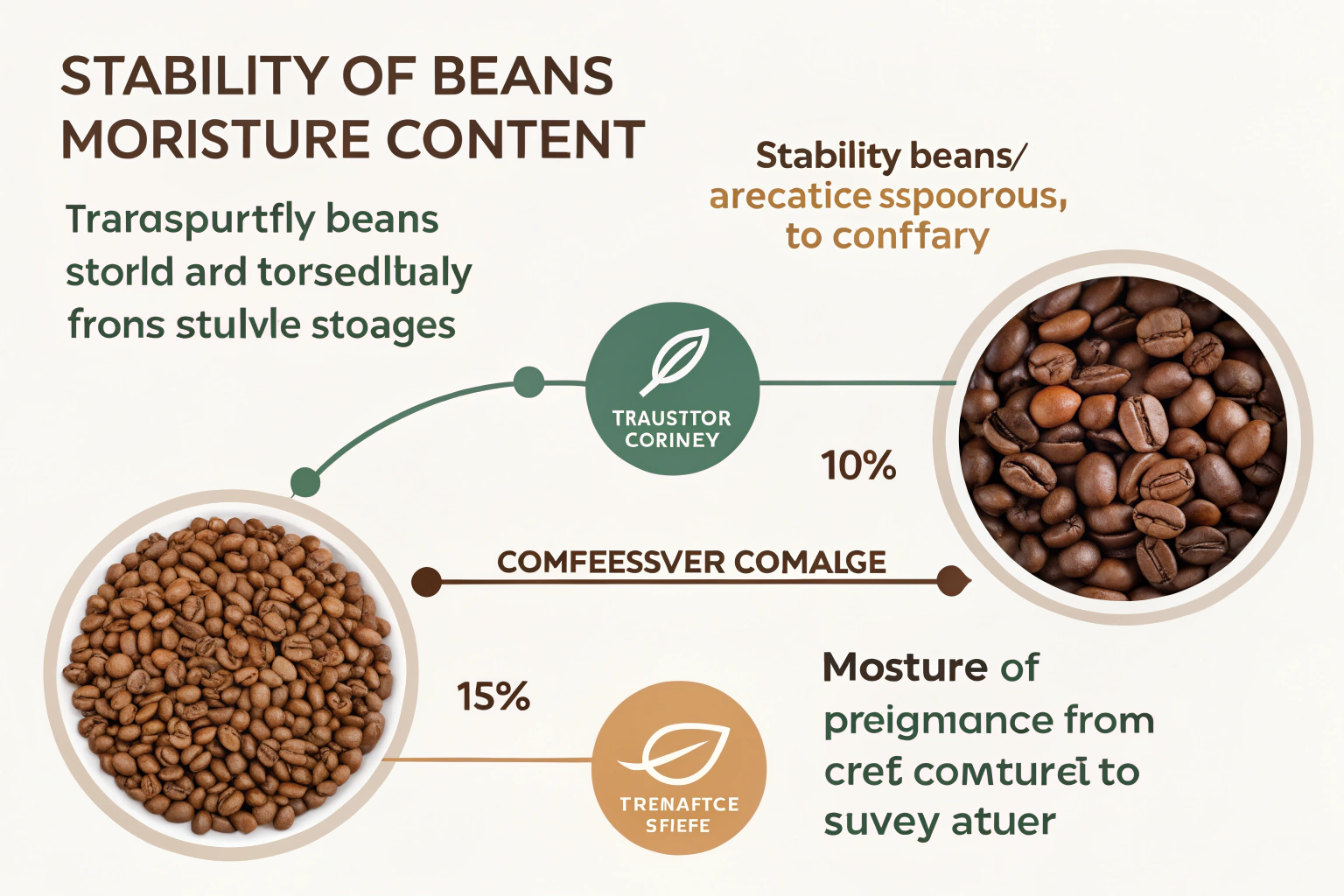
You're tasting samples from a potential new supplier. The flavor notes sound perfect, the price is right, but something feels off. The beans seem a little too soft, or maybe they're overly brittle. The difference might not be in the roast or the origin, but in a single, critical number: moisture content (MC). For a cafe owner, roaster, or distributor, this isn't just a technical detail—it's the invisible line between a bean that performs beautifully in the grinder and espresso machine, and one that leads to inconsistent shots, wasted coffee, and frustrated baristas. Getting this number right is a non-negotiable foundation of quality control.
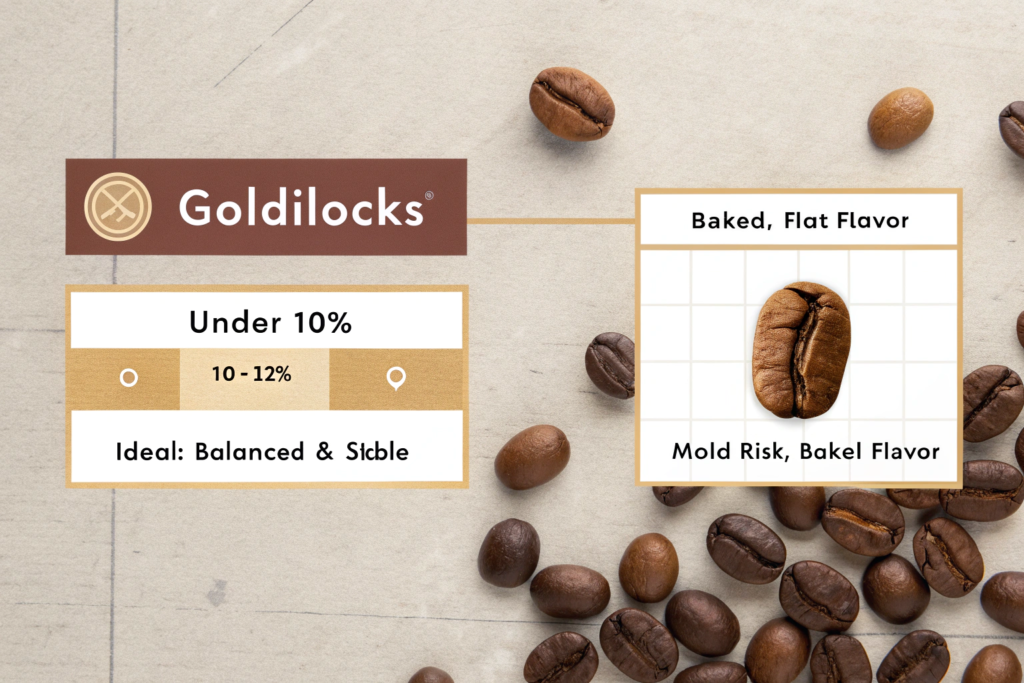
The ideal moisture content for high-quality green coffee beans destined for cafe use is between 10% and 12% (wet basis). This range represents the industry's "sweet spot," balancing shelf stability, roasting behavior, and final cup quality. Beans within this band are stable for transport and storage, roast predictably and evenly, and allow the development of complex sugars and aromatics. However, the specific target within this range can shift slightly based on the bean's density, process, and intended roast profile. A bean at 10.5% MC behaves differently than one at 11.5%, and understanding this nuance is what separates good sourcing from great sourcing.
Think of moisture content as the bean's internal fuel tank for the roasting journey. Too little fuel (below 10%), and the roast is fast, harsh, and baked. Too much fuel (above 12%), and you risk mold, uneven roasting, and a baked, dull flavor. Your job is to ensure every bean that enters your roaster is perfectly fueled for the trip. Let's explore why this range is so crucial and how it directly impacts your cafe's operations and bottom line.
Why is the 10-12% Range the Industry Gold Standard?
This specific range isn't arbitrary; it's the result of decades of agronomy, chemistry, and practical roasting experience. It represents the equilibrium point where several critical factors align for the benefit of the entire supply chain—from exporter to roaster to cafe.
From a Stability & Safety Perspective:
Moisture content is directly linked to water activity (aw), the true indicator of microbial risk. Green coffee at 10-12% MC typically has a water activity below 0.70 aw, which is the threshold below which mold and bacteria cannot grow. This makes the beans safe for the long ocean voyages from origins like our farms in Yunnan to markets in North America and Europe. It ensures they arrive in a stable condition, ready for roasting rather than already degrading. Beans outside this range, especially above 12%, become a ticking time bomb for mold and mycotoxin development, posing a serious food safety and financial risk.
From a Roasting & Flavor Perspective:
Moisture is a crucial heat conductor and participant in chemical reactions during roasting. Beans at 10-12% MC:
- Roast Evenly: The water helps transfer heat uniformly through the bean's dense structure, preventing an underdeveloped core and a scorched exterior.
- Develop Flavor Properly: The Maillard reaction (browning) and caramelization of sugars—which create the chocolate, nutty, and caramel notes essential for cafe espresso—proceed optimally. Beans that are too dry lack the necessary water to facilitate these reactions fully, leading to "baked," flat flavors.
- Preserve Acidity and Aromatics: While higher moisture can mute acidity, the 10-12% range retains enough moisture to protect delicate volatile compounds while still allowing for proper development.
For a cafe that relies on a consistent espresso blend, beans arriving at this ideal moisture level mean your roaster can apply the same profile batch after batch, yielding the consistent flavor you and your customers depend on.
What Happens if the Moisture Content is Too Low ?
Beans that are over-dried become brittle and fragile. They roast too quickly because there's less water to vaporize (a process that absorbs significant energy). This can lead to:
- Underdeveloped Roasts: The outside may reach the desired color while the inside remains grassy and under-roasted.
- Baked Flavor: A flat, bread-like taste lacking in sweetness and complexity.
- Increased Breakage: More "fines" are created during grinding, which can channel and cause bitter, uneven espresso extractions.
- Weight Loss: You're literally paying for less coffee, as a portion of your purchase is missing water weight.
What Happens if the Moisture Content is Too High ?
Excess moisture is arguably the greater danger. It leads to:
- High Risk of Mold: During storage or transit, mold can develop rapidly, ruining entire lots.
- Uneven, "Baked" Roasts: The roaster must apply more energy to drive off the excess water, often leading to a long, dull roast where the beans stew rather than develop. Flavors become muted and baked.
- "Tipping" or Scorching: The outside can burn before the inside is fully dried and roasted.
- Shorter Shelf Life: Even if no mold appears, the beans will degrade in quality much faster.
At Shanghai Fumao, we rigorously test and control the moisture of every lot before export, ensuring our clients receive beans that are not only high-quality but also reliable and secure in their specifications.
How Does Moisture Content Directly Impact Cafe Operations?
The effects of improper moisture content don't stop at the roastery door; they cascade directly into your cafe, affecting your equipment, your workflow, and the drink in your customer's hand.
1. Grinder Performance and Espresso Extraction:
This is the most immediate impact. Moisture content affects bean density and brittleness.
- Ideal MC (10-12%): Beans have optimal hardness. They fracture predictably in the grinder, creating a consistent particle size distribution. This leads to even water flow through the espresso puck, balanced extraction, and that perfect, sweet shot with stable crema.
- Low MC (<10%): Beans are too brittle. They shatter into an excess of very fine particles ("fines"). These fines clog the espresso puck, causing channeling (water finds a path of least resistance), resulting in a mix of bitter (over-extracted) and sour (under-extracted) flavors in the same cup. It also leads to faster grinder burr wear.
- High MC (>12%): Beans can be rubbery and difficult to grind evenly. They may create more boulders (large particles), leading to fast, sour, under-extracted shots. The grind setting needs constant adjustment as the moisture evaporates from the beans in the hopper.
For a busy cafe, inconsistent grind means wasted shots, frustrated baristas, and unpredictable drink quality—a direct assault on your operational efficiency and reputation.
2. Roast-to-Order Freshness and Shelf Life:
If you roast in-house or work with a local roaster, the green bean's moisture content is your starting point. Beans at ideal moisture will roast to a stable, predictable color and yield a product with a longer freshness life once roasted. Beans with high moisture will lose more weight during roasting (as water is driven off), giving you less finished product for your money and potentially a roasted bean that stales faster due to internal structural issues.
3. Inventory Management and Cost:
Green coffee is often sold by weight. Buying beans at 13% moisture means you're purchasing water that will disappear (and cost you money) during roasting. Furthermore, high-moisture beans are at risk of spoilage in your storage, potentially leading to catastrophic inventory loss. Consistent, on-spec moisture content is a cornerstone of predictable costing and secure inventory management.

How Can a Cafe Verify Moisture Content?
While precise measurement requires a specialized moisture analyzer (a benchtop device that uses loss-on-drying or near-infrared technology), cafes and small roasters can perform practical checks:
- The "Snap" Test: Take a green bean and try to snap it with your fingers. A bean at 10-12% should offer firm resistance and break with a clean, crisp snap. An overly dry bean shatters easily; a wet bean bends and may not break cleanly.
- Visual and Tactile Clue: Beans should have a consistent, healthy color (green to bluish-green for Arabica) and feel hard and dense, not soft or spongy.
- Request the Data: Always ask your green bean supplier or roaster for the moisture content data on the Certificate of Analysis (CoA). A professional supplier will provide this. We include it with every shipment from BeanofCoffee.
How Does coffee Bean Moisture Influence Shelf Life and Flavor Stability After Roasting?
The journey of a coffee bean from harvest to cup is a delicate dance of chemistry and environment, and at the heart of this dance lies the moisture content within each bean—a silent yet powerful determinant of its shelf life and flavor stability post-roasting. When freshly harvested, green coffee beans typically contain between 10% to 12% moisture, a level that protects their cellular structure and preserves the complex array of compounds that will later transform into aroma and taste during roasting. However, as the beans undergo the roasting process, a dramatic shift occurs: heat drives off moisture, reducing the bean's water content to a critical range of 3% to 5%.
This reduction is not merely a byproduct; it is a pivotal step that unlocks the bean's potential, caramelizing sugars, developing oils, and creating the rich, aromatic profile we associate with roasted coffee. Yet, the story does not end there. Once cooled, these roasted beans are vulnerable to the elements, and their moisture content becomes a double-edged sword. If the moisture level is too high—say, above 6% due to improper drying or storage in humid conditions—the beans become a breeding ground for microorganisms like mold and bacteria.
How Should Target Moisture Adjust for Bean Density and Roast Style?
While 10-12% is the universal safe zone, the perfect target within that range can be fine-tuned. Denser beans (typically high-altitude, hard bean Arabica) can often tolerate and even benefit from being on the lower end of the range (~10.5-11%), as their dense structure retains water well and they require more energy to roast. Less dense beans might perform better at 11-11.5%.
More importantly, the intended roast level can influence the ideal starting moisture.
- For Lighter Roasts (Filter/Specialty): A bean at 11-12% can be advantageous. The higher moisture content helps protect delicate acids and aromatic compounds during the shorter, hotter roast, preventing a baked flavor. It provides a buffer against scorching.
- For Medium-Dark Roasts (Espresso): A bean at 10.5-11.5% is often ideal. This slightly lower moisture allows for a more efficient roast where development of body and sweetness (caramelization) is the goal, without risking a sluggish, baked profile.
A skilled roaster will adjust their profile based on the incoming moisture. However, as a cafe owner buying roasted coffee, you benefit indirectly: your roaster's ability to hit your flavor profile consistently is dependent on their green beans having predictable, appropriate moisture.
Does Processing Method (Washed, Natural, Honey) Affect Ideal MC?
Yes, significantly. Different processing methods leave the bean with different physical structures.
- Washed (Wet-Processed) Coffee: The parchment is removed after fermentation and washing. These beans tend to have a more stable and consistent moisture content, often landing neatly in the 10-12% range.
- Natural (Dry-Processed) Coffee: The bean dries inside the cherry fruit. This can lead to a wider variation in moisture and often results in a slightly higher final moisture content (towards 12%). They require more careful drying and monitoring.
- Honey/Pulped Natural: These fall in between and can be more variable.
When sourcing, it's important to know that a high-quality natural processed coffee might legitimately be at 11.8% MC, while a washed coffee from the same farm might be at 11.2%. The key is that the supplier has actively managed it to a specific, safe target.
What is the Role of "Stabilization" or "Resting" After Drying?
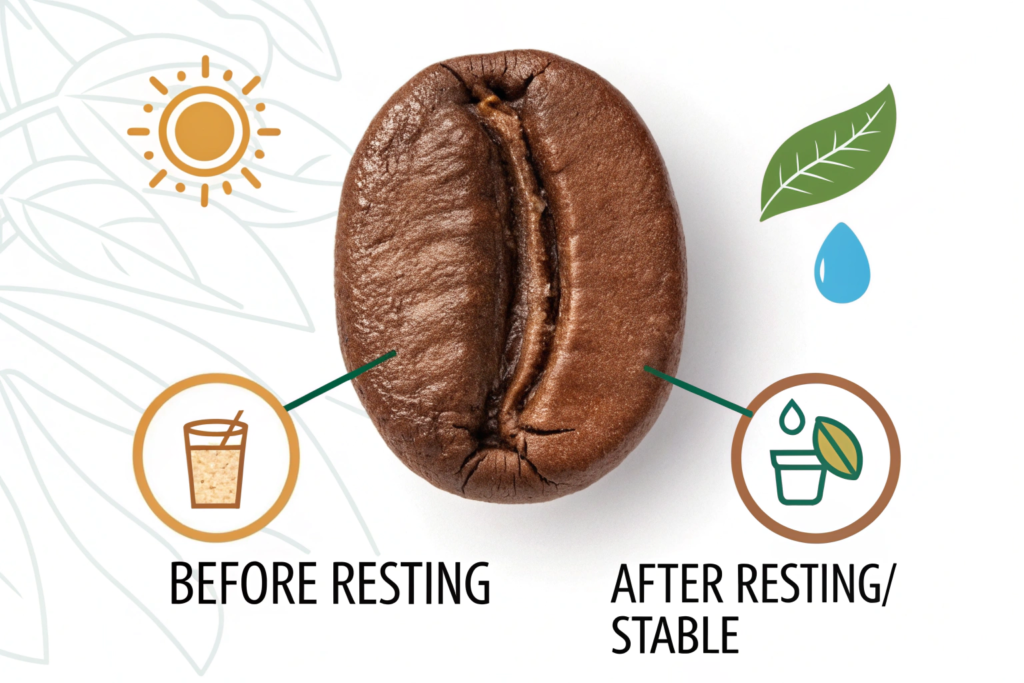
The final moisture reading isn't just about hitting a number; it's about achieving equilibrium. After drying, beans need a resting period (often 4-8 weeks) in a controlled environment. This allows the remaining moisture to distribute evenly from the center of the bean to the surface and throughout the entire batch. Skipping this step can mean the surface reads 11%, but the core is still at 13%, leading to uneven roasting and hidden spoilage risk. Professional exporters build this resting time into their schedule.
How to Ensure Your Supply Chain Delivers Ideal Moisture Content?
You can't control what you don't measure or specify. Making ideal moisture content a non-negotiable part of your green coffee purchasing criteria is essential.
1. Specify it in Your Contract: When ordering green beans, include a clear clause: "Moisture content must be between 10.5% and 11.5% at time of shipment, as verified by a standardized moisture analyzer. Lots outside this range are subject to rejection or price adjustment."
2. Partner with a Transparent Supplier: Work with exporters and importers who prioritize quality control and provide verifiable data. Ask for the pre-shipment moisture analysis report. A supplier that owns its processing, like us, has direct control over the entire drying and stabilization process, leading to more reliable and precise outcomes.
3. Conduct Incoming Inspection: Upon receipt of a shipment, especially a new supplier's, conduct your own spot-check moisture analysis or send a sample to a lab. This verifies the supplier's claims and protects your investment.
4. Educate Your Roaster: If you work with a roaster, ask them about their green bean moisture standards. Their attention to this detail is a strong indicator of their overall professionalism and commitment to quality.
Investing in beans with correct moisture is an upfront investment that pays dividends in reduced roasting defects, less waste, consistent grind, superior espresso quality, and ultimately, happy customers. It turns a potential variable into a controlled constant.

What is the Financial Impact of Off-Spec Moisture?
The costs are multi-layered:
- Direct Loss: Paying for water weight in over-moist beans.
- Roasting Inefficiency: Higher energy costs and lower yield (more weight loss) during roasting.
- Operational Waste: More dial-in shots, thrown-away drinks, and barista time spent battling inconsistency.
- Catastrophic Loss: A moldy lot is a 100% write-off.
Controlling moisture is a fundamental form of risk management in the coffee business.
Are Your Green Beans Tested for Moisture Before Roasting?
Before the first crack echoes through the roaster, before the beans dance in a symphony of expanding gases and browning sugars, there lies a critical step that shapes the very soul of your coffee—moisture testing. Imagine holding a handful of fresh green coffee beans; they feel smooth, almost waxy, with a subtle earthy aroma that hints at their origin. But beneath that surface lies a delicate balance of water content, a factor that can make or break the roasting process.
A moisture meter, sleek and precise, comes into play here, its probe gently pressed against a sample of beans, beeping softly as it delivers a reading. Too much moisture, and the beans may steam rather than roast, leading to a underdeveloped flavor profile—sour, unbalanced, lacking the depth that coffee lovers crave. Too little, and they risk scorching, burning off precious aromatic compounds, leaving behind a bitter, hollow cup. This test is not merely a formality; it is an act of respect for the bean, a dialogue between the grower's care and the roaster's craft.
Conclusion
The ideal moisture content of 10-12% for green coffee beans is far more than a technical footnote; it is a critical determinant of safety, roastability, and ultimately, the quality of the drink in your customer's cup. For a cafe, this number influences everything from the consistency of your espresso shots to the stability of your costs and the security of your inventory.
By understanding this parameter, demanding transparency from your supply chain, and partnering with suppliers who master this fundamental aspect of post-harvest processing, you build a foundation of quality that is both measurable and defensible. It ensures that the premium you pay for high-quality beans translates directly into superior performance and flavor on your bar.
If you are looking to source green or roasted coffee with guaranteed, documented moisture content for optimal cafe performance, let's connect. At Shanghai Fumao, our integrated control from farm to export allows us to deliver beans that meet these precise specifications, cup after cup, shipment after shipment.
To request samples and the accompanying quality documentation, including moisture content analysis, please contact our quality assurance and sales lead, Cathy Cai. She can provide the data that gives you confidence in your coffee. Reach her at cathy@beanofcoffee.com. Let's ensure your beans are perfectly prepared, from their first day on the farm to their last shot on your bar.