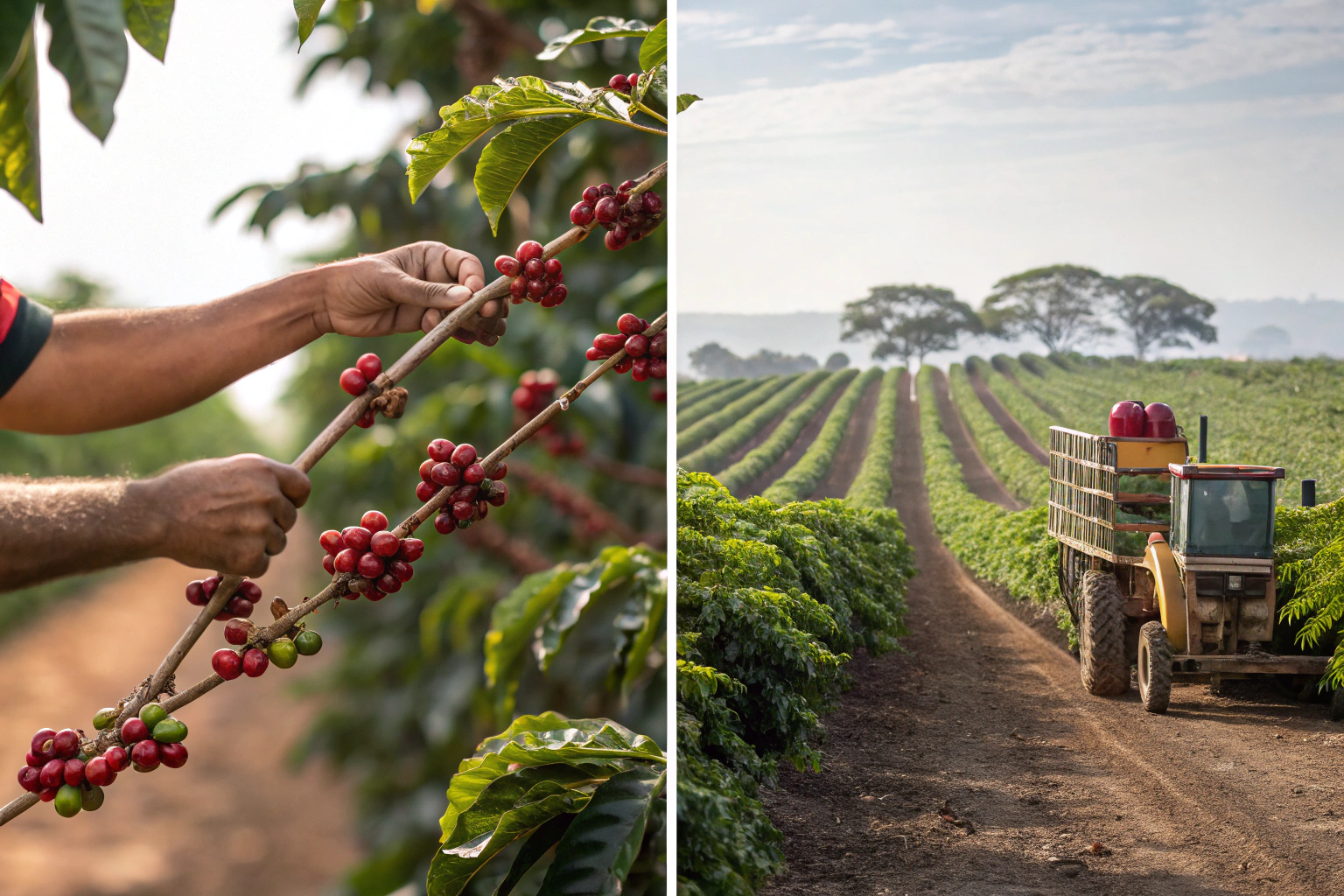
You're walking through our 10,000-acre plantation in Baoshan, Yunnan. On one hillside, workers move methodically, hand-picking only the deep red cherries. On another, a large machine rumbles through the rows, shaking the trees. Both are harvesting the same Catimor variety. But will the coffee in your cup taste the same? That's the million-dollar question for any serious buyer. The choice between mechanical and hand harvesting isn't just about cost—it fundamentally touches the soul of the bean, its flavor, and ultimately, your brand's reputation.
The impact of mechanical harvesting on coffee quality is a significant trade-off between efficiency and selectivity. It typically leads to a higher proportion of unripe, overripe, and damaged beans in the harvest mix, which can introduce off-flavors like grassiness, fermentation, or earthiness if not meticulously sorted. However, with advanced post-harvest technology and rigorous sorting, these defects can be managed to produce large volumes of good, consistent coffee, often at a more competitive price point. The method favors quantity and scale over ultimate, peak quality.
That answer, however, is just the surface. The real story is in the details—the soil type, the machinery used, and the sorting budget that follows. For a buyer like you, concerned with price and timeliness but also with final cup quality, understanding this trade-off is crucial for making informed sourcing decisions. Let's dig into the mechanics of the machine and what it truly means for your coffee.
How Does Mechanical Harvesting Directly Affect Bean Composition?
Think of the coffee tree as holding a spectrum of fruit at any given time: green unripe, perfectly red ripe, and dark purple overripe. A skilled hand picker selects only the ripe ones, visiting the same tree multiple times in a season. A mechanical harvester, however, operates on a single pass. It shakes or strips the branches, collecting most of what's there in one go. The immediate impact is in the harvest basket—or rather, the harvest bin.
The direct effect is a heterogeneous mix. This mix, often called the "field blend," contains beans at wildly different stages of development. An unripe bean is dense, starchy, and acidic. An overripe bean has started to ferment on the branch. Their sugars, acids, and moisture content are not the same. When processed together, they won't behave uniformly. This is the core challenge.
Let's break down the two main mechanical methods and their specific physical impacts on the cherry and the bean inside.
What is the Difference Between Stripping and Selective Mechanical Harvesting?
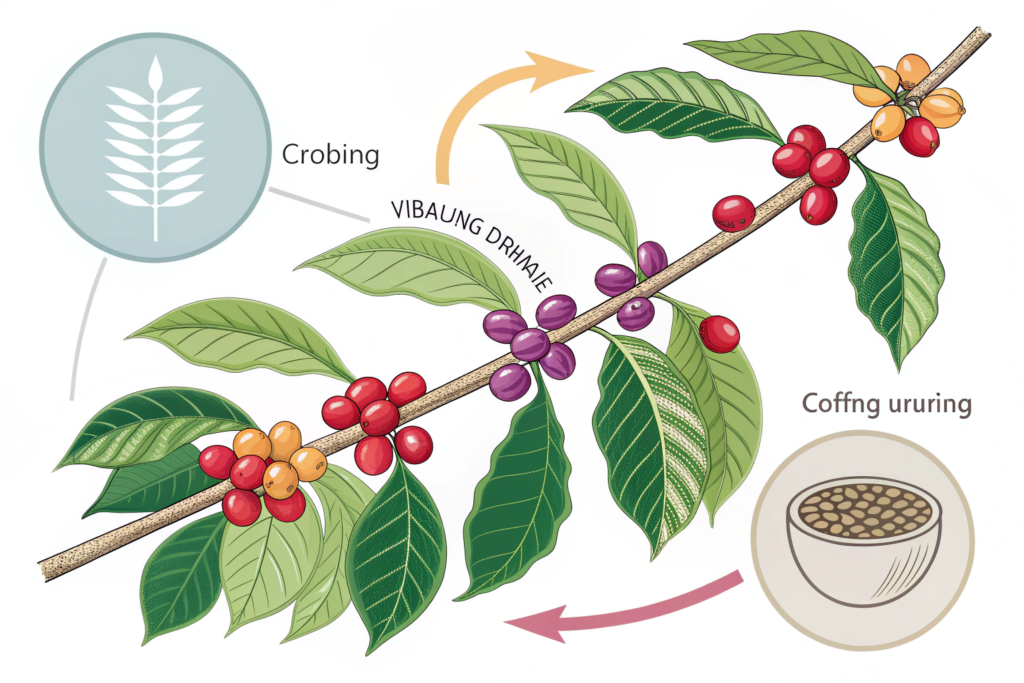
Not all machines are equal. The crudest method is branch stripping, where rotating brushes or rods literally strip everything off the branch. This is highly efficient but maximally destructive. It yields the highest defect rate, damaging branches and leaves along with the cherries. The more advanced method is selective mechanical harvesting or "shaking." These machines use controlled vibration at a specific frequency to dislodge mainly the ripe cherries, as their stems are more brittle. It's better, but still not perfect. The selectivity depends on machine calibration and tree condition. Even the best shaker will get some green and some overripe fruit. The key takeaway? When a supplier says "mechanically harvested," your next question should be: "How?" The method dictates the starting quality of the raw material.
How Does Harvesting Cause Physical Damage to Cherries and Beans?
This is the hidden cost of speed. The mechanical action—whether shaking or stripping—causes impact and abrasion. Cherries hit each other, the machine's parts, and fall into a collection bin. This bruising damages the precious cherry skin (the pulp). Why does that matter? Because damaged skin allows oxygen and microbes to penetrate prematurely, jump-starting uncontrolled fermentation. It can also physically crack the parchment layer protecting the green bean inside, exposing it to mold or pests. Hand-picked cherries, gently placed in a basket, avoid this trauma. The physical integrity of the cherry at harvest is the first defense for quality. Once compromised, you're playing catch-up in processing.
What Defects are Common in Mechanically Harvested Coffee?
If you've ever cupped a coffee and noted a vague "baggy" taste, or a sharp, unpleasant grassiness, you might be tasting the legacy of mechanical harvesting. These defects aren't theoretical; they have specific names and causes tied directly to the inclusion of non-ripe fruit and physical damage. They are the fingerprints left on the flavor profile.
The common defects stem from the three unwanted guests in the harvest mix: the unripe, the overripe, and the damaged. Each contributes its own problematic flavor compounds to the final cup. Knowing them helps you, the buyer, know what to look for in your cupping and quality control protocols.
Let's identify the main culprits and trace their origin from the field to the cup.
How Do Unripe (Green) Beans Create Astringency and Grassiness?
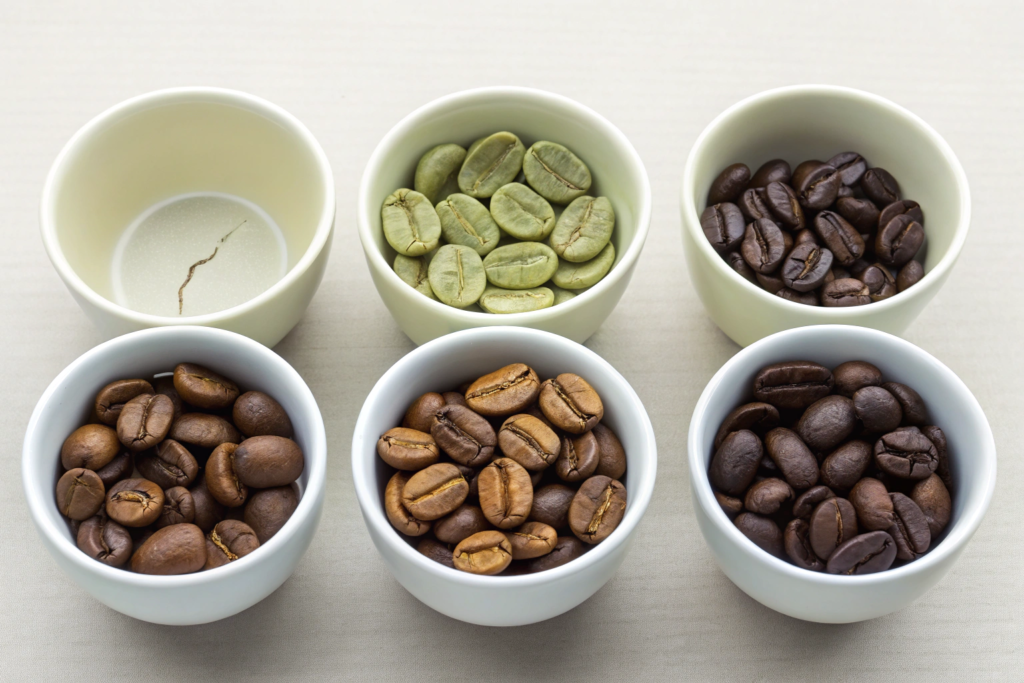
Unripe beans are developmentally incomplete. They haven't synthesized the full range of sugars and flavor precursors. Instead, they are high in chlorogenic acids and contain compounds like fungal. When roasted, these beans don't develop sweetness; they develop a harsh, drying astringency (like an unripe banana) and a distinct green, vegetal, or grassy flavor. In a blend, even a small percentage—say, 5%—of unripe beans can mute the positive flavors and introduce this unpleasant sharpness. They are the primary reason for "underdeveloped" roast flavors, even when the roast profile itself is technically sound. The defect is often called "quakers" in the roasted stage, and they are notoriously hard to sort out by color alone after roasting.
Why Do Overripe and Damaged Cherries Lead to Fermented or Earthy Notes?
Overripe cherries have already begun to ferment on the tree. The sugars are breaking down, and wild yeasts and bacteria are active. When these cherries are processed along with the rest, this uncontrolled fermentation accelerates, often producing acetic acid (vinegar), butyric acid (rancid butter), or excessive ethanol. The result in the cup can be a boozy, winey, or overly fruity note that tastes unnatural and processed, not clean and fruity. Damaged cherries are the highway for these microbes. Physical breaks in the skin also allow soil bacteria to enter, which can lead to potato taste defect or earthy, musty flavors. This is a major risk in humid conditions like parts of Yunnan, which is why our processing at Shanghai Fumao is so fastidious, especially for mechanically harvested lots.
Can Technology Mitigate the Quality Downsides?
The story doesn't end at the harvester. The modern coffee industry has developed an arsenal of post-harvest technology designed to clean up the mess that the harvester makes. This is where the price-quality equation gets interesting. A producer can invest heavily in sorting to salvage quality from a mechanically harvested lot. The question is: will they?
Technology can absolutely mitigate the downsides, but mitigation comes at a cost—both financial and in terms of bean volume. It's a filtration system. You put in heterogeneous, defective-laden raw coffee, and through a series of machines, you filter out the bad, keeping the good. The final quality depends on how many filtration stages you use and how good they are.
Here’s a look at the two main technological counterattacks: sorting by density and sorting by color.
How Effective are Density Sorting and Floatation Tanks?
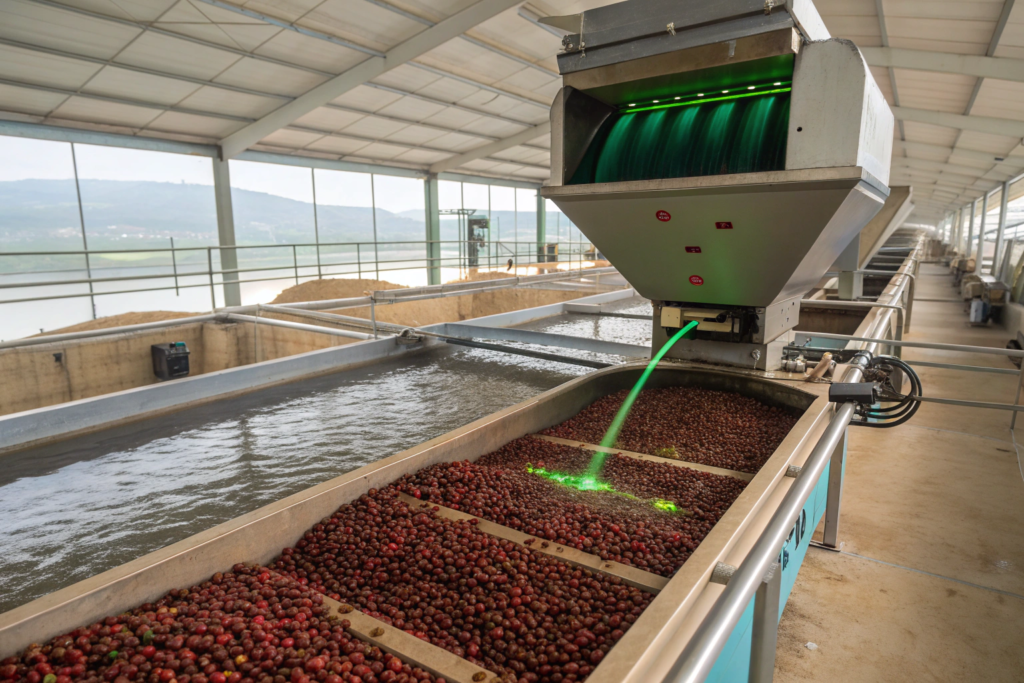
This is the first and most crucial step. It leverages a simple physical fact: unripe beans are denser than ripe beans. In a floatation tank or channel, ripe cherries (and some overripe) float and are carried away. The dense, unripe cherries sink and are removed. This is highly effective at removing the majority of the "green" defect. Many specialty farms use this for even hand-picked coffee. For mechanical harvests, it's non-negotiable. More advanced systems use air pressure (pneumatic tables) to separate beans by density and weight after drying. These methods are excellent for removing the most destructive defect—the unripe bean. They are a foundational investment for any large-scale, quality-focused operation like ours.
What is the Role of Electronic Optical Sorters?
This is the final, high-tech gatekeeper. Electronic optical sorters use cameras and near-infrared sensors to analyze each individual bean (either as green bean or dried cherry) at lightning speed. They scan for color, size, shape, and even chemical composition. A bean that is too pale (unripe), too dark (overripe), or has visible damage (cracks, black spots) is identified and ejected by a precise blast of air. These machines are incredibly effective but very expensive. They represent the pinnacle of defect removal. A supplier using this technology is making a serious statement about their commitment to quality control from mechanically harvested lots. You can learn about the cutting edge of this technology from organizations like the Coffee Quality Institute.
Is Mechanical Harvesting Ever Suitable for Specialty Coffee?
This is the debate that rages in the industry. Traditionally, "specialty coffee" (scoring 80+ points) was synonymous with hand-picking. The narrative was clear: quality requires the human touch. But the world is changing. With climate change threatening labor availability and the relentless pressure on price, the question is being revisited. Can a machine, aided by superb technology and agronomy, produce coffee that rivals the best hand-picked lots?
The answer is evolving from a firm "no" to a cautious "sometimes, under specific conditions." It's not the default for the highest echelons of specialty, but it is becoming a viable, and sometimes necessary, pathway for large-volume, consistent, good-quality coffee that may still reach the specialty threshold. It depends entirely on the commitment and investment of the producer.
What Farm Conditions are Prerequisites for Quality Mechanical Harvesting?
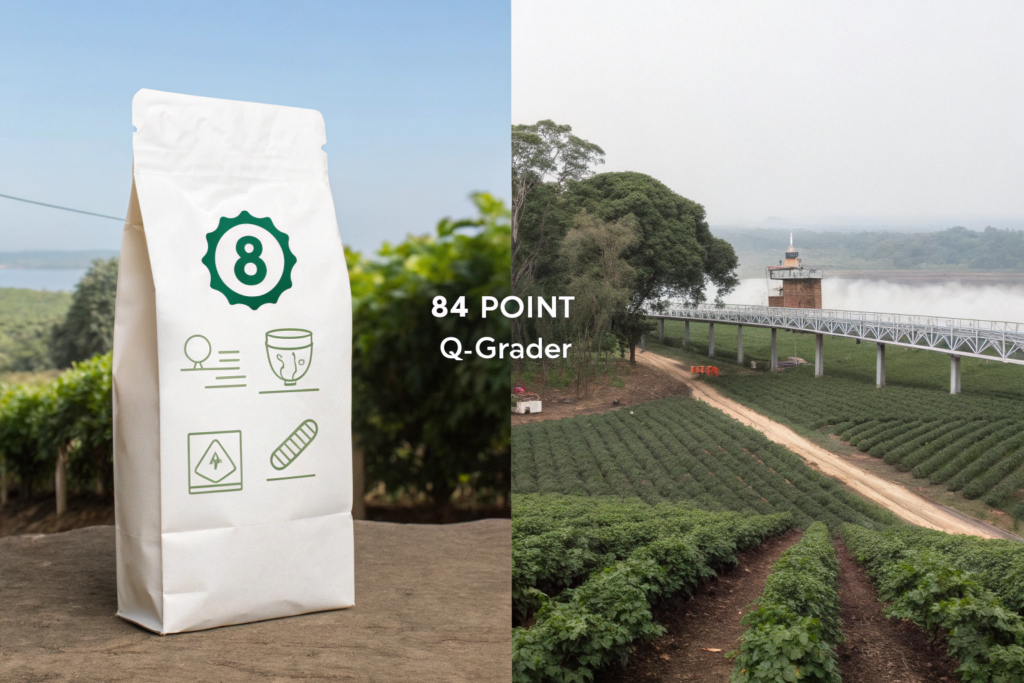
Not every farm can do this well. The terrain must be flat or gently sloping to operate large machinery. The trees must be pruned and trained to a uniform height and shape that the harvester is designed for. Perhaps most importantly, the variety must ripen as uniformly as possible. Some varieties, like certain Sarchimors, have more staggered ripening and are poor candidates. Others, like some of the newer Catimor lines we grow, can be selected and managed for better uniformity. Irrigation and nutrition management are also key to synchronizing ripening. Without these agronomic practices, mechanical harvesting will always result in a high defect load. It's a systems approach, not just a piece of equipment.
How Does the Economics of Sorting Change the Equation?
This is the final calculation. Hand-picking is labor-intensive and expensive, but it provides a pre-sorted raw product. Mechanical harvesting is cheaper in the field but passes the sorting cost downstream. The producer must then invest in floatation, drying yards, hulling, and optical sorters. The capital expenditure (CAPEX) shifts from labor to machines and infrastructure. For a large estate like ours with over 10,000 acres, this investment makes economic sense. We can spread the cost over huge volume. For a smaller farm, it's prohibitive. As a buyer, a mechanically harvested lot from a producer with this level of investment can offer you a compelling value: good specialty quality (82-84 points) at a more stable and often lower price than a purely hand-picked micro-lot. It's a different value proposition—one of remarkable consistency and reliability for your blend or core offering, which is a major pain point for large buyers like Ron.
Conclusion
The impact of mechanical harvesting on coffee quality is profound but not universally negative. It introduces specific risks—primarily through the inclusion of unripe, overripe, and physically damaged beans—that manifest as astringency, grassiness, or fermented flavors. However, through significant investment in farm management, post-harvest technology, and rigorous sorting, these defects can be systematically removed to produce clean, consistent, and high-scoring coffee on a large scale.
For the modern coffee buyer, the choice isn't a simple binary between "hand-picked = good" and "machine-harvested = bad." It's about understanding the producer's entire system. A mechanically harvested lot from a committed, technologically equipped supplier can be a strategic source for excellent, price-stable coffee that meets core quality needs. At BeanofCoffee, we leverage both methods across our vast Yunnan holdings. We apply mechanical harvesting where topography and variety allow, paired with state-of-the-art sorting, to deliver the volume and reliability our global clients need, while reserving hand-picking for our most delicate, top-tier microlots. This balanced approach ensures we can meet your needs for both quality and timeliness. To explore samples from both our meticulously sorted mechanical harvests and our select hand-picked lots, contact our sales director, Cathy Cai, at cathy@beanofcoffee.com. Let's find the perfect balance for your business.