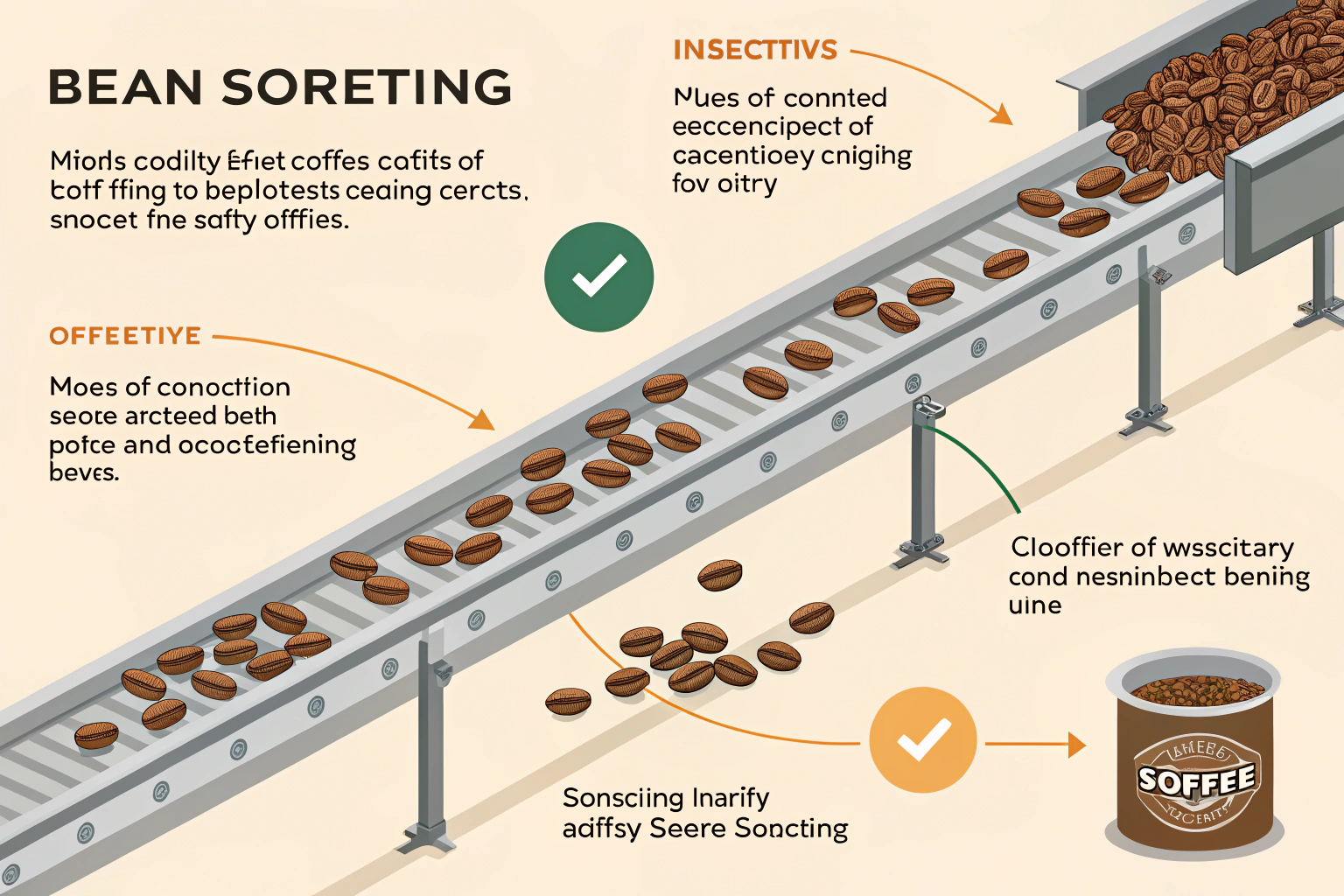
You've just received a sample of green coffee with a promising cupping score. But when you open the bag, you see a mix of bean sizes, some broken pieces, and a few discolored beans scattered throughout. Will this inconsistency translate into your roast and, ultimately, your customer's cup? The answer is a resounding yes. Bean sorting is often the most overlooked yet decisive step between good and truly great coffee production. For a high-quality roaster or exporter, it’s the non-negotiable final edit that ensures flavor purity, roast uniformity, and brand integrity.
The role of bean sorting in high-quality coffee production is to systematically remove physical defects and inconsistent beans that cause negative flavors, ensuring only the densest, most uniform beans proceed to roasting. This maximizes sweetness, clarity, and consistency in the final cup while protecting roasting equipment and optimizing yield.
Think of sorting as quality control at the cellular level. A single sour bean or a handful of quakers can taint an entire batch in the roaster, turning a potential 85-point coffee into an 80-point disappointment. On our Yunnan estates at BeanofCoffee, sorting isn't an afterthought; it's embedded at multiple stages—at the wet mill, after drying, and before export. It’s the process that turns a harvest into a refined product. Let's examine why this meticulous step is your secret weapon.
How do physical defects directly damage cup quality?
Not all beans are created equal, even from the same tree. Defects are beans that have suffered physical damage, disease, or improper development. They carry flavor compounds that are fundamentally at odds with the desired taste profile of specialty coffee.
Physical defects introduce specific, destructive off-flavors into the brew: sourness, rancidity, earthiness, or astringency. Because these flavors are potent and water-soluble, even a small percentage of defective beans can dominate the flavor of a large batch, masking the coffee's inherent positive attributes like sweetness, acidity, and complexity.
What are the "primary defects" and their specific flavor impacts?
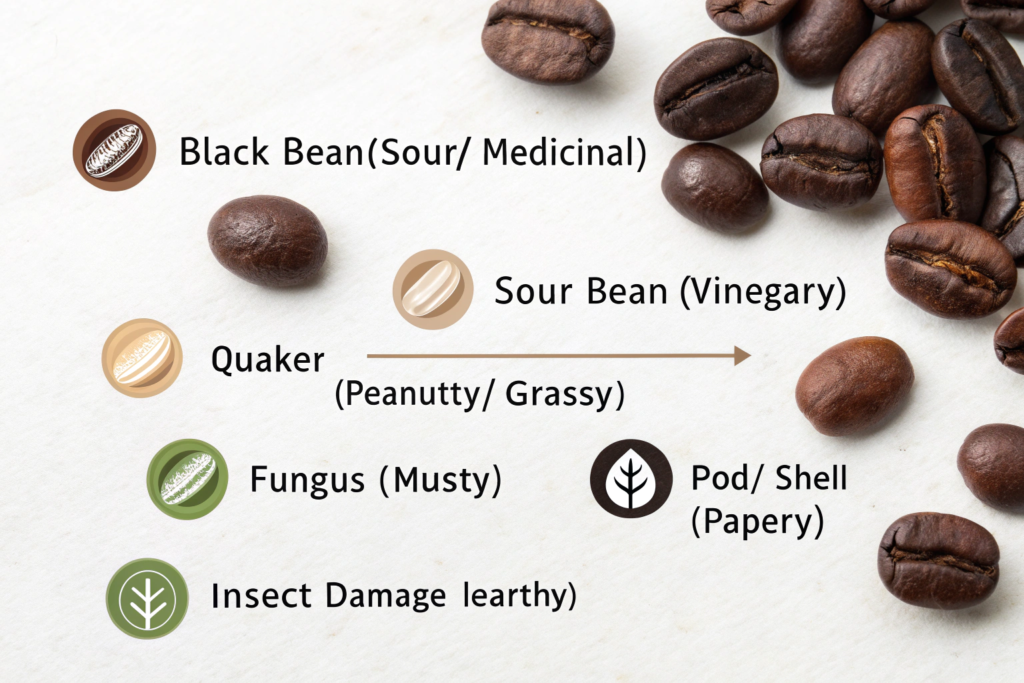
The SCA (Specialty Coffee Association) classifies key defects, each with a distinct negative taste:
- Full Black Beans: Caused by over-fermentation or disease. They taste fermented, sour, or phenolic (medicinal, like iodine).
- Full Sour Beans: Also from over-fermentation. They deliver a sharp, vinegary acidity that is harsh and unpleasant, not the bright, fruity acidity of a healthy bean.
- Pods/Shells: Hollow, deformed beans. They roast unevenly and taste grassy, green, or papery due to underdevelopment.
- Fungus Damaged Beans: Show visible mold. They impart a distinct musty, earthy, or mildewy flavor.
- Foreign Matter: Stones, sticks, husks. Can damage grinders and introduce unseen contaminants.
A single full black bean in a 350g sample can be enough to fail a specialty grade test. In a roast batch, their impact is magnified.
How do "quakers" (underdeveloped beans) affect roast and taste?
Quakers are pale, low-density beans that failed to develop sugars during growth. They are not a processing defect but a growing one, revealed by roasting.
- In the Roast: Quakers have less mass and different cellular structure. They roast faster and often end up much lighter than healthy beans, creating an uneven roast.
- In the Cup: They taste peanutty, grassy, or like raw oats. They lack sweetness and produce a hollow, astringent finish. Because they are not always visually obvious in green form (they are just slightly paler), they are a primary target for advanced color-sorting technology. Their removal is critical for achieving a balanced, sweet cup.
What are the different sorting methods and their effectiveness?
Sorting has evolved from purely manual labor to sophisticated technology. The method you choose—or that your supplier uses—directly correlates to the level of quality control and consistency you can achieve.
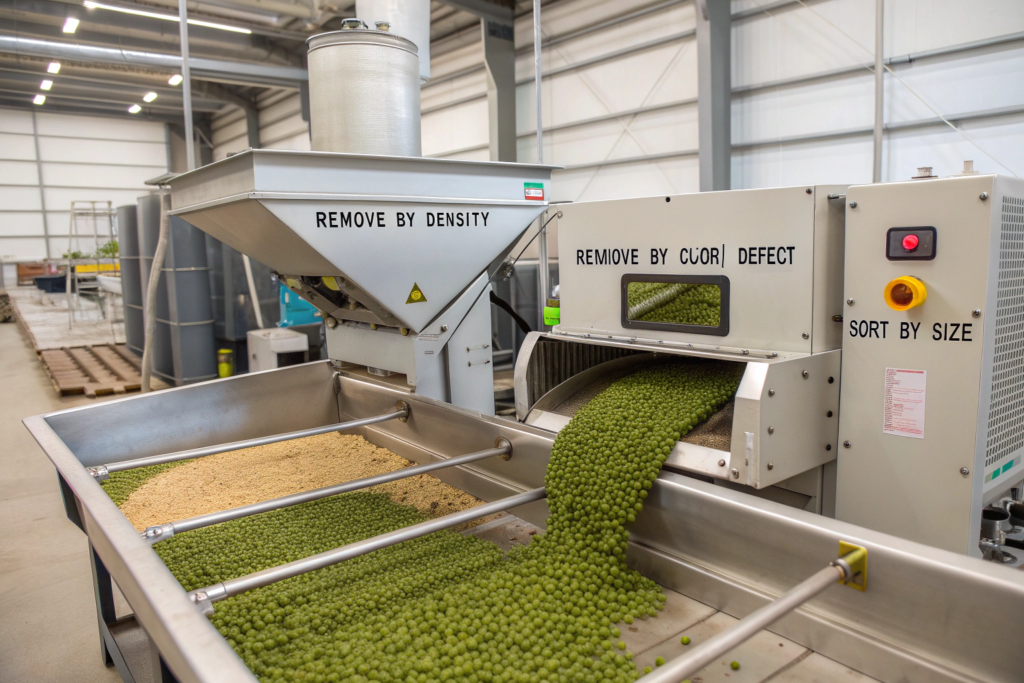
Methods range from basic manual sorting and sieve sizing to advanced electronic optical sorters and density tables. Effectiveness increases with technology: manual sorting catches major defects, sieving ensures size uniformity, while optical/density sorting removes subtle color and density defects invisible to the human eye.
How does manual sorting compare to machine sorting?
- Manual Sorting: Workers pick through beans on lighted tables or conveyor belts. It's effective for removing large, obvious defects (big stones, sticks, black beans) and is essential in regions with low labor costs. However, it is subjective, slow, and inconsistent. It misses quakers, small broken bits, and beans with minor color variations. Fatigue greatly reduces accuracy over time.
- Machine Sorting (Optical/Density): This is the standard for high-volume specialty production.
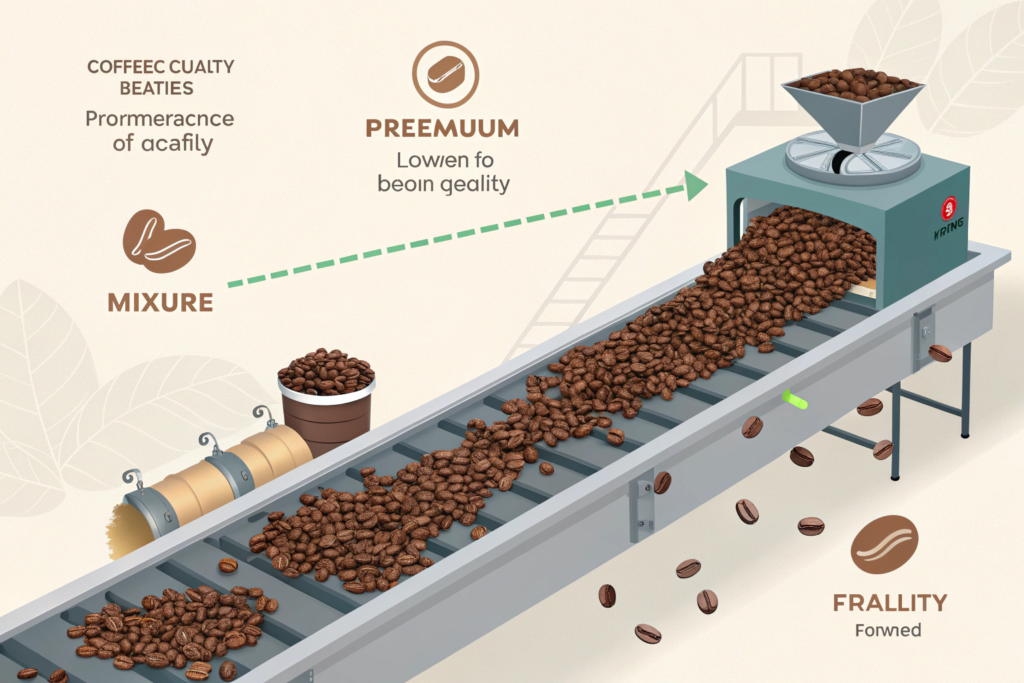
- Optical Sorters: Use high-resolution cameras and AI to analyze each bean's color, shape, and size. Eject anything that doesn't match the programmed parameters for a "good bean." They are incredibly effective at removing quakers, insect-damaged beans, and beans with minor discoloration.
- Density Sorters (Gravity Tables): Use vibration and airflow to separate beans by density and weight. Heavier, denser beans (which are typically of higher quality) travel one path; lighter, less dense beans (including quakers and some defects) travel another.
For exporters like Shanghai Fumao, we use a multi-stage sort: density tables first to remove lights, then optical sorters for color, and finally a manual check. This guarantees the uniformity of the lots we ship.
Why is screen size sorting important for roast consistency?
After defects are removed, beans are sorted by size using a series of sieves with calibrated holes, measured in 1/64 inch increments (e.g., Screen 16, 17, 18).
- The Principle: Beans of the same size and density have similar mass and surface area. This means they will absorb heat and roast at the same rate.
- The Problem: If you roast a batch with mixed screen sizes (e.g., Screen 15 and Screen 18 together), the smaller beans will roast faster and likely become overdeveloped (bitter) by the time the larger beans reach their ideal roast level. This leads to a muddled, uneven flavor profile with both underdeveloped and baked notes.
By roasting a uniform screen size, you achieve an even development, where sweetness, acidity, and body are in harmony. It allows for precise roast profile replication.
How does meticulous sorting impact the roasting process?
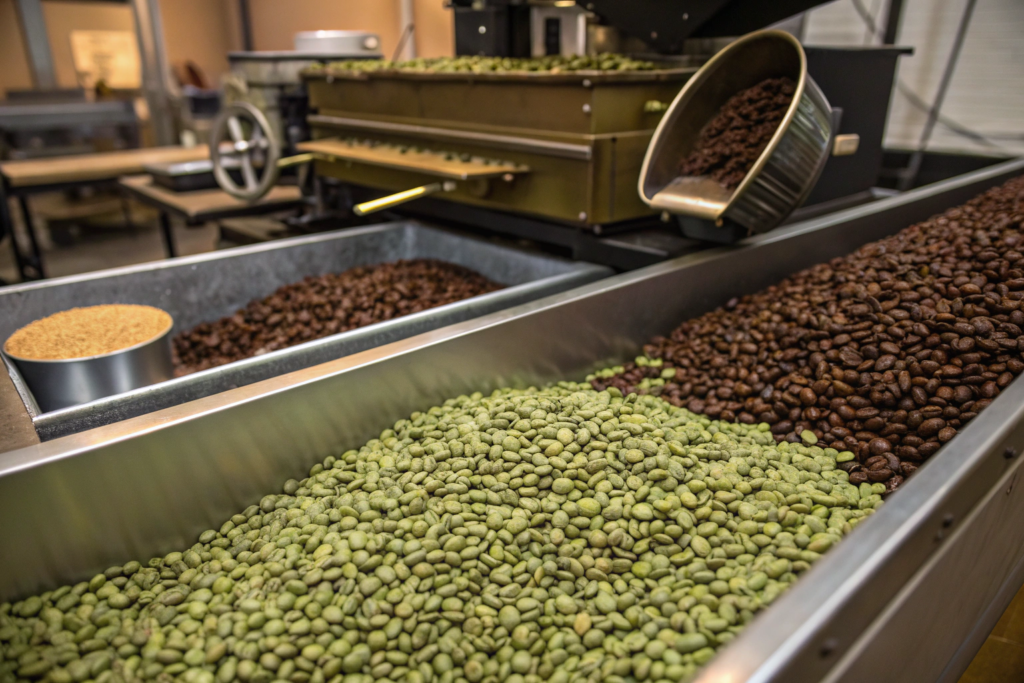
The roaster's job is to develop the potential locked inside the green bean. Sorting provides the roaster with a consistent, predictable raw material. It transforms roasting from a battle against variables into a precise craft.
Meticulous sorting provides roast uniformity, protects machinery from damage, improves yield, and allows the roaster to highlight the intrinsic flavors of the origin rather than compensating for defects. It turns the roast profile into a precise tool for expression, not a salvage operation.
How do defects like stones or sticks damage roasting equipment?
This is a direct, costly operational risk. A small stone or metal fragment hidden in a green coffee batch can have catastrophic consequences inside a roasting drum.
- It can crack or chip the drum's internal fins, affecting airflow and heat distribution.
- It can damage the motor or bearings from an imbalanced load.
- At best, it will produce sparks and create a fire hazard, while also shattering into fragments that contaminate the entire batch.
The cost of equipment repair and downtime far exceeds the investment in proper sorting. This is why even commodity-grade coffee undergoes basic stone removal.
Why does bean density uniformity lead to better flavor development?
As mentioned, sorting by size and density creates a uniform mass. In the roaster, this means:
- Even Heat Transfer: All beans in the drum reach key temperature milestones (like first crack) within a much tighter time window.
- Predictable Development: The Maillard reaction and caramelization happen consistently across the batch.
- Clear Flavor Target: The roaster can choose a development time to optimally highlight the coffee's inherent caramel sweetness or fruity acidity, knowing that the beans will respond as a cohesive unit.
The result is a cup with greater clarity, definition, and balance. The origin characteristics of our Yunnan Arabica—its chocolate and nut notes—shine through without interference.
What is the economic impact of sorting on yield and price?
Sorting seems like a process of removal, which intuitively suggests loss. However, in quality coffee, it's a process of value concentration. You are removing low-value material to create a higher-value product.
While sorting reduces total physical weight (volume), it dramatically increases the value per unit and the usable yield for the roaster. It minimizes waste during roasting, allows for premium pricing, and reduces the risk of costly rejected shipments or customer complaints.
How do you calculate the "usable yield" after sorting?
A simple formula:
Usable Yield (%) = (Weight of Sorted, Exportable Beans / Total Weight of Unsorted Cherry or Parchment) x 100
For specialty coffee, this yield might be lower than for commodity coffee because standards are stricter. For example, to achieve a Grade 1 standard, you might keep only 80-85% of the harvested weight. However, the price per kilogram of that sorted, high-grade lot can be 50-100% higher than the bulk, unsorted price. The net financial return is greater. Furthermore, for the roaster, the "usable yield" is nearly 100% of what they receive, with no need for further sorting or loss from defective beans during roasting.
Does investment in optical sorters pay off for medium-sized farms?
Absolutely, and it's a game-changer. The payback period is often calculated:
- Increased Price: Ability to sell as "Specialty Grade" or "Elephant Screen 18+" at a significant premium.
- Reduced Labor Costs: Automates the most tedious part of manual sorting.
- Market Access: Opens doors to demanding international buyers (like us) who require defect-free, consistent lots.
- Brand Reputation: Establishes the farm or exporter as a quality-focused supplier, leading to long-term contracts.
For a cooperative or a medium-sized estate like portions of our operation, an optical sorter can pay for itself within 1-3 seasons through these combined benefits. It's a capital investment that fundamentally upgrades the business model.
Conclusion
Bean sorting is the silent guardian of quality in coffee production. It is the essential, non-negotiable bridge between the potential of the harvest and the reality of the exquisite cup. By ruthlessly eliminating physical and developmental defects, it ensures roast uniformity, flavor purity, and operational efficiency. For the high-quality roaster, it means predictable results and delighted customers. For the exporter and farmer, it is the key to accessing premium markets and building a sustainable, reputable business.
In the world of specialty coffee, what you remove is just as important as what you keep. Sorting is the discipline that makes this philosophy a practical reality.
At Shanghai Fumao, our multi-stage sorting protocol is a core part of our value proposition. We ensure that every lot of Yunnan Arabica or Catimor we export meets rigorous standards for uniformity and purity. If you are a roaster seeking a supply partner who prioritizes this foundational level of quality control, contact our Export Manager, Cathy Cai to request samples: cathy@beanofcoffee.com. Experience the clarity that comes from precision, from the ground up.