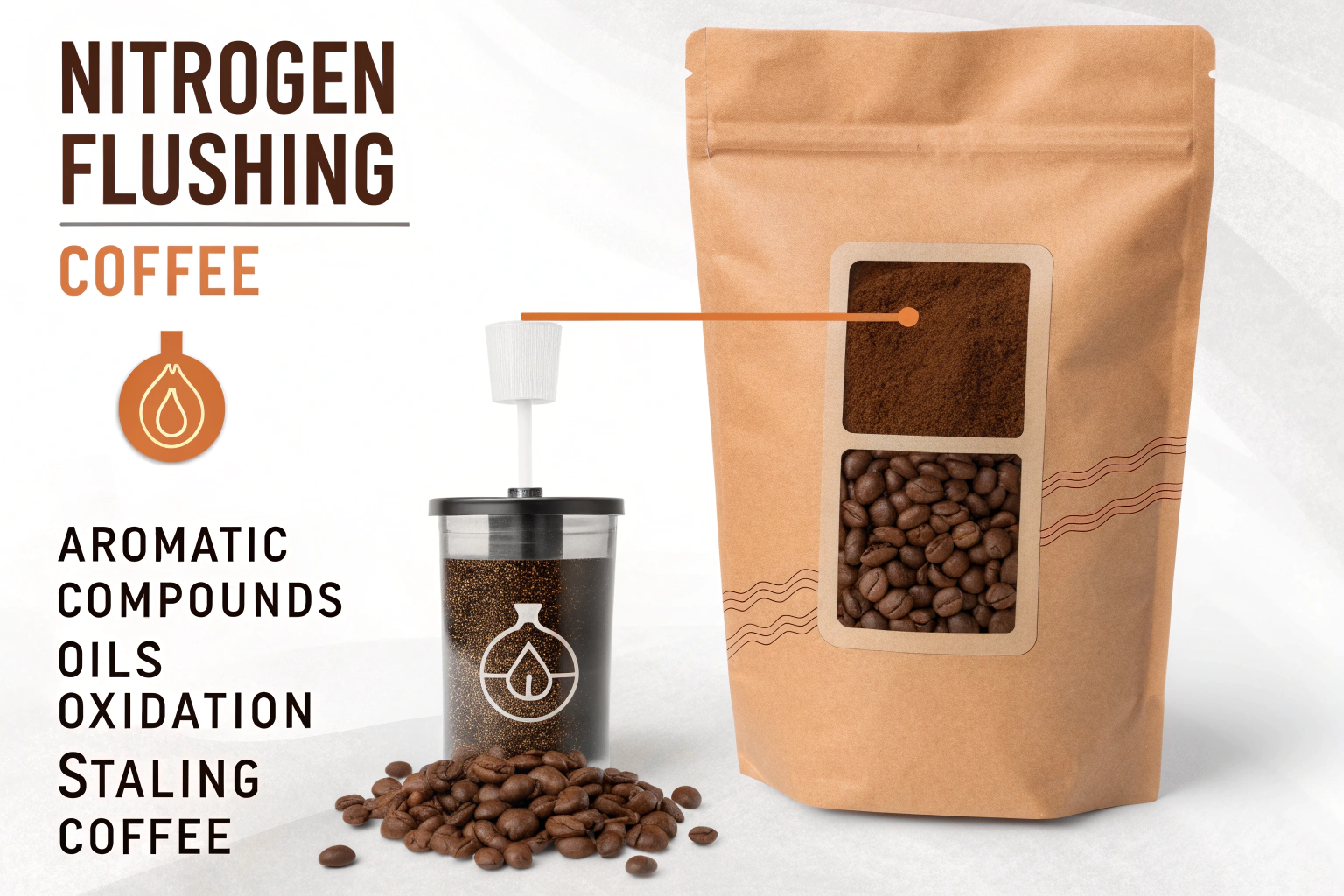
You've roasted the perfect batch. The aroma is incredible, the flavor notes are vibrant. Now, your biggest enemy—oxygen—awaits. How do you lock in that peak freshness from our Yunnan farm to a shelf thousands of miles away? The most powerful weapon in modern coffee packaging isn't the bag or the valve; it's the invisible gas inside: nitrogen. As an exporter who ships roasted coffee globally, I've seen nitrogen flushing transform shelf life from a guessing game into a guarantee.
Nitrogen flushing is the process of displacing oxygen inside a coffee package with inert nitrogen gas before sealing. Its primary role is to dramatically slow down oxidation and staling by creating an oxygen-deficient environment, thereby preserving the volatile aromatic compounds and fragile oils of roasted coffee. This extends the peak freshness window from mere weeks to several months, ensuring the coffee tastes as intended upon opening, whether it's on a store shelf in North America or in a customer's kitchen.
That's the core function. But why is this simple gas swap so revolutionary? Because it directly attacks the fundamental chemistry of coffee degradation. Without it, you're in a race against time. With it, you buy time—precious, quality-preserving time that is critical for global distribution, inventory management, and brand reputation. Let's explore how this invisible process works and why it's a non-negotiable for any serious coffee exporter or brand.
How Does Nitrogen Physically Protect Coffee from Oxidation?
To understand nitrogen flushing, you must first understand the enemy: oxygen (O₂). Roasted coffee beans are packed with hundreds of volatile aromatic compounds and surface oils. Oxygen molecules are highly reactive; they actively bond with these compounds in a process called oxidation, breaking them down.
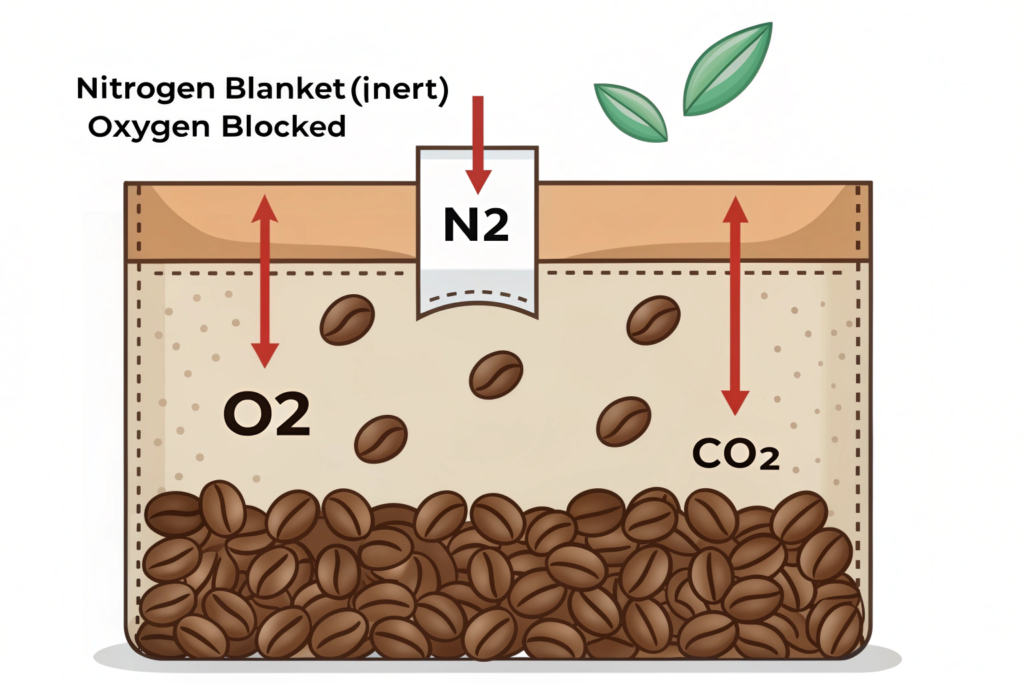
Think of it like a sliced apple turning brown. Nitrogen flushing works by removing the oxygen that fuels this reaction. Here's the precise sequence: After coffee is filled into a high-barrier bag (foil-lined to block gas exchange), a tube is inserted. The bag is then purged with pure, food-grade nitrogen. Since nitrogen is heavier than air, it pushes the oxygen-rich air out through the top of the bag. The one-way degassing valve allows this outflow without letting air back in. The bag is then immediately heat-sealed. The result is an atmosphere inside the bag that is typically less than 2% oxygen, compared to 21% in normal air. This inert environment puts the chemical processes of staling into a state of near-suspended animation.
What Happens to Coffee Oils and Aromatics Without Nitrogen?
Without this protection, oxidation attacks on two fronts:
- Oil Rancidity: The oils on the bean's surface oxidize, becoming rancid. This produces stale, cardboard-like, or bitter flavors.
- Aromatic Degradation: The delicate volatile compounds that create the coffee's fragrance and top notes (floral, fruity, etc.) are destroyed first, leaving the coffee smelling and tasting flat.
Nitrogen flushing effectively "freezes" these compounds in their fresh state. For our Shanghai Fumao roasted products destined for overseas markets, this process is mandatory. It ensures that when you open a bag of our Yunnan Arabica, you smell the coffee we roasted, not the journey it took.
Is the Degassing Valve Still Necessary with Nitrogen Flushing?
Absolutely. The valve serves a separate, critical function. Roasted coffee continues to release carbon dioxide (CO₂) for days after roasting—a process called degassing. If sealed in a fully airtight bag without a valve, pressure would build and burst the bag. The one-way valve allows CO₂ to escape without allowing oxygen to enter. In a nitrogen-flushed bag, the valve lets the last bit of displaced air and initial CO₂ out during sealing, and then continues to release CO₂ during storage while maintaining the low-oxygen blanket inside. The valve and nitrogen work as a team.
Why Is Nitrogen Flushing Critical for Export and Brand Integrity?
For coffee that travels—whether from our facility in Yunnan to a distributor in Europe or directly to a consumer in the USA—transit time is a fact of life. Nitrogen flushing bridges the gap between roasting freshness and delivery reality.
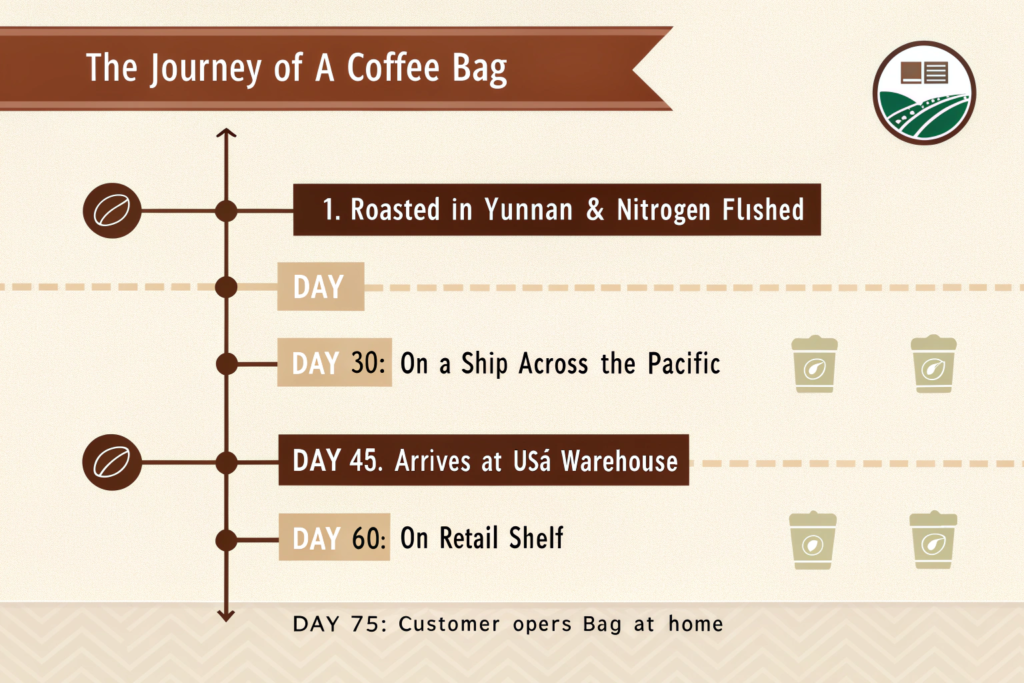
The commercial imperative is clear: Extended Shelf Life = Reduced Risk. Sea freight can take 30-45 days. Warehouse storage and retail shelf time add more weeks. A non-flushed bag of coffee would be well past its prime upon arrival. Nitrogen flushing reliably extends the "peak flavor" window to 4-6 months or more, making intercontinental trade viable without sacrificing quality. This directly addresses the core pain points of timeliness and quality security for international buyers. It means a roaster or brand can import a container of our roasted coffee with confidence, not anxiety. It's a cornerstone of being a reliable and stable supplier.
How Does This Impact Inventory and Cash Flow for Buyers?
For large company buyers, distributors, and private label brands, nitrogen flushing provides crucial financial flexibility. It allows for:
- Larger, More Economical Orders: You can order a full container without worrying about the coffee staling before it's sold.
- Smoother Inventory Management: You can hold stock for longer periods, buffering against supply chain disruptions.
- Reduced Waste: Dramatically lower rates of unsellable, stale product.
This operational stability translates directly to better margins and planning confidence. It turns coffee from a fragile, time-sensitive product into a more stable commodity.
What Is the Difference Between "Packaged Fresh" and "Tastes Fresh"?
This is a key marketing and ethical distinction. A bag can be "packaged fresh" (roasted yesterday) but if it's poorly packaged and sits on a shelf for two months, it won't "taste fresh" when opened. Nitrogen flushing ensures that "packaged fresh" reliably equals "tastes fresh" for the consumer, regardless of the supply chain journey. This protects your brand's promise and reduces customer complaints. It's an investment in trustworthiness.
What Are the Technical Steps and Equipment Involved?
Nitrogen flushing isn't magic; it's a precise industrial process. Implementing it correctly requires specific technology and quality control.
The process is typically integrated into automated vertical form-fill-seal (VFFS) machines. Here's how it works in our packaging line:
- Bag Formation: The machine forms a bag from a roll of multi-layer barrier film.
- Filling: The pre-weighed coffee is dropped into the open bag.
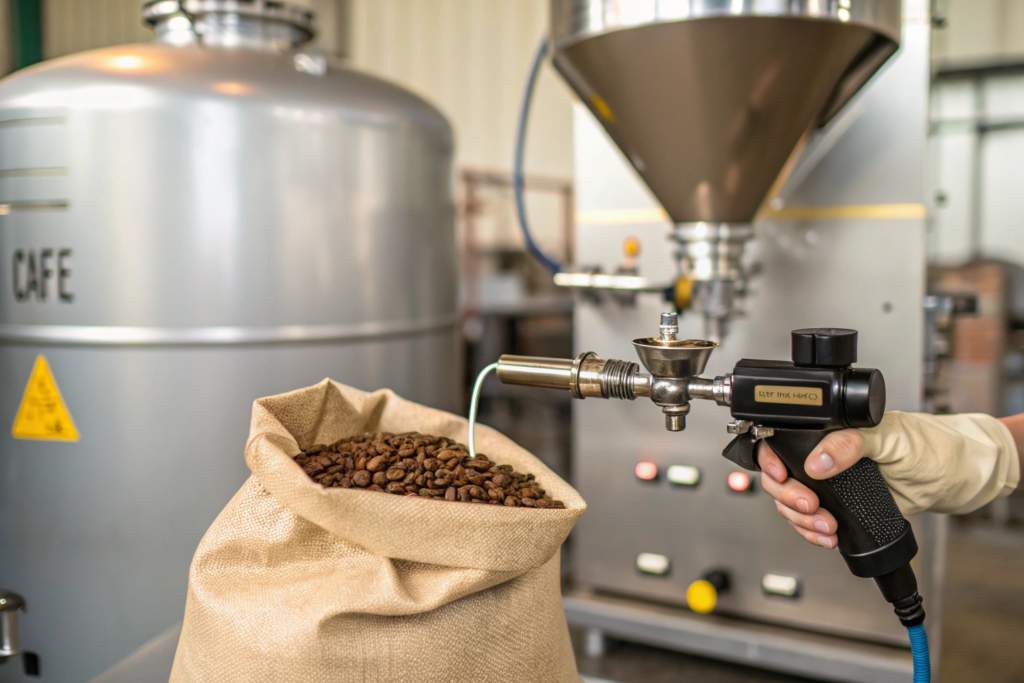
- Gas Flushing: A nozzle descends into the bag, flooding it with nitrogen. The oxygen is displaced and forced out.
- Sealing: The bag is immediately heat-sealed at the top while still under a slight positive pressure of nitrogen.
- Valve Application: The degassing valve is typically applied and sealed into the bag material during the film manufacturing process, prior to being loaded onto the packaging machine.
Key to the process is monitoring the residual oxygen level. Professional lines use handheld or inline oxygen analyzers to spot-check sealed bags, ensuring the oxygen content is consistently below the target (e.g., 1-2%). This is a critical part of our quality control protocol.
Can Small Roasters or Exporters Afford Nitrogen Flushing?
Yes, absolutely. While large VFFS machines are expensive, scalable solutions exist. Single-chamber vacuum and gas flush sealers are affordable for small-batch producers. These work by placing the filled, valve-equipped bag inside a chamber, evacuating the air, flushing with nitrogen from a tank, and then sealing the bag. The capital cost is manageable and is a worthwhile investment for any roaster or exporter serious about product integrity. For us, offering nitrogen flushing wasn't an option; it was a requirement to meet the quality expectations of our North American and European clients.
What Type of Packaging Film Is Required?
Nitrogen flushing is only as good as the bag that contains it. The packaging must have a high oxygen barrier. This is achieved with films that include a metalized layer (like aluminum) or EVOH (ethylene vinyl alcohol) copolymer. Standard poly bags or simple kraft paper bags with a liner are too permeable; oxygen will slowly migrate through the material, rendering the flush ineffective over time. The bag must be a true fortress.
How Does Nitrogen Flushing Compare to Other Preservation Methods?
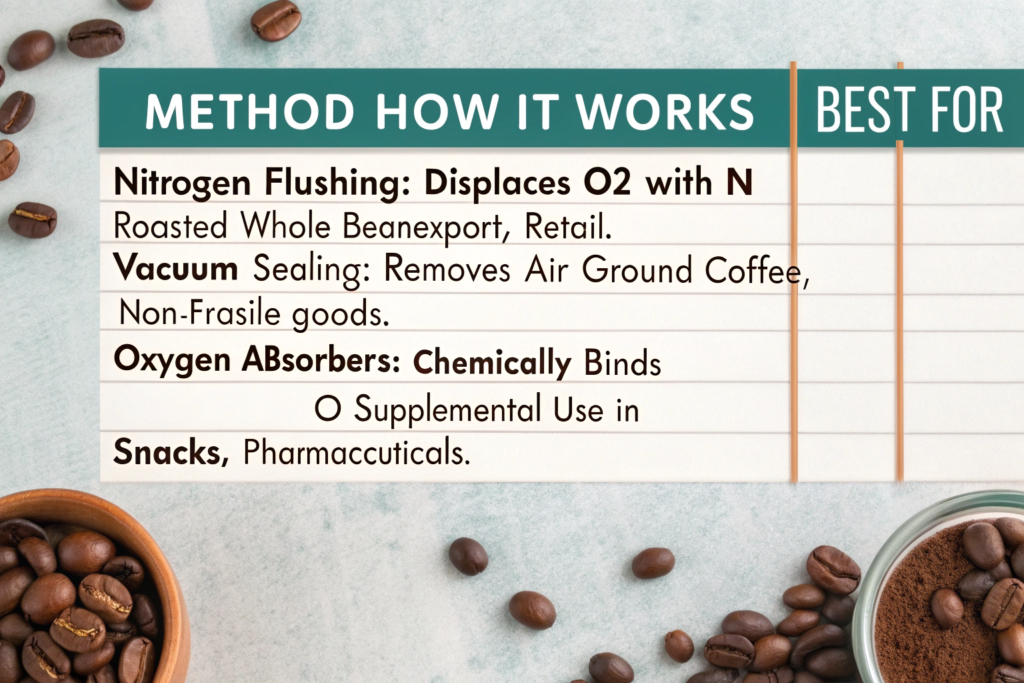
Nitrogen flushing isn't the only tool, but it's the most effective and widely used for roasted whole bean coffee. Let's compare.
- Vacuum Sealing (Without Gas): Removes air but can crush fragile whole beans, damaging their structure and affecting grind consistency. It also doesn't address the issue of CO₂ off-gassing, which can deform the bag over time. Not ideal for quality whole bean coffee.
- Oxygen Absorbers (Sachets): These are a supplemental technology. They contain iron powder that reacts with residual oxygen. They are sometimes used inside a nitrogen-flushed bag as a "backup" to scavenge any tiny amount of remaining O₂ or that which migrates through the film over very long periods. They are not a replacement for flushing, as they work after the fact and don't create the same inert atmosphere.
- Pressurized Cans (like beer): Effective but expensive, heavy, and less sustainable. Used for some ground coffee but rare for specialty whole bean.
For the balance of cost, effectiveness, product protection, and consumer convenience, nitrogen flushing in a valve bag is the undisputed industry standard for preserving roasted whole bean coffee.
Does Nitrogen Flushing Affect the Taste of the Coffee?
No. Nitrogen is an inert, tasteless, and odorless gas. It does not interact with the coffee compounds. Its only role is to displace the reactive oxygen. The coffee tastes like itself, just for a much longer time. This is a critical point: nitrogen preserves the existing flavor; it does not add or subtract anything.
Is It Used for Green Coffee as Well?
It's less common but growing. For long-term storage of high-value green coffee, especially in humid climates, GrainPro-type hermetic bags are standard. These work on a similar principle: they create a sealed, modified atmosphere, but through the natural respiration of the beans consuming oxygen, not through active flushing. Large-scale nitrogen flushing of green beans is sometimes used in specialized, controlled-atmosphere warehouses.
Conclusion
Nitrogen flushing is the silent guardian of coffee quality in the global supply chain. It is a direct, scientific response to the chemical reality of coffee staling. By creating an oxygen-free cocoon around the beans, it arrests the decay process, granting the product a longevity that aligns with the realities of international logistics and retail.
For exporters like us, it is a non-negotiable component of our promise: to deliver coffee that is not only grown and roasted with care but also arrives in a state that honors that work. For roasters, brands, and distributors, it is the assurance that their investment is protected. And for the end consumer, it is the simple joy of opening a bag that smells and tastes as fresh as the day it was sealed.
At Shanghai Fumao, nitrogen flushing is a standard step for all our roasted export products. It is our commitment to ensuring that the distinct character of our Yunnan Arabica and Catimor reaches you intact, no matter the distance.
If you are sourcing roasted coffee and value guaranteed freshness upon arrival, insist on nitrogen-flushed packaging. It's the difference between hoping for quality and knowing it's preserved.
To experience the difference that professional, nitrogen-flushed packaging makes, request samples of our roasted coffees. Contact Cathy Cai at cathy@beanofcoffee.com. Taste the freshness, preserved.