You open the warehouse door. The smell hits you first. Not the sweet, grassy scent of green coffee. Something else. Musty. Damp. A hint of a sour, fermenting odor. You pull a bag from the middle of the pallet. The jute feels... cool. Slightly clammy. You cut it open. The beans look dull. You cup them. Mold. The entire pallet is a loss. Thousands of dollars. And it all comes down to a single, invisible number that you didn't check: the moisture content. You're asking: How did water ruin my coffee, and how do I make sure it never happens again?
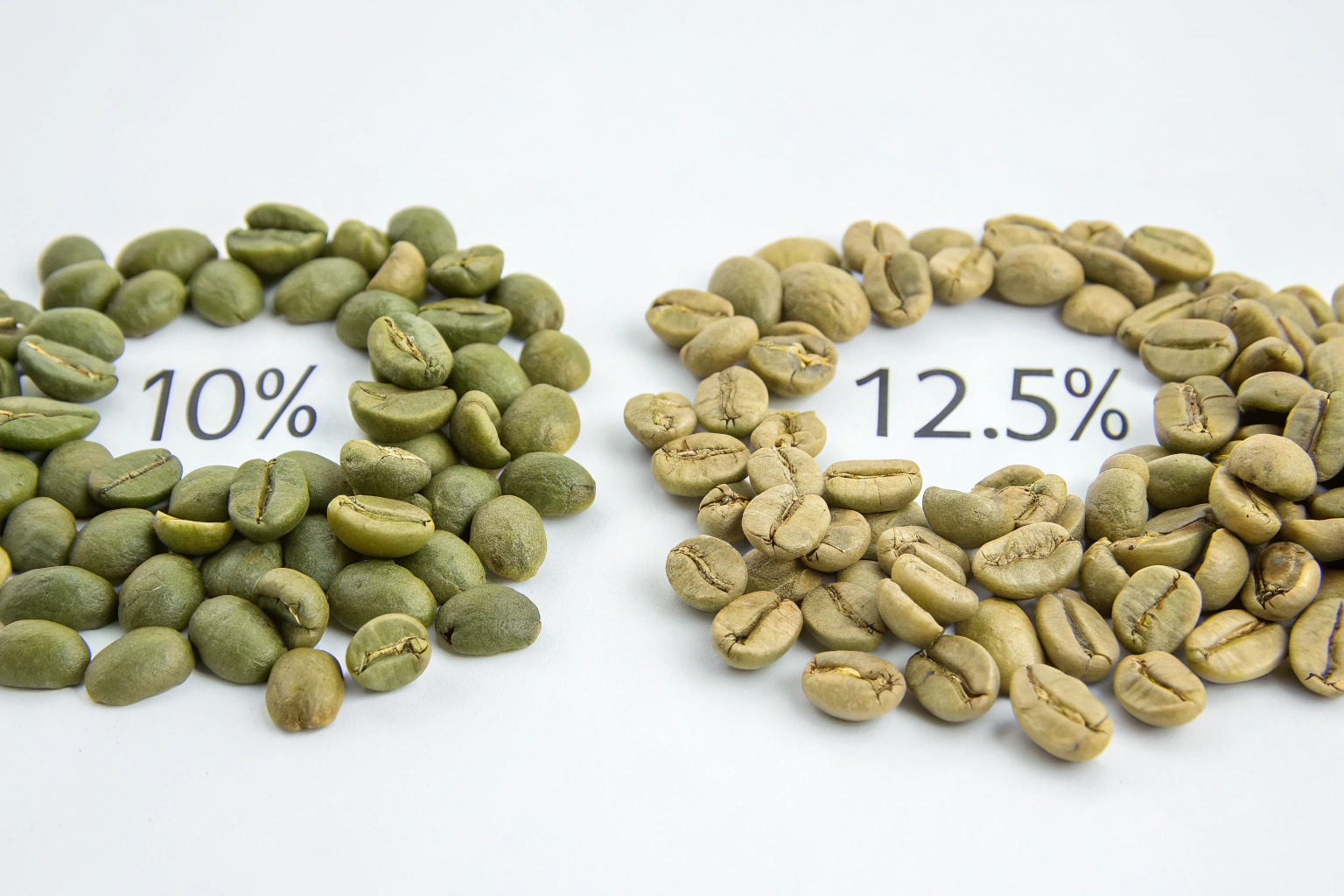
Green coffee bean moisture level is the single most critical factor in determining its stability, safety, and longevity in storage. The target range for safe, long-term storage is 10% to 12% moisture content. Below 10%, the bean becomes brittle and loses cup quality, tasting flat and papery. Above 12.5%, the risk of mold growth, yeast activity, and Ochratoxin A (OTA) production increases exponentially. The goal is equilibrium: a stable internal moisture that prevents both biological degradation and physical deterioration.
At Shanghai Fumao, we manage the moisture of thousands of tons of coffee every year. It's not a one-time check. It's a continuous process, from the drying patio in Baoshan to the container loading at Shanghai port. Let me explain exactly why moisture is the invisible guardian of your coffee's quality, and how to ensure it's in the right place.
What Is the Ideal Moisture Content for Long-Term Green Coffee Storage?
There is no single magic number. Coffee is a natural product, and its moisture content will fluctuate slightly with the ambient environment. The goal is to stay within a safe, proven range that minimizes risk.
The internationally accepted ideal moisture range for long-term green coffee storage is 10.5% to 11.5%. At this level, the water activity (Aw) is typically below 0.55, which is the critical threshold below which mold and bacteria cannot reproduce. Coffee in this range is considered "stable." It can be stored for 6-12 months in proper conditions with minimal degradation. Moisture between 11.5% and 12.5% is acceptable for shorter-term storage (3-6 months) but requires more careful monitoring. Anything above 12.5% is high-risk and should not be accepted without a clear plan for immediate use.
What Happens If Moisture Is Too High (Above 12.5%)?
This is the danger zone. A moisture content above 12.5% provides enough "free" water for microorganisms to become active.
Mold Growth: The most visible risk. Molds like Aspergillus and Penicillium can begin to grow, visible as a white, grey, or green powdery substance on the bean. This mold consumes the bean's sugars and produces musty, earthy, and phenolic off-flavors that ruin the cup.
Ochratoxin A (OTA) Production: The invisible, but far more serious risk. Certain molds, particularly Aspergillus ochraceus, produce OTA, a mycotoxin that is a potential human carcinogen and is strictly regulated in major markets (EU limit: 5 ppb). High moisture is the primary driver of OTA formation during storage.
Fermentation and Souring: If the coffee was bagged warm with high moisture, internal yeast and bacterial activity can continue. This leads to fermenty, sour, or "stinker" beans. The entire bag can become a micro-fermentation vessel, destroying the lot. At Shanghai Fumao, we reject any incoming lot that tests above 12.5% moisture. It's simply not worth the risk.
What Happens If Moisture Is Too Low (Below 9%)?
The risk is not biological, but physical and sensory. An over-dried bean is a fragile, faded bean.
Physical Fragility: The bean loses its elasticity. It becomes brittle and prone to shattering and chipping during handling, milling, and transportation. This increases the percentage of broken beans and lowers the screen size grade.
Sensory Fading: The volatile aromatic compounds that give coffee its character are, in part, held in place by the bean's moisture matrix. When the bean is over-dried, these compounds volatilize and escape more rapidly. The coffee tastes flat, papery, and hollow. It lacks the sweetness and complexity of a properly dried bean.
Roasting Issues: Over-dried beans have lower density and less thermal momentum. They roast faster and can easily scorch or tip. They are more difficult to control in the roaster. A moisture content below 9% is a sign of poor drying practices or excessively long, hot storage.
How Is Green Bean Moisture Measured Accurately?
You can't judge moisture by feel. A bean can feel dry on the outside but have high internal moisture that hasn't equilibrated. Accurate measurement requires the right tool, used correctly.
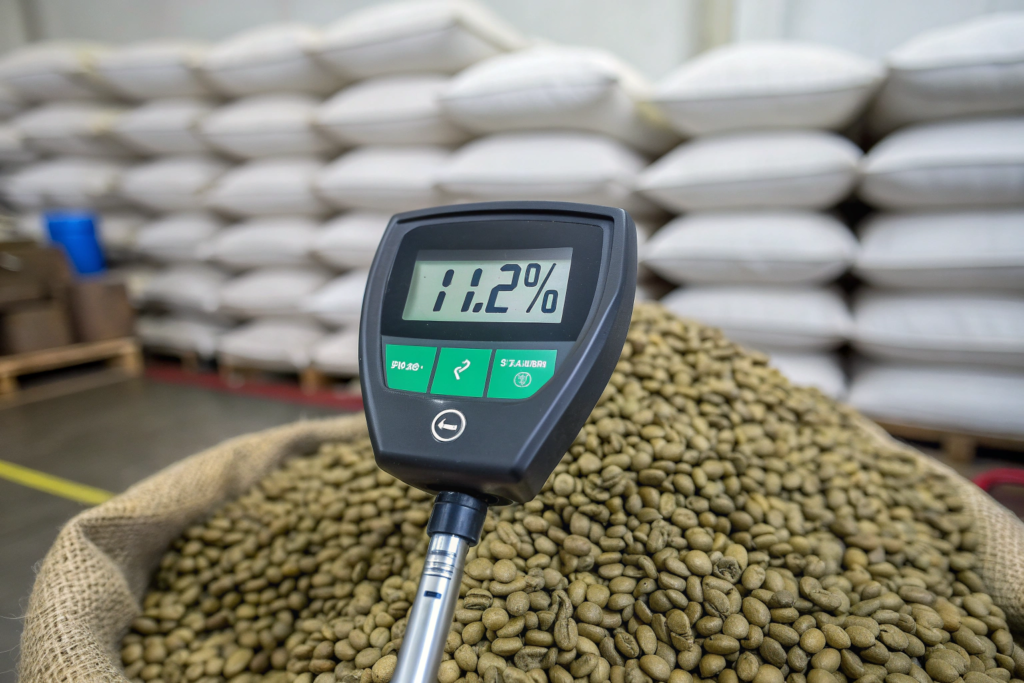
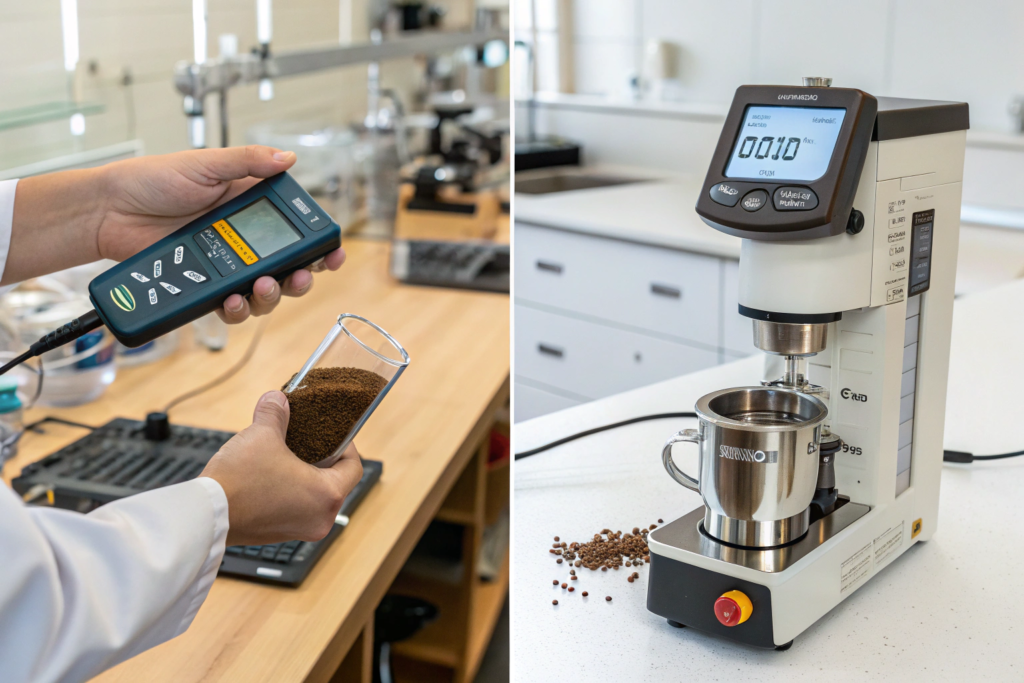
Green bean moisture is measured accurately using a calibrated electronic moisture meter designed for coffee or grains. The industry standard is a capacitance or resistance meter. The measurement process must follow a specific protocol: (1) The meter must be calibrated for coffee. (2) A representative sample of at least 100 grams must be drawn from the lot. (3) The sample must be at room temperature. (4) The measurement should be taken multiple times and averaged. For the highest accuracy, particularly for contract disputes, the oven-drying method (loss on drying) is used by laboratories.
What Kind of Moisture Meter Should I Use for Green Coffee?
Do not use a hay moisture meter or a general-purpose wood meter. You need a meter specifically calibrated for green coffee beans or grains/seeds.
Popular and reliable brands among coffee professionals include Draminski, Agratronix, and Dole. These are portable, pin-type or cup-type meters. They work by measuring the electrical properties of the bean, which change predictably with moisture content. A good meter will cost a few hundred dollars. It's a non-negotiable investment for any roaster buying full containers or storing green coffee for more than a few weeks. At Shanghai Fumao, we use calibrated bench-top meters for our daily quality control and cross-check against laboratory oven tests for export certification.
What Is the Correct Technique for Getting a Reliable Reading?
Technique matters. A sloppy measurement is worse than no measurement.
Step 1: Sample Correctly. Don't just test the top beans in a bag. Use a trier to pull beans from the center of several bags in the stack. Mix them to create a composite sample.
Step 2: Temperature Equilibration. If the coffee just arrived from a cold warehouse or a hot truck, let the sample sit in the sealed bag at room temperature for an hour. Moisture meters are temperature-sensitive.
Step 3: Fill the Chamber. Fill the meter's measuring chamber completely, according to the manufacturer's instructions. The beans should be packed consistently.
Step 4: Take Multiple Readings. Empty the chamber, refill it with the same sample, and take another reading. Do this three times and average the results. Beans are not perfectly uniform; an average is more reliable.
Step 5: Clean and Store. Keep your meter clean and store it in a dry place. Periodically check its calibration using a calibration standard.
How Does Water Activity Differ from Moisture Content in Predicting Stability?
Moisture content tells you how much total water is in the bean. Water Activity (Aw) tells you how much of that water is available for biological and chemical reactions. This is a crucial distinction.
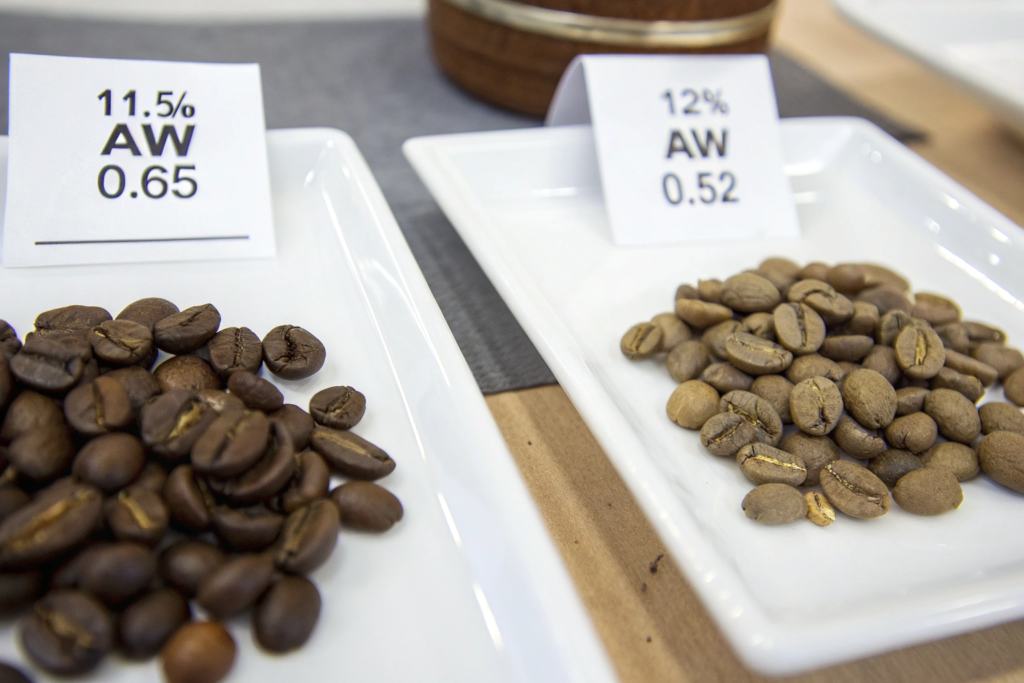
Moisture Content is a quantitative measure—the total percentage of water by weight. Water Activity (Aw) is a qualitative measure of the "free" water not chemically bound to the bean's cellular structure. It is measured on a scale from 0.0 to 1.0. The critical threshold for microbial stability is Aw < 0.55. A coffee can have an acceptable moisture content of 11.5% but a dangerously high Aw of 0.65 if it was dried improperly (too fast, or at too high a temperature). Conversely, a coffee can have a slightly elevated moisture of 12% but a safe Aw of 0.52 if it was dried slowly and rested properly.
Why Is Aw a Better Predictor of Mold and OTA Risk?
Mold spores don't care about the total water. They care about the available water. If the water is tightly bound to the coffee's cellulose and sugars, the mold cannot access it.
A high Aw means there is a significant amount of "free" water that mold, yeast, and bacteria can use for growth. The Aw scale is logarithmic. The difference between 0.50 and 0.70 is huge in terms of biological risk. An Aw below 0.55 is considered the "safe zone" where virtually no microbial growth occurs. This is why many large commercial roasters and food safety programs are now specifying Aw limits in their contracts. It's a more precise and reliable indicator of true stability. At Shanghai Fumao, we monitor both moisture content and water activity on all export lots. It's a key part of our food safety and quality assurance program.
How Can a Coffee Have "Good" Moisture but "Bad" Water Activity?
This happens when coffee is dried too quickly using high heat, such as in a poorly managed mechanical dryer. The outside of the bean dries rapidly, sealing the surface and trapping moisture inside.
The overall moisture percentage might measure 11.5%. But that water is not "bound." It's free and mobile within the bean's structure. This coffee will have a high Aw reading (e.g., 0.65). It will appear stable for a short time, but over weeks or months in storage, that internal free water will migrate and cause problems—mold, fading, and off-flavors. This is the "hidden" instability that Aw testing reveals. Slow, gentle drying (sun-drying on raised beds, or low-temperature mechanical drying) allows the water to chemically bind to the bean's matrix, resulting in a lower, safer Aw.
How Should Roasters Manage Moisture to Protect Their Green Coffee Inventory?
You've bought coffee with perfect moisture and Aw. The responsibility now shifts to you. How you store that coffee at your roastery will determine whether it stays perfect or degrades.
Roasters manage green coffee moisture by controlling the storage environment and practicing disciplined inventory rotation. The key principles are: (1) Store green coffee in a cool, dry, odor-free space, ideally between 60-70°F (15-21°C) and 50-60% relative humidity. (2) Keep all bags off the concrete floor on pallets. (3) Monitor the environment with a simple hygrometer. (4) Practice FIFO (First-In, First-Out) inventory rotation. (5) Re-test the moisture of long-stored coffee (6+ months) before roasting to understand how its profile may have shifted.
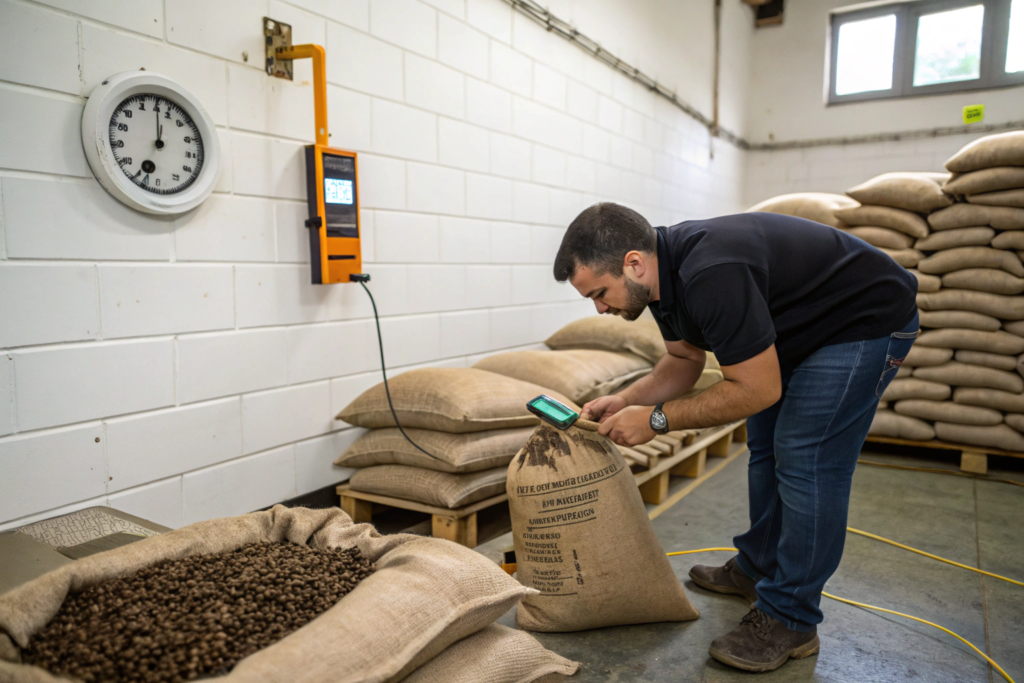
What Is the Ideal Roastery Storage Environment?
You don't need a million-dollar climate-controlled vault. But you do need to be intentional.
- Temperature: Cool and stable. Avoid storing coffee next to the roaster, afterburner, or in a hot attic. Heat accelerates aging and moisture migration.
- Humidity: Moderate (50-60% RH). In a very dry environment (like a heated warehouse in winter), green coffee can slowly lose moisture over months, becoming brittle. In a very humid environment (like a basement in summer), it can absorb moisture and become a mold risk. A simple room hygrometer will tell you your environment.
- Airflow: Some gentle air circulation is good to prevent stagnant pockets of humidity.
- Pallet Position: Always on pallets. Concrete floors wick moisture and can be significantly colder, causing condensation inside the bottom bags.
At Shanghai Fumao, we advise our clients on these best practices. We want the coffee they receive to be the coffee they cup.
How Long Can I Safely Store Green Coffee in My Roastery?
Under good conditions (cool, dry, dark), a high-quality, properly dried green coffee like our Yunnan Arabica can maintain excellent quality for 9-12 months. Some dense, low-acid coffees can hold even longer.
The key is to re-test the coffee if you're pushing those time limits. After 8 months in your storage, pull a sample. Check the moisture content. Cup it against your original arrival sample. You may notice the acidity has softened and the body is slightly rounder. That's not a defect. That's a change. You can then adjust your roast profile or your blend percentage accordingly. The goal is not to freeze time. The goal is to understand and manage the evolution of your inventory. A disciplined approach to moisture management, from origin to roastery, is what separates a consistent, reliable coffee program from a frustrating gamble.
Conclusion
Green coffee moisture is the quiet, invisible factor that determines whether your coffee thrives or dies in storage. It's the difference between a vibrant, sweet cup and a musty, faded disappointment. It's the gatekeeper of food safety, standing guard against mold and mycotoxins.
The numbers are simple: target 10-12% moisture, and an Aw below 0.55. The tools are accessible: a calibrated moisture meter and a cool, dry storage space. The discipline is the hard part—the commitment to checking, monitoring, and managing.
When you source from a supplier who treats moisture control as a core discipline—from the drying patio to the container—you're not just buying beans. You're buying peace of mind and the foundation for a consistently excellent coffee program.
If you want to know the exact moisture and Aw specs for our current Yunnan lots, I'm happy to share the data. My email is cathy@beanofcoffee.com.