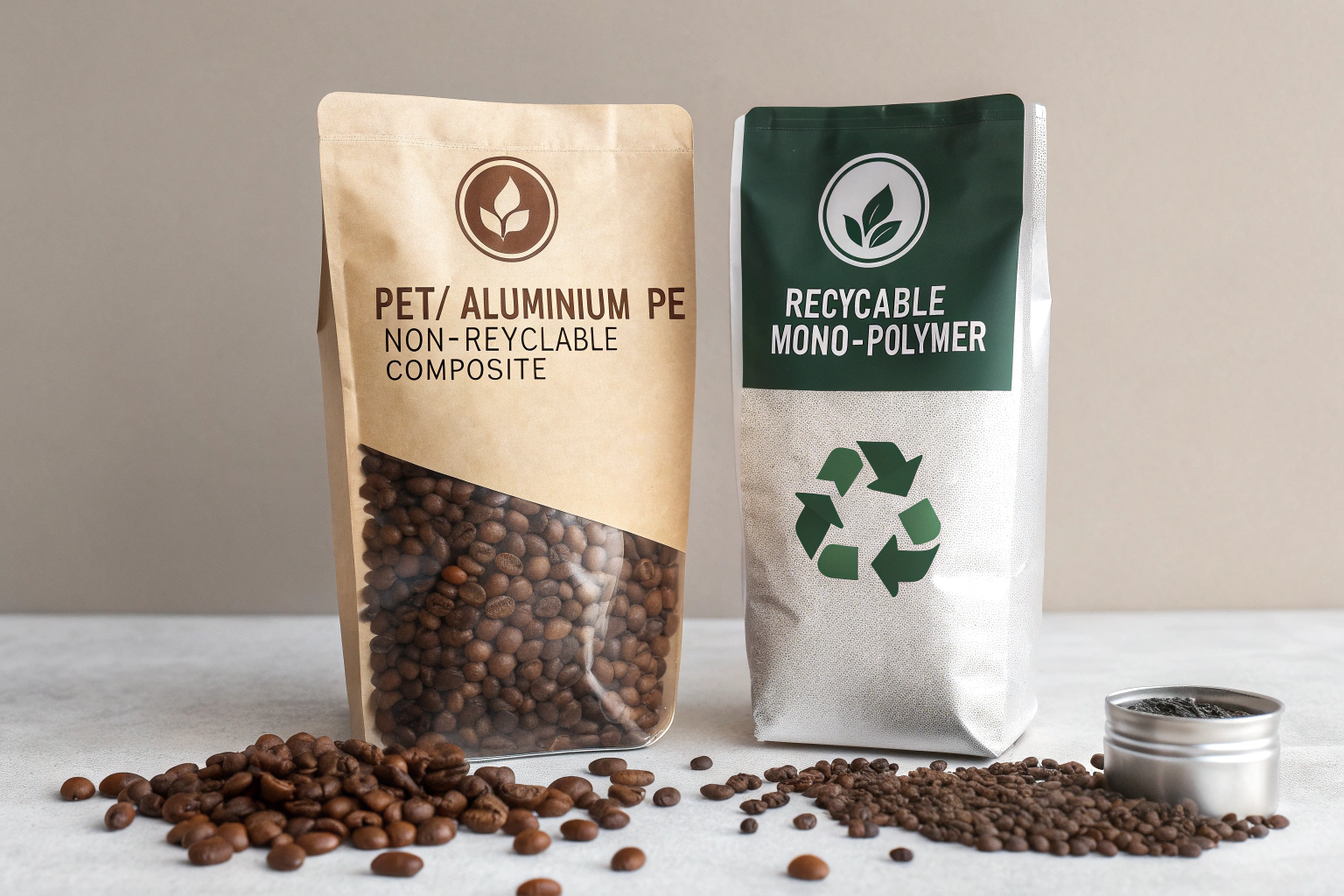
You've invested in high-altitude Yunnan beans, perfected your roast profile, and built relationships with buyers in North America and Europe. Then your client in Amsterdam asks: "Is your packaging PPWR-compliant?" Your distributor in Melbourne wants to know if your bags can go in their soft plastics collection. You realize—the coffee is sustainable, but the package might be landfill. How do you fix this?
Ensuring your coffee bags are recyclable requires a fundamental redesign of the traditional multi-material laminate. The solution is threefold: 1) Eliminate the aluminium foil barrier layer and replace it with a high-barrier polyolefin structure (mono-material PE/PP) that is technically recyclable; 2) Reduce total material usage and switch to metal-free, all-plastic constructions that sorting facilities can recognize and process; and 3) Prepare for regulatory deadlines—the EU mandates all packaging be recyclable by 2030, and coffee bags specifically must be compostable by February 2028 under the new PPWR. This is not a marketing choice. It is a compliance requirement and a supply chain access issue.
I have been watching this shift closely. At Shanghai Fumao, we export to markets where these regulations are already shaping buyer requirements. The old "functional sandwich" of PET/aluminium/PE that kept coffee fresh for 18 months is now a liability. Let me walk you through how the industry is solving this—and how you can ensure your packaging doesn't become your product's final destination in a landfill.
Why Are Traditional Coffee Bags Not Recyclable?
Before you can fix the problem, you must understand why the standard coffee bag—the one that has worked perfectly for decades—is now considered unrecyclable waste.
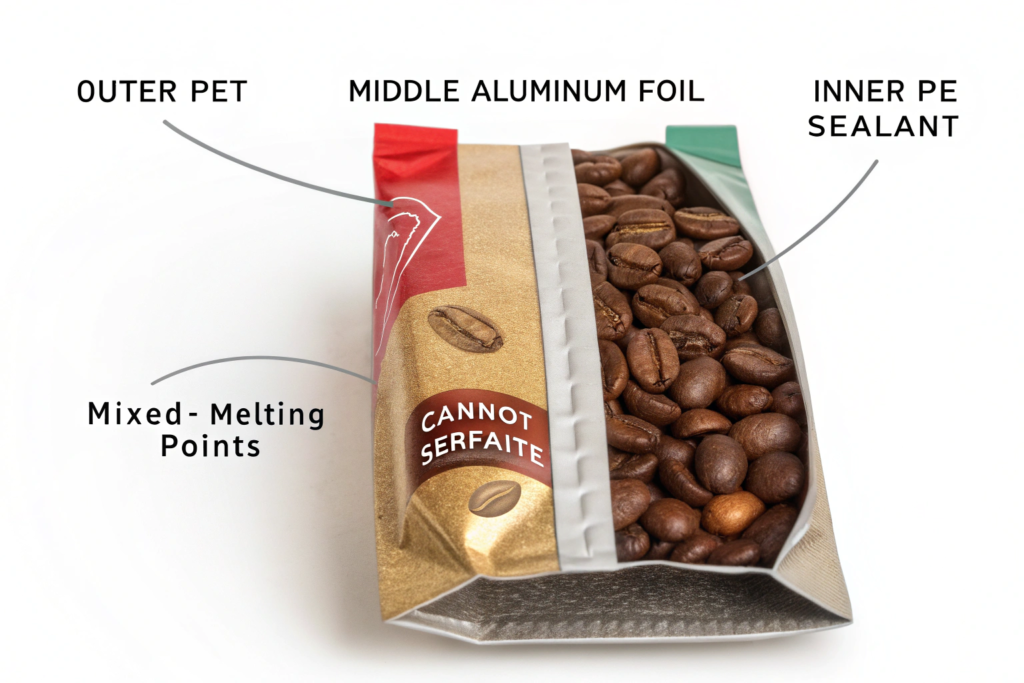
Traditional coffee bags use a multi-layer laminate structure—typically PET (polyester) for strength, aluminium foil for oxygen barrier, and PE (polyethylene) for heat-sealing. This composite cannot be recycled because recycling facilities cannot separate the aluminium from the plastics, and the mixed materials have different melting points that contaminate the recycled stream.
The problem is not the materials individually. It is their combination. As Tchibo's packaging expert Helena explains: "Recycling works best when the source materials can be sorted by type. We have combined layers of different materials here that our plants cannot simply separate and recycle. This composite ends up in the unpopular mixed plastics sorting fraction and is sent for thermal utilisation."
Peet's Coffee states this plainly on their FAQ: "Our bags are made of a mixture of Polyethylene Terephthalate (PET)...and aluminum. These bags are recyclable in some areas but not all. Please check with your municipal department." This ambiguity—"recyclable in some areas"—is the hallmark of a non-recyclable design. It means the package requires specialized facilities that do not exist in mainstream waste infrastructure.
Why Did the Industry Use Aluminium in the First Place?
Aluminium is not a mistake. It is the gold standard for oxygen barrier. Coffee is exceptionally sensitive to oxidation, which destroys aromatic compounds and produces rancid flavors. The metallic layer provided:
| Function | Why It Was Used | The Recycling Problem |
|---|---|---|
| Oxygen Barrier | Zero oxygen transmission; 12-18 month shelf life | Foil is microns thin, embedded between plastics—impossible to separate |
| Shape Memory | Bags hold form on filling lines; "stand-up pouch" structure | Metal deforms plastically; plastics are elastic—incompatible recycling |
| Heat Resistance | Outer layers tolerate high sealing temperatures without melting | Different melt temps cause contamination in recycling extruders |
The industry is now abandoning aluminium not because it is ineffective, but because it is incompatible with circular economy regulations. The compromise is real: you lose some barrier performance and some production efficiency. But you gain access to regulated markets.
What Is the "Mixed Plastics Fraction" and Why Is It Bad?
When your non-recyclable coffee bag enters a sorting facility, it is rejected from the rigid plastics stream, rejected from the paper stream, and diverted to the mixed plastics fraction. This material has no viable recycling market. It is baled, shipped, and incinerated for energy recovery (waste-to-energy) or landfilled.
This is the hidden cost of traditional packaging. You are not just disposing of a bag. You are paying for a material that has no second life. The European Recycling Industries Confederation publishes annual reports on plastic sorting efficacy across EU member states.
At Shanghai Fumao, we now ask our packaging suppliers for one critical document: third-party certification that the full laminate structure is compatible with existing polyolefin recycling streams. If they cannot provide it, we do not buy it.
What Is the Recyclable Alternative: Mono-Material Polyolefin Structures?
The solution is not complicated chemistry. It is disciplined material selection. The industry is converging on a single family of plastics.
Recyclable coffee bags are now manufactured using mono-material polyolefin structures—specifically polyethylene (PE) and polypropylene (PP)—which eliminate the aluminium layer entirely and replace it with a high-barrier plastic film that has similar melting points, allowing the entire bag to be sorted, melted, and recycled into new plastic products.
This is not a theoretical concept. It is commercially deployed. BKI Foods launched Denmark's first metal-free, recyclable coffee bag in 2019 after testing over 70 prototypes. Their specification:
- Material: High-barrier film of PE and PP only
- Metal content: Zero
- Material reduction: 15% less plastic per bag
- CO₂ reduction: 20-23% lower carbon footprint
- Recycled into: Trash bags, barrels, buckets (when sorted as soft plastic)
- Validation: Technical University of Denmark, Danish Technological Institute
Jet Technologies' ShieldCycle uses the same principle: "polyolefin-based plastic structure...replaces the non-recyclable aluminium layer...with layers that are technically recyclable, ensuring that all components can be easily melted down and reused."
How Do These Bags Protect Coffee Without Aluminium?
This is the engineering question. The answer is advanced barrier coatings applied directly to polyolefin films.
| Barrier Technology | How It Works | Recyclability Status |
|---|---|---|
| SiOx (Silicon Oxide) | Clear ceramic coating; excellent oxygen barrier | Compatible with PE/PP; does not separate |
| AlOx (Aluminium Oxide) | Transparent metal oxide; nearly foil-equivalent | Thin coating; recyclable; not a separate layer |
| EVOH (Ethylene Vinyl Alcohol) | Oxygen barrier layer; must be "sandwiched" | Requires total weight; PPWR exempt |
| PP/PE Blends | Optimized crystallinity; sufficient for 6-9 month shelf life | Fully recyclable; commercially proven |
BKI explicitly states: "The film for our coffee bags is a newly developed high-barrier film that has the same or better barrier properties as aluminum foil or a metallized aluminum film."
The trade-off is not quality. The trade-off is production speed and heat resistance. As Tchibo notes, mono-materials are more challenging to seal because the entire structure softens in a similar temperature window, requiring precise machine calibration.
What About Compostable Coffee Bags?
The new EU PPWR creates a separate, mandatory category for compostable coffee packaging.
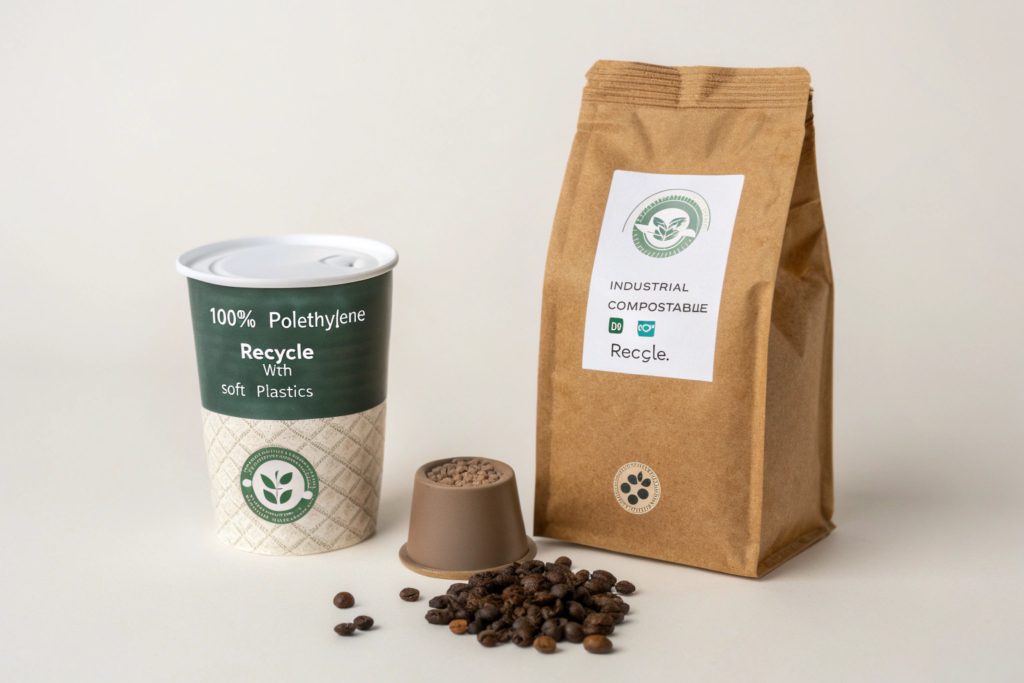
From 12 February 2028, "teabags, coffee bags and coffee pods" placed on the EU market must be compostable in industrial controlled conditions.
This is a critical distinction:
- Recyclable plastic bags (mono-material PE/PP) are permitted for bulk coffee, ground coffee, whole bean
- Compostable bags are mandatory for single-serve pods and certain single-use coffee sachets
You cannot choose compostable as an alternative to recyclable for all products. The regulation is specific. For standard coffee bags (non-pod, non-sachet), recyclable plastic is the compliance pathway. The EU Commission's PPWR guidance provides definitive category definitions.
At Shanghai Fumao, we are qualifying both material families. Our standard export bags are transitioning to mono-PE structures. Our sample-sized pouches are trialing home-compostable films. The destination market determines the specification.
What Are the Regulatory Deadlines You Cannot Ignore?
You may intend to switch to recyclable packaging. But when must you actually do it? The answer is arriving faster than many buyers expect.
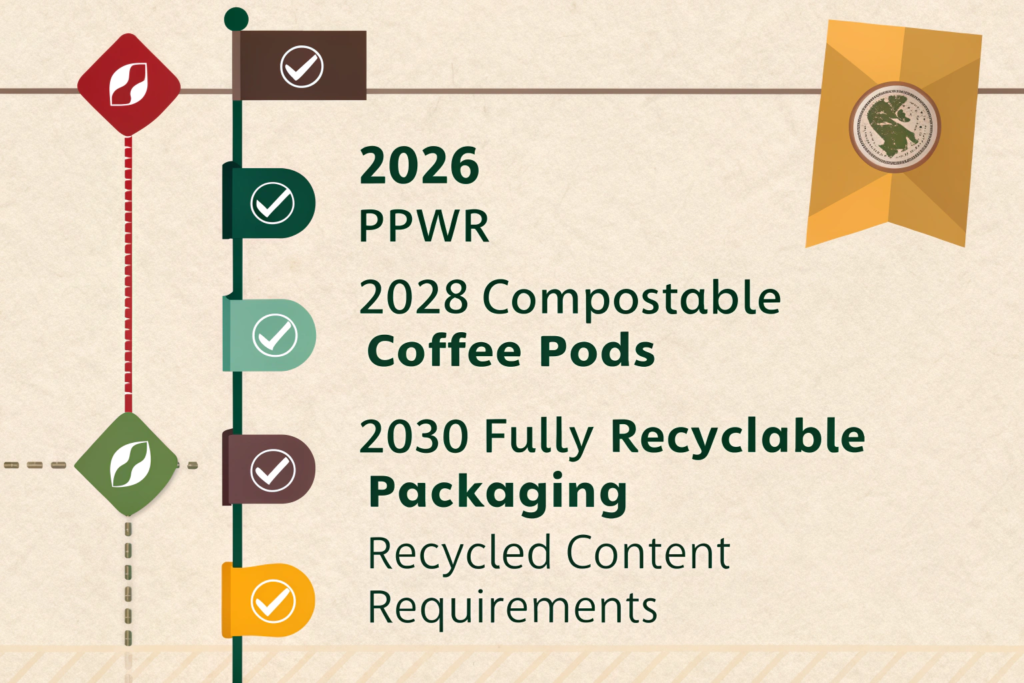
The EU Packaging and Packaging Waste Regulation (PPWR) (EU) 2025/40 entered into force 11 February 2025 and will apply from 12 August 2026. Key deadlines for coffee exporters: by 2030, all packaging must be recyclable; by 2028, coffee bags and pods must be compostable; by 2030, plastic packaging must contain minimum recycled content.
This is not future speculation. It is law. If you sell into the EU (including your clients who distribute to Europe), your packaging must comply with these timelines.
What Are the Specific PPWR Requirements for Coffee Bags?
Let me extract the exact obligations from the regulation text:
| Requirement | Deadline | Applicability to Coffee Bags |
|---|---|---|
| Recyclability | 1 January 2030 | All coffee packaging must be "designed for material recycling" with performance grades A, B, or C |
| Compostability | 12 February 2028 | Coffee bags, pods, and sachets for single-use beverage preparation must be industrially compostable |
| Recycled Content (Plastic) | 1 January 2030 | Minimum % recycled plastic in packaging (exact % TBD; exemptions for compostable and plastic components) |
| PFAS/PFOA Prohibition | Immediate/2026 | Per- and polyfluorinated alkyl substances banned in food contact packaging |
| Labelling | By 2026/2028 | Harmonized EU labeling for material composition; digital codes (QR) for sorting information |
Crucially: compostable coffee bags are not exempt from recyclability targets. They have a separate compliance pathway. If your coffee bag is not a single-serve pod or sachet, the PPWR does not mandate compostability—it mandates recyclability.
Do These Regulations Apply to You as a Chinese Exporter?
Yes. The PPWR applies to "all packaging placed on the EU market" regardless of origin. If your coffee bag arrives in Rotterdam, Hamburg, or Le Havre, it must comply.
Furthermore, your EU-based importer or distributor is legally responsible for compliance. They will require an EU Declaration of Conformity from you as the packaging manufacturer. If you cannot provide it, they will find a supplier who can.
At Shanghai Fumao, we are already receiving PPWR documentation requests from European buyers. This is not a 2030 problem. It is a 2026/2028 problem that requires packaging trials and supplier qualification today. The EU's Access2Markets portal provides detailed exporter guidance on compliance documentation.
How Do You Verify and Certify Recyclable Packaging?
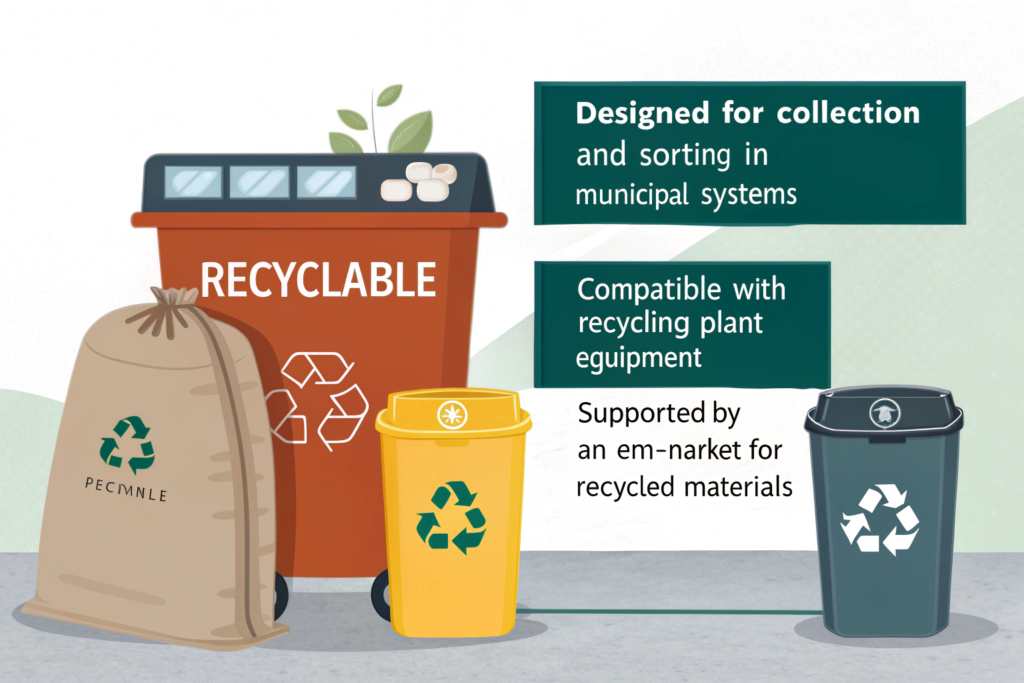
Switching materials is insufficient. You must prove the new structure is recyclable in real-world waste infrastructure—where the air hums with the low, rhythmic thud of sorting machines, where conveyor belts snake like metallic rivers carrying a chaotic tide of plastic bottles, crumpled cardboard, and forgotten electronics. Here, the light flickers over piles of mixed waste, casting shadows that dance with the ghost of what could be recycled if only it fit. To prove recyclability isn’t just about lab tests or glossy reports; it’s about surviving the brutal journey through a system that doesn’t care for novelty—it cares for familiarity, for the predictable curves of PET bottles, the crisp edges of corrugated cardboard. Your new structure, with its innovative lattice or biodegradable composite, must withstand the rough tumble of mechanical sorters, the scorching heat of baling presses, the chemical baths of recycling facilities.
It must not jam the machinery, must not contaminate batches of traditional plastics, must not disintegrate into unrecognizable fragments that end up in landfills or incinerators. Imagine the tension as a sample piece is fed into a pilot recycling line: the clatter of gears, the hiss of steam, the moment of truth when the sorted output is dumped into a bin—will your material emerge, clean and ready for rebirth, or will it lie there, a silent testament to good intentions but poor preparation? Prove it, not in a sterile lab, but in the gritty, pulsing heart of the waste infrastructure, where the proof of recyclability isn’t just a number on a page, but a tangible, usable resource, ready to be transformed into something new, again and again.
What Certifications and Testing Should You Demand?
As a buyer sourcing coffee bags or specifying packaging for your roasted coffee, you need:
-
Technical recyclability assessment: Testing by a recognized institute (e.g., Technical University of Denmark, cyclos-HTP, Intertek) confirming the bag does not contaminate polyolefin recycling streams.
-
Material composition declaration: Verification that the bag is polyolefin (PE/PP) with no aluminium, no PVC, no PVDC, and minimal EVOH ( if used).
-
Recycled content certification: If claiming post-consumer recycled (PCR) content, third-party mass balance certification.
-
Compostable certification (if applicable): EN 13432 (Europe), ASTM D6400 (US), AS 4736 (Australia).
BKI's process is the benchmark: "The analysis report was conducted by the Technical University of Denmark...The foil contains only polyolefin plastic; specifically polyethylene (PE) and polypropylene (PP). Hence, the foil can be disposed of and recycled as a mixed polyolefin."
What About Fibre-Based Coffee Packaging?
The 4evergreen alliance has developed Circularity by Design Guidelines for fibre-based beverage packaging (cartons, cups). However, these guidelines apply to "used beverage cartons" and similar cellulose-based structures—not flexible plastic coffee bags.
If you are considering paper-based coffee bags:
- They must have no plastic lining or use recyclable dispersion coatings
- They must be compatible with standard paper recycling mills
- They generally have inferior oxygen barrier compared to polyolefin films
For whole-bean and ground coffee requiring 6-12 month shelf life, mono-material polyolefin films are currently the only commercially viable recyclable solution. The 4evergreen Alliance publishes updated guidance on fibre-based packaging circularity.
What Are the Supply Chain and Operational Trade-Offs?
You have decided to switch. Now you must run the new material on your filling machines. This is where many packaging transitions fail.
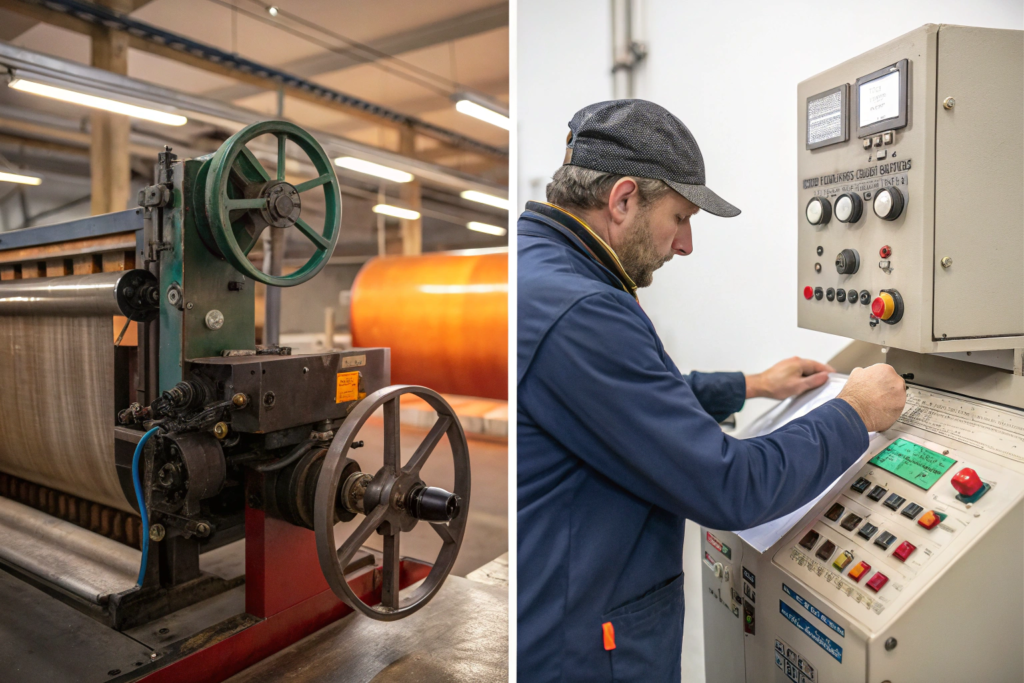
Mono-material polyolefin films have different mechanical properties than metalized composites. They are more elastic, have lower heat resistance, and require precise temperature control on form-fill-seal equipment.
What Machine Adjustments Are Required?
Tchibo's experience is instructive:
| Parameter | Traditional Laminate (PET/Alu/PE) | Mono-Material Polyolefin | Required Adjustment |
|---|---|---|---|
| Sealing Temperature | High; outer layers heat-resistant | Lower; all layers soften together | Reduce temp 15-20°C; tighter control |
| Sealing Jaw Pressure | Moderate | Higher pressure needed | Pneumatic adjustment |
| Film Stiffness | Rigid; holds shape | Softer; "draggy" | Tension control; former modifications |
| Seam Integrity | Forgiving | Sensitive to contamination | Regular jaw cleaning; anti-static |
BKI reported a positive outcome: "The foil runs significantly faster through our production machinery, allowing us to pack even more coffee bags for you every day. Furthermore, the bags are easier to seal, and we have lowered the sealing temperature of the bags by at least 15%, resulting in significant energy savings."
The trade-off is not universally negative. Some converters report improved efficiency post-transition. However, trial runs and machine tuning are non-negotiable.
How Do You Manage Inventory of Two Material Specifications?
During transition, you will inevitably have:
- Old stock (non-recyclable) bags
- New stock (recyclable) bags
- Different specifications for different customers/markets
The solution is SKU segregation and clear customer communication. We at BeanofCoffee now include a packaging specification line on every commercial invoice: "Packaging: Mono-PE Recyclable Film (APCO/PPWR Compliant)" or "Packaging: Traditional Laminate (Non-Recyclable - Not for EU Market)."
Conclusion
Ensuring your coffee bags are recyclable is no longer a voluntary sustainability initiative. It is a regulatory requirement for market access, a buyer expectation in mature economies, and an increasingly visible component of your brand's environmental footprint.
The pathway is now clear:
-
Eliminate aluminium and mixed-material composites. Switch to mono-material polyolefin (PE or PP) high-barrier films. This is the only commercially proven, technically recyclable solution for long-shelf-life coffee.
-
Obtain third-party verification. Do not rely on supplier claims. Demand recyclability testing from accredited institutes confirming compatibility with polyolefin recycling streams.
-
Prepare for PPWR compliance. If you sell into Europe, your packaging must be recyclable by 2030. If you sell single-serve pods or sachets, they must be compostable by February 2028.
-
Validate your filling line compatibility. Mono-materials behave differently. Run trials, adjust sealing parameters, and document your settings before committing to volume orders.
-
Label clearly and educate your customers. Recyclable bags are worthless if they are placed in the wrong bin. Use regional sorting instructions (e.g., "Recycle with Soft Plastics" in Australia; check local PPWR guidance in Europe).
-
Consider compostable for specific applications. For sample packs, single-serve, or markets with emerging organic waste collection infrastructure, certified compostable films (EN 13432) are a viable complement to your primary recyclable packaging.
At Shanghai Fumao, we are actively transitioning our export packaging to mono-PE recyclable structures. We have qualified suppliers, validated test reports, and documented machine settings. We do this not because it is easy—it required discarding years of established specifications. We do it because our buyers in Europe, Australia, and North America are demanding it, and the regulations are no longer hypothetical.
If you are sourcing coffee from China and need packaging that meets APCO, PPWR, or your own corporate sustainability targets, let's talk. We can provide third-party recyclability documentation for our current bag specifications and discuss custom packaging solutions for your private label programs. Contact our Sales Director, Cathy Cai. She will connect you with our quality and logistics teams. Email Cathy at cathy@beanofcoffee.com. Let's ensure your coffee's only destination is the cup—not the landfill.