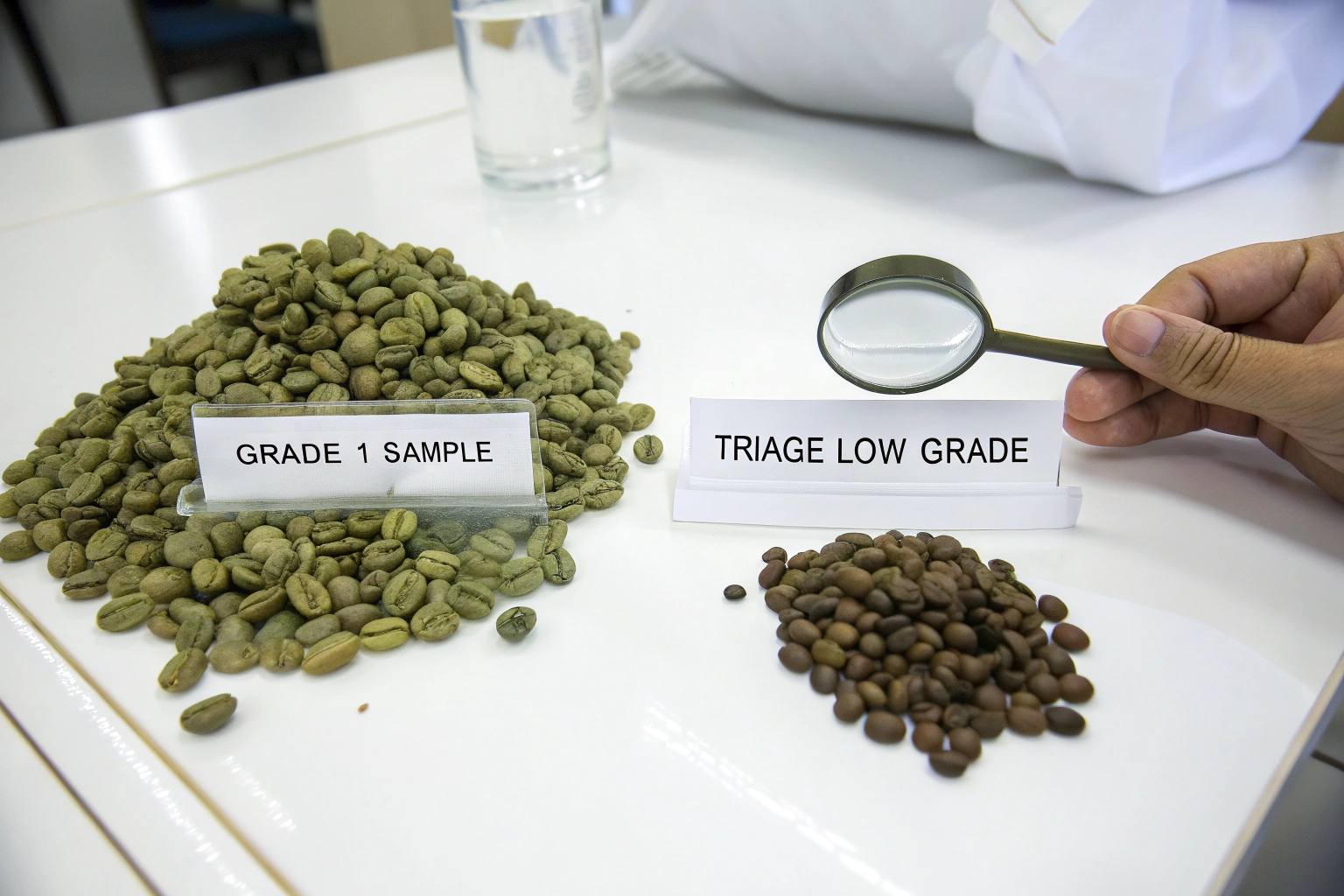
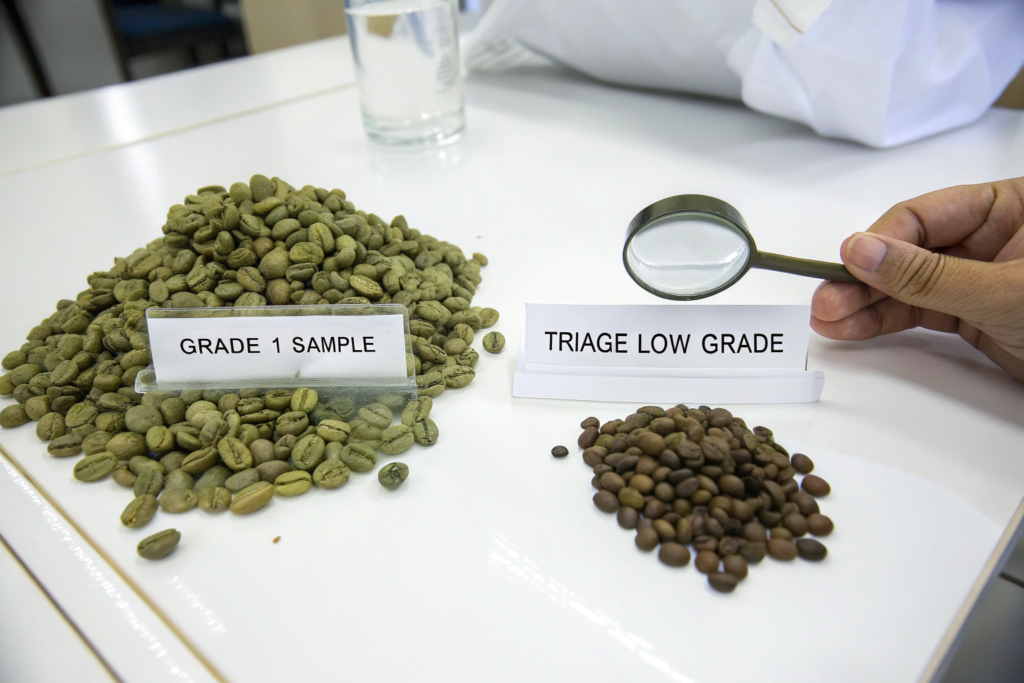
I once had a buyer send me a sample of a coffee he was buying from another supplier. It was labeled "Yunnan Grade 1." He asked me to cup it and give him my honest opinion. The cup was okay. It was not terrible. But it was flat. It lacked the vibrant sweetness and heavy body he expected. I poured the green sample out on a grading tray. Within seconds, I saw the problem. Mixed in with the large, uniform Screen 17/18 beans was a significant percentage of smaller Screen 14/15 beans, some broken bits, and a few floaters. It was not a pure Grade 1 lot. It was a blend dressed up as a premium product. The supplier was stretching their margin by cutting the good stuff with cheap filler. The pain for that buyer was real. He was paying a premium price for a commercial-grade blend.
To ensure your coffee supplier isn't mixing lower grade beans, you must implement a multi-step verification process that includes requiring a detailed lot specification sheet with screen size and defect tolerances, physically inspecting a representative green sample against SCA grading standards upon arrival, and cross-referencing the physical coffee with the supplier's documented traceability and mill processing logs for the specific lot.
This is about protecting your investment and your brand. You are buying a specific quality. You have a right to receive exactly what you paid for. Let me walk you through the tools and techniques you can use to detect adulteration and ensure the integrity of your supply chain.
What Are the Visual and Physical Signs of Bean Adulteration?
Your eyes are your first line of defense. You do not need a expensive lab to spot a poorly sorted or adulterated lot. You just need a flat surface, good lighting, and a little bit of training. The signs are there if you know what to look for.
The visual and physical signs of bean adulteration include a lack of screen size uniformity (a mix of large and small beans in the same sample), the presence of an excessive number of primary and secondary defects (full blacks, sours, insect damage, broken beans) beyond the tolerance for the claimed grade, and a dull, inconsistent color that suggests the mixing of different ages or processing batches.
A true premium lot has a certain visual integrity. It looks uniform. It looks clean. A mixed lot looks chaotic.
How Can I Use a Simple Sizing Screen to Check Grade Consistency?
This is the single most effective tool for a roaster to verify screen size claims. A set of handheld sizing screens costs less than $100 and takes five minutes to use. It is essential equipment for any receiving dock.
The Process for a Spot Check:
- Obtain the Spec: Your contract should state the minimum screen size retention. For example, "Minimum 90% retained on Screen 17."
- Take a Sample: Pull a random 100-gram sample from the middle of the bag, not just from the top.
- Screen It: Pour the sample over a Screen 17 (or whatever the spec is) with a Screen 14 below it to catch the smalls. Shake gently for 30 seconds.
- Weigh the Fractions: Weigh the beans that stayed on top of Screen 17. Weigh the beans that fell through Screen 17.
- Calculate the Percentage: If 92 grams stayed on Screen 17, your sample is 92% above screen. This meets the 90% spec. If only 78 grams stayed on Screen 17, your sample is 78% above screen. This fails the spec.
A failed screen size test is objective evidence of a quality issue. It is not subjective opinion. It is a measurement. It tells you the supplier either did not sort the coffee properly or they intentionally mixed in a lower screen size fraction to increase volume.
At Shanghai Fumao, we encourage our clients to spot-check our shipments with sizing screens. Our Green Coffee Specifications page outlines our exact tolerances. We are confident in our sorting because we invest in the equipment and the labor to do it right. For official SCA screen size standards, refer to the Specialty Coffee Association Green Coffee Grading Protocols.
What Does an Excessive Number of "Shells" or "Floaters" Indicate?
A "shell" is a hollow, malformed bean. A "floater" is a bean that is so low in density that it floats in water. These are primary indicators of poor processing or the intentional mixing of low-grade triage.
- The Cause: Shells and floaters are often the result of drought stress, poor fertilization, or—most commonly—improper drying. Beans that are dried too quickly at high heat can "case harden" and trap moisture inside, creating a hollow shell.
- The Gravity Table Solution: In a professional dry mill, the gravity separator (densimetric table) is designed to remove exactly these defects. The light, hollow beans float on the air cushion and are separated from the heavy, dense beans.
- What Their Presence Means: If you find more than a handful of shells and floaters in a "Grade 1" or "Specialty" sample, it means one of two things: 1) The supplier does not have a gravity separator (they are a low-tech operation), or 2) They have a gravity separator but they are intentionally running it too fast or re-mixing the "lights" fraction back into the main lot to increase volume.
The Float Test: You can do a quick "float test" at your cupping lab. Take a 50-gram sample of green beans and drop them in a beaker of water. Stir gently. Let them sit for 60 seconds. In a properly sorted specialty lot, less than 1-2% of the beans should float. If you see a significant layer of beans floating on the surface, the lot has not been properly density sorted. It has been padded with low-density filler.
This is a non-negotiable quality marker for us at Shanghai Fumao. Our five-line dry mill runs every export lot over a gravity separator tuned for maximum separation. The lights fraction goes to the domestic instant coffee market. It never goes into an export bag.
How Can Traceability Documentation Prevent Grade Mixing?
Visual inspection tells you if the coffee in front of you is mixed. Traceability documentation tells you if the coffee could have been mixed somewhere along the supply chain. The paper trail should tell a single, coherent story.
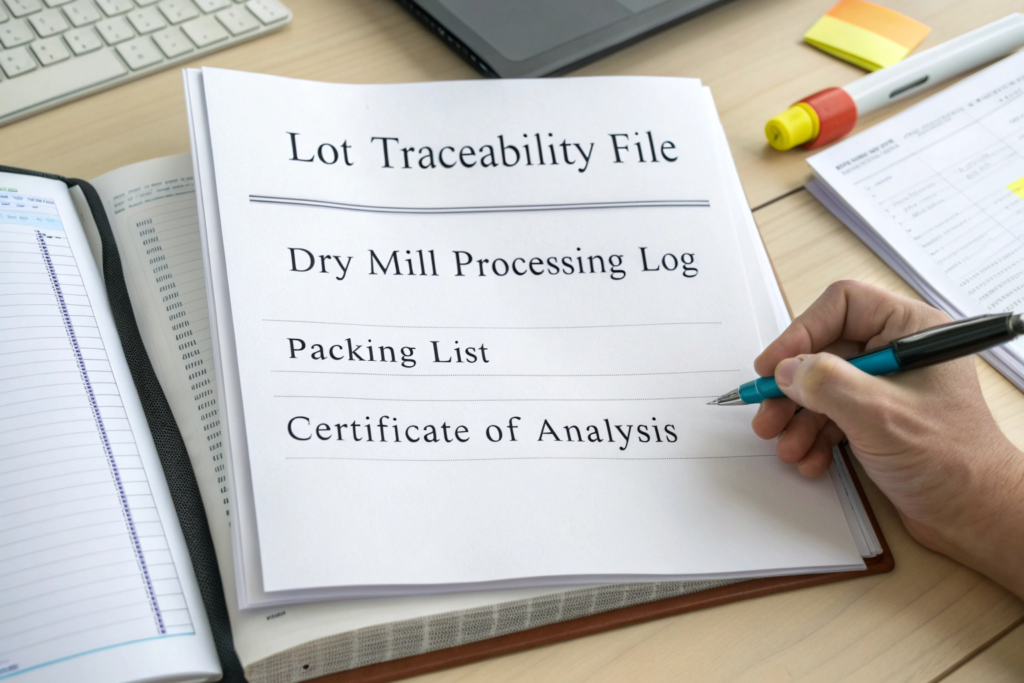
Traceability documentation prevents grade mixing by establishing a verifiable chain of custody from the specific farm block or processing batch to the final export bag, with each document (internal mill logs, warehouse receipts, and export certificates) referencing the same unique lot number, making it logistically difficult and easily detectable for a supplier to blend in beans from an untracked source.
If the paper trail is broken, the physical coffee is suspect. A supplier who is meticulous about their documentation is usually meticulous about their physical product.
Why Should I Request the Dry Mill Processing Log for My Lot?
This is an internal document that most roasters never ask to see. But it is one of the most powerful tools for verifying that a lot is pure.
What the Dry Mill Processing Log Shows:
- Input Volume: The exact weight of parchment coffee that went into the mill for that specific run.
- Run Date and Time: A continuous time stamp. A single lot should have a contiguous start and end time. If the log shows the run was paused for several hours and then restarted, it could indicate a changeover where another coffee was introduced.
- Machine Settings: The settings for the gravity separator and sizing grader.
- Output Volumes by Grade: The exact weight of Screen 18+, Screen 16/17, and "Lights" produced from that specific run.
How to Use It:
Ask your supplier: "Can you please provide the internal dry mill processing log for lot number [Your Lot Number]?"
When you receive it, check two things:
- Mass Balance: Does the volume of your purchased grade (e.g., 5,000 kg of Screen 17+) make sense as a percentage of the total input? If the log shows they only produced 3,000 kg of Screen 17+ from that run, but they sold you 5,000 kg, they must have blended in coffee from another run. That is a red flag.
- Continuity: Is it one continuous run? Or are there gaps?
At Shanghai Fumao, we maintain these logs for every lot. They are part of our ISO 22000 documentation. We are happy to provide excerpts to our contract clients as part of our Custom Blends Program. It is a level of transparency that commodity traders simply cannot offer. For more on supply chain transparency, the Blockchain in Transport Alliance is driving standards for digital documentation in logistics.
How Does Mass Balance Analysis Help Detect Adulteration?
Mass balance is a simple accounting principle applied to coffee. You cannot sell more of a specific grade than you physically produced from a given amount of cherry.
A Simplified Example:
- A farm harvests 10,000 kg of coffee cherry.
- After pulping and drying, this yields roughly 2,000 kg of dried parchment.
- After dry milling and density sorting, this 2,000 kg of parchment yields approximately 1,600 kg of exportable green coffee.
- Of that 1,600 kg, maybe 60% (960 kg) is premium Screen 17/18+.
- Conclusion: That specific farm block can only produce 960 kg of that premium grade.
If a supplier claims to have sold 2,000 kg of "Single-Estate Premium Grade" from that one small farm block, they are either lying about the volume or they have blended in coffee from another, likely lower-quality, source to meet the demand.
As a buyer, you cannot do a full mass balance analysis yourself. But you can ask the right questions. "How many hectares is the farm this lot comes from? What is the typical yield per hectare for this grade?" A supplier who is transparent about their production will have ready answers. A supplier who is blending will get vague or defensive.
Because Shanghai Fumao is a large, vertically integrated estate, our mass balance is clean and auditable. We know exactly what each block produces. We do not need to buy outside coffee to fill orders. Our volume comes from our land. This is the ultimate guarantee against blending.
What Roasting and Cupping Clues Reveal Mixed Grades?
Sometimes the mixing is not visually obvious in the green state, especially if the lower-grade beans are of a similar color. But the roaster never lies. The different densities and sizes of mixed-grade beans will react differently to heat, creating a visual and sensory signature that is unmistakable.
The roasting and cupping clues that reveal mixed grades include an uneven roast color in the finished batch (a mix of dark and light beans), a muddled or hollow cup profile lacking distinct origin character, and the presence of off-flavors like papery, woody, or fermented notes that are inconsistent with the main body of the cup.
If your roast data and your cupping notes are erratic and inconsistent from batch to batch, the problem is likely in the green coffee bag. It is not your roaster. It is the raw material.
Why Does an Uneven Roast Color Suggest Inconsistent Bean Density?
This is a direct result of the physics we discussed in the density sorting article. A coffee bean is a thermal mass. It absorbs heat at a rate determined by its density, size, and moisture content.
- High-Density, Large Beans (Screen 17/18): These are like large stones. They heat up slowly and evenly. They require more energy to reach the desired color and development.
- Low-Density, Small Beans (Screen 14/15, Floaters): These are like dry kindling. They heat up rapidly. They scorch easily.
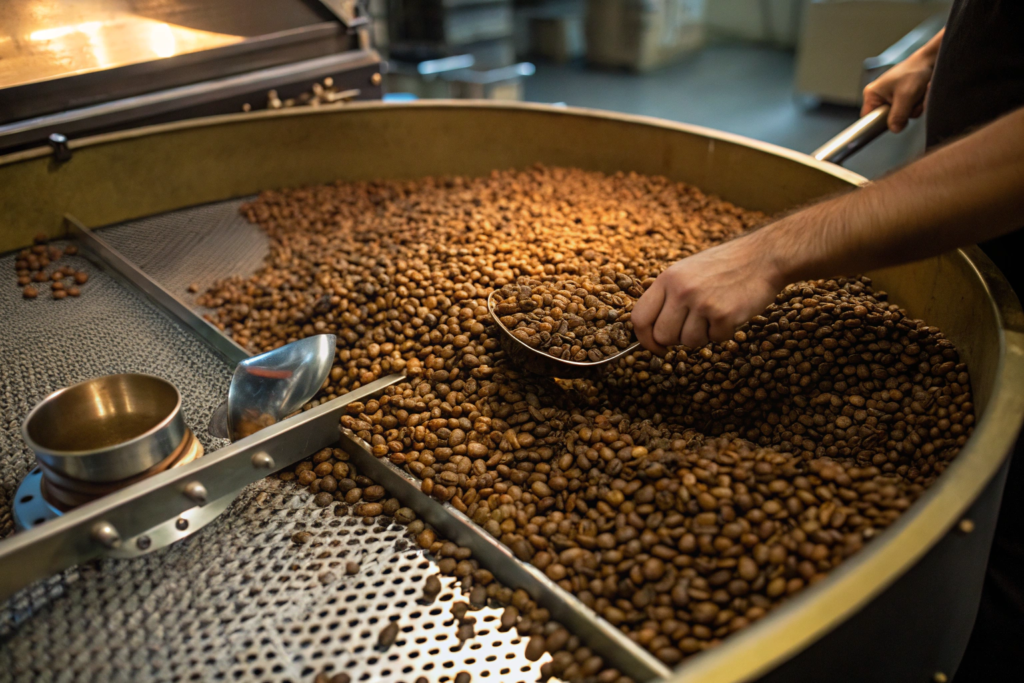
When you roast a batch of mixed-grade beans, you apply heat based on an average. The low-density, small beans over-roast. They become dark brown or even black. They may show signs of tipping or scorching. The high-density, large beans under-roast. They remain lighter in color, sometimes with a pale, wrinkled surface. They are underdeveloped in the center.
What You See: When you dump the batch into the cooling tray, you see a mottled, uneven color. A mix of dark and light beans. A well-sorted, single-grade lot will have a remarkably uniform roast color across the entire batch.
The Taste: This uneven roast translates directly into a muddled cup. You taste both the ashy, bitter notes from the over-roasted beans and the grassy, sour, peanutty notes from the under-roasted beans. The flavor is confused and unpleasant.
At Shanghai Fumao, our density sorting protocol is specifically designed to eliminate this variable. We want you to see a uniform roast color and taste a clean, coherent flavor. Our Grade 1 Arabica is guaranteed to roast evenly. For more on the science of roast defects, Roast Magazine is an invaluable technical resource.
What Off-Flavors in the Cup Point to Low-Grade Adulteration?
Even if the roast color looks okay, your palate can detect the adulteration. Lower-grade beans and defects have specific, identifiable flavor signatures.
| Off-Flavor | Likely Cause | What It Indicates |
|---|---|---|
| Papery, Woody, Flat | Aged past-crop beans, or beans stored improperly. | The supplier mixed in old, dead coffee to increase volume. |
| Ferment, Vinegar, Overripe Fruit | Over-fermented beans, or "stinker" beans. | Poor wet-mill processing. These beans were likely bought cheaply as triage. |
| Earthy, Musty, Moldy | Beans dried on the ground or stored in humid conditions. | Serious food safety and quality failure. The supplier is cutting corners on drying and storage. |
| Phenolic, Medicinal | Severe mold or chemical contamination. | The lot is contaminated and should be rejected immediately. |
If you cup a coffee that is supposed to be a clean, washed Grade 1 Arabica, and you detect any of these off-flavors, it is a sign that the lot is not pure. The supplier has likely blended in a percentage of cheaper, defective coffee to lower their cost.
This is why cupping every single arrival is non-negotiable. You are not just tasting for quality. You are auditing for integrity. At Shanghai Fumao, our Q-Grader cups every export lot before it ships. We reject any lot that shows these defects. We would rather lose money on a rejected lot than lose a client's trust.
Conclusion
Ensuring your coffee supplier is not mixing lower grade beans requires a combination of vigilance, knowledge, and the right tools. It is a three-part defense: Visual and Physical Inspection (using your eyes and a sizing screen), Documentation Audit (reviewing traceability and mass balance), and Sensory Verification (observing the roast and cupping the cup).
A supplier who is cutting corners will eventually be exposed by one of these methods. The visual inspection catches the obvious size mixing. The documentation audit reveals the logistical impossibilities. And the cupping table reveals the hidden flavor defects.
At BeanofCoffee, we build our entire operation around transparency and integrity. We are a single estate. We control the process from seed to bag. We do not need to mix grades because our quality and our volume come from our own land and our own disciplined processing. We encourage you to test our coffee against these standards. We are confident it will pass.
If you want to receive a sample of our Grade 1 Arabica and put it through your own inspection process, we welcome the scrutiny. Email Cathy Cai. She can send you a pre-shipment sample and the corresponding documentation package for you to review. Contact Cathy at: cathy@beanofcoffee.com