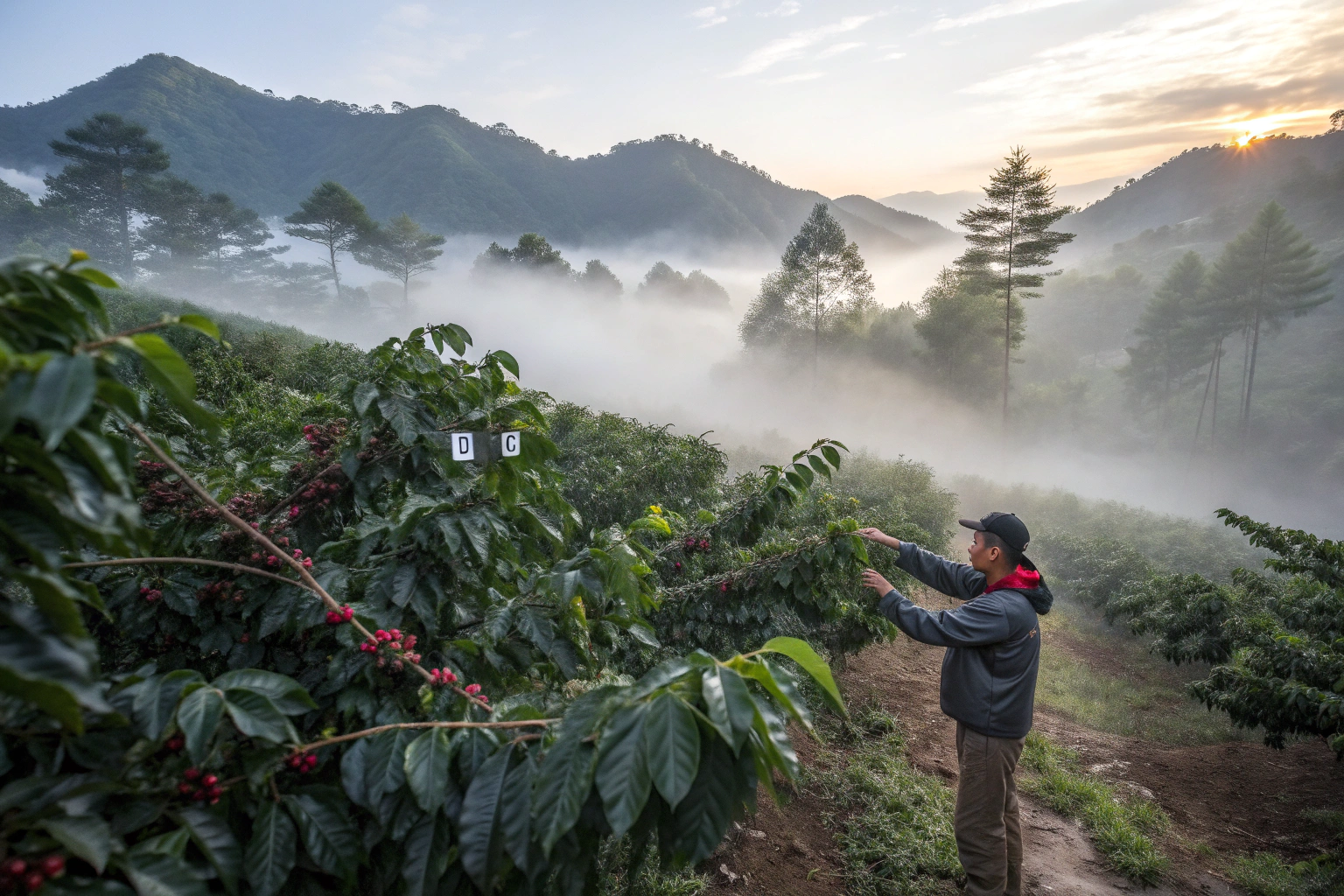
I walked our highest-altitude block one December morning a few years ago. The temperature gauge nailed to a shade tree read 6°C. My breath made clouds. The cherries on the Catimor trees were deep purple-red, almost black, and firm to the touch. A visiting buyer from Australia was with me. He picked a cherry, bit into the sweet mucilage, and said, "This tastes different from yesterday's block." He was right. The previous day we had walked a block 300 meters lower. The cherries there were softer, sweeter in a simpler way, and already beginning to loosen from the branch. The only variable was climate.
Climate affects coffee bean quality in Yunnan through three interacting factors: altitude-driven temperature drops that slow cherry maturation and increase sugar concentration, a monsoon-to-drought seasonal rhythm that creates a dry harvest window for mold-free processing, and diurnal temperature swings that stress the bean beneficially, producing the malic acidity and dense structure that define high-scoring specialty lots.
You cannot separate the cup from the climate. The soil, the varietal, the processing method—these all matter. But climate is the composer. It sets the tempo. Everything else plays to its rhythm. If you are buying Yunnan coffee and you do not understand the climate mechanics behind the lot you are purchasing, you are buying blind.
How Do Temperature Fluctuations Shape the Yunnan Arabica Cup?
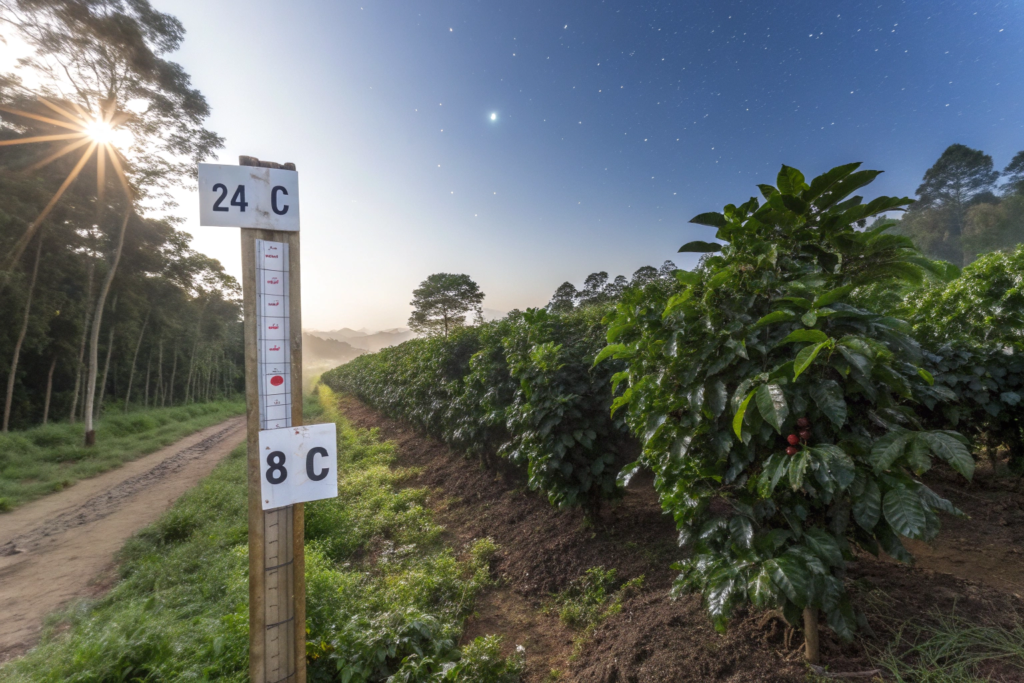
Temperature is not a single number. It is a range. A dance between day highs and night lows. In Yunnan, that dance has a wide amplitude. During the harvest months, a typical day might swing from 22°C at noon to 8°C at night. That 14-degree gap is not a problem. It is a quality asset.
Temperature fluctuations shape the Yunnan Arabica cup by slowing nighttime respiration rates, which reduces the consumption of stored sugars inside the coffee seed, resulting in a bean with higher sucrose content that caramelizes during roasting into the deep chocolate and brown sugar notes characteristic of Baoshan specialty lots.
Plants respire. They burn sugar for energy, just like us. During the day, photosynthesis produces sugar. At night, respiration consumes it. The rate of respiration is temperature-dependent. In warm tropical nights, the coffee tree burns through a significant portion of its daily sugar production. The bean ends up with less residual sweetness. In Yunnan, the cold nights put respiration into slow motion. The sugar factories shut down. The bean retains more of what it built during the day. When you roast that bean, the extra sucrose caramelizes. The Maillard reaction has more fuel. The cup comes out sweeter, heavier, with a rounded mouthfeel that you cannot fake with processing tricks.
Why Do Cold Nights Produce Denser Beans with Higher Acidity?
Bean density is a physical measure that roasters care about deeply. A dense bean conducts heat differently. It requires more energy to crack. It rewards a skilled roaster with complex flavor development. Cold nights are the density engine.
When the ambient temperature drops at night, the coffee cherry cools. The metabolic activity inside the seed slows. The bean's cells divide more slowly and pack together more tightly. The result is a physically harder, denser bean with a higher concentration of organic acids. Malic acid, in particular, accumulates under cold stress. Malic acid is the same acid that gives green apples their crispness. In the cup, it reads as a clean, refreshing acidity that balances the heavy sweetness. This is why our high-grown Baoshan Catimor has a malic brightness that surprises buyers who expect a flat, dull cup from a Catimor variety. The variety matters, but the cold nights override the genetics to a remarkable degree.
What Happens to Coffee Quality During an Unusually Warm Harvest?
Not every year is ideal. Climate variability is the farmer's constant anxiety. A warm harvest season disrupts the sugar-acid balance that cool nights create. I have seen it happen.
Two harvests ago, we experienced an unusually warm November. Night temperatures stayed above 14°C, nearly 6 degrees warmer than the ten-year average. The cherries ripened faster. The picking window compressed. The beans, when milled and cupped, showed lower acidity and a thinner body. Scores dropped by about 1.5 points across the board. The coffee was still specialty, still clean, but the "sparkle" was missing. The warm nights had burned off the sugars we normally bank. This is the vulnerability of Yunnan's quality model. We depend on the cold. If long-term warming trends erode the diurnal temperature swing, the distinctive Yunnan cup profile will shift. Farmers will need to plant at even higher altitudes, or invest in more shade canopy to artificially cool the cherries. It is a problem we are already discussing in grower cooperatives.
How Does the Monsoon Cycle Dictate the Harvest Calendar and Quality?
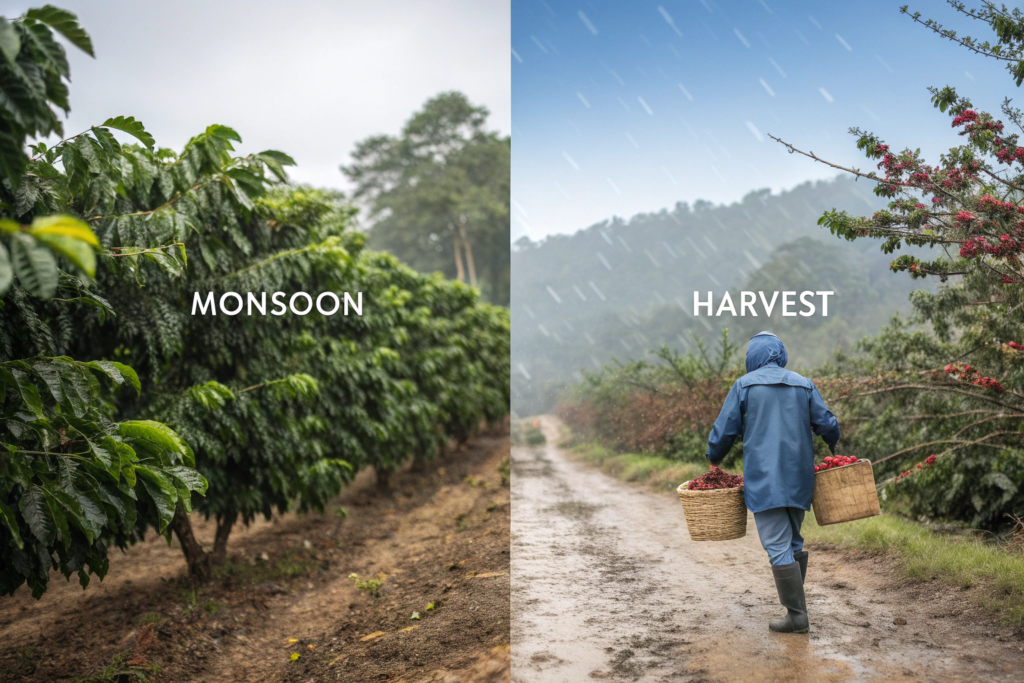
Water governs everything. When it falls. When it stops. The monsoon cycle in Yunnan is a binary switch. Half the year, it rains. Half the year, it is dry. The coffee tree's entire life is synchronized with this rhythm.
The monsoon cycle dictates Yunnan's coffee quality by providing heavy rainfall during the vegetative growth and cherry development phase from June to September, then delivering a reliably dry period from October to February that allows cherries to ripen slowly on the branch and be harvested without rain-related mold or fermentation defects.
This is a structural advantage over many competing origins. In parts of Colombia or Sumatra, harvest coincides with rain. Farmers pick cherries in the wet. The parchment dries under cloudy skies or with mechanical dryers that can overheat the bean. Mold risk is high. Fermentation control is difficult. In Yunnan, the sky clears just as the cherries turn red. The sun is reliable. The air is dry. We pick, process, and dry without a weather panic. This consistency translates into a clean cup, year after year.
How Does the Timing of the Monsoon Rains Affect Flowering?
The monsoon's arrival is the starting gun for the coffee tree's reproductive cycle. A coffee tree does not flower on a fixed calendar date. It flowers in response to a trigger—the first heavy rain after a period of water stress.
In Yunnan, the dry winter stresses the trees mildly. They conserve energy. Then, in March or April, the first monsoon showers arrive. The sudden moisture shock triggers a synchronized flush of flowering across the entire farm. The white blossoms smell like jasmine and last only a few days. The timing of this first rain is critical. An early rain in late February, followed by a dry spell, can cause a split flowering. Some flowers bloom and are pollinated. Others wait. The result is uneven cherry maturation. You get ripe, underripe, and overripe cherries on the same branch at harvest time. That heterogeneity hurts quality. A uniform, well-timed monsoon onset produces a uniform flowering, which produces a uniform ripening nine months later. Uniformity at harvest is the single biggest quality lever a farmer has. Our Baoshan estate has been fortunate. The Lancang Valley's microclimate tends to produce a clean, single-trigger monsoon onset most years.
Why Is a Dry Harvest Season So Valuable for Processing?
Processing is the moment of truth. A perfect cherry can be ruined by bad processing. A dry harvest season makes good processing dramatically easier. This sounds obvious, but the implications are profound.
Sun-drying on raised beds is the preferred method for specialty coffee. It is gentle. It preserves volatile aromatics. Mechanical drying, while faster, risks tipping the bean temperature above 40°C, which kills the embryo and produces a flat cup. In a rainy harvest climate, sun-drying is a gamble. You spread the parchment, it rains, you rush to cover it, moisture spikes, mold spores activate. In Yunnan's dry season, the gamble is removed. We spread the parchment under clear skies. The relative humidity is low, around 40% to 50%. The beans dry evenly over two to three weeks. The moisture drops from 55% to 11% in a smooth curve. This slow, predictable dehydration stabilizes the cell structure and locks in the sweetness developed by the cold nights. It is why our naturals have a clean fruit character without the fermented "funk" that plagues some origins.
What Microclimates Within Yunnan Produce Distinct Cup Profiles?
Yunnan is not a monolith. It is a province the size of Germany. The climate in Baoshan is not the climate in Pu'er. The mountains, the rivers, the latitude gradients all create pockets of distinct weather. These microclimates imprint themselves on the bean.
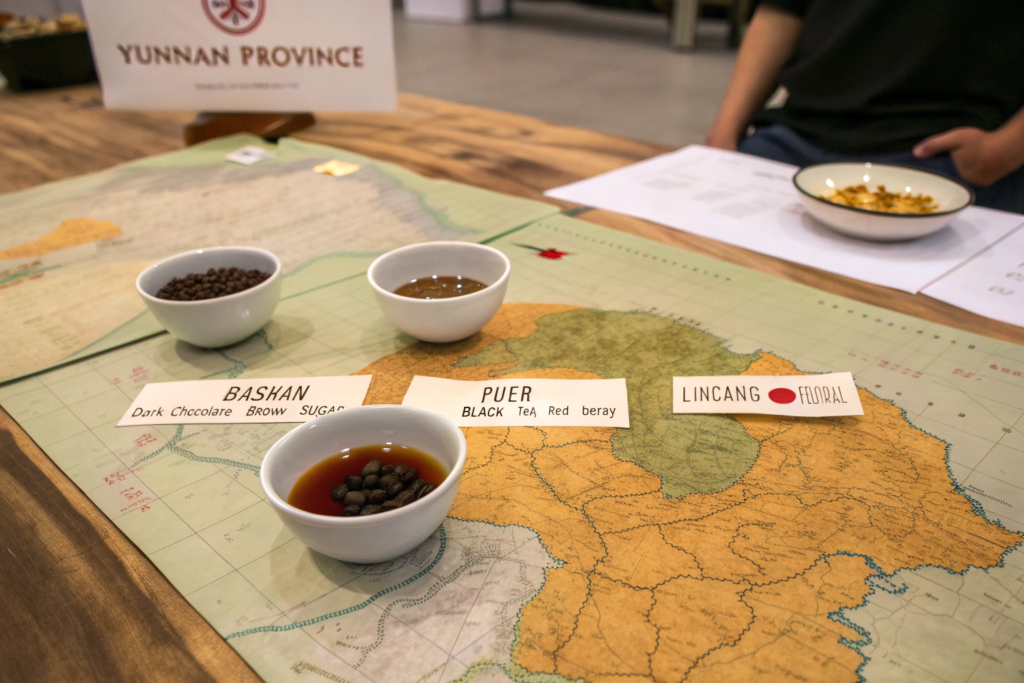
Yunnan's coffee microclimates produce distinct cup profiles based on local interactions between elevation, proximity to the Lancang River, fog frequency, and soil composition. Baoshan produces heavy-bodied, chocolate-forward cups. Pu'er yields lighter-bodied, tea-like and red fruit cups. Lincang's higher altitudes produce brighter, more acidic, and floral profiles.
The differences are not imaginary. They are repeatable and measurable. When I send a Baoshan sample and a Pu'er sample to a buyer, they cup differently even if the variety and processing are identical. The terroir speaks louder than the processing. A washed Catimor from Baoshan at 1,500 meters will be rounder, sweeter, and heavier. A washed Catimor from Pu'er at 1,300 meters will be brighter, more astringent on the edges, with a tea-like finish. Both can score 83. But they fit different roles in a roaster's lineup.
How Does the Gaoligong Mountain Range Influence Baoshan Coffee?
The Gaoligong Mountains are Baoshan's guardian. They run north to south along the border with Myanmar, a massive wall of green that catches the moisture-laden winds from the Indian Ocean. The mountains force the air upward. It cools. It condenses into fog and rain on the western slopes.
Baoshan's coffee farms sit on the eastern side of the range, in a rain shadow. The mountains block the harshest monsoon weather, creating a slightly drier, more stable climate than the rest of western Yunnan. The fog that spills over the ridgeline each morning provides diffused light and moderated temperatures. The Gaoligong ecosystem also contributes something subtle. The forest biodiversity is intense. The soil is rich with decomposing leaf litter from native hardwoods. The microbial life in that soil is complex and healthy. That soil life feeds the coffee roots a diverse nutrient profile. You cannot point to a single chemical compound in the cup and say "that came from the Gaoligong microbes." But the overall complexity and depth of flavor, the savory umami undertone in a Baoshan natural, that is the fingerprint of a living, wild-adjacent ecosystem.
What Makes the Pu'er Tea-Coffee Transition Zone Unique?
Pu'er is famous for tea. The name "Pu'er" is synonymous with aged fermented tea cakes that sell for thousands of dollars. When the coffee wave hit Yunnan, many Pu'er tea farmers diversified into coffee on their lower-elevation land, keeping the prime tea terraces higher up.
This shared land-use history created a unique agricultural mosaic. Coffee and tea grow within sight of each other. The soil has been managed for tea cultivation for centuries. It is slightly more acidic, with a different mineral balance than the volcanic soils of Baoshan. The climate is warmer and wetter. The resulting coffee cup often has a distinct black tea note. Not a defect. A varietal character linked to the terroir. It is a dry, slightly tannic finish that tea drinkers appreciate. For a roaster designing a single-origin offering, this tea-like quality is a storytelling goldmine. You can market "Coffee from the Tea Mountains" with authenticity. The cup backs up the narrative. The Pu'er coffee industry has leaned into this identity, and it differentiates their product in a crowded specialty market.
How Is Climate Change Affecting Yunnan's Long-Term Coffee Quality Prospects?
I am not a climate scientist. I am a farmer who reads climate science because my livelihood depends on it. The projections for Yunnan are a mixed bag. Some trends favor coffee. Others threaten it. The net effect is uncertainty, and uncertainty is expensive.
Climate change is affecting Yunnan's coffee prospects by raising average temperatures, which compresses the cold diurnal window that drives quality, altering monsoon timing in ways that disrupt uniform flowering, and opening new high-altitude land for coffee cultivation that was previously too cold, creating a geographic shift upward in the coffee belt within the province.
The warming is measurable. Our farm's weather records show an average temperature increase of about 0.8°C over the past 20 years. The coldest nights are not as cold. The diurnal swing is narrowing. If this trend continues linearly, the quality advantage we currently enjoy from cold nights will gradually erode. We will need to climb higher up the mountain to find the same cold. But there is a limit to how high we can go. The mountains have peaks. Above 1,800 meters, frost risk becomes a yearly threat even with warming. The available high-altitude land is finite.

Are Farmers Adapting with Shade Trees and New Varietals?
Adaptation is underway. It is not a future plan. It is happening now. The most visible adaptation on our farm and many neighboring estates is the planting of shade trees. Ingas, bananas, and native hardwoods are being interplanted between the coffee rows.
Shade trees create a microclimate buffer. They lower the ambient temperature at the cherry level by 2°C to 3°C. They reduce water loss from the soil. They provide leaf litter that builds organic matter. The canopy also mitigates the impact of extreme heatwaves, which are becoming more frequent. The trade-off is that shade reduces yield. Fewer cherries per tree. But the quality of those cherries is higher. For a specialty producer, that trade-off is acceptable. Better to produce fewer bags of 84-point coffee than more bags of 80-point coffee. The other adaptation lever is varietal selection. We are trialing heat-tolerant Arabica lines and assessing which existing varietals perform best under warmer conditions. Catimor's Robusta heritage gives it some natural heat tolerance, which is why we have not abandoned it entirely. The goal is a portfolio of varieties that spreads the climate risk.
Will Yunnan Gain or Lose from Global Coffee Climate Shifts?
The global picture is grim. The traditional coffee belt is shrinking. Brazil, Vietnam, parts of Central America face severe production challenges from drought and heat. In this context, Yunnan's position is relatively advantageous. We are at the cool northern edge of the belt. Warming pushes the viable zone uphill and northward. That opens new land for us, while it closes land for equatorial producers.
There is a scenario, not improbable, where Yunnan becomes a more significant global origin as other regions decline. The quality is already proven. The infrastructure is modern. The domestic market provides a floor. The climate, while warming, is starting from a cooler baseline. We have room to adapt before hitting thermal limits. I am cautiously optimistic. But optimism requires investment. The specialty coffee industry in Yunnan cannot be complacent. We need to invest in weather stations, irrigation for newly planted shade trees, genetic research, and farmer training. The climate will change. The question is whether we change with it fast enough.
Conclusion
Climate is the invisible hand that shapes every Yunnan coffee bean. The cold nights build density and sweetness. The monsoon rhythm sets the flowering and harvest clock. The dry winter provides a processing window that equatorial farmers envy. The microclimates of Baoshan, Pu'er, and Lincang paint different flavors across the province. And the slow creep of warming temperatures is pushing the industry to adapt, to climb higher, to plant shade, to select smarter.
For a coffee buyer, this means that a Yunnan lot is not just a bag of beans. It is a weather report. A snapshot of a specific season in a specific valley. Understanding the climate that produced the lot helps you understand the cup.
If you want to taste the climate in the cup—to compare a cold-night Baoshan lot against a warmer Pu'er lot, or a high-altitude Typica against a valley-floor Catimor—we can arrange a sample set. We include the elevation data, the harvest weather summary, and the cupping notes. Contact Cathy Cai at cathy@beanofcoffee.com and ask for the "Climate and Cup" sample kit. Let the bean tell you the story of its mountain.