I get this question a lot from buyers. A roaster in Ohio once told me he loved our Yunnan beans but had no idea if his landed cost was fair. He was paying $4.20 per pound after shipping. Was that good? Bad? He could not tell. That uncertainty is dangerous. It eats your margin. It makes you hesitant to place the next order. And honestly, it gives freight companies too much power.
So, how do you calculate freight per pound on a coffee shipment? The basic formula is simple. Take the total freight cost, divide it by the total weight of the coffee in pounds. That gives you a number. But that number is almost never the full story. You need to add terminal handling, customs brokerage, inland trucking, and sometimes tariffs. You also need to account for volume. Coffee is heavy, but it also takes up space. Ocean carriers charge by weight or measure, whichever is greater. So a shipment of dense green beans might be charged by weight, while a shipment of packaged roasted coffee might be charged by volume. Knowing which one applies to you is the first step.
Let me walk you through the real numbers. I will show you how I calculate freight per pound for our own shipments from Yunnan to the US West Coast. I will also share the mistakes I made early on. You know, the ones that cost me thousands of dollars.
What Is Freight per Pound and Why Does It Matter?
Freight per pound is the total transportation cost divided by the net weight of your coffee. It sounds straightforward. But most buyers forget to include the hidden costs. They look at the ocean freight quote and stop there. That is a mistake. The ocean freight is only about 40% to 60% of the total landed cost. The rest comes from fees that pile up at the origin port, the destination port, and everywhere in between.
Why does this matter? Because if you calculate freight per pound wrong, you might reject a good supplier. Or you might accept a bad one. I have seen buyers walk away from a $3.80 per pound offer because they thought the freight was too high. Then they signed with a supplier at $3.50 per pound. But that supplier hid terminal fees. The final landed cost was $4.40 per pound. The first offer was actually cheaper. So the lesson is simple. Always ask for a full landed cost breakdown. Do not just compare the ocean freight line.
Another thing. Freight per pound changes with volume. If you ship one pallet, the per-pound cost is high. If you ship a full container, the per-pound cost drops. That is basic math. But many small roasters do not realize how much they can save by waiting and consolidating. I will talk more about that later.

How Do You Break Down Freight per Pound?
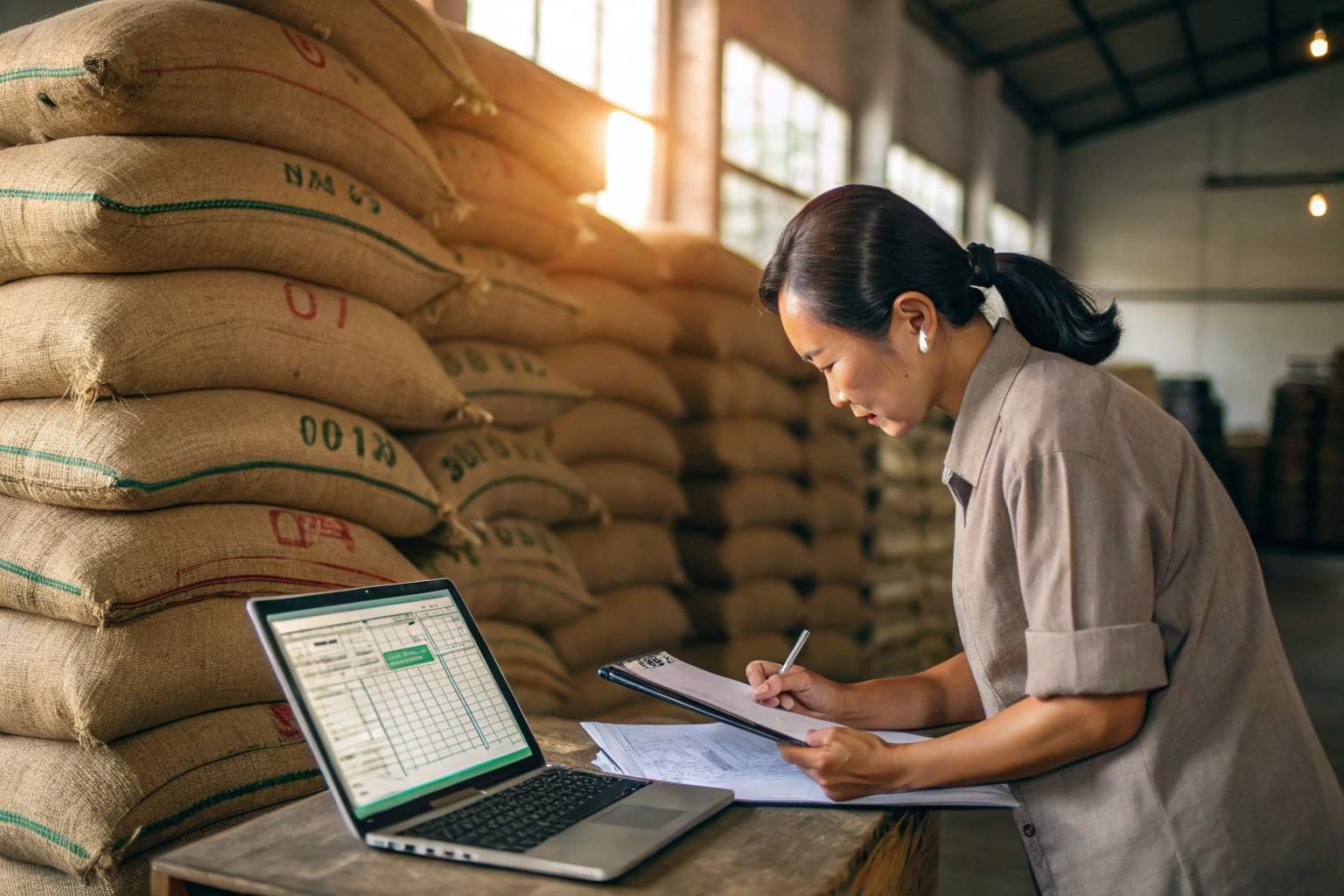
You break it down by listing every cost from farm gate to your door. Start with the origin charges. These include export customs clearance, terminal handling at the origin port, and document fees. Then add the ocean freight itself. Then add destination charges. These include terminal handling at the destination port, customs brokerage, and delivery to your warehouse. Then add any tariffs or duties. Finally, divide the total by the net weight in pounds. I use a simple spreadsheet. You can find helpful freight calculators online, like the one from Freightos. That tool gives you a baseline. But always confirm with your freight forwarder.
For coffee specifically, you also need to consider moisture loss. Green coffee can lose 0.5% to 1% of its weight during transit. That does not change the freight cost, but it changes the per-pound cost of the coffee you actually receive. So if you buy 40,000 pounds and lose 200 pounds, your effective freight per pound goes up slightly. It is a small detail. But a detail that matters.
Why Do Small Shipments Cost More per Pound?
Small shipments cost more per pound because the fixed costs do not shrink. The terminal handling fee is the same whether you ship 1,000 pounds or 40,000 pounds. The customs brokerage fee is the same. The trucking fee is often the same. So when you divide those fixed costs by a small weight, the per-pound number explodes. For example, a 1,000-pound shipment might have $800 in fixed fees. That is $0.80 per pound just in fixed costs. A 40,000-pound shipment has the same $800 in fixed fees. That is $0.02 per pound. That is a huge difference. This is why I always tell small roasters to consolidate. Wait until you have enough coffee to fill at least half a container. Or work with a consolidator who can combine your order with others. The Flexport platform has tools for this. But you can also ask your supplier. We often help our smaller buyers pool their orders with other buyers in the same region.
How Do You Calculate Ocean Freight for Coffee?
Ocean freight is the biggest single line item. But it is also the most variable. Rates change every week. They depend on the route, the season, the carrier, and the fuel price. I have seen rates from Yunnan to Los Angeles range from $1,800 to $4,500 per 20-foot container in a single year. That is a wild swing. So you need a method. You cannot just guess.
The method I use is this. First, get three quotes from different freight forwarders. Do not just use one. Second, ask for the all-in rate. That means the rate includes origin charges, ocean freight, and destination charges. Some forwarders quote only the ocean freight. Then they add fees later. That is how you get surprised. Third, check the transit time. A cheaper rate might take 45 days instead of 30 days. That extra time ties up your money. It also increases the risk of quality loss. So calculate the true cost, not just the dollar amount. You can check current market rates on Maersk or similar carrier websites.
Once you have the all-in rate, divide by the weight. But remember, containers have weight limits. A 20-foot container can hold about 40,000 pounds of green coffee. A 40-foot container can hold about 44,000 pounds, but the volume is larger. So for coffee, the 20-foot container is often more efficient. It lets you reach the weight limit before you run out of space. That lowers your per-pound cost.

What Is the Formula for Ocean Freight per Pound?
The formula is: (Ocean Freight + Origin Charges + Destination Charges) / Net Weight in Pounds. Let me give you a real example. Suppose the all-in rate is $3,200 for a 20-foot container. The net weight of coffee is 40,000 pounds. Then the freight per pound is $3,200 / 40,000 = $0.08 per pound. That is the ocean freight portion. But wait. You also have tariffs. If the tariff is 0% for green coffee, then you add nothing. If it is 3%, then you add $0.12 per pound based on a $4.00 per pound coffee value. So the total freight and duty per pound is $0.20. That is a useful number. You can compare that to other origins. For more on tariff classifications, check the US International Trade Commission database. It is free and official.
But here is the tricky part. The formula changes if you ship packaged coffee. Packaged coffee is lighter per cubic foot. So you might hit the volume limit before the weight limit. In that case, the carrier charges by measure. One cubic meter equals about 35.3 cubic feet. If your coffee takes up 30 cubic meters, the chargeable weight might be higher than the actual weight. So you need to calculate both. Use the greater number. That is the standard rule in ocean freight.
How Do You Convert Cubic Meters to Pounds?
To convert cubic meters to pounds, you first convert cubic meters to cubic feet. One cubic meter is 35.3147 cubic feet. Then multiply by the density of your coffee. Green coffee has a density of about 40 to 45 pounds per cubic foot. So one cubic meter of green coffee weighs about 1,412 to 1,589 pounds. But the carrier does not use your density. They use a standard conversion. For ocean freight, one cubic meter is often treated as 1,000 kilograms, which is 2,204.62 pounds. That is the volumetric weight. So if your shipment takes up 20 cubic meters, the volumetric weight is 44,092 pounds. If your actual weight is 40,000 pounds, the carrier charges you for 44,092 pounds. That increases your per-pound cost. This is why you should always pack coffee densely. Use high-quality burlap bags. Do not leave empty space in the container. You can learn more about packing standards from the Specialty Coffee Association. They publish useful guidelines for green coffee packaging.
What Costs Add to Your Freight per Pound?
Many buyers forget the add-ons. They focus on the ocean freight. But the add-ons can double your per-pound cost. I learned this the hard way in 2018. I shipped a container to Seattle. The ocean freight was $2,100. I thought the total would be around $2,500. Then the bill came. It was $3,900. The extra $1,400 came from terminal handling, chassis fees, customs brokerage, and a surprise inspection. That was a painful lesson. So now I list every possible cost before I quote a buyer.
The main add-ons are these. Origin terminal handling charge. Destination terminal handling charge. Customs brokerage fee. ISF filing fee. Chassis fee. Demurrage and detention. Inland trucking. And tariffs. Some of these are fixed. Some are variable. Some are avoidable. For example, demurrage happens when your container sits at the port too long. You can avoid it by clearing customs quickly. That means having your documents ready before the ship arrives. The US Customs and Border Protection website explains the process. Read it. It will save you money.
Another add-on is the tariff. For green coffee, the US tariff is usually zero. But for roasted coffee, it can be higher. And if you source from China, there may be additional tariffs depending on the trade situation. Always check the current rates. The USDA Foreign Agricultural Service publishes updates. Do not rely on old information.

How Do Tariffs and Duties Affect Your Freight?
Tariffs and duties are not technically freight. But they affect your landed cost per pound. So you must include them. If you calculate freight per pound without tariffs, you are lying to yourself. I always add a line for duties in my spreadsheet. For green coffee, I use 0% unless I know otherwise. For roasted coffee, I use the current rate. For packaged coffee, I also add the cost of the packaging materials and the labeling. Those are not freight, but they are part of the per-pound cost of getting the product to your door. The International Coffee Organization has a useful tariff database. Check it before you finalize your budget.
One more thing. Currency exchange rates matter. If you pay in USD but your supplier pays the freight forwarder in RMB, the exchange rate affects the final cost. I have seen a 3% swing in a month. That is $0.12 per pound on a $4.00 coffee. So lock in your rate if you can. Or at least budget a small buffer.
What Are Inland Transportation and Warehouse Fees?
Inland transportation is the trucking from the port to your warehouse. Warehouse fees are the storage and handling at the destination. These can be significant. For example, a container from Los Angeles to Denver might cost $1,500 in trucking. That is $0.0375 per pound on 40,000 pounds. A warehouse might charge $50 per pallet for receiving. If you have 20 pallets, that is $1,000. Another $0.025 per pound. These numbers add up. So always ask for a door delivery quote. Do not just ask for port-to-port. The Federal Motor Carrier Safety Administration has resources on trucking regulations. But your freight forwarder should handle this. Just make sure they include it in the quote.
How Can You Reduce Freight Costs on Coffee?
You can reduce freight costs. But you have to be smart. You cannot just squeeze the freight forwarder. You need to change how you ship. The biggest savings come from consolidation and planning. I have helped buyers cut their per-pound freight cost by 30% just by changing their order pattern. It is not magic. It is math.
The first strategy is consolidation. Instead of shipping every month, ship every three months. Combine your orders. Fill a container. This lowers your per-pound cost because you spread the fixed fees over more pounds. The second strategy is to use a freight forwarder who specializes in coffee. They know the routes. They know the carriers. They can get better rates. The third strategy is to negotiate. Do not accept the first quote. Ask for a discount. Ask for free detention time. Ask for a waiver on chassis fees. I do this every time. Sometimes I get it. Sometimes I do not. But it never hurts to ask.
Another strategy is to choose a different port. Los Angeles is expensive. Oakland is sometimes cheaper. Seattle is sometimes cheaper. It depends on your final destination. So compare. I once saved a buyer $600 per container by routing through Oakland instead of Long Beach. That was $0.015 per pound. Not huge, but it adds up.
When Should You Consolidate Coffee Shipments?
You should consolidate when your order volume is less than half a container. If you are shipping 10,000 pounds, you are paying a high per-pound cost. If you wait and ship 40,000 pounds, you pay much less. But you have to balance that with your cash flow. You do not want to tie up too much money in inventory. So the sweet spot is often a 20-foot container. That is about 40,000 pounds. Most small roasters can use that in three to four months. If you cannot, then work with a consolidator. A consolidator combines your shipment with others. You share the container. You pay only for your share. The Alibaba platform has some consolidation services. But you can also ask your supplier. We at BeanofCoffee often help our smaller buyers pool their orders. It is a win-win.
One more thing. Consider shipping roasted coffee instead of green coffee. Roasted coffee is lighter. It takes up more volume. But you pay less in tariffs if you are in a country with a trade agreement. And you can sell it faster. So the per-pound freight might be higher, but the total landed cost might be lower. Do the math for your specific situation.
How Do You Negotiate Better Freight Rates?
You negotiate better rates by being a good customer. Pay on time. Give accurate weights. Provide all documents in advance. Freight forwarders give better rates to customers who are easy to work with. They also give better rates to customers who ship regularly. So if you can, sign a contract for a year. Commit to a certain volume. In exchange, ask for a fixed rate. That protects you from market spikes. I did this with a forwarder in 2022. We agreed on a rate of $2,800 per container for 12 months. By the end of the year, the market rate was $4,200. I saved $1,400 per container. That was a good deal. You can find freight market news on LinkedIn groups. Many forwarders post updates there. Follow them. Learn the market. Then negotiate from a position of knowledge.
Conclusion
Calculating freight per pound is not complicated. But it is easy to get wrong. You need to include every cost. You need to understand weight versus volume. You need to plan for tariffs and fees. And you need to negotiate. Do not just accept the first quote. Do not just look at the ocean freight line. Look at the full landed cost. That is the only number that matters.
If you want help calculating the freight per pound for your next coffee shipment, reach out to our export manager Cathy Cai at cathy@beanofcoffee.com. She can send you a sample landed cost breakdown for a 20-foot container from Yunnan to your port. We own over 10,000 acres of coffee plantations in Baoshan City, Yunnan Province, and we export both raw beans and processed, packaged products to North America, Europe, and Australia. You can learn more about our operation at BeanofCoffee. Let us help you get a clear number. Then you can focus on roasting great coffee.