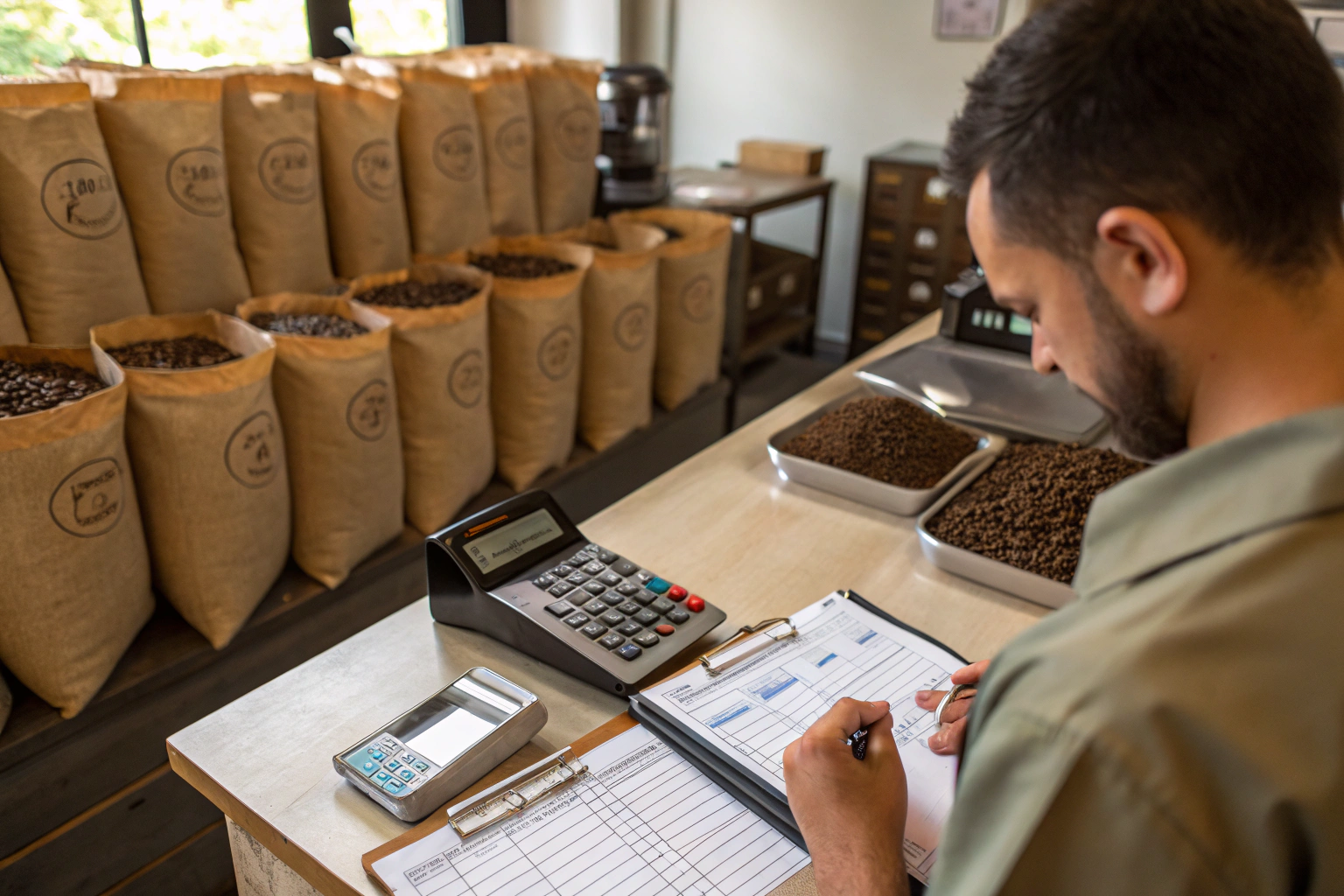
You have a roastery. You have customers. You have a supplier. Now you need to figure out how much coffee to order. This is not a guess. It is a calculation. Order too little, and you run out. You lose sales. You disappoint customers. You panic and pay premium prices for emergency spot coffee. Order too much, and you tie up your cash in inventory that sits in the warehouse, slowly losing freshness. You pay storage costs. You risk the coffee going stale. Both mistakes are expensive. The optimal order size is the sweet spot. It is the balance point. I have helped many of my roaster clients find this balance. Let me show you how.
The optimal order size for your roastery is calculated using the Economic Order Quantity model, adjusted for the specific realities of green coffee: its freshness window, its price volatility, and your cash flow constraints. At BeanofCoffee, I help my clients run this calculation. It is a simple tool that saves them money and headaches.
The calculation is not complex. It is based on a few key variables. Understand the variables, and you can master the process. Let me break it down.
What Is the Economic Order Quantity Model for Green Coffee?
The Economic Order Quantity, or EOQ, is a classic business formula. It balances two opposing costs: the cost of ordering and the cost of holding inventory. The goal is to find the order size that minimizes the total cost. It is a powerful tool for managing any inventory, including green coffee.
The EOQ model calculates the ideal order size by weighing the fixed cost of placing an order against the variable cost of storing the coffee. At BeanofCoffee, I use this model as a starting point for my clients. It provides a rational, data-driven baseline for their ordering decisions.
The formula is a starting point. It is not a rigid rule. But it gives you a number to anchor your thinking. It replaces a gut feeling with a calculation.

How Do You Calculate the "Holding Cost" for Green Beans?
The holding cost is the cost of keeping a pound of coffee in your warehouse for a year. It includes several components. The cost of the capital tied up in the inventory. The cost of the storage space. The cost of insurance. And for green coffee, the cost of quality degradation. The coffee is slowly losing freshness. This is a real cost, even if it does not show up on an invoice. A common estimate for holding cost is 20% to 30% of the coffee's value per year. If your coffee costs $4.00 per pound, your holding cost is $0.80 to $1.20 per pound per year. This is a significant number. It is the reason why you do not want to over-order.
What Counts as the "Ordering Cost" in Coffee Procurement?
The ordering cost is the fixed cost of placing and receiving an order. It is independent of the order size. It includes the time you spend communicating with the supplier, the bank fees for the wire transfer, the customs brokerage fees, and the internal receiving costs. For a container of coffee, the ordering cost might be several hundred dollars. The key insight of the EOQ model is that these two costs, holding and ordering, move in opposite directions. As you order more, the ordering cost per pound goes down, but the holding cost per pound goes up. The optimal order size is where the total cost is minimized.
How Does the Freshness Window Limit Your Maximum Order Size?
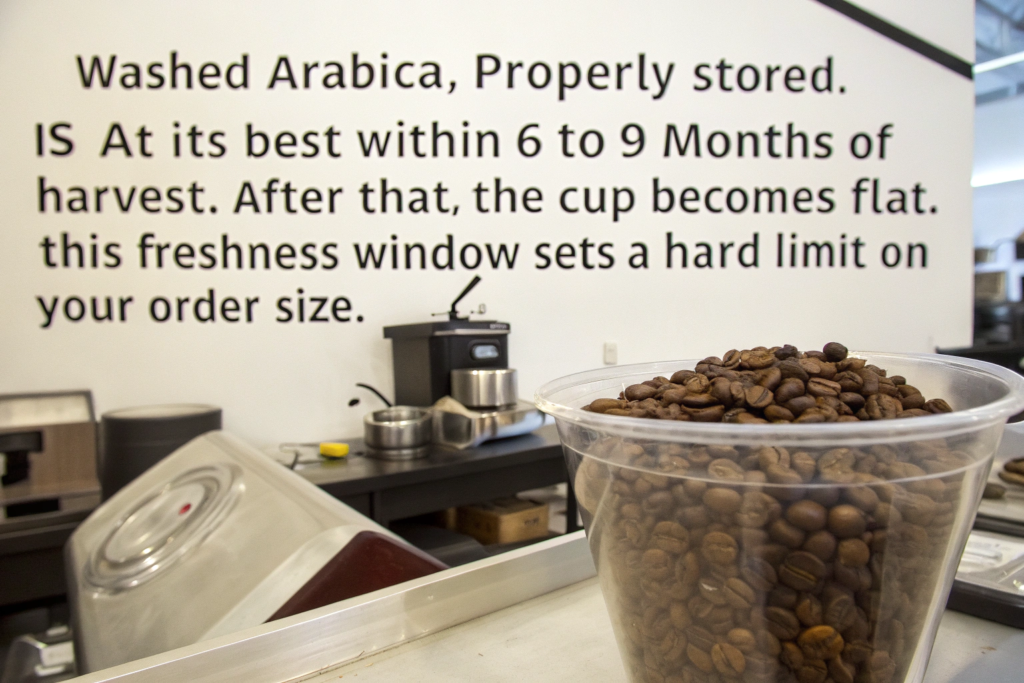
Coffee is not a can of beans. It is a fresh product. It has a peak. A washed Arabica, properly stored, is at its best within 6 to 9 months of harvest. After that, the quality begins to decline. The acidity fades. The aromatics dissipate. The cup becomes flat. This freshness window sets a hard limit on your order size.
The freshness window is the period during which the green coffee retains its optimal sensory qualities. At BeanofCoffee, I advise my clients to order no more coffee than they can realistically use within a 6-month window. Ordering beyond this risks the coffee degrading before it is roasted.
The EOQ formula might suggest a larger order. But the freshness window is a biological reality. It overrides the financial calculation. You must use the coffee while it is still alive. You are not a museum. You are a roastery.
What Is the Average Shelf Life of a Washed Yunnan Arabica?
A washed Yunnan Arabica, processed with care and stored in a GrainPro bag in a cool, dry environment, will maintain its peak quality for about 9 to 12 months from the harvest date. The first 6 months are the sweet spot. The coffee is vibrant, the acidity is bright, the flavors are distinct. From 6 to 9 months, the coffee is still very good, but it is beginning to mellow. Beyond 12 months, the decline accelerates. The coffee becomes flat, woody, and past its prime. This is why I ship fresh-crop coffee. It is why I encourage my clients to order what they can use, not more.
How to Match Order Frequency to Your Roast Volume?
The goal is a steady flow of fresh coffee. The order frequency should be matched to your roast volume. If you roast 100 pounds of green coffee a week, and you want to order every 8 weeks, your order size is 800 pounds. This is a simple calculation. The key is to ensure that the 800 pounds will be used within the freshness window. If it takes you 20 weeks to use 800 pounds, you are ordering too much. You should either order less, or order more frequently, or find a way to increase your sales. The freshness window is the constraint. Your roast volume is the driver. The order frequency is the variable you control.
How to Use Your Cash Flow to Determine a Realistic Order Size?
Even if the math says you should order a full container, your bank account might disagree. Cash is the lifeblood of a small business. Tying up a large amount of cash in green coffee inventory can cripple your operations. You need to balance the efficiency of a large order against the reality of your cash flow.
Your cash flow is a hard constraint on your order size. At BeanofCoffee, I understand this. I work with my clients to find an order size that is financially comfortable. This might mean starting with smaller, more frequent orders, and scaling up as the business grows. The goal is a healthy, sustainable operation.
Do not let a "good deal" on a large volume push you into a cash crunch. The stress is not worth the savings. A smart buyer knows their limits.
What Is the Real Cost of Capital Tied Up in Inventory?
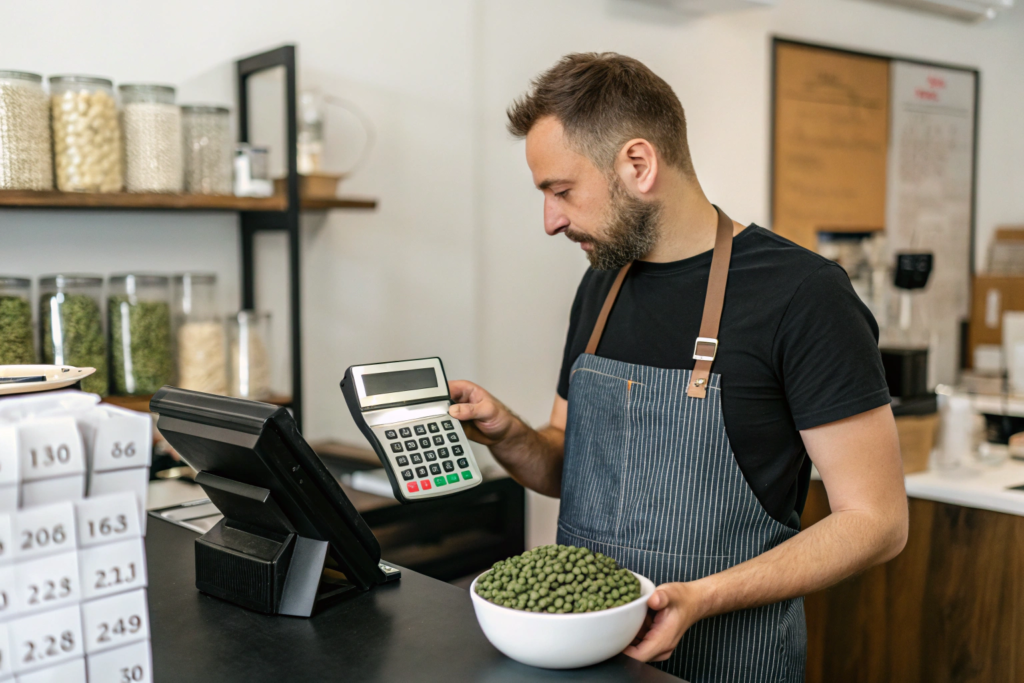
The cash you spend on green coffee is cash that is not available for other things. It cannot be used for marketing, for equipment, for hiring, or for paying your own salary. This is the opportunity cost of capital. It is a real cost, even if it is not on an invoice. If you have $20,000 tied up in coffee inventory, that is $20,000 you cannot use to grow your business. The goal is to minimize the amount of capital that is sitting idle in the warehouse. The EOQ model helps with this. The freshness window helps. Your own cash flow analysis is the final check. It is a balance between financial efficiency and operational flexibility.
How to Work with Your Supplier on Payment Terms to Ease Cash Flow?
Your payment terms have a direct impact on your cash flow. If you pay a 30% deposit and then the balance upon shipment, you have a gap. The coffee is on the water, but you have not yet received it, and you have paid for it. This is a drain on your cash. If you can negotiate better terms, like a deferred payment or a letter of credit, you can ease this pressure. A letter of credit, for example, often means you do not pay until the documents are presented. This can give you several weeks of extra float. As your relationship with your supplier deepens, you can discuss more flexible terms. The goal is a payment schedule that works for both of you. It is a partnership, not a one-way street.
How to Adjust Order Size for Seasonal Demand Fluctuations?
Your demand is not constant. It spikes in the winter. It dips in the summer. It spikes around the holidays. Your ordering needs to reflect these fluctuations. You cannot order the same amount every month and expect to be right.
Seasonal demand fluctuations require a flexible ordering strategy. At BeanofCoffee, I work with my clients to anticipate their seasonal peaks. We build a plan that accounts for the busy winter season and the slower summer months. The goal is to have enough coffee on hand during the rush, without overstocking during the lull.
The roastery is a seasonal business. Your ordering must be seasonal too. The key is to plan ahead. Communicate your forecast to your supplier. Let us know what you expect. We can then help you build a supply plan that matches your demand curve.

How to Build a Simple Demand Forecast for Your Coffee Business?
A simple forecast starts with your historical sales data. Look at your sales over the last 12 months. Identify the peaks and the valleys. The winter holiday season is usually the peak for coffee sales. The summer is usually the slowest. Use this pattern to project your future demand. You do not need a complex statistical model. A simple spreadsheet is enough. Calculate your average weekly sales for each month. Adjust for any known factors, like a new wholesale account or a planned marketing campaign. This forecast is your best guess. It is the foundation of your ordering plan.
How to Use a "Rolling Order" System to Stay Flexible?
A rolling order system is a simple, flexible approach. Instead of placing one large order for the whole season, you place smaller orders on a regular schedule, say monthly or quarterly. Each order is based on your most recent forecast. This allows you to adjust your volume up or down as your demand changes. It reduces the risk of overstocking. It keeps your inventory fresh. It is a more agile approach. I offer this kind of flexibility to my clients. We agree on a basic framework, but we adjust the volumes as we go. It is a partnership built on communication and trust.
Conclusion
Calculating the optimal order size is not a one-time task. It is an ongoing process. It is a balance of financial efficiency, biological reality, and operational flexibility. The EOQ model gives you a starting point. The freshness window gives you a hard limit. Your cash flow gives you a practical constraint. And your seasonal demand gives you the pattern you need to follow. When you master these variables, you stop guessing. You start calculating. You order with confidence. You minimize waste. You maximize freshness. You protect your cash. This is the foundation of a well-run, profitable roastery.
Let's calculate your optimal order size together. Contact me, Cathy Cai, at cathy@beanofcoffee.com. Tell me about your roast volume, your storage capacity, and your cash flow situation. I will help you build a simple ordering plan that fits your business. No pressure. No overselling. Just a clear, practical path to a smarter supply chain. Your roastery deserves it.