You've just roasted a new batch. The beans look mostly uniform, but something's off in the cup. The flavor is flat, papery, or strangely peanutty, with a lingering hollow bitterness. You might blame the roast profile or the origin. But often, the culprit is hiding in plain sight: Quakers. As an exporter who sees thousands of kilos of green coffee, I can tell you that these defective beans are the silent killers of flavor, and knowing how to find them is a fundamental skill for any serious buyer or roaster.
Quakers are underdeveloped coffee beans that fail to roast properly due to a lack of sugars. In their roasted state, they appear lighter in color (pale tan to beige), are often smaller and more wrinkled, and feel softer or less dense than properly roasted beans. They do not develop the oils or sheen of a mature bean and can be identified by visual sorting, tactile feel, and their distinct, unpleasant flavor when tasted. Removing them is a critical, non-negotiable step in ensuring cup quality.
That definition seems simple. But here’s the truth: Quakers are masters of disguise. In a dark roast, their color difference shrinks. In a blend, they hide among different varieties. They are a defect of the seed, not the roast, meaning they originate on the farm. As a buyer, understanding Quakers gives you power—it helps you diagnose quality issues, hold suppliers accountable, and protect your final product. Let's break down how to hunt them down at every stage.
Why Do Quakers Ruin the Flavor of Your Coffee?
Think of a Quaker as a coffee bean that never grew up. It’s stunted. During its growth on the tree, it didn't receive enough nutrients or suffered from stress (drought, disease), resulting in severely underdeveloped sugars and cellular structure. During roasting, these sugars don't caramelize, and the Maillard reaction barely happens.
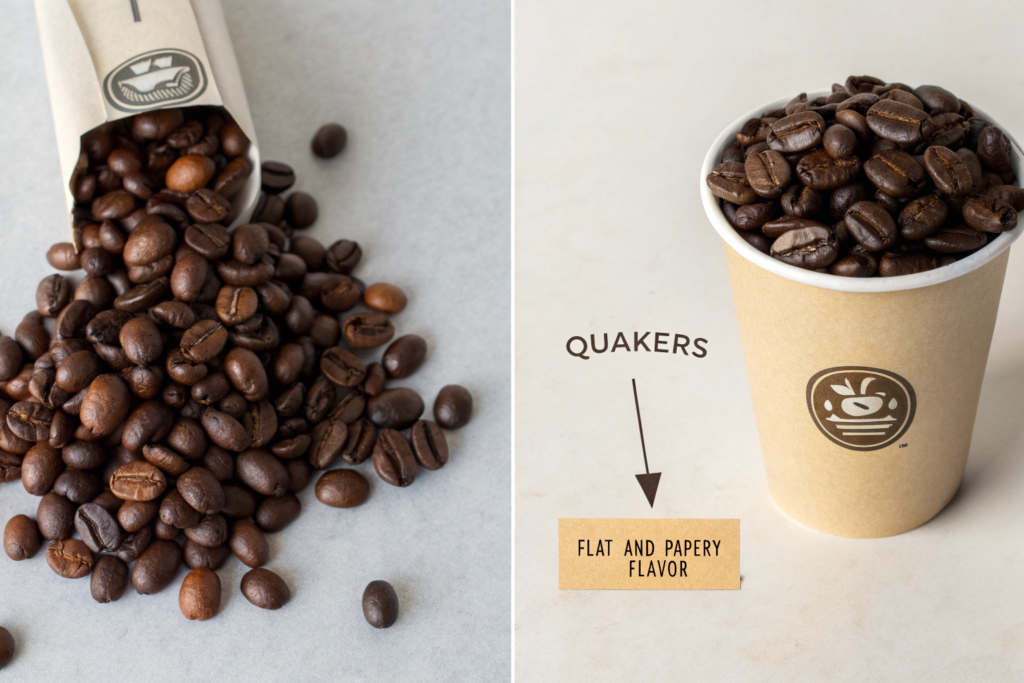
Quakers ruin flavor because they introduce off-tastes that are completely foreign to coffee's desired flavor spectrum. Instead of adding sweetness, acidity, or body, they contribute flavors described as papery, woody, peanutty, bready, or like raw grain. A single Quaker in a grind can taint an entire cup because its negative flavor compounds are potent and soluble. They create a hollow, astringent aftertaste that strips away the coffee's complexity and leaves a flat, unfinished impression. For a roaster or brand, this means inconsistency. One batch might have a few Quakers and taste dull; the next, with none, tastes vibrant. This variability is the enemy of a reliable, stable product. Eliminating Quakers is the most direct way to improve the baseline quality of any coffee, which is why we focus on removing them during our processing at Shanghai Fumao.
What Chemical Deficiency Causes a Bean to Become a Quaker?
The core deficiency is in sucrose and other reducing sugars. Healthy coffee seeds store sucrose as their main energy reserve. This sucrose is the primary fuel for the caramelization and Maillard reactions during roasting, which create color, aroma, and complex flavors. A Quaker has drastically low sucrose content. It also has underdeveloped cellulose structure, so it’s less dense. When heated, it doesn't expand and darken properly. It's essentially being "baked" rather than "roasted." This biochemical failure at the farm level is why you can't fix a Quaker with a longer or hotter roast—you'll just burn the good beans around it. This is a fundamental quality control issue that starts long before the roastery.
How Many Quakers Does It Take to Spoil a Batch?
Even one is too many for a discerning palate in a single-cup brew. Industry studies and practical experience suggest that in a standard 60g liter of brewed coffee, as few as 2-3 quakers in the ground dose can be detectable as a negative flavor shift—a loss of clarity and sweetness. For espresso, where concentration is higher, the impact is even more pronounced. For commercial blends, a higher tolerance might exist, but they still drag down the overall quality. This is why professional green coffee grading, like the SCA protocol, penalizes the presence of Quakers (considered a "primary defect"). As a buyer, you should ask your supplier about their Quaker removal process. A good quality export lot should have had them removed via electronic sorting and hand-picking.
What Are the Visual and Tactile Signs of a Quaker?
Your eyes and fingers are your first and best tools. Quakers stand out, but you have to know what to look for, especially after roasting.
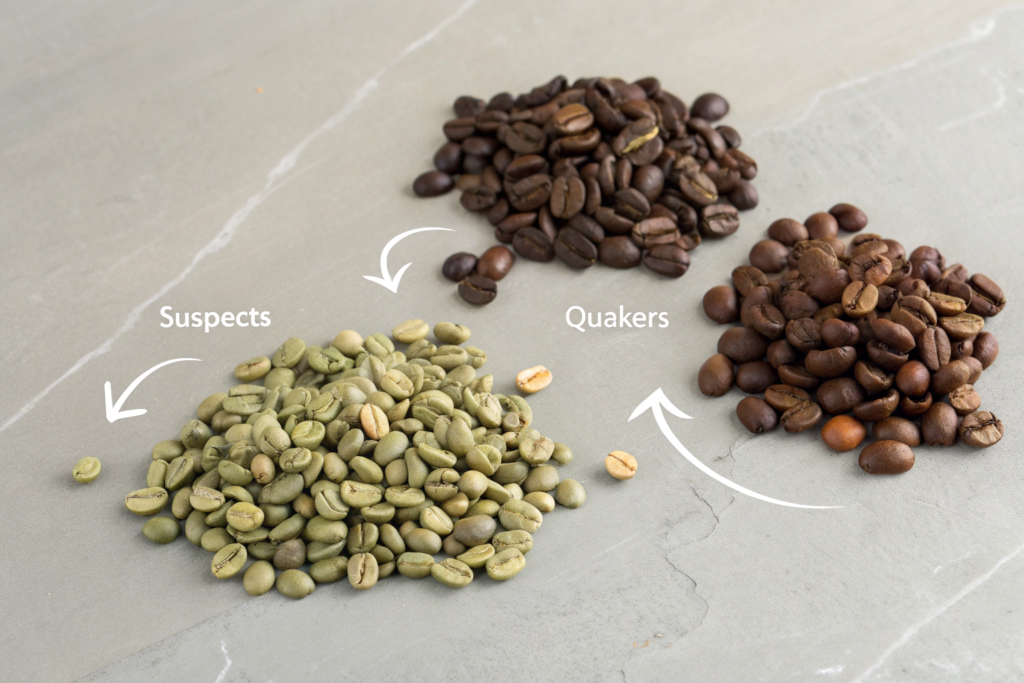
Visual Signs: Color is the primary indicator. In a light to medium roast, Quakers are dramatically lighter—a pale tan, beige, or greyish-yellow against the rich brown of proper beans. They often look "baked" rather than roasted. They are frequently smaller and more shriveled, with a wrinkled surface that lacks the smooth expansion of a healthy bean. In very dark roasts, the color difference diminishes, making them harder to spot visually. Tactile Signs: Pick up a suspected Quaker. It will feel significantly lighter and less dense. Roll it between your fingers; it may feel softer or more crumbly. Try to crush it with a fingernail—a Quaker will often crush more easily than a hard, well-developed bean. These physical traits are a direct result of that underdeveloped cellular structure.
How Does Roast Level Affect Quaker Visibility?
Roast level is a game of contrast. In Light Roasts, Quakers are glaringly obvious. The contrast between the pale Quaker and the cinnamon-to-light-brown proper bean is high. This is the easiest time to sort them out manually. In Medium Roasts, they are still visible but can hide among the variation of a natural process bean, for example. In Dark Roasts (Full City+ and beyond), the overall color is so dark that Quakers may only appear as a slightly lighter brown or grey patch, losing the high contrast. They become "stealth Quakers." This is why many professional roasters who work with dark profiles will do a primary sort on the green beans or rely on post-roast electronic color sorters. It's a crucial point: if you buy dark roast coffee, your supplier's pre-roast sorting is even more critical.
Can You Spot Potential Quakers in Green Coffee?
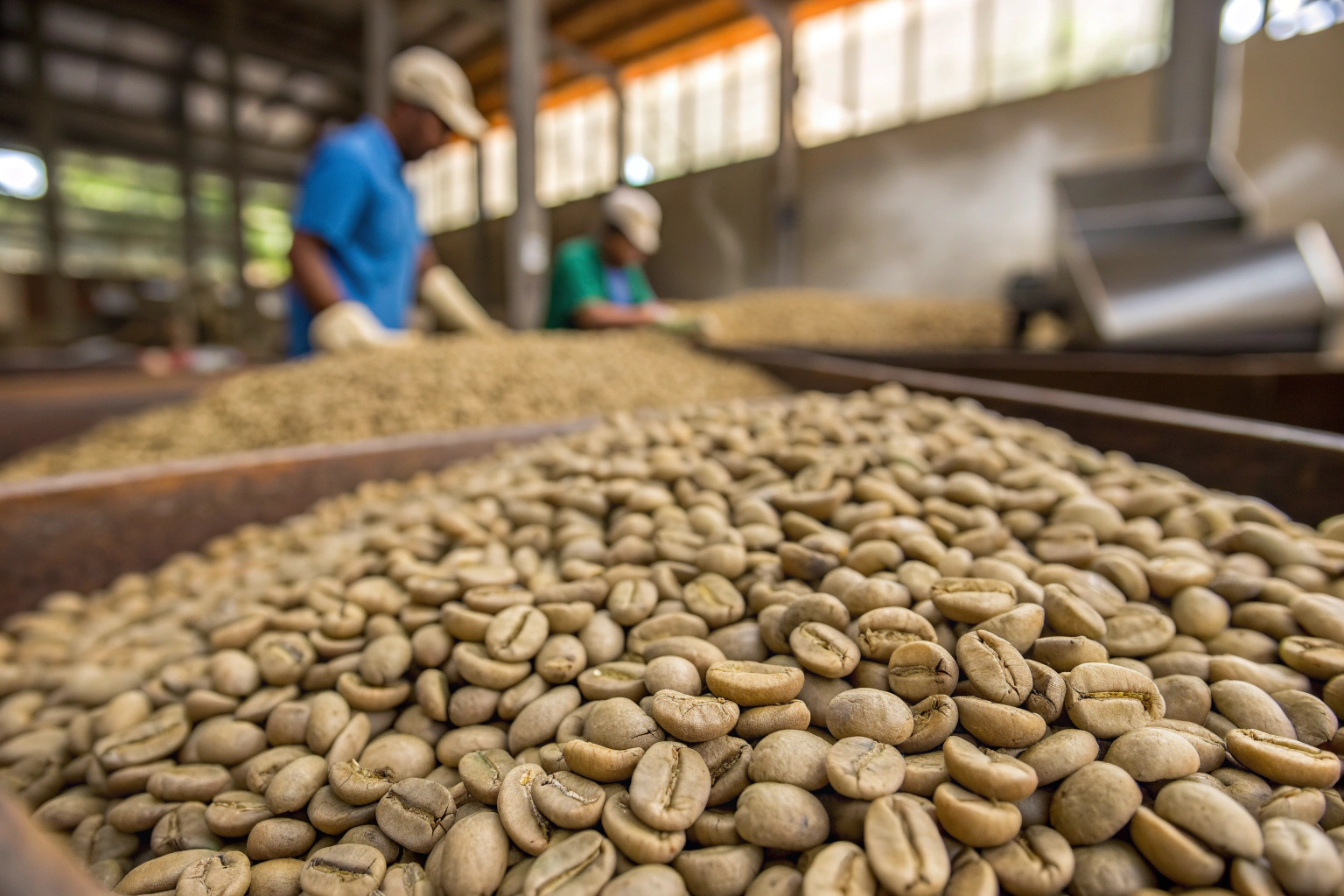
Yes, to a trained eye, but it's much harder. In green form, potential Quakers are often smaller, paler (lime green or whitish), and may have a shriveled, misshapen appearance. They feel lighter and less dense. However, not all small, pale green beans become Quakers, and some Quakers can look deceptively normal when green. This is why the roasting of a sample is a non-negotiable part of quality assessment. You must roast a representative sample of the green coffee to reveal the true Quaker count. This is a standard step in our pre-shipment process for buyers. We roast samples from each lot to check for defects ourselves, because we know it's the ultimate test. It’s a key part of our quality control that ensures good quality for our clients.
What Tools and Techniques Help Remove Quakers?
You've identified the problem. Now, how do you fix it? Removal is a multi-stage process, starting at the farm and ending at the roastery. There's no single magic bullet, but a combination of technology and manual labor.
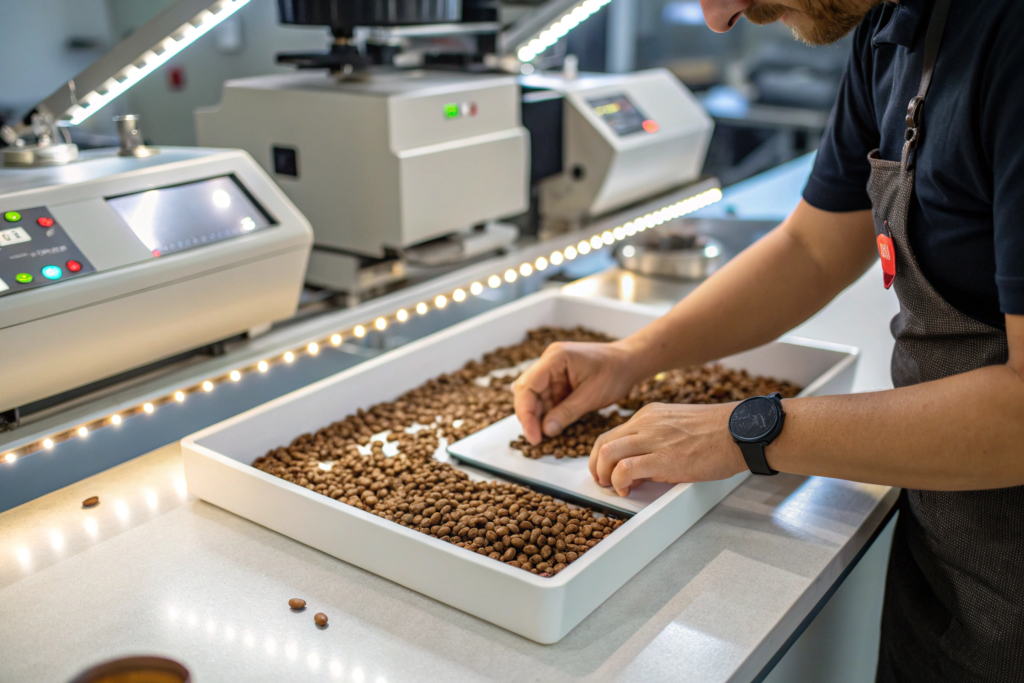
The most effective techniques are layered: 1) Pre-Roast (Green Bean Stage): Using advanced optical sorters that detect color, size, and shape to eject defective beans, including potential Quakers. Also, manual sorting tables where workers pick out suspicious beans. 2) Post-Roast: Using color sorters again, which are extremely effective as the color contrast is highest. For smaller operations, manual sorting on a lit table or tray is essential. The technique is simple: spread the roasted beans in a thin layer under bright, neutral light and pick out the light-colored offenders. Some roasters use a combination of sizing screens and airflow (to exploit the Quaker's lower density) before a final hand sort.
Is Manual Picking or Machine Sorting More Effective?
For maximum purity, you need both. Machine sorting (optical/color sorters) is fantastic for high-volume, consistent removal based on objective parameters like color. It's efficient and gets 95-98% of defects. However, machines can miss Quakers that are close in color to the good beans (especially in dark roasts) or those stuck to good beans. Manual picking is the final quality gate. The human eye and brain are exceptional at pattern recognition and catching anomalies that machines miss. It's slow and costly but irreplaceable for premium coffee. At our Shanghai Fumao processing center, green beans pass through optical sorters and then a final manual check before bagging. We advise our roasting clients to implement at least a post-roast hand sort for their most critical batches. This dual approach is what defines a reliable supply chain.
How to Set Up an Efficient Post-Roast Sorting Station?
Keep it simple and consistent. You need a well-lit, clean surface. Use a white tray or sorting table—the white background makes color differences pop. Ensure the lighting is bright, neutral white (daylight LEDs are ideal), not yellow. Spread the roasted beans in a single, even layer. Train your staff (or yourself) to scan in a pattern, not randomly. A quick method is to gently shake the tray; denser beans often settle to the bottom, bringing lighter Quakers to the top. Have a dedicated container for the discarded Quakers. For a roastery, building this into the cooling cycle—sorting beans directly after cooling before packaging—integrates quality assurance into the workflow. This practice directly protects the stable flavor profile of your brand.
How Can Buyers Evaluate a Supplier's Quaker Control?
As a buyer, you're not just purchasing beans; you're purchasing the work that went into cleaning them. A supplier's approach to Quaker control is a direct indicator of their overall quality standards and professionalism.
Evaluate a supplier by asking specific questions and conducting practical tests. Ask directly: "What is your process for removing Quakers and other defects? Do you use optical sorters? Is there a final manual check?" Request a pre-shipment sample and roast it yourself. Don't just cup it; spread the roasted beans on a white plate and count the visible Quakers. This is your ultimate test. A good supplier will be transparent about their process and will have already minimized Quakers to a level that meets SCA standards (e.g., less than 5 full defects per 300g sample). Furthermore, examine the green coffee consistency. A lot with a high degree of size and density uniformity will generally have fewer Quakers, as it indicates better cherry selection and processing.
What Questions to Ask Your Coffee Supplier About Defects?
Move beyond "is this high quality?" to precise, technical questions:
- "What is the defect count per 300g for this lot, and how many of those are Quakers?"
- "Can you share the report from your optical sorter or grading session?"
- "Do you roast samples from each lot for your own QC before shipping?"
- "What is your policy if a client receives a lot with a higher-than-expected Quaker count?"
Their willingness and ability to answer these questions show depth of quality control. A supplier like Shanghai Fumao will have this data readily available because we grade every lot. It’s part of how we build trust and ensure security for your investment.
Should You Reject a Shipment for Too Many Quakers?
It depends on your contract and the severity. If the Quaker count significantly exceeds the agreed-upon standard (often aligned with SCA Green Coffee Grade specifications), you have grounds for a complaint. The first step is always to communicate with the supplier immediately, providing photographic evidence of the roasted sample showing the Quakers. A professional supplier will want to resolve this, either by offering a discount, arranging for re-sorting (if feasible), or replacing the lot. This is why building a relationship with a trustworthy exporter is key—they will stand by their product. For us, our reputation is built on consistent quality, so we take such claims seriously and work to make it right. It’s about being a reliable long-term partner, not a one-time vendor.
Conclusion
Identifying and removing Quakers is not a minor detail; it is a central act of quality preservation. It's the process that separates commodity coffee from carefully crafted coffee. For the roaster, it unlocks the true potential of the bean. For the buyer, it provides a clear, measurable criterion to assess suppliers.
The journey of a Quaker—from a stressed coffee cherry on a tree to a flavor-wrecking agent in your cup—highlights the interconnectedness of the supply chain. Good farming, precise processing, and meticulous sorting are all required to keep them out. As an exporter, our job is to stop them long before they reach you.
If you are tired of unpredictable cup quality and want to partner with a supplier who obsesses over these details, let's talk. At BeanofCoffee, our integrated control from our Yunnan plantations through to final sorting ensures that Quakers are removed, allowing the authentic character of our Arabica, Catimor, and Robusta to shine through consistently.
To evaluate our quality control firsthand, request a sample. Roast it, spread it on a white plate, and see the difference for yourself. Contact Cathy Cai to arrange it: cathy@beanofcoffee.com. Taste coffee, not defects.