
Most buyers walk into a negotiation assuming the price is the battle. It's not. Price is just a number. The real battlefield is cash flow. And cash flow is controlled by payment terms. I learned this the hard way when I first started shipping containers from Baoshan. A buyer in Germany promised a 50% deposit. We shook hands. I started processing his order. Then his bank delayed the SWIFT transfer for two weeks. My coffee sat in the warehouse. My workers waited. I almost missed the vessel. That was the moment I realized: rigid payment terms hurt both sides. But flexible terms? They can actually make a deal happen when a straight discount fails.
To negotiate flexible payment terms with exporters, you must first prove that you are a low-risk buyer with a track record, then structure the payment schedule to align with verifiable production milestones. You are not asking for a favor; you are proposing a risk-sharing mechanism that lowers the exporter's fear of default while securing your cash flow. It is a partnership proposal, not a price negotiation.
Here's the thing. Exporters like me in China are conservative. We've heard every scam story. We've seen buyers disappear after the goods land. So if you come in hot, demanding "Net 90 days open account" on the first email, the conversation ends. But if you approach it with logic and a concrete plan, the door opens. I want to sell my coffee. I just need to know I won't get burned.
Why Do Exporters Insist on a 30% T/T Advance Payment?
It feels aggressive, right? A supplier asks for a big chunk of cash before even turning on the milling machine. It feels like they don't trust you. But it's usually not about trust. It's about survival. When I demand 30% upfront, I am not taking your profit. I am buying raw materials to start your order.
The 30% Telegraphic Transfer advance is the exporter's working capital lifeline. It covers the immediate hard costs of processing, packing, and inland transport. Coffee is an agricultural commodity, and Chinese banks often require exporters to show a purchase contract and a deposit receipt before they will extend any short-term credit for processing. Without that upfront cash, a mill in Yunnan simply cannot afford to tie up its liquidity in a single order.
What Costs Does the Deposit Actually Cover?
Let's break down where that 30% goes. It's not pure profit. Honestly, margins in commodity coffee trading are thin. The deposit covers the cash expenses that hit my account before the container even reaches the port.
First, there's the cherry purchase. If I'm buying fresh cherries from my neighbors to fulfill a big order, the farmers don't take credit. They want cash on delivery. Then, there's the dry milling cost. The factory charges me per kilo to remove the parchment layer. Then, the grading and hand-sorting. Then, the GrainPro bags. Those bags aren't free. They cost nearly $2 each. For a container of 320 bags, that's over $600 just for packaging.
Finally, there's the trucking from Baoshan to the port. It's a long drive. The trucker wants fuel money. If I only receive the balance after the ship sails, I've been out of pocket for 3 or 4 weeks. A small to medium exporter can't finance five containers at the same time that way. The 30% advance is simply the buyer funding the production costs of their own order.
Why Can't Exporters Just Use Bank Loans?
Some buyers think, "Just go to a bank." But coffee isn't always seen as solid collateral by local banks in Yunnan. It's perishable. It's volatile in price. The ICC guidelines on trade finance note this: commodity trade relies heavily on prepayment rather than pure bank intermediation, especially in developing agricultural markets.
Interest rates for working capital loans can be high. If I borrow money, the interest eats my margin. I'd have to charge you a higher price to cover the loan. So, a deposit isn't a sign of weakness. It keeps the overall price lower. You're just providing the bridge financing instead of a bank. It's cleaner.
What Are the Safest Alternatives to 100% T/T for Both Sides?
So, 100% T/T is the cleanest and most common for new relationships. But if you've been buying from me for two years, or if you're a big company with audited accounts, you deserve better terms. You shouldn't have to tie up your entire budget months before the coffee lands.
The safest alternatives to standard T/T are Letters of Credit at Sight and milestone-based staggered T/T payments. A Letter of Credit shifts the risk from the buyer-seller relationship to the banking system, ensuring the exporter gets paid upon presenting clean documents. Staggered T/T breaks the payment into pieces: a small deposit to start, a larger payment against the shipping documents, and a final balance upon receiving and approving a pre-shipment sample scan.
How Does a Letter of Credit Actually Protect You?
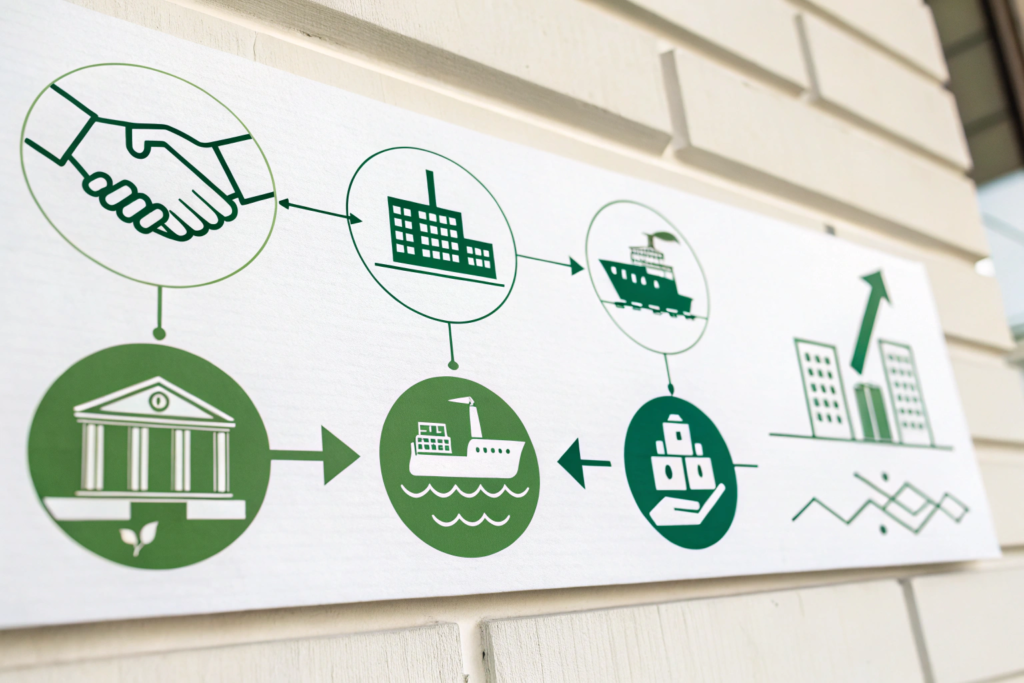
A Letter of Credit, or L/C, sounds complex, but it's a simple promise. Your bank tells my bank, "We will pay you the moment you prove the coffee is on the ship." It protects you, the buyer, because I don't get a cent until I deliver the Bill of Lading, the inspection certificate, and the insurance policy.
The beauty for me as an exporter is that I can sometimes discount that L/C with my bank. I can get working capital against your bank's promise. The risk is the paperwork. One tiny typo—like "Catimor" spelled "Catinor"—and the bank rejects the documents. It's rigid. But for a large transaction, it's the gold standard. It usually costs about 1% to 2% of the invoice value.
A common structure I offer to trusted partners is 30% T/T, 70% L/C at Sight. This gives me the cash to start processing, but gives you the security that the big chunk of money doesn't move until the coffee is on the water.
How Do Milestone Payments Work for Green Coffee?
This is my favorite method for building long-term trust. It's flexible and doesn't involve complex bank fees. We just break the deal into three parts.
The first trigger is the start of processing. You pay 20%. The second trigger is the stuffing of the container. I send you a video of the seal being put on, and you pay 50%. The final 30%? You pay that 7 days after the vessel departs, giving you time to check the scanned documents.
| Payment Method | Security for Buyer | Cash Flow for Exporter | Complexity |
|---|---|---|---|
| 100% T/T Advance | Low | Excellent | Low |
| 30/70 T/T vs. Documents | Medium | Good | Low |
| L/C at Sight | High | Medium (Unless Discounted) | High |
| Milestone Payments | High | Medium | Medium |
You see that? We can move the dial. Not every deal needs to be pure risk for you. If you have a track record, bring it up. Show me your LinkedIn. Show me your references from other Yunnan suppliers. I'll be happy to structure something like this. It shows you're a serious large company buyer.
How Can You Lower the Exporter's Perceived Risk to Get Better Terms?
An exporter's biggest fear isn't making less money. It's losing the entire shipment. The ocean is full of stories about buyers who reject the documents at the last minute, forcing the container to sit at a foreign port racking up demurrage. If you can make me feel like that scenario is impossible, I'll give you almost any terms you want.
You lower the exporter's risk by presenting a transparent, "open book" approach to your business. You must immediately provide a Company Profile, a bank reference letter from your trade finance officer, and evidence of a successful, similar-sized import. You neutralize the fear of the unknown. When an exporter sees a buyer as a "known quantity" with assets to lose, the fear of a trade dispute plummets, and flexible terms become a safe marketing tool.
Does Visiting the Plant in Yunnan Actually Help?
Absolutely. It changes everything. If Ron, the confident buyer from America, gets on a plane and comes to Baoshan, he stops being an email address. He becomes a person. He sees our 10,000 acres. He sees my drying patios. He meets the team.
When you break bread with someone, the trust level multiplies. After a visit, I'm much more likely to accept a lower deposit. Why? Because you've seen the coffee. You can't claim later that "the quality wasn't what I expected" if you hand-picked the lot yourself. It's a psychological commitment. If you can't visit, offer a video call. Walk me through your roastery. Show me the bags of your current stock. Let me see that you're a real operation, not a virtual office.
What Kind of Credit Insurance Can a Buyer Suggest?
Here's a very advanced move. If you're a big distributor in North America, you probably have trade credit insurance through a company like Euler Hermes or Coface. Tell me that.
Say, "Look, my receivables are insured. If I default, the insurance covers it." I can't tell you how few buyers say this. But for me, it's magic words. It transforms a "private company risk" into an "insurable event." I might even ask you to add BeanofCoffee as a named beneficiary on the policy for our shipment. It costs you a small administrative fee, but it gets you massive leverage to ask for 60-day payment terms.
You can also reference stability metrics. If your company is publicly listed or has a strong D&B rating, share the link. The D-U-N-S number is a quick way to prove you're established. If you have a long history on a platform like Alibaba, show your transaction history. Old sellers' feedback is gold.
What Are the Unspoken Costs of Aggressive Payment Demands?
Sometimes buyers overplay their hand. They demand 100% L/C at 90 days. They ask for the moon because they can. And the exporter says "Okay, fine." But they don't really agree. They just hide the cost. In the coffee export business, nothing is free. If you squeeze the payment terms too hard, you pay in other ways. The price per kilo goes up. The quality goes down. Or the coffee just sits there.
The unspoken cost of aggressive payment terms is that the exporter silently prices the risk of your terms into the FOB cost, or worse, deprioritizes your container when there's a supply bottleneck. You might get your 60-day credit, but you unknowingly paid a 5% price premium to cover the exporter's shadow interest cost. And if a late-season frost cuts supply, the spot-market buyer paying cash will get the beans; you, waiting on credit, will get an email about a "delay."
Are You Secretly Paying a Financing Fee?
Let's be blunt. If you ask me, a Chinese exporter, to ship you a container and wait 60 days to get paid, I am effectively loaning you money. I am acting as your bank. And banks charge interest.
I'm not a bank. I'm a farmer. If I have to borrow from my local credit union to cover the gap between shipping the coffee and receiving your payment, the interest rate might be 6% or 7% annually in my local currency. I can't swallow that. So, before I agree to your terms, I will inflate the FOB price by roughly 1.5% to 2% to cover the "time value of money."
You might feel happy you got credit. But you lost the negotiation on the unit price. It is often smarter to take a standard 30/70 T/T payment schedule and then ask for a volume discount. You get a cleaner price comparison, and you know exactly what you're paying for.
Why Does Cash Flow Priority Affect the Delivery Schedule?
Coffee is a seasonal product. The harvest comes in waves. In January, I might have an ocean of Catimor. By May, the good lots are picked over.
If I have one container of 85-point beans left, and two buyers want it—one pays 30% deposit today, the other wants 60-day open account—guess who gets the beans? The one who pays today. It's not personal. It's liquidity. The cash buyer solves my immediate payroll problem.
I've seen buyers who negotiated incredible payment terms, then got furious because their shipment was constantly "bumped" by a week. They had a contract, sure. But a contract with a frustrated supplier is just a piece of paper. A happy supplier prioritizes you when things get tight. So, my advice? Don't bleed us dry on terms. Leave a little cash on the table. It guarantees you get your coffee on time.
Conclusion
Negotiation isn't a fight. It's a puzzle. You're trying to fit your cash flow needs together with the exporter's survival needs. The 30% T/T deposit exists for a reason. It buys the raw materials. But if you're a solid buyer, you shouldn't be stuck there forever. You can move to structured milestone payments or a bank-backed L/C. It all comes down to risk. You have to kill the exporter's fear.
Show your track record. Visit the origin if you can. Share your insurance details. Prove you're not going to reject the cargo on a technicality. If you do that, I'll forget about the rigid rules. I'll work with you to find a rhythm that works for both of us.
And if you do all of this, you stop being just a buyer. You become a partner. We own the crop together. We manage the logistics together. That's the kind of relationship I love to build here at BeanofCoffee.
If you're looking for a supplier who understands that payment terms need to be as flexible as the coffee market, you should talk to us. Let's map out a payment structure that fits your budget cycle while keeping our Yunnan mills running smoothly. We're fair, and we're direct.
Reach out to Cathy Cai to start the conversation. She can walk you through sample contract terms and find a starting point that works for your company.
Email: cathy@beanofcoffee.com. We'll find the balance between trust and cash.