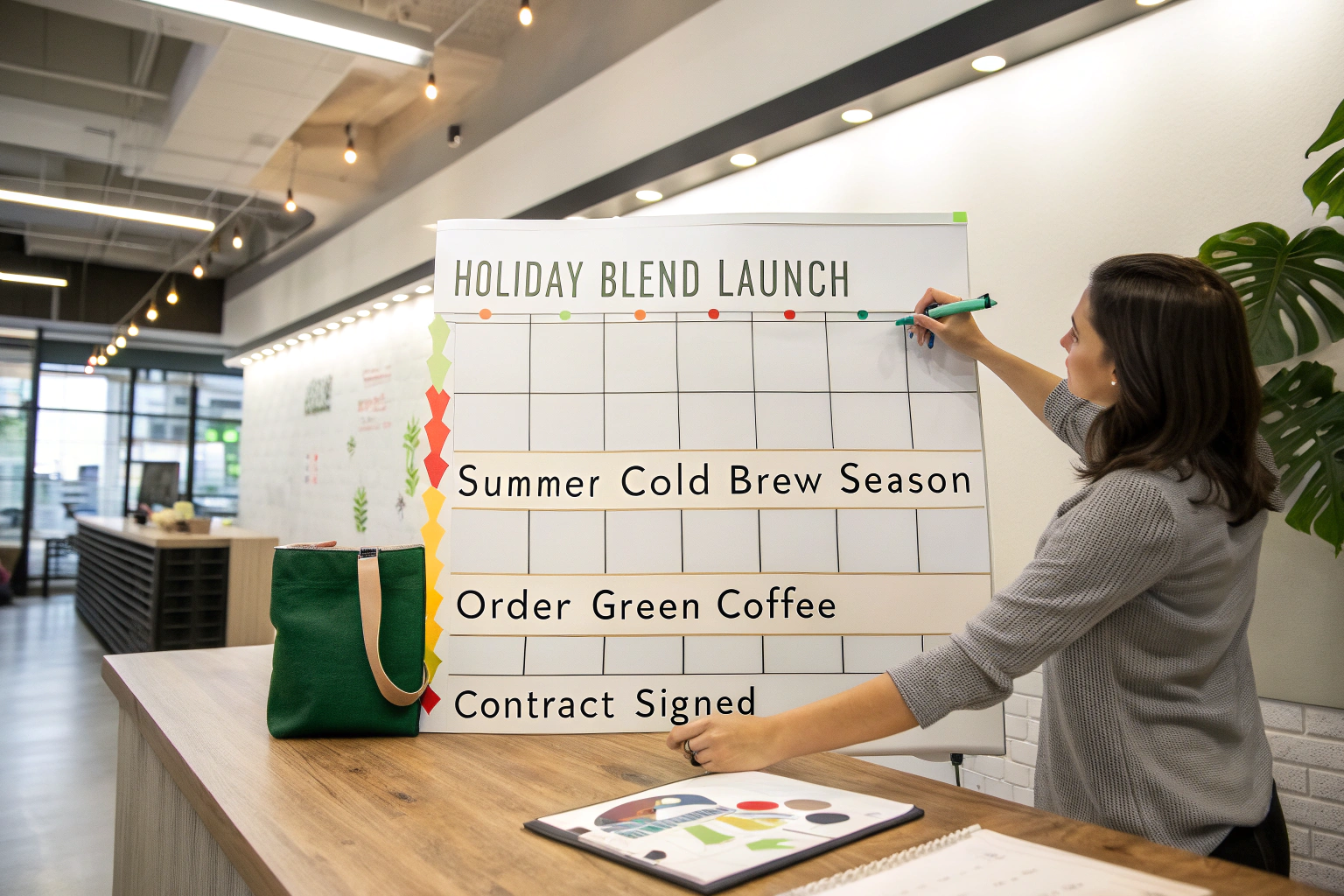
I received a panicked email from a roaster last October. He was a good client. He had built a successful "Winter Spice" seasonal blend that his customers waited for all year. The launch date was November 1st. It was October 5th. He was just emailing me to order the green coffee base. I had to tell him the truth. The coffee was in Baoshan. The next available vessel departure was in two weeks. Ocean transit was three weeks. Customs was a week. His coffee would arrive in mid-November. His blend would not hit shelves until December. He had missed half of his selling season. The pain in his voice was real. He had lost thousands of dollars in revenue because of a simple calendar mistake.
To plan your coffee buying calendar and avoid missing selling seasons, you must work backward from your target retail launch date, subtracting the total lead time for each stage—including ocean transit (3-5 weeks), production at origin (8-12 weeks for custom orders), and sample approval (2-3 weeks)—which for a September launch of a new Yunnan single-origin means placing your order no later than May.
This is the discipline of professional coffee sourcing. It is not complicated. It just requires a calendar and a willingness to plan ahead. Let me walk you through the exact timeline calculations that will ensure your seasonal offerings hit the shelf on time, every time.
What Is the Total Lead Time for a Container of Yunnan Coffee?
Before you can plan backward, you need to know the length of the timeline you are working with. Many roasters dramatically underestimate the total lead time for a container of coffee from a distant origin like Yunnan. They think in terms of the ocean voyage, forgetting everything that happens before the ship sails.
The total door-to-door lead time for a container of Yunnan coffee, from contract signing to arrival at a U.S. roastery, is typically 12 to 16 weeks for a standard lot and can extend to 16-20 weeks for a custom blend or a lot requiring a specific, approved pre-shipment sample.
This is not a delay. This is the reality of producing, preparing, and shipping a high-quality agricultural product across the world. You must internalize this 3-4 month window.
How Long Does Each Stage of Production and Logistics Actually Take?
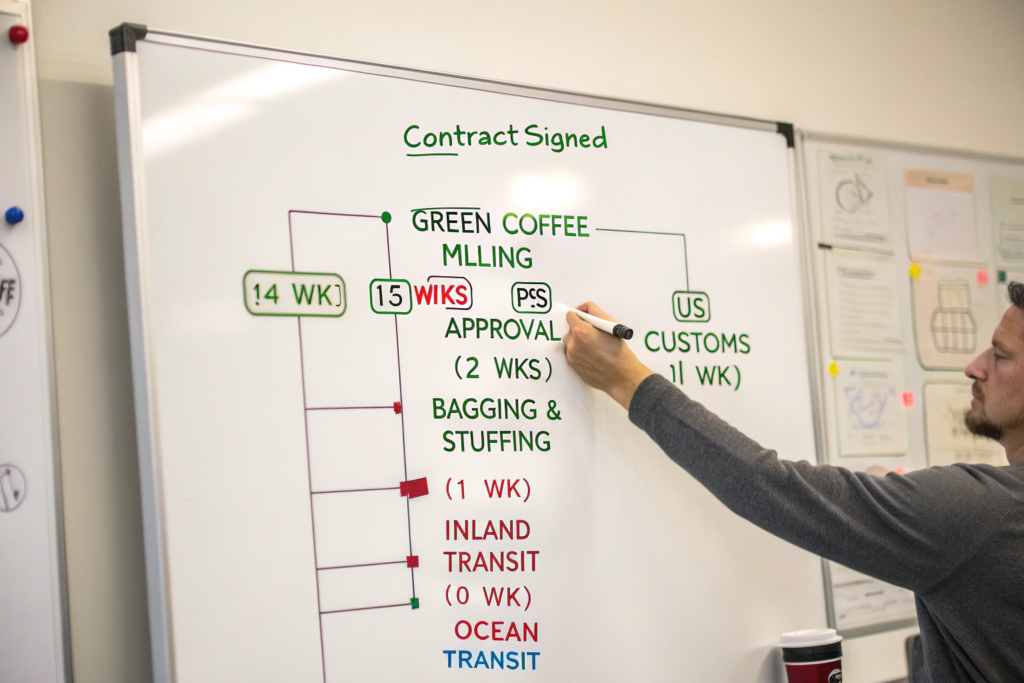
Let's break down the 12-16 week timeline into its component parts. This is the checklist you should use for your own planning.
| Stage | Activity | Typical Duration | Notes |
|---|---|---|---|
| 1. Contract & Spec | Finalize contract, sign spec sheet | 1 Week | Assumes prior sampling is complete. |
| 2. Production | Green bean allocation, milling, sorting | 2-4 Weeks | Longer for specialty grades and custom screen sizes. |
| 3. Blending (if custom) | Custom blending and homogenization | 1-2 Weeks | Additional time for custom blend orders. |
| 4. PSS Approval | Roast PSS, ship to buyer, approval | 2-3 Weeks | Dependent on courier speed and buyer's cupping schedule. |
| 5. Bagging & Stuffing | Final bagging, container loading | 1 Week | Scheduled after PSS approval. |
| 6. Inland Transit | Trucking from Baoshan to Shanghai Port | 1 Week | 3-4 days driving + port cut-off buffer. |
| 7. Ocean Transit | Shanghai to U.S. West Coast Port | 3-4 Weeks | Add 1-2 weeks for East Coast or Gulf ports. |
| 8. U.S. Customs & Handling | Clearance, devanning, truck to roastery | 1-2 Weeks | Subject to customs holds and trucking availability. |
| Total Estimated Time | Contract to Roastery Door | 12-17 Weeks | Plan for 4 months. |
This table is your planning tool. Print it out. Put it on your wall. Every time you plan a new coffee, consult this timeline. At Shanghai Fumao, Cathy Cai can provide a more precise timeline estimate for your specific order based on current production schedules. Our Logistics & Planning page also has resources.
Why Does a Custom Blend Add 2-4 Weeks to the Timeline?
If you are ordering a standard lot of our Grade 1 Arabica from inventory, the timeline can be on the shorter end of the range (closer to 12 weeks). However, a Custom Blend requires extra time.
The Custom Blend Time Adders:
- Component Segregation: We must identify and allocate specific lots of the different components for your blend (e.g., 70% Washed Arabica, 30% Natural Catimor). This may require milling separate batches.
- Blender Scheduling: Our 5-ton ribbon blender is a shared resource. Your custom blend must be scheduled into the production queue. During peak season, there may be a wait.
- Post-Blend QC: After blending, we perform extra quality control. We take samples from the top, middle, and bottom of the blend batch and cup them to ensure homogeneity. This takes additional time.
If you are planning a custom blend for a specific launch, you absolutely must account for this extra 2-4 weeks. A custom blend ordered in May will arrive in September. The same custom blend ordered in July will arrive in November.
At Shanghai Fumao, our Custom Blends Program page outlines the process and the recommended lead times. We work with you to build a realistic timeline.
How to Align Your Buying with the Yunnan Harvest and Shipping Cycles?
The production timeline is one constraint. The agricultural calendar of Yunnan is another. You cannot order fresh new-crop coffee in August. It does not exist yet. The coffee has its own seasonal rhythm that you must align with.
To align your buying with the Yunnan harvest cycle, you should contract for new crop coffee between January and March, understand that the coffee will be resting in parchment until April/May, and plan for the arrival of freshly milled green coffee at your roastery during the peak shipping window of July through October.
If you need coffee to arrive in the spring, you must buy past-crop coffee that has been properly stored. If you want the freshest new crop, you must plan for a late summer or fall arrival.

When Is the "Freshness Sweet Spot" for Arriving Yunnan Coffee?
There is an optimal window for receiving Yunnan coffee. It is determined by the harvest, the resting period (reposo), and the milling schedule.
- Harvest: November - March. The coffee is picked and dried.
- Reposo (Resting): March - May. The coffee rests in parchment to stabilize its moisture and flavor.
- Dry Milling: May - July. The parchment is hulled into green bean.
- Peak Freshness for Arrival: July - September. This is when the freshly milled new crop coffee is arriving at U.S. ports. It is vibrant, complex, and at its peak flavor potential.
If you want to launch a new single-origin Yunnan coffee and you want to make a big deal about it being "Fresh Crop," you should target a September or October launch. This means placing your order in May or June.
If you are buying coffee for a blend that you use year-round, you might take a large shipment in August and store it properly in GrainPro. Or, you might work with us to schedule quarterly shipments from our warehouse in Baoshan, so you always have a fresh supply. Our Inventory Management program is designed to support this.
How Do Chinese New Year and Golden Week Affect Your Timeline?
This is a critical detail that catches many Western buyers off guard. China has two major national holidays that effectively shut down business and logistics for a week or more.
- Chinese New Year (Spring Festival): Late January or February. Impact: Mills, trucking companies, and ports operate at minimal capacity or close completely for 2-3 weeks. Do not expect shipments to move during this period. Plan to have all orders booked and all documents finalized before the holiday begins in mid-January.
- Golden Week (National Day): October 1st - 7th. Impact: Another week-long national shutdown. Logistics are heavily congested in the week leading up to and following the holiday.
Planning Around Holidays:
If your target vessel departure is July 15th, you need to ensure the inland trucking and port cut-off happen before the holiday congestion. Cathy Cai is an expert at navigating these holiday schedules. She will proactively advise you on the impact of upcoming holidays on your specific shipment timeline. You can find official Chinese holiday calendars on resources like Travel China Guide.
How to Use a Reverse Calendar to Lock in Seasonal Blends and Promotions?
You know the total lead time. You know the seasonal constraints. Now it is time to build your own calendar. The most effective method is Reverse Planning. You start with the date the coffee must be on your shelf and work backward, step by step, to today.
Using a reverse calendar involves starting with the non-negotiable "on-shelf" date for your seasonal offering, then subtracting the total estimated lead time (12-16 weeks) to arrive at the "Order By" date, and then building in an additional 4-6 weeks of buffer for sampling, contract negotiation, and unforeseen delays.
This is not a one-time exercise. It should be an annual ritual, ideally done in the late summer or early fall for the following year.
Can You Provide a Sample 12-Month Planning Calendar for a Roaster?
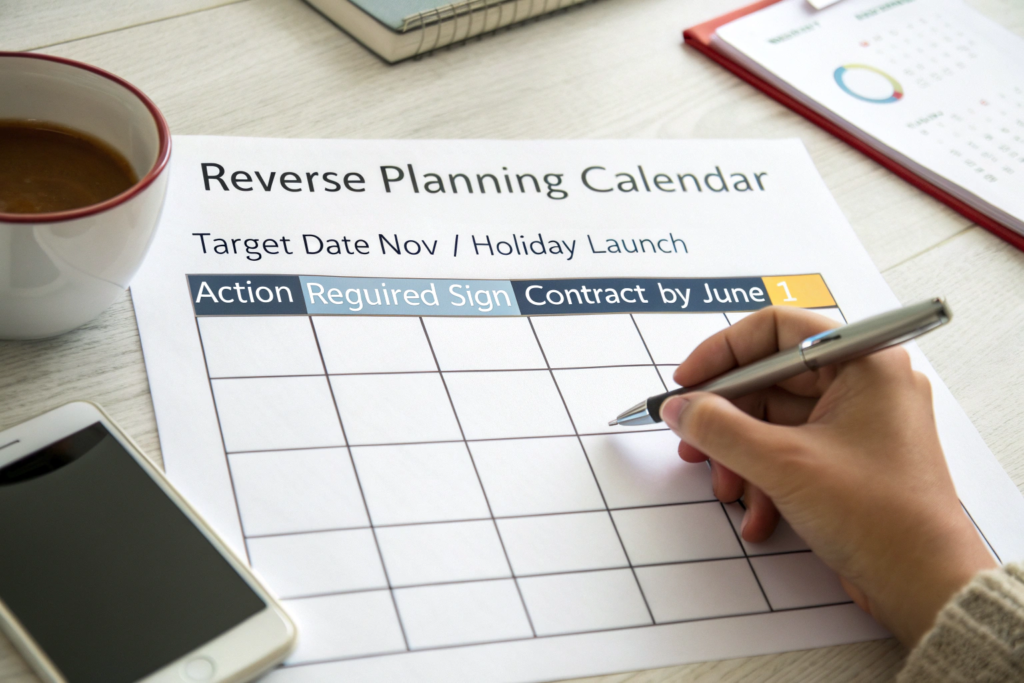
Let's build a hypothetical 12-month plan for a roaster who wants to launch a new Yunnan single-origin in September and a Holiday Blend in November.
| Month | Sourcing & Planning Activity | Production & Logistics Activity |
|---|---|---|
| January | Review last year's sales data. Set volume targets for new crop. | Yunnan harvest is in full swing. |
| February | Request new crop parchment samples from suppliers. Begin cupping. | Yunnan harvest finishes. Chinese New Year may delay responses. |
| March | Finalize contract for September Launch single-origin. Lock in price and volume. | Coffee is resting in parchment (reposo). |
| April | Finalize contract for November Holiday Blend (if custom). Request PSS for Sept lot. | Dry milling begins for early lots. |
| May | ORDER DEADLINE for September Launch. Approve PSS for September lot. | Coffee for September order is milled, bagged, and shipped. |
| June | ORDER DEADLINE for November Holiday Blend. Approve PSS for Holiday Blend. | Coffee for September order is in transit. |
| July | Plan marketing materials for September launch. | September coffee arrives at roastery! Begin test roasts. |
| August | Finalize roast profile for September coffee. Begin production roasting. | Holiday Blend is milled, bagged, and shipped. |
| September | SEPTEMBER COFFEE LAUNCHES ON SHELF. | Holiday Blend is in transit. |
| October | Plan marketing push for Holiday Blend. | Holiday Blend arrives at roastery. Begin production roasting. |
| November | HOLIDAY BLEND LAUNCHES ON SHELF. | Peak shipping season may cause port delays. |
| December | Sell through remaining seasonal inventory. | Begin planning and sampling for next year's crop. |
This calendar is a living document. It aligns your marketing and sales activities with the physical reality of the coffee supply chain. It prevents the October panic email. At Shanghai Fumao, we work with our long-term partners to co-create these calendars. We want to be integrated into your planning cycle.
What "Safety Buffers" Should You Build Into Your Sourcing Calendar?
The timeline I have provided is for a smooth, ideal scenario. But the world is not ideal. Ships are late. Customs flags containers. Trucks break down. You must build buffer time into your plan.
Recommended Safety Buffers:
- Ocean Transit: Add 1-2 weeks of buffer to the carrier's stated transit time. Blank sailings and port congestion are common.
- U.S. Customs: Add 1 week of buffer for clearance, especially if your coffee is organic and requires a VACIS or X-ray exam.
- PSS Approval: Do not assume you will cup the sample the day it arrives. Give yourself a 1-week window in your planning.
- Roastery Acclimation: When the coffee arrives, it needs 1-2 weeks to acclimate to your roastery's environment and off-gas any residual CO2 from transit before it roasts its best.
Total Recommended Buffer: Add 4-5 weeks to the "best-case" timeline.
If the best-case timeline is 12 weeks, plan for 16-17 weeks. It is always better to have coffee arrive early and sit in your warehouse (properly stored in GrainPro) than to have it arrive late and miss your launch date. Early is on time. On time is late.
Conclusion
Planning your coffee buying calendar to avoid missing selling seasons is a discipline that separates successful, growing roasters from those who are constantly scrambling. It requires shifting your mindset from reactive spot-buying to proactive, strategic sourcing. It requires internalizing the 3-4 month lead time from Baoshan to your loading dock. It requires aligning your orders with the natural rhythm of the Yunnan harvest. And it requires building a reverse calendar with generous safety buffers.
This is not busywork. It is the foundation of a reliable, profitable, and stress-free coffee program. When you have a plan, you can focus on what you do best: roasting great coffee and building your brand. You are not putting out fires.
At Shanghai Fumao, our goal is to be a predictable, reliable partner in your supply chain. We want to help you build these calendars and stick to them.
If you are ready to start mapping out your sourcing calendar for the upcoming year, let's schedule a planning call. We can review the harvest forecast, discuss your volume needs, and pencil in the key dates. Email Cathy Cai. Tell her you want to set up a "Sourcing Calendar Planning Session." Contact Cathy at: cathy@beanofcoffee.com