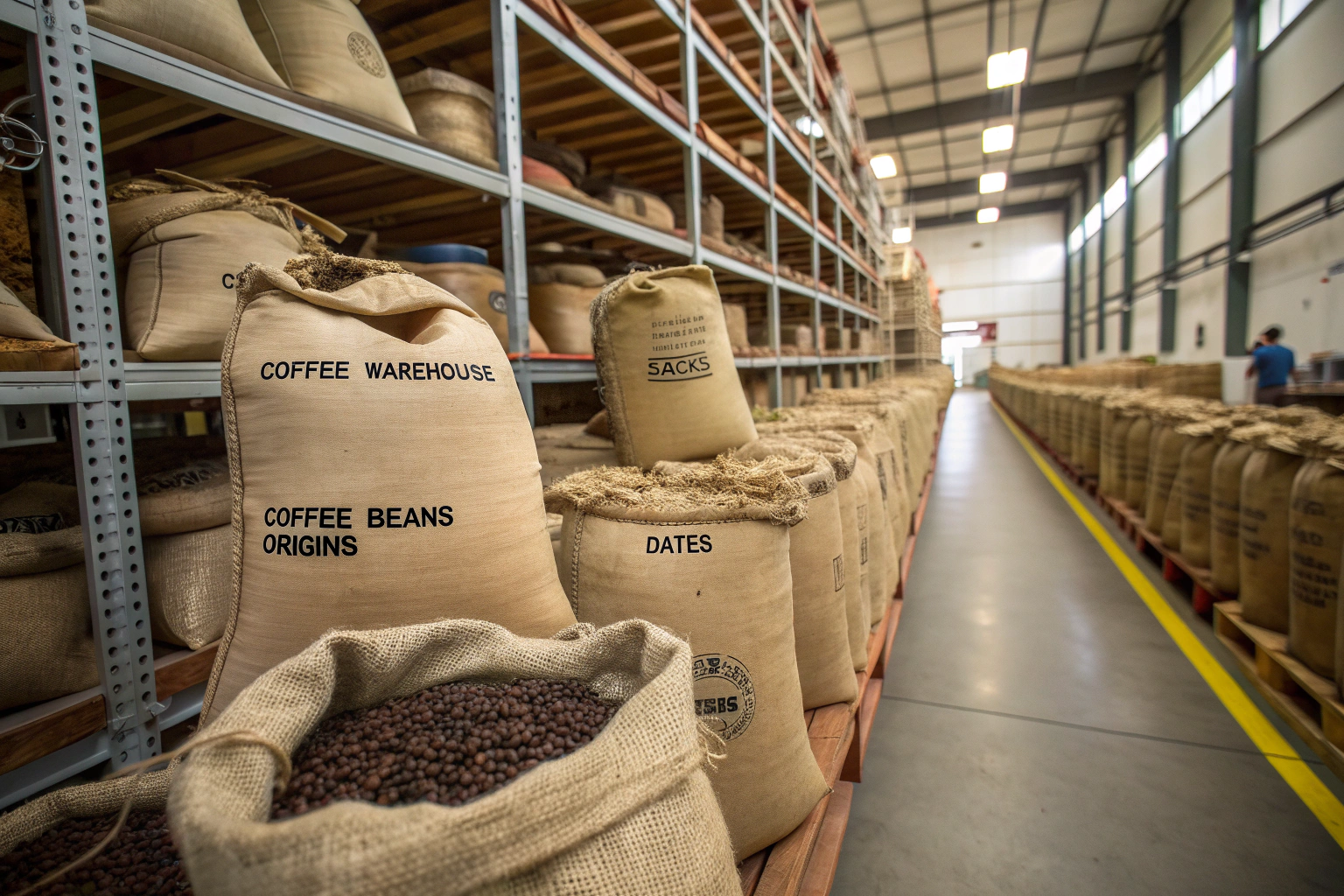
In March 2025, a roaster in Manchester called me in a genuine panic. His main Colombian supplier had just declared force majeure. Heavy rains had washed out a key mountain road. No trucks could reach the farm. His container, which was supposed to sail in two weeks, was not even picked yet. He had 60 days of inventory left. Sixty days. That is the blink of an eye in the coffee business. I asked him one question: “Do you have a secondary origin locked in?” Silence. He did not. That silence cost him three weeks of scrambling, a spot purchase at a 40% premium, and a blend recipe he had to reformulate on the fly. The problem was not the rain. Rain happens. The problem was a sourcing strategy built on a single point of failure.
Securing a consistent coffee supply year-round requires a deliberate portfolio strategy that blends harvest calendar diversification, multi-origin contracts, safety stock buffering, and forward booking. You cannot rely on one country, one farm, or one harvest cycle. You must build a sourcing calendar that gives you at least two active harvest windows at any point in the year. This is not about loyalty to a single farm. It is about loyalty to your own customers, who expect their favorite blend to taste the same every single month.
At BeanofCoffee, we think about supply consistency from the farmer’s side. Our 10,000 acres in Baoshan give us a stable base. But even we plan for gaps. We know when our harvest finishes. We know when our parchment stock starts to run low. And we know exactly which partner origins can fill the gap for our export clients. The strategy I am about to share is the exact one I use to keep our own export pipeline flowing.
How Do Global Harvest Calendars Impact Your Sourcing Strategy?
A buyer from Sydney once told me his sourcing strategy was “buy when I run low.” That is not a strategy. That is a gamble. Coffee is not manufactured. It is harvested. Each origin has a specific window when the cherries are ripe, picked, processed, milled, and ready for export. If you ignore this calendar, you are buying old-crop coffee at a premium or competing for fresh coffee when every other buyer on the planet is also bidding.
Global harvest calendars dictate the freshness, quality ceiling, and price of your green coffee. A fresh-crop Arabica from Yunnan, harvested in November, milled in December, and shipped in January, hits peak flavor between month two and month six post-harvest. If you are buying Colombian coffee in July, you are buying a mid-crop or an old-crop lot that has been sitting in a warehouse for eight months. The calendar is not a suggestion. It is a physical constraint.
A smart sourcing strategy aligns your major contracts with the harvest cycle of your primary origins. But it also uses a secondary origin that harvests six months later to backfill the freshness gap. This is the heartbeat of a professional green buying operation.
Why Does the Yunnan Harvest Window Offer a Strategic Advantage?
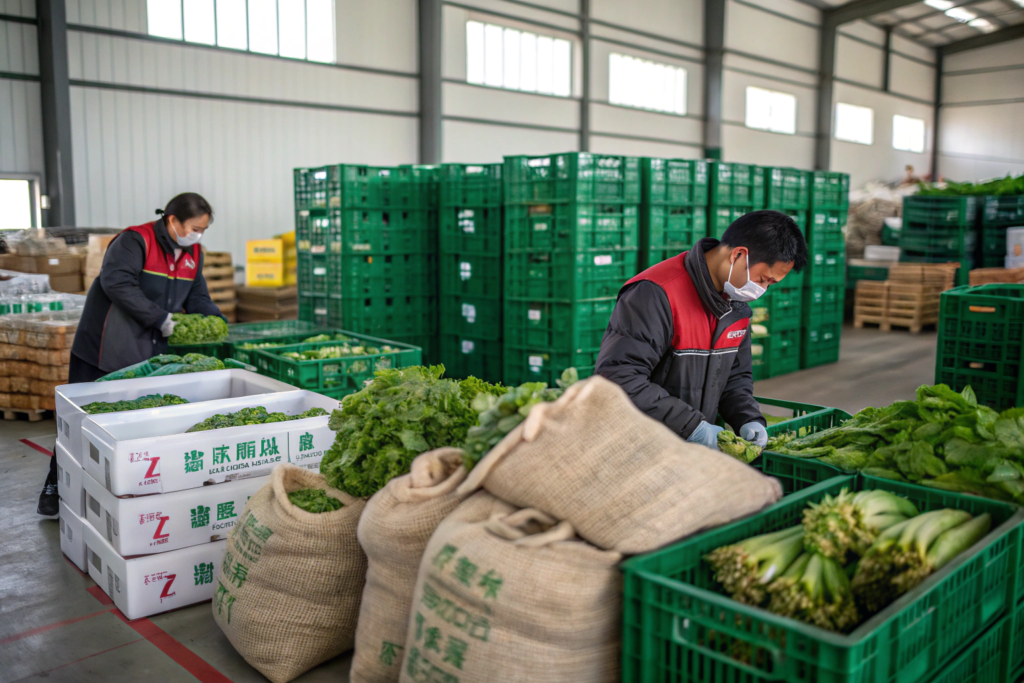
Our harvest in Baoshan runs from late October through February. The peak of the main crop hits in December and January. This timing is strategically brilliant. Why? Because it is exactly the gap between the Central American harvest and the South American mitaca, or fly crop.
Let me lay this out. Most Central American coffees are fresh and shipping from February through May. By June, those lots are getting picked over. The best lots are sold. The leftovers are on the warehouse floor. Meanwhile, Brazil’s massive main crop hits the market around July to September. So, between May and July, there is often a freshness vacuum. Available fresh-crop Arabica is scarce. Prices spike. Old-crop coffee starts showing baggy, papery defects.
Yunnan coffee fills this gap perfectly. Our main crop is milled and ready for export from January through April. Coffee shipped in April arrives in Europe or the U.S. in May. Just as the Central American fresh crop is fading. This means a roaster using Yunnan as a secondary origin receives a peak-freshness coffee at a moment when fresh options are genuinely limited. This is not just a quality play. It is a pricing power play. The ICO harvest calendar data confirms this seasonal pattern across origins.
How Should You Build a Bi-Annual Sourcing Calendar?
A bi-annual sourcing calendar splits your year into two freshness windows. Window One covers origins that harvest from October to February. This includes China, Ethiopia, and parts of Colombia. Window Two covers origins that harvest from April to September. This includes Brazil, Peru, and Indonesia. Your goal is to have one active contract from each window at all times.
Here is a simplified table of how I think about it for a medium-sized roaster buying 50 containers a year:
| Sourcing Window | Primary Origin | Secondary Origin | Shipping Months | Freshness Peak |
|---|---|---|---|---|
| Window One (Winter) | Yunnan, China | Sidamo, Ethiopia | Jan - April | May - July |
| Window Two (Summer) | Cerrado, Brazil | Sumatra, Indonesia | July - Oct | Nov - Jan |
See the overlap? In May, you are cupping fresh Yunnan. In November, you are cupping fresh Brazil. There is never a month where you are relying entirely on warehouse-stored coffee that is pushing 10 months old. You always have a fresh option to blend in. This also gives you negotiation leverage. If a Brazilian supplier knows you have a Yunnan contract arriving in April, they cannot hold you hostage on price in March. You have an alternative. The alternative is real. It is on the water.
What Is a Safety Stock Strategy for Green Coffee Importers?
I keep 15% more parchment coffee in our Baoshan warehouse than our forward contracts strictly require. It costs me money. The warehouse rent. The tied-up capital. The slow, quiet aging of the beans. Some years, I look at that extra stock and think, "What a waste of money." Then a drought hits Brazil. Or a shipping lane gets blocked. And suddenly, that "wasted" stock is the most valuable asset we own. Our clients get their coffee. Our competitors' clients get delay notices.
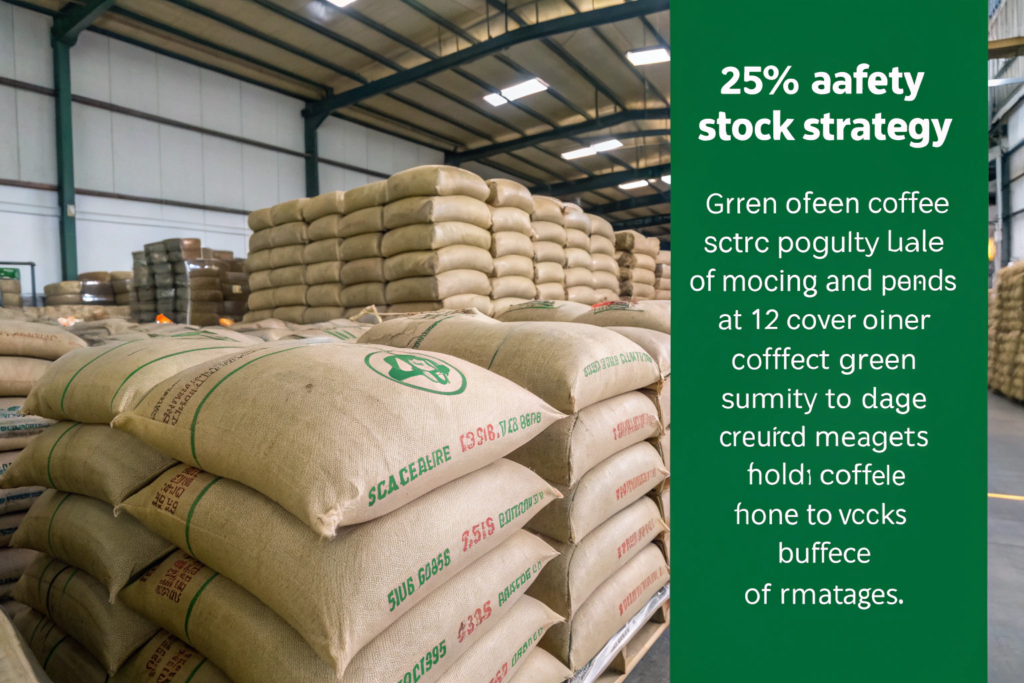
A safety stock strategy is the deliberate holding of extra green coffee inventory beyond forecasted demand. It acts as a shock absorber between a volatile supply chain and your roastery's production schedule. The rule of thumb for a roaster is to hold 25% more green coffee than your average monthly consumption, with a floor of at least 45 days of cover. For an importer or large buyer, that buffer might be a full container of a generic blending base that sits untouched until an emergency.
Safety stock is insurance. And like insurance, it feels expensive until you need it. The trick is to structure your safety stock so it is not dead money. It must be a coffee you can eventually use in a blend without ruining the profile.
How Do You Calculate the Right Buffer Level for Your Roastery?
The wrong way to calculate safety stock is to guess. "Yeah, we have a few pallets in the back." The right way is to track your "burn rate." How many pounds of green coffee do you roast per week? Multiply that by the number of weeks of cover you need. Add a variability buffer for demand spikes.
Let's build a concrete example. A roaster burns 2,000 pounds of green coffee per week. Their lead time from order to delivery from China is 8 weeks. In a perfect world, they order 8 weeks before they run out. But the world is not perfect. The vessel might be delayed 2 weeks. Customs might hold the container for 1 week. So, the realistic lead time is 11 weeks. At a 2,000-pound weekly burn rate, they need 22,000 pounds of cover just to survive one normal disruption.
Now add the safety stock. I recommend an additional 25% on top of that realistic lead time. So, 22,000 pounds plus 5,500 pounds equals 27,500 pounds of total green coffee inventory. That is roughly 13 pallets. That buffer means a 3-week port strike does not stop your roaster. It does not stop your wholesale deliveries. It buys you time to source a spot replacement if the container is totally lost. This is the buffer that separates professional roasters from hobbyists. A supply chain resilience model from McKinsey frames inventory as a strategic hedge against lead time volatility.
Which Coffee Grade Works Best as an Emergency Blending Stock?
Not every coffee makes good safety stock. A delicate, floral Geisha is a terrible choice. It peaks fast and fades fast. If you hold it for six months, you lose the very thing you paid for. Your safety stock coffee needs to be a workhorse. It needs to be stable, versatile, and forgiving.
I recommend a clean, washed Arabica with a neutral, chocolate-nut profile. A solid Yunnan Catimor at 82 points. A Brazilian Cerrado at 80 points. These coffees do not dominate a blend. They support it. If your Ethiopian Yirgacheffe lot is delayed, you can bump up the percentage of your Yunnan base in the espresso blend. The flavor shifts slightly toward chocolate and body. But it does not collapse. Your customers notice nothing.
At BeanofCoffee, many of our contract clients specifically buy a small container of our Grade 2 washed Arabica precisely for this purpose. It is not their hero coffee. It is their safety net. It sits in their warehouse, vacuum-packed in GrainPro, quietly holding its quality. One client roasts it as a single-origin breakfast blend when inventory is fine. When an emergency hits, it disappears into the espresso blend as a base extender. The coffee never goes to waste. The safety stock has a dual identity. A product and a policy.
How Can Forward Contracts Stabilize Your Supply and Price?
A few years ago, a large French roaster asked me for a one-year fixed-price contract on our Catimor. They wanted the same price per pound, every quarter, for 12 months. My first instinct was to say no. The coffee market is too volatile. What if the C-price spiked? What if the Renminbi strengthened? I could lose a fortune. But then I realized I could hedge. I could lock in my own costs. And I could offer them exactly what they wanted: stability. We signed a 12-month forward contract with quarterly shipments. That client is still with us today. They have not missed a single blend launch in four years.
Forward contracts are legally binding agreements to sell or buy a specific volume of coffee at a fixed price for delivery at a future date. They remove the daily volatility of the C-market and the spot freight market from your cost of goods sold. For a roaster, a forward contract turns an unpredictable commodity expense into a predictable fixed cost.
This is the financial backbone of supply consistency. A stable price means a stable budget. A stable budget means you can invest in marketing, staff, and equipment without fear of a sudden 20% spike in your raw material cost.

What Are the Key Clauses in a Coffee Forward Contract?
Not all forward contracts are equal. A bad contract locks you in without an escape hatch. A good contract builds in a few critical protections. The first clause I always look at is the "delivery window." It should not say "Delivery: March." That is too vague. It should say "Delivery: March 1 to March 15, 2026." A tight window prevents the supplier from shipping at the very end of the month to hit a quarterly target.
The second clause is the "quality specification reference." The contract must link the quality promise to a specific pre-shipment sample, referenced by a unique lab report number. If the shipped coffee does not match that sample, you have the right to a price adjustment or outright rejection. Without this clause, "premium quality" is just a lawyer's opinion.
The third clause is the "force majeure extension." Yes, force majeure protects the supplier if a volcano erupts. But what if the delay is a shipping bottleneck, not a natural disaster? Some contracts now include a "logistics delay clause" that allows the supplier 14 extra days without penalty, but charges a 1% price discount for each subsequent week of delay. This keeps the supplier financially motivated to fix the problem fast. At BeanofCoffee, we build these details into every forward contract because we want our buyers to feel secure, not suspicious.
How Do You Hedge Currency Risk in a Long-Term Coffee Contract?
I learned this lesson painfully. I signed a six-month contract with a U.S. buyer in January, priced in Chinese Renminbi. By June, the Renminbi had appreciated 4% against the dollar. My cost structure was in RMB. My payment was in RMB. So, I was fine. But my buyer? His dollar bought 4% less coffee. He was effectively paying more with each shipment. He was furious. He felt tricked. I had not explained the currency risk. I just assumed he knew.
Now, I have a conversation with every buyer about invoicing currency. If you are a U.S. roaster buying from China, you have two options. You can insist the contract is in USD. The exporter then carries the currency risk and will build a small buffer into their price. Or you can accept the contract in RMB and manage the currency risk yourself. Managing it yourself is not as hard as it sounds. You can use a forward exchange contract with your bank. You lock in today's USD-to-RMB exchange rate for the date of your future coffee payment. This small financial instrument costs a small fee, but it eliminates the guessing game.
Professional coffee buyers treat currency hedging as seriously as they treat coffee quality. A 3% currency swing can wipe out a 10% margin on a container. The International Trade Administration guide on currency risk walks through these hedging strategies in clear terms. Read it. Understand it. Use it. Your profit margin depends on it.
Where Does Supplier Diversification Fit Into a Consistency Plan?
I once asked a long-term client in Melbourne why he still bought 30% of his volume from me, even when he found a slightly cheaper source in Laos. He said, "The day I put all my eggs in your basket is the day you own my business. I like you. But I do not want you to own my business." He was absolutely right. That is not disloyalty. That is strategic independence.
Supplier diversification means intentionally splitting your volume across at least two or three independent origins or exporters. This protects against a single farm's crop failure, a single country's export ban, or a single shipping lane's disruption. Diversification is not about finding the single best supplier. It is about building a network where no single failure can stop your operations.
Diversification adds complexity. You have more relationships to manage. More samples to cup. More contracts to negotiate. But that complexity is your shield against catastrophic failure.

How Do You Qualify a Secondary Supplier Without Risking Quality?
You do not give a new supplier a container order on the first date. That is reckless. You run a three-step qualification process. Step one is the paper qualification. Ask for their export license, their organic certificate, their last three years of audit reports. If they hesitate, walk away. A legitimate exporter has these documents ready as PDFs.
Step two is the sample qualification. Request three consecutive shipment samples from their current production. Not just one perfect sample. Three. You want to see the variance. If the first sample cups at 84, the second at 83.5, and the third at 83.8, you have a consistent supplier. If the scores are 85, 80, 82, you have a problem. Consistency matters more than a single high score.
Step three is the micro-lot trial. Order 5 to 10 bags. Pay for them. Ship them. Roast them. Serve them. Get your customers' feedback. This is a real-world test. At BeanofCoffee, we actively encourage new clients to start with a single pallet. It is low risk for them. It proves our consistency. If the micro-lot succeeds, scale it. If it fails, you lost a few thousand dollars, not a container. A Guide to supplier due diligence outlines a similar staged approach.
Why Should You Consider Intra-Asia Diversification Alongside Traditional Origins?
Most roasters think of diversification as having a Colombian source and an Ethiopian source. That is cross-continental diversification. It protects against regional climate disasters. But it does not protect against a global logistics meltdown. Remember the Suez Canal blockage? A ship stuck in Egypt delayed coffee from East Africa, Asia, and parts of Europe. Diversification by continent did not help.
This is where intra-Asia diversification becomes valuable. Asia is a massive, fragmented continent. Yunnan, China harvests from October to February. Sumatra, Indonesia harvests from March to June. Vietnam harvests from November to January. But the shipping routes from Shanghai to the U.S. West Coast are completely different from the routes from Ho Chi Minh City to Europe.
A roaster with a Yunnan supplier and a Sumatra supplier has two independent harvest windows and two independent shipping lanes. A disruption in the South China Sea might delay the Vietnam shipment. But the Yunnan shipment, routed through Shanghai on a Pacific crossing, might be completely unaffected. You are also hedged against currency risk. The Chinese Renminbi and the Indonesian Rupiah do not move in lockstep. This type of diversification is the next frontier for advanced coffee buyers who have already mastered the basic calendar approach.
Conclusion
Consistent coffee supply is not a product you can buy. It is a system you must build. The system has four pillars. First, a harvest calendar that gives you two overlapping origins, so you always have a fresh crop arriving. Second, a safety stock buffer that absorbs the shocks of shipping delays and quality rejections without halting production. Third, a forward contract structure that locks in your price and your volume, turning a volatile commodity into a stable budget line. Fourth, a diversified supplier network that ensures no single farm, country, or shipping lane can hold your business hostage.
We built BeanofCoffee to be a pillar of consistency for our own clients. Our Baoshan farm harvests in a winter window that bridges a global freshness gap. We keep safety stock in our warehouse. We offer flexible forward contracts with transparent currency terms. And we actively encourage our buyers to diversify—even if it means they buy some volume from a competitor. A buyer with a diversified network is a stable buyer. A stable buyer is a long-term partner. That is the business we want to be in.
If your supply chain feels fragile, if one late container would derail your entire quarter, let’s talk. We can help you build a consistency plan that includes Yunnan Arabica as a strategic anchor. Contact Cathy Cai at cathy@beanofcoffee.com. Tell her your annual volume and your biggest supply pain point. She will build a sample box and a proposed shipping calendar. You are not just buying coffee. You are buying the ability to sleep through the night, knowing your roastery will have beans tomorrow morning.