You ship a container of Yunnan coffee to Los Angeles. You pick the HTS code you used last time. It worked before. Then CBP sends a pre-penalty notice. Your broker calls. The code was wrong. The duty rate was higher. Now you owe back duties, interest, and a fine. That is the problem. Tariff code errors do not just slow your shipment. They can cost you four times the unpaid duty. They can get your cargo seized. They can end your import privileges.
Inaccurate tariff code declarations can trigger civil penalties up to four times the unpaid duties under 19 USC 1592, shipment delays, cargo seizure, forced reclassification, loss of import privileges, and reputational damage with customs authorities. In the U.S., even unintentional errors can result in penalties because importers are held to a strict liability standard. In China, customs fines for misclassification range from 0.3万元 to over 10万元 depending on the severity. At BeanofCoffee, we verify the HTS code on every coffee shipment before it leaves Yunnan. That one step prevents most of these problems.
So, what exactly happens when you get the code wrong? And how do you protect yourself? Let me walk you through the real consequences. I have seen shipments held at port. I have seen buyers pay fines. Let me share what I know.
What Are the Most Common Coffee Classification Mistakes?
You may think classification is simple. Coffee is coffee, right? It is not. The HTS system breaks coffee into many subcategories. Each one has a different duty rate. Each one has different rules. One wrong digit can change everything.
The most common coffee classification mistakes are confusing green coffee with roasted coffee, missing the decaffeinated distinction, misclassifying coffee extracts under Chapter 21 instead of Chapter 9, and using a general coffee code instead of the specific 10-digit HTS code. Research shows that 3 out of 5 classification errors happen because someone picks a general "coffee" line or misses the decaf distinction. These errors lead to wrong duty rates, delayed entries, and penalties.
Let me break down the main coffee HTS codes. This is where most mistakes happen.
| HS Code | Product | U.S. Duty Rate |
|---|---|---|
| 0901.11 | Green coffee, not decaffeinated | Free |
| 0901.12 | Green coffee, decaffeinated | Free |
| 0901.21 | Roasted coffee, not decaffeinated | Free |
| 0901.22 | Roasted coffee, decaffeinated | Free |
| 0901.90 | Coffee husks and skins | Free / small rate |
| 2101.11 | Coffee extracts, instant coffee | Dutiable |
| 2101.12 | Preparations with coffee basis | Dutiable |
The FnB Tech coffee HS code guide explains that while most coffee under 0901 enters the U.S. duty-free, products under Chapter 21 are dutiable. Instant coffee under 2101.10.21 from the EU faces a 100% ad valorem duty under HTS 9903.23.20. That is a massive difference. If you classify instant coffee as regular coffee, you could face a huge duty bill. The USITC coffee report confirms that coffee substitutes and coffee preparations are dutiable at rates that vary by product type and origin.
So, what does this mean? It means you must know exactly what you are shipping. Green beans are not the same as roasted beans. Roasted beans are not the same as instant coffee. Each one has its own code. Each one has its own rate.
Why Do Green and Roasted Coffee Get Different Codes?
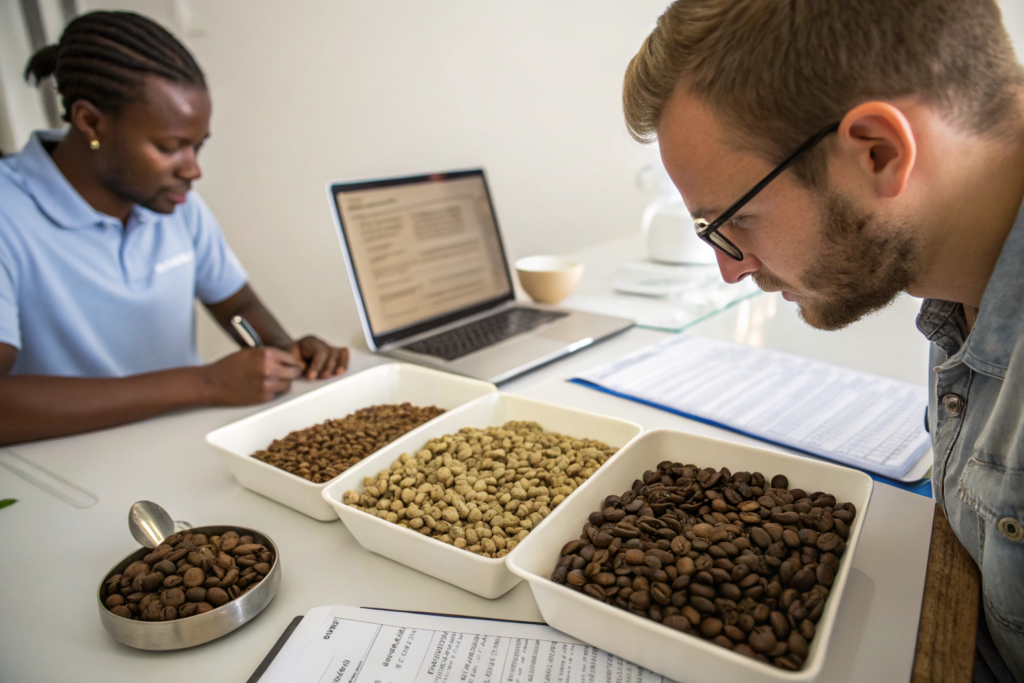
Green coffee and roasted coffee are different products in the HTS system. Green coffee is raw. Roasted coffee has undergone substantial transformation. The CBP Coffee Informed Compliance Publication explains that heading 0901 covers coffee in all forms, but the subheadings separate green from roasted. Green coffee falls under 0901.11 or 0901.12. Roasted coffee falls under 0901.21 or 0901.22.
Why does this matter if both are duty-free in the U.S.? Because the code affects more than duty. It affects statistical reporting. It affects food safety requirements. It affects country-of-origin rules. And in other countries, the duty rates are very different. In China, for example, raw coffee beans under 09011100 face an 8% tariff and 9% VAT. Semi-roasted coffee under 09011200 faces a 15% tariff and 13% VAT. A Chinese customs clearance case describes a buyer who declared "semi-roasted beans" as "raw beans." The result was an additional 12% VAT payment, a 7-day customs detention, and a 5,000 yuan testing fee. The lost orders from missing the exhibition cost three times more than the tax itself.
So, what does this mean? It means the green-versus-roasted distinction is not just about the code. It is about your total landed cost. Get it wrong, and you pay more.
How Does the Decaffeinated Distinction Affect Classification?
Decaffeinated coffee has its own codes. Green decaf is 0901.12. Roasted decaf is 0901.22. Regular green is 0901.11. Regular roasted is 0901.21. The WCO Chapter 9 notes explain that decaffeinated coffee has undergone a process to extract caffeine, usually leaving a caffeine content of no more than 0.2% by weight.
This distinction matters because decaf coffee may face different regulations. Some countries have specific labeling rules for decaf. Some have different food safety requirements. The European Commission classification guide explains that subheading 0901.12 covers unroasted coffee that has undergone a process to extract caffeine. Subheading 0901.11 covers unroasted coffee that has not undergone that process.
The FnB Tech guide reports that 3 out of 5 classification mistakes happen because someone misses the decaf distinction. That is a high error rate. It suggests that many importers do not check their product specs carefully. They assume all coffee is the same. It is not.
What Penalties Apply for Tariff Code Misclassification?
You made a mistake. Maybe it was unintentional. Maybe you trusted your broker. Maybe you used an old code. Now you face the penalties. The penalties depend on the severity. The U.S. has three tiers. China has its own framework. Let me explain both.
Under 19 USC 1592, U.S. Customs can impose civil penalties at three levels: negligence, gross negligence, and fraud. Negligence penalties may reach two times the lawful duties owed. Gross negligence penalties can reach four times the lawful duties. Fraud penalties can equal the domestic value of the merchandise. These penalties apply per violation, not per shipment. CBP can also seize goods for misdeclared value, origin fraud, or prohibited merchandise. In China, customs fines for misclassification range from 0.3万元 to over 10万元 depending on the severity and whether the error affected tax collection.
The Foley & Lardner import risk analysis explains that when duty rates are high, any error that impacts the amount of tariff paid can lead to major penalties. Customs has access to electronic import data from all importers. This gives them an unprecedented ability to identify potential tariff underpayments. The Stile International CBP penalty guide confirms that penalties apply per violation, not per shipment. A single misclassification that affects multiple entries can result in multiple penalties.
Let me show you the U.S. penalty tiers clearly.
| Violation Type | Maximum Civil Penalty |
|---|---|
| Fraud | Domestic value of merchandise |
| Gross negligence | 4× unpaid duties |
| Negligence | 2× unpaid duties |
| Recordkeeping violation | Up to $100,000 per release |
How Does CBP Determine Negligence vs. Fraud?
CBP looks at the facts. Did the importer exercise reasonable care? Did they have a system to check codes? Did they ignore warning signs? The Foley analysis states that showing the importer exercised "reasonable care" in its import operations is the way to minimize potential penalties. This is especially important because Customs is not allowing normal mitigating measures that it normally credits to importers when assessing penalties.
What does reasonable care look like? It means you have a process. You check codes before you file. You keep records. You correct errors when you find them. The Stile guide explains that voluntary disclosures are a critical risk reduction tool. When an importer identifies an error and discloses it before CBP discovery, penalties are often significantly reduced or eliminated.
So, what does this mean? It means the penalty you face depends partly on what you do after you find the error. If you hide it, the penalty is worse. If you disclose it, the penalty may disappear.
What Happens in a Typical Coffee Misclassification Case?
Let me give you a real example. A Chinese customs decision from Xiamen in 2026 describes a company that declared imported goods under code 3908101190 at a 6.5% tariff rate. The correct code was 3908909000 at a 10% tariff rate. The Xiamen Customs penalty decision shows the company was fined 0.3万元 and had to pay the 9,585 yuan in back duties.
Another case from Changzhou in 2026 involved equipment declared under code 847989990 at a 0% tariff rate. The correct code was 8479819000 at a 9% rate. The Changzhou Customs penalty decision shows a fine of 8,000 yuan and 157,620.08 yuan in back duties.
These are not coffee cases. But they show the pattern. The fine is often a percentage of the unpaid duty. The back duty is always owed. The total cost is the back duty plus the fine plus the administrative cost of the investigation.
For coffee specifically, a Chinese customs case involving imported coffee beans from Uganda shows a company that declared 2 shipments of unroasted coffee beans worth $220,440. The case involved origin certificate issues. The penalty was 1.567万元, about 30% of the unpaid tax. That is a significant cost for a paperwork error.
How Do Errors Affect Your Supply Chain and Reputation?
You may think the penalty is the worst part. It is not. The penalty is a one-time cost. The supply chain disruption lasts longer. The reputational damage lasts even longer. Let me explain.
Tariff code errors cause supply chain delays through customs holds, inspections, and forced reclassification. A Chinese customs case describes a shipment held for 7 days because of a classification error. That delay caused the buyer to miss an exhibition, costing three times more than the tax itself. Errors also trigger increased scrutiny on future shipments. Once CBP flags an importer, audits and inspections continue for years. This increases clearance times and costs on every future shipment.
The Stile CBP penalty guide lists the hidden costs beyond fines: operational delays at ports, increased examinations and inspections, higher bond requirements, loss of trade privileges and programs, reputational damage with suppliers and customers, legal fees and internal resource drain, and disruption to supply chain reliability. These indirect costs often exceed the penalty itself.
So, what does this mean? It means a tariff code error is not just a tax problem. It is a business problem. It affects your cash flow. It affects your customer relationships. It affects your ability to import smoothly in the future.
What Happens to Your Cargo During a Customs Hold?
When CBP suspects a classification error, they may hold your cargo. The Stile guide explains that CBP may seize goods for misdeclared value, origin fraud, or prohibited merchandise. Once seized, recovery is costly and uncertain. Even if the cargo is not seized, it may sit at the port for days or weeks while CBP reviews the classification.
During that time, you pay storage fees. You pay demurrage. Your buyer waits. If the coffee is green coffee, it may lose quality in a hot container. If the coffee is roasted, it may go stale. The CBP coffee publication explains that coffee imports must comply with FDA requirements and other applicable laws. A classification error can trigger a broader review of your entire shipment.
I have seen a container of coffee sit at the Port of Long Beach for 12 days because of a classification question. The buyer lost two weeks of sales. The storage fees alone were $2,400. The coffee was fine, but the delay hurt the buyer's cash flow.
How Does a Misclassification Affect Future Imports?
Once you have a penalty on your record, CBP pays more attention to your future shipments. The Foley analysis explains that CBP has access to electronic import data from all importers. This gives them an unprecedented ability to identify potential tariff underpayments. If you have a history of errors, your risk score goes up. Your shipments get flagged more often.
The KPMG CBSA audit list report notes that importers who have made classification errors may face assessments for additional duties and taxes owed as well as penalties. In some cases, importers may be entitled to refunds if errors lead to overpaid duties and taxes. But the audit process itself is costly and time-consuming.
So, what does this mean? It means one error can create a pattern. That pattern can follow you for years. The best way to avoid it is to get the code right the first time.
How Do You Protect Yourself From Classification Penalties?
You want to avoid penalties. You want smooth clearance. You want your coffee to arrive on time. The good news is that you can protect yourself. The process is not hard. It just takes discipline. Let me show you what works.
You protect yourself from classification penalties by using reasonable care, getting binding rulings for uncertain products, maintaining records for five years, conducting post-entry reviews, and making voluntary disclosures when you find errors. The CBP Coffee Informed Compliance Publication states that the importer of record is responsible for using reasonable care to enter, classify, and determine the value of imported merchandise. Reasonable care means having a process, not just good intentions.
The CBP Coffee publication explains that an importer of record's failure to exercise reasonable care could delay release of merchandise and, in some cases, could result in penalties. The Stile guide states that compliance is not an expense. It is a strategic investment.
Let me give you a simple checklist for coffee importers.
| Protection Step | What It Does |
|---|---|
| Verify HTS code before every shipment | Prevents the error |
| Get a binding ruling for new products | Locks in the correct code |
| Keep records for 5 years | Required by law |
| Conduct post-entry reviews | Catches errors before CBP does |
| File voluntary disclosures | Reduces or eliminates penalties |
| Use a licensed customs broker | Adds expertise |
How Do You Use Binding Rulings for Coffee?
A binding ruling is a written decision from CBP that tells you the correct classification for your product. The CBP Coffee publication explains that an importer may obtain a ruling under Regulations of U.S. Customs and Border Protection, 19 C.F.R. Part 177.
How do you get a ruling? You submit a request to CBP. You describe your product in detail. You include samples, photos, and specifications. You explain the processing method. You propose a classification. CBP reviews the request and issues a ruling. That ruling is binding on CBP for that product.
I use binding rulings for new products. When we started exporting semi-washed Yunnan coffee, I was not sure if it should be classified as green or semi-processed. I requested a ruling. CBP told me the correct code. Now I use that code on every shipment. No more guessing. No more risk.
The UStradeStack HTS guide recommends searching the CBP CROSS database for binding rulings on similar products. That is a free resource. You can see how CBP has classified similar coffee products in the past. It helps you choose the right code.
What Is the Role of Reasonable Care in Avoiding Penalties?
Reasonable care is your legal obligation. The CBP Coffee publication explains that the importer of record is responsible for using reasonable care to enter, classify, and determine the value of imported merchandise. This is not just a suggestion. It is a requirement.
What does reasonable care look like in practice? It means you have a system. You train your staff. You use a licensed broker. You verify codes before filing. You keep records. You correct errors when you find them. The Foley analysis explains that importers typically have 310 days from the date of entry to correct any errors through a Post-Summary Correction before CBP liquidates the entry.
So, what does this mean? It means you have time to fix mistakes. But you must be proactive. You must review your entries. You must correct errors before CBP finds them. That is reasonable care.
Conclusion
Inaccurate tariff code declarations have serious consequences. You face civil penalties up to four times the unpaid duties under U.S. law. You face fines in China and other countries. You face shipment delays, cargo seizure, increased scrutiny, and reputational damage. The cost is not just the fine. It is the lost sales, the storage fees, the customer frustration, and the long-term compliance burden.
You can protect yourself. Verify the HTS code before every shipment. Get binding rulings for uncertain products. Keep records for five years. Conduct post-entry reviews. Make voluntary disclosures. Use a licensed customs broker. These steps take time. But they are cheaper than a penalty.
If you want a supplier who verifies every HTS code and prepares accurate customs documents, contact us. BeanofCoffee owns over 10,000 acres in Baoshan, Yunnan. We export Catimor, Arabica, and Robusta to North America, Europe, and Australia. We prepare HTS code documentation and origin certificates for every shipment. For orders or questions, email Cathy Cai at cathy@beanofcoffee.com. She will help you get your coffee through customs without surprises.