I once handed a sample of our washed Arabica to a skeptical roaster at a trade show in Berlin. He cupped it, nodded, and then looked at the label. "Yunnan, China." He paused. "I didn't know China grew coffee worth drinking." His reaction is not unique. For decades, the global coffee industry treated China as an invisible origin. A place that produced a little low-grade commodity for instant coffee and nothing more.
The main coffee growing regions in China are concentrated almost entirely within Yunnan Province, with over 95% of the country's Arabica output, followed by much smaller emerging areas in Fujian and Hainan Island that focus on Robusta. Within Yunnan, the key sub-regions are Pu'er, Baoshan, Dehong, and Lincang.
That Berlin roaster has since become a regular customer. The secret of Chinese specialty coffee is spreading, driven by consistent cupping scores and a supply chain that works. But to understand the coffee, you have to understand the land. The mountains. The rivers. The people who pick the cherries. Let me walk you through the geography that shapes every bean we export.
What Makes Yunnan Province the Heart of Chinese Coffee Production?
Yunnan is not just the heart of Chinese coffee. It is practically the entire body. Walk into any coffee shop in Shanghai, Beijing, or Chengdu, and if the beans are domestically grown, they almost certainly came from Yunnan. The province produces over 95% of China's coffee. The numbers are lopsided because nature made them that way.
Yunnan Province dominates Chinese coffee production because its latitude, altitude, and monsoon climate create the only large-scale Arabica-suitable terroir within China's borders, a unique convergence of the Tropic of Cancer crossing, mountainous topography, and a dry harvest season that allows for stable cherry maturation and processing.
The coffee belt wraps around the planet between the Tropics. Yunnan sits at the northern edge, around 25 degrees north. That is pushing the limit for Arabica. But the province's mountainous terrain compensates for the latitude disadvantage. The high elevation, mostly between 1,200 and 1,600 meters, cools the air enough for Arabica to thrive. The monsoon pattern does the rest. Rain falls heavily from June to September, feeding the trees during the growing season. Then, from October to February, the dry season arrives. The cherries ripen slowly. The dry air prevents mold. Farmers pick under clear blue skies. That harvest window, perfectly timed with dry weather, is a gift that many equatorial origins do not receive.
How Do Baoshan and Pu'er Differ as Coffee Sub-Regions?
Baoshan and Pu'er are the two heavyweight coffee cities of Yunnan. They sit on opposite sides of the province, and they produce different cups. Think of them as siblings with distinct personalities.
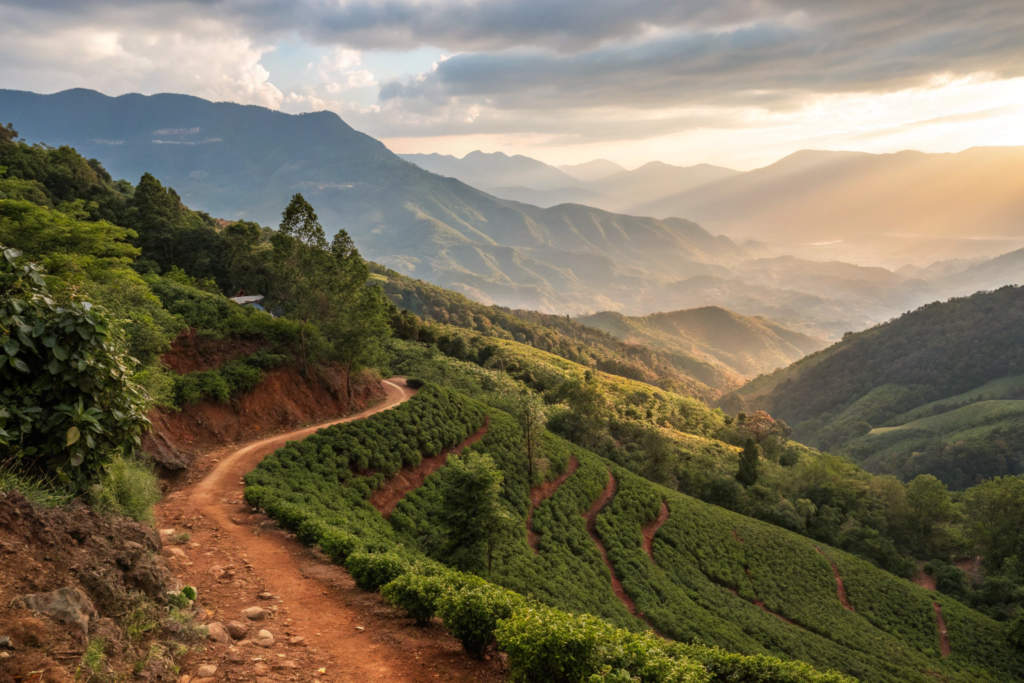
Baoshan, where our farm is located, lies in the western part of Yunnan, nestled against the Gaoligong Mountains. The elevation here is high, typically 1,400 to 1,600 meters. The soil is red volcanic earth mixed with limestone. The nights are cool. The coffee matures slowly and develops dense beans with high sugar content. The cup tends toward dark chocolate, brown sugar, and a round, creamy body. Pu'er, further south and slightly lower in elevation on average, is warmer. It is the traditional tea capital of China that has diversified aggressively into coffee. Pu'er produces massive volumes. The cup is often lighter in body, with more red fruit and nutty notes. Some Pu'er lots have a distinct black tea character, which makes poetic sense given the region's tea heritage. A roaster building a blend might use Baoshan for the bass note and Pu'er for the treble.
Why Is the Lancang River Valley Critical to Coffee Farming?
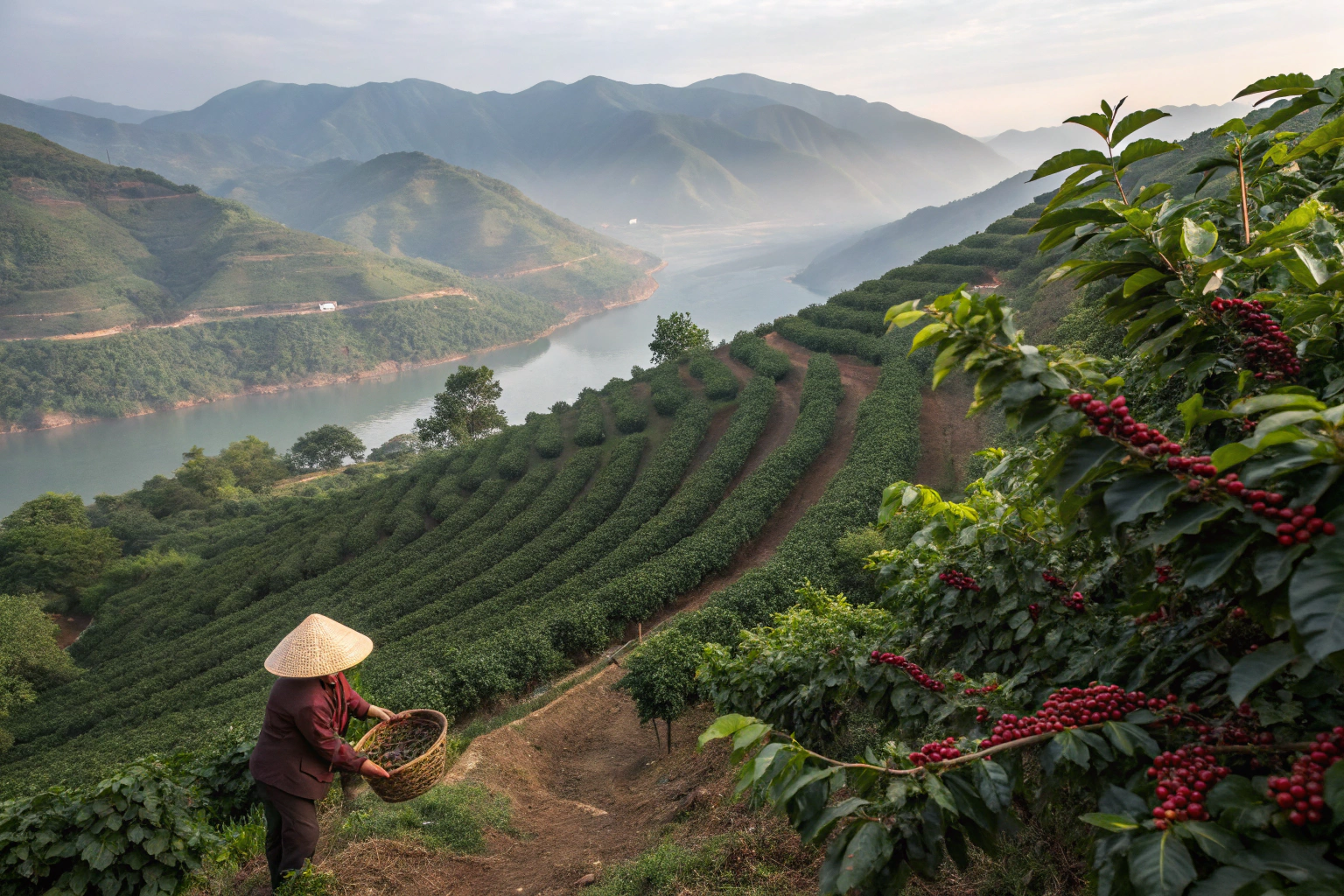
The Lancang River, which becomes the Mekong when it flows into Southeast Asia, is the artery of Yunnan coffee. The river carves a deep valley through the province, and the coffee farms cling to the slopes above it.
The river creates a microclimate. It acts as a heat sink, moderating temperature extremes. On cold winter nights, the flowing water releases stored heat, protecting the coffee trees from frost damage at higher altitudes. The valley also channels fog in the early mornings, diffusing sunlight and slowing down the cherry's sugar development in a way that concentrates flavor. This fog effect is something we see daily on our Baoshan estate. The mist rolls up from the river at dawn, blankets the trees for a few hours, and burns off by mid-morning. It is a natural shade mechanism without the trees. The river also provides irrigation water for the dry months, though most specialty farms rely primarily on the monsoon. An often overlooked detail is that the Lancang Valley's steep slopes force farmers to terrace their fields, which adds labor cost but prevents soil erosion and creates a stunning visual landscape that reinforces the premium origin story.
How Does Fujian Province Contribute to China's Coffee Market?
If Yunnan is the Arabica kingdom, Fujian is the Robusta outpost. It is a tiny piece of China's coffee puzzle, but it exists, and it serves a specific purpose. Fujian sits on the southeastern coast, facing Taiwan. The climate is subtropical, hot, and humid. The conditions are wrong for quality Arabica but acceptable for Robusta.
Fujian Province contributes a small fraction of China's total coffee output, focusing almost exclusively on Robusta cultivation for the domestic instant coffee and blended beverage market, with production centered in the hilly interior regions where the climate mimics traditional Robusta-growing zones of Vietnam.
The coffee from Fujian rarely enters the specialty conversation. The cup is harsh, bitter, and high in caffeine. That is the point. Instant coffee manufacturers need that punch. The domestic market for instant coffee in China is enormous, and Fujian supplies a local source. The province's historical role as a tea producer, particularly oolong, also means that some tea farmers have diversified a small portion of their land into coffee as an experimental cash crop. The volumes are small compared to Yunnan, perhaps a few thousand bags annually. But the existence of a Robusta zone within China provides the country's coffee sector with a degree of self-sufficiency that many consuming nations lack. It also means that Chinese coffee traders have hands-on experience with both Arabica and Robusta, which is valuable in the global market.

Is Hainan Island an Emerging Coffee Origin to Watch?
Hainan, the tropical island province in the South China Sea, is another Robusta-friendly zone. The island's climate is fully tropical, with coconut palms and rainforest. Historically, Hainan has been a minor coffee producer, mostly for local consumption and the tourist market.
There are small, artisanal efforts to grow Arabica in Hainan's higher interior elevations, but the results are inconsistent. The heat is too intense for delicate Arabica varieties. Robusta, however, grows vigorously. Some specialty roasters in China have experimented with well-processed Hainan Robusta for espresso blends, where the extra body and crema are assets. The "emerging origin" label is probably too generous for now. Hainan is more of a curiosity than a commercial force. But curiosity is how markets start. I would not bet against Hainan developing a niche Robusta specialty segment in the next decade, especially given the domestic demand for coffee. The island has the land, the climate, and the proximity to the booming South China market.
What Are the Altitude and Climate Profiles of China's Coffee Regions?
Altitude is the quality engine of Arabica coffee. The higher you go, the cooler it gets. Cooler temperatures slow down the cherry's maturation, giving the bean more time to accumulate sugars and develop complex flavor precursors. Chinese coffee regions span a wide altitude range, from marginal lowlands to premium highlands.
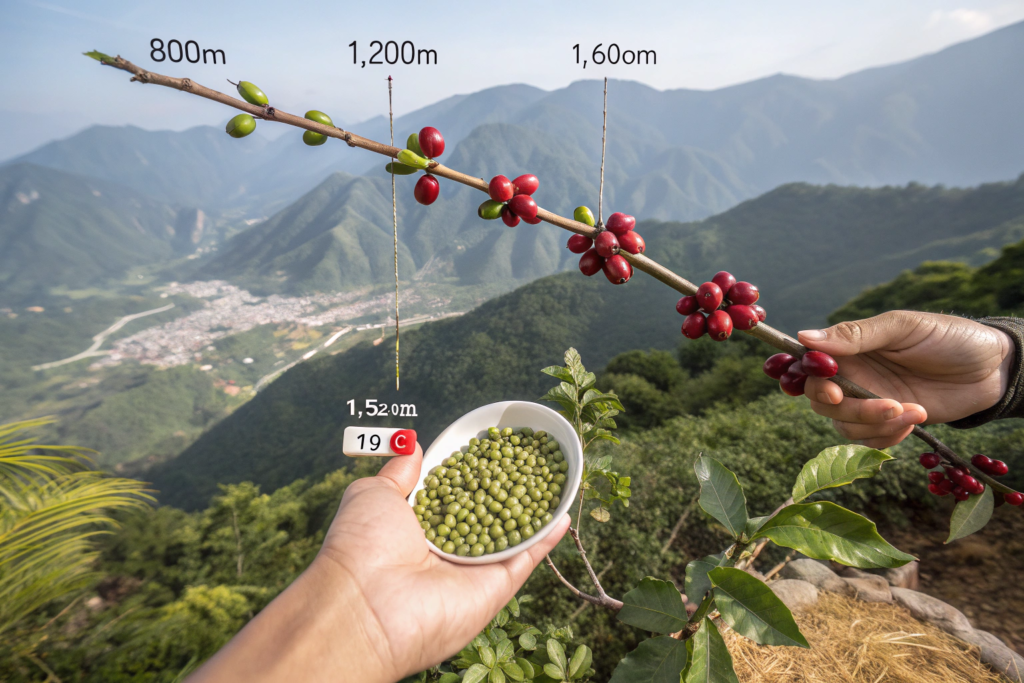
China's primary coffee regions in Yunnan range from 800 meters to 1,600 meters above sea level, with the highest quality specialty lots concentrated above 1,300 meters. The climate is subtropical monsoon, with a distinct wet season for growth and a dry season for harvest, and diurnal temperature swings of 10°C to 15°C that stress the cherry beneficially.
The temperature variation between day and night is a key quality driver. On our Baoshan farm, a typical November day might be 24°C at noon and drop to 10°C at night. That 14-degree swing forces the coffee seed to respire differently. It burns sugars more slowly. The acids develop complexity. Low-elevation coffee, grown where nights stay warm, lacks this stress and produces a flatter, simpler cup. This is why we plant our best varietals at the top of our property and our lower-quality robusta at the bottom.
How Does Elevation Affect the Cup Profile of Chinese Arabica?
The altitude-to-cup correlation is strong and predictable. A Yunnan Arabica grown at 800 meters will taste mild, nutty, and somewhat flat. Good for a commercial base, but nothing exciting. That same varietal grown at 1,500 meters transforms. The acidity becomes more pronounced. The sweetness deepens from simple sugar to complex caramel. The body thickens.
I have run this experiment on our own farm. We cupped Catimor from a 1,000-meter block against Catimor from a 1,550-meter block, same harvest, same processing. The low-altitude lot scored 80.5. The high-altitude lot scored 84. The difference was dramatic. The high-grown beans were denser, physically harder, and made a sharper cracking sound during roasting. The brewed cup had a malic acidity reminiscent of green apple, with a cocoa finish. The lower-grown cup was soft, with a muted acidity and a shorter aftertaste. For a roaster, this means altitude data on the bag is not just a marketing number. It's a flavor predictor. Ask your Yunnan supplier for the specific elevation range of the lot, not just the regional average. The number tells you what to expect before you even grind the sample.
What Is the Impact of the Dry Harvest Season on Processing?
The dry harvest window in Yunnan, from October through February, is a competitive advantage that most equatorial origins envy. In Colombia or parts of Ethiopia, harvest coincides with rain. Farmers scramble to dry parchment between showers. The risk of mold and over-fermentation is high.
In Yunnan, the rain stops just as the cherries turn red. The sun shines consistently for four months. Humidity drops. This allows for slow, even sun-drying on raised beds or patios without the panic. The parchment can rest for two to three weeks, drying gradually to 11% moisture. The slow drying stabilizes the cellular structure and preserves the volatile aromatic compounds. It also enables us to consistently produce natural and honey-processed coffees without the fermented, boozy defects that plague rainy-harvest naturals. The dry season is also why we can offer reliable organic certification. Less moisture means less fungal pressure, which means less need for fungicides. Nature cooperates with the processing, rather than fighting it.
What Coffee Varieties Are Grown Across China's Regions?
The genetic material in the ground determines the ceiling for cup quality. You can farm perfectly, but if the variety is a low-quality commercial strain, the cup will never be exceptional. China's coffee variety landscape has shifted dramatically over the past two decades, from a near-monoculture of Catimor to a diverse mix that now includes some of the world's most celebrated Arabica cultivars.
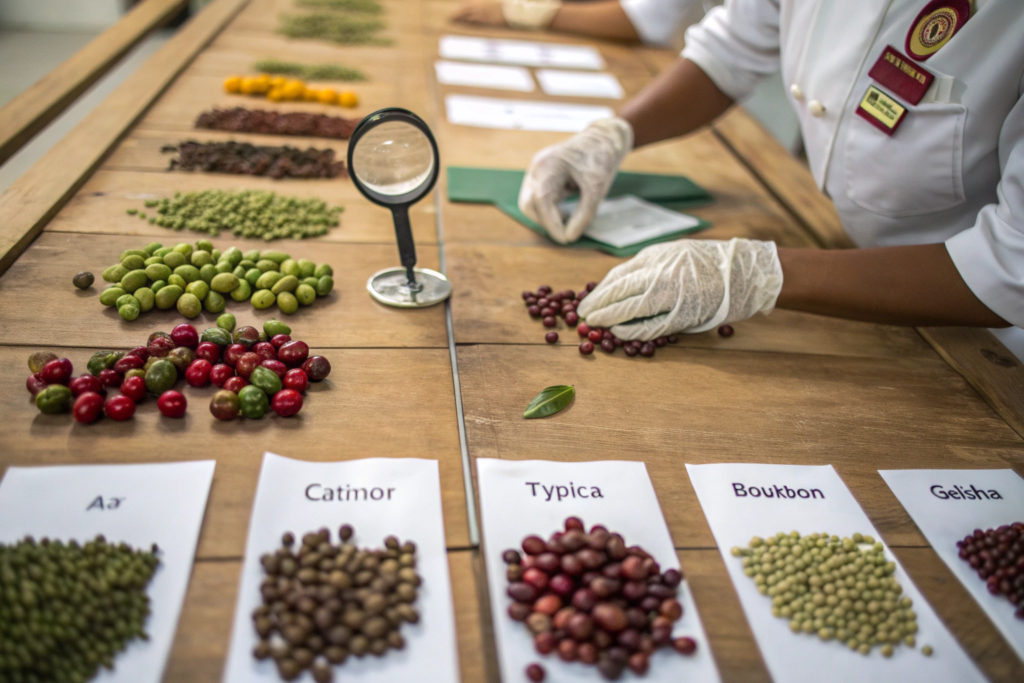
Catimor remains the dominant variety across all Chinese coffee regions due to its high yield and rust resistance, but the specialty sector has rapidly expanded plantings of Typica, Bourbon, Caturra, and even Geisha, particularly in the premium high-altitude zones of Baoshan and Pu'er.
The Catimor dominance is a legacy of the 1990s, when the Chinese government, in partnership with the World Bank, promoted the variety to kickstart the coffee industry. Catimor, a cross between Caturra and Timor Hybrid, carries Robusta genes that make it robust against leaf rust and productive in terms of cherry yield. The downside was a reputation for harsh, astringent flavor in the cup. That reputation was partly deserved for poorly grown and processed Catimor. But the story is changing. High-altitude, carefully processed Catimor from Baoshan now cups in the specialty range. Still, the market demands variety. Plant breeders and adventurous farmers have responded by importing and propagating pure Arabica lines.
How Is Catimor Being Replaced by Specialty Varieties in Yunnan?
The shift from Catimor to specialty varieties is a long-term play. It takes three to four years for a new coffee seedling to produce a commercial harvest. Farmers are making investment decisions today that will shape their income in 2028 and beyond.
Government subsidies, private investment, and technical assistance from organizations like the Coffee Quality Institute have accelerated the transition. Nurseries in Pu'er and Baoshan now sell Typica and Bourbon seedlings in volume. Some farms, including ours, have dedicated blocks for Geisha, the Panamanian-origin variety that commands astronomical prices at auction. The Geisha experiment in Yunnan is still young. The early cupping results are promising—floral, jasmine, bergamot—but the yields are low and the trees are finicky. For most farmers, Typica is the practical upgrade path. It produces a cleaner, sweeter cup than Catimor, with a classic Arabica profile that international buyers recognize instantly. The challenge is that Typica is susceptible to rust. It requires more care, more shade, and more spraying. The cost of production is higher, and the price must reflect that.
Is Robusta Grown Commercially in China?
Yes, but the volumes are small and geographically concentrated. Robusta in China is grown mainly in the lower, hotter areas of Yunnan, particularly along the border with Vietnam and Laos, and in the coastal provinces of Fujian and Hainan.
Chinese Robusta serves the domestic instant coffee and three-in-one mix market. It rarely enters the export stream as green beans because Vietnam, right next door, produces Robusta at a lower cost and in vastly greater volumes. The competitive advantage for Chinese Robusta is not cost but logistics and freshness for domestic buyers. Some Chinese Robusta is also used as a blending component for espresso roasts sold within China, where the extra body and crema are valued. I don't grow Robusta on our estate. The land is too valuable for a low-margin commodity. But I respect its role in the broader market ecosystem. It provides a local supply for a segment that would otherwise be 100% imported.
Conclusion
China's coffee growing regions tell a story of rapid transformation. Yunnan is the undisputed heartland, with Baoshan, Pu'er, Dehong, and Lincang each contributing distinct cup profiles shaped by altitude, soil, and the Lancang River's influence. Fujian and Hainan play minor roles, primarily as Robusta zones for the domestic instant market. The altitude profile, from 800 to 1,600 meters, creates a quality gradient that smart buyers can use to select the exact flavor profile they need. The genetic landscape is evolving fast, with Catimor ceding ground to Typica, Bourbon, and Geisha as the specialty market matures.
For a buyer who thinks China is just a commodity producer, the map I've drawn here should rewrite that assumption. The region that produces our beans is not a faceless factory. It's a specific, beautiful, and increasingly sophisticated coffee origin.
If you want to taste the difference that a specific mountain, a specific altitude, and a specific variety can make, we can send you samples from our different blocks. Compare our high-grown Catimor against our Typica. Cup the washed against the natural. Understand the region through its flavors. Contact Cathy Cai at cathy@beanofcoffee.com and request a regional sample kit. The map is interesting. The cup is convincing.