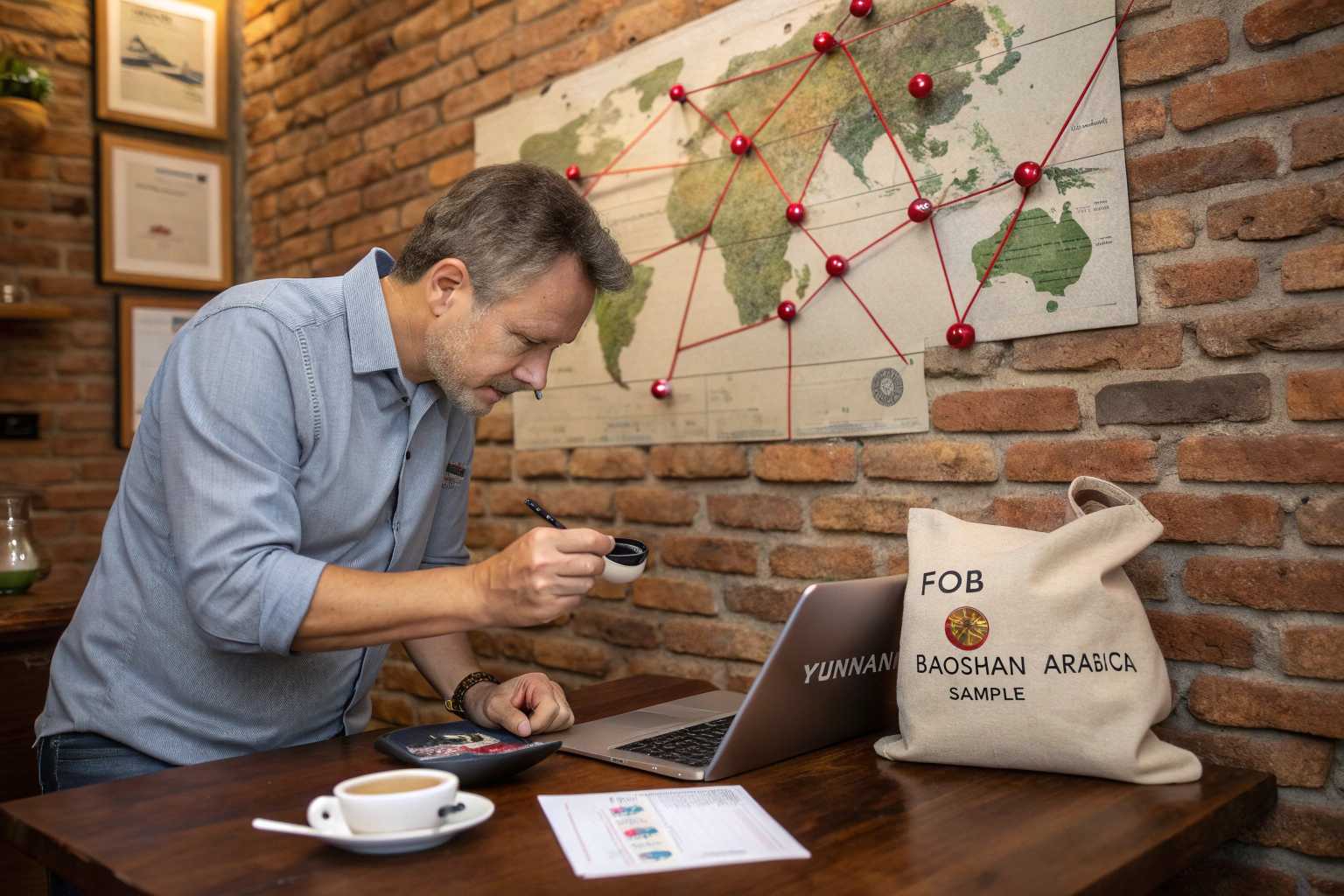
I received an email last month from a startup roaster in Austin. He was blunt. He wrote, "I need 84-point coffee at 80-point prices. Is that possible?" I smiled when I read it. Every buyer wants that. The holy grail. High quality, low price. Most people think it's a fantasy. They think you have to choose between the two. That is only half true.
You can find the cheapest high-quality Arabica beans by targeting undervalued origins with recent infrastructure upgrades, buying during the harvest flush when cash-strapped farmers are most willing to negotiate, committing to volume contracts that lower per-unit costs, and sourcing directly from farms rather than through multiple intermediary layers.
Here is the uncomfortable truth that most coffee sourcers won't admit publicly. The relationship between price and quality is not a straight line. It's a scatterplot. There are overpriced mediocre beans and underpriced excellent beans. Your job as a buyer is to hunt the underpriced gems. That requires moving away from famous origin names and looking at the numbers—cupping scores, defect counts, moisture readings, and FOB quotes—side by side.
What Are the Most Undervalued Origins for High-Quality Arabica?
Origin prestige drives price. A washed Arabica from a famous region like Yirgacheffe or Huila carries a brand tax. The name alone adds 30 to 50 cents a pound, regardless of cup score. Smart buyers know this. They ask themselves: "Can I get the same score from a place nobody is talking about yet?" The answer, right now, is yes.
The most undervalued origins for high-quality Arabica today are regions that have recently modernized processing but lack legacy marketing power. Yunnan, China sits at the top of that list, along with parts of Uganda, Papua New Guinea, and certain lesser-known Indonesian islands where specialty infrastructure has quietly improved.
Yunnan is the clearest example. Ten years ago, Yunnan coffee was commercial filler at best. Today, the washed specialty lots from Baoshan cup at 84, 85, even 86 points. But the global market has not fully repriced Yunnan to match its new quality. The reputation lag creates a pricing gap. A 84-point Yunnan Catimor often trades 20% to 30% below a 84-point Colombian Castillo. Not because the cup is worse. Because the Colombian name commands a premium that Yunnan hasn't earned in the buyer's mind yet. That gap is your opportunity. It will not last forever. The secret is getting out.
Why Is Origin Branding Keeping Some Great Coffees Cheap?
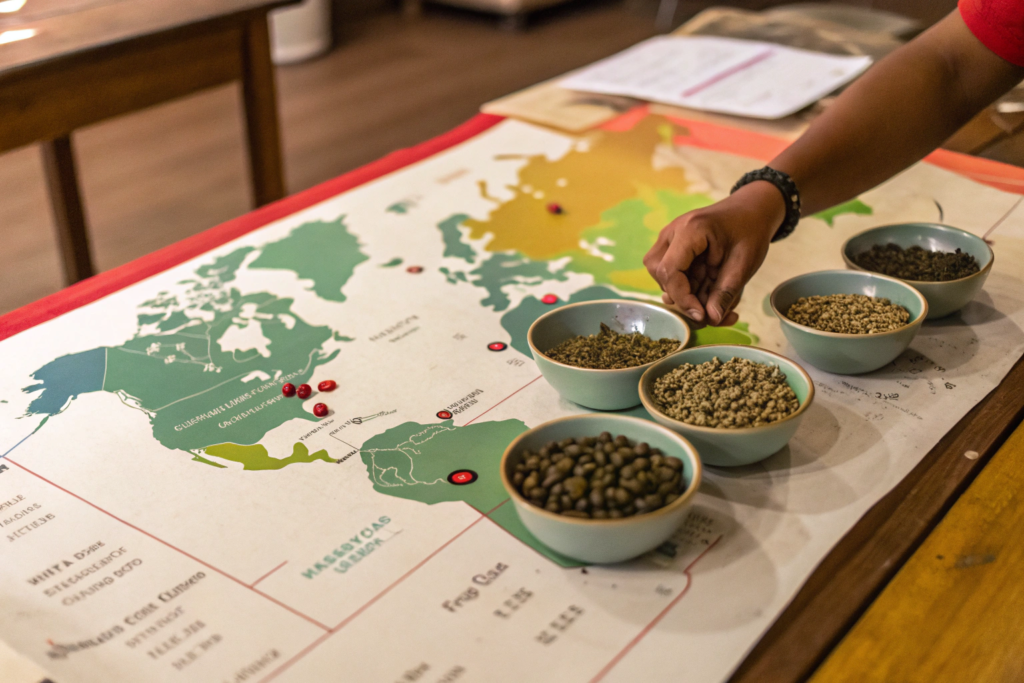
Origin branding is a powerful market force. Colombia invested decades and millions of dollars building the Juan Valdez image. Ethiopia embedded its coffee names into the identity of specialty coffee itself. These investments paid off. They created consumer recognition that translates into higher green bean prices.
But branding is a story, not a chemical test. A consumer in a cafe sees "Single Origin Colombia" and feels safe. They don't see the cupping score. They trust the brand. This creates a market inefficiency. Origins with weak consumer-facing brands but strong quality have to price lower to attract volume buyers. Yunnan suffers from this exactly. When was the last time a customer walked into a cafe and said, "Do you have a Yunnan single origin?" It happens, but rarely compared to requests for Ethiopian or Colombian. The roaster knows this. They buy the Yunnan bean, it cups beautifully, but they sell it as a "house single origin" or a rotating seasonal offer, not as a flagship. The price they pay reflects their marketing challenge, not the bean's intrinsic quality. As a buyer, you can exploit this inefficiency. You are paying for the bean, not the brand story. Let the roaster build the story. You just secure the quality at the discount.
How to Evaluate Emerging Origins Without Visiting the Farm?
Not every buyer can jump on a plane to Yunnan. Travel costs money and time. But you can still diligence an emerging origin from your office. Start with the sample. Request a pre-shipment sample from the exporter, not just a "representative" sample they pulled six months ago. You want the sample from the actual lot you might buy.
Then, go beyond the cup. Ask for the technical data sheet. What is the moisture content? Water activity? Screen size distribution? Defect count per 350 grams? A good exporter will have this data from an independent lab or an SGS inspection. If the exporter hesitates or says "trust me," move on. Next, check the exporter's digital footprint. Do they have a professional website? Do they show photos of their processing facility? Is there a Google Maps pin for the farm? I've seen buyers cross-check a supplier's claimed altitude by plugging the coordinates into Google Earth and checking the elevation profile. One buyer found a supplier claiming 1,800 meters when the satellite data showed the farm at 1,200 meters. The coffee was fine, but the lie destroyed trust. An emerging origin with transparent, data-rich exporters is investable. An emerging origin with vague claims and no lab data is a gamble.
| Origin | Typical SCA Score Range | FOB Price per lb (Specialty Grade) | Brand Premium Factor | Value Rating |
|---|---|---|---|---|
| Colombia (Huila) | 82 - 87 | $3.20 - $4.50 | High (20-30% over intrinsic) | Established Premium |
| Ethiopia (Yirgacheffe) | 84 - 89 | $3.80 - $5.50 | Very High (25-35% over intrinsic) | Iconic Premium |
| Brazil (Minas Gerais) | 80 - 84 | $2.50 - $3.20 | Moderate (5-10% over intrinsic) | Volume Value |
| Yunnan (Baoshan) | 82 - 86 | $2.60 - $3.40 | Low (0-5% over intrinsic) | High Value Opportunity |
| Uganda (Mt. Elgon) | 80 - 84 | $2.40 - $3.00 | Low (0-5% over intrinsic) | Emerging Value |
How Does Buying Directly from the Farm Reduce Wholesale Costs?
The coffee supply chain is long. Farmer to local collector to processor to exporter to importer to roaster. Every hand that touches the bean takes a cut. A dollar per pound at the farm gate can become three dollars by the time it reaches the roaster. Most of that markup is logistics and financing, but some of it is pure intermediary profit.
Buying directly from the farm cuts out at least one, often two, intermediary layers, reducing the per-pound cost by 15% to 30% while simultaneously giving you more control over quality selection and lot traceability. The savings come from eliminating the commissions and risk premiums added by local collectors and regional brokers.
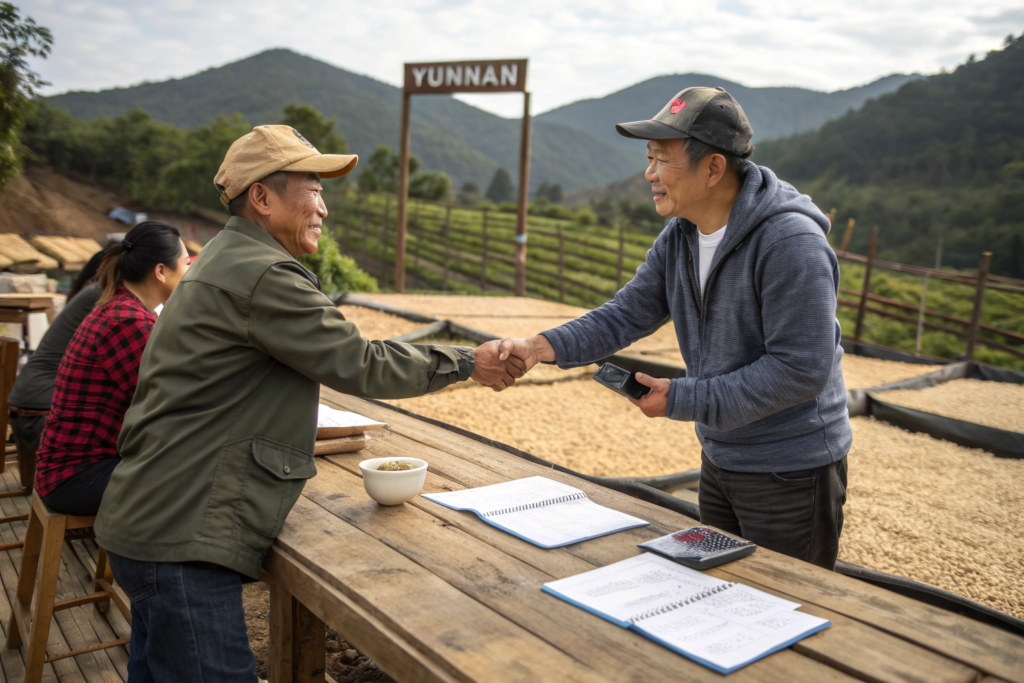
When you buy from a broker, you are paying them to source, aggregate, and finance the coffee. That service has value, especially for small roasters buying less than a container. But for a buyer moving serious volume, the broker's value diminishes. You are better off finding a large, well-managed farm that can fill a container with a single, uniform lot and ship it directly. That farm is us. We are not brokers. We are growers. The coffee you buy from BeanofCoffee was grown on land we own, processed in our mill, and stuffed into the container by our team. There is no middleman between me and you. That structural efficiency translates directly into a lower FOB price for the same cupping score.
What Is the Difference Between FOB and Farmgate Pricing?
Farmgate price is what the farmer receives when they deliver parchment to the local mill or buying station. FOB price is what you pay to have the green coffee loaded onto a ship at the port of origin. Between those two prices sits a whole ecosystem of costs and profits.
The farmgate price might be $1.80 per pound for a specialty lot. By the time the parchment is milled, sorted, graded, bagged, transported to the port, documented, and loaded, the cost might be $2.30. Add a 15% margin for the exporter, and you are at $2.65 FOB. Now, if the same farm sells through a local collector who takes a 5% cut, then a regional processor who takes 8%, then an exporter who takes 12%, the FOB price climbs to $3.10 or more. The coffee is the same. The quality is the same. The price is different purely because of the number of hands involved. When you negotiate with a farm like ours that controls the entire chain from seed to container, your negotiation starts closer to the true cost of production. The discussion shifts from "what margin does each middleman need" to "what is a fair price that sustains the farm and gives you a competitive landed cost." That is a much simpler and more productive conversation.
How to Verify That You Are Actually Buying Directly from a Farm?
The coffee industry has a transparency problem. Some exporters market themselves as "farm direct" but are actually buying parchment from dozens of smallholders and repackaging it. There is nothing wrong with that model, but calling it "farm direct" is misleading. You are paying a farm-direct premium for a aggregated lot.
How do you verify? Ask the exporter for a single, named producer. If they say "we work with many small farmers in the region," they are an aggregator, not a single estate. That is fine. Just negotiate accordingly. Don't pay the estate premium. Ask for photos of the farm with geo-tagged metadata. Ask for a video call with the farm owner. Walk the farm on video. I do this with serious buyers all the time. I take my phone, walk to the drying beds, and show them the parchment with a timestamp. Another test: ask for a lot from a specific, small block of the farm. A true estate can isolate a micro-lot. An aggregator cannot easily do that. They mix cherry from many farms at the washing station. If the exporter can provide a lot from "Block 7, North Slope, 1,550 meters," you are dealing with a real estate. If the best they can do is "Yunnan washed Arabica," you are dealing with a general source.
When Is the Best Time to Buy Green Coffee for Maximum Savings?
Coffee is an agricultural product. It has a harvest season. The price of the same bean fluctuates throughout the year based on supply availability, demand pressure, and the seller's cash flow needs. Most buyers buy when they need the coffee. Smart buyers buy when the coffee wants to be sold.
The best time to buy green coffee for maximum savings is during or immediately after the harvest in the origin country, when the farmer or exporter faces peak cash flow pressure from paying pickers and processors, and the fresh crop creates a temporary supply surplus that puts downward pressure on spot prices.
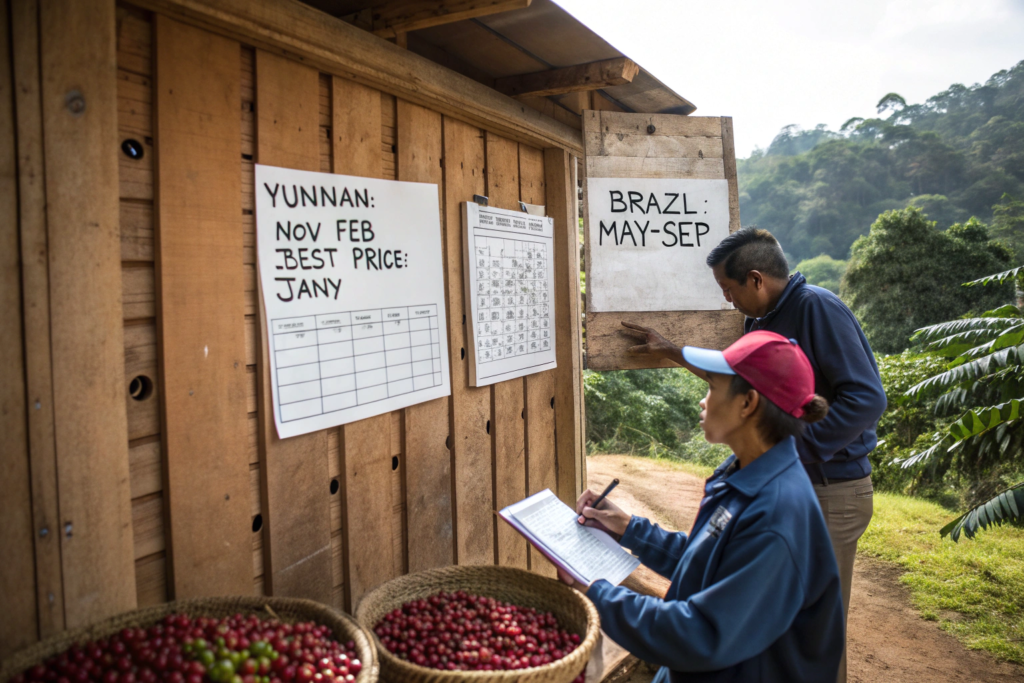
For our harvest in Baoshan, the main picking season runs from November through February. By January, the rush is at its peak. We are paying hundreds of seasonal workers. We are funding the wet mill operations. Cash is flying out the door. That is when we are most open to offering a sharp price on a container of spot coffee. A buyer who contacts me in January with a cash offer for an immediate shipment will get a better price than a buyer who contacts me in August, when the coffee is safely stored, the harvest expenses are paid off, and I am in no hurry to sell. The seasonal price swing can be 5% to 10%. That is real money on a container.
How Does Cash Flow Pressure Affect Farmer Pricing?
Farming is a capital-intensive business with a single payday. We spend money all year—on fertilizer, pruning, weeding, equipment maintenance—and only get paid when the coffee sells. The harvest itself is the most expensive period. Pickers want cash. Sometimes daily. The processor needs fuel. The bag supplier needs payment within 30 days.
This creates a cash flow bottleneck. The farmer or exporter needs working capital to bridge the gap between harvest expenses and export revenue. If a buyer can offer fast payment terms—like a 50% advance against the contract and 50% against the shipping documents—that liquidity is extremely valuable. It saves the farmer from taking a high-interest loan from a local bank. I will often reduce my per-pound price by a few cents in exchange for favorable payment terms. The buyer saves on the coffee cost. I save on the financing cost. It's a pure win-win that does not touch the quality of the bean. The key is timing. The offer has to arrive when the liquidity need is highest. That window is predictable. It is the same every year. Mark the harvest calendars of your target origins and align your purchasing push with their peak cash crunch.
Is There a Price Benefit to Buying "Past Crop" Coffee?
Sometimes. "Past crop" is a term for coffee that has been stored for over a year, usually because it didn't sell during its fresh season. The quality of past crop varies wildly. Some is stored perfectly in hermetic bags and cups at 83 points. Some is stored badly and tastes like old library books.
The price of past crop is always discounted. Sometimes heavily. A lot that was $3.00 FOB fresh might sell for $2.30 a year later. For a roaster doing a dark roast espresso blend, where the roast character dominates the origin character, past crop can be a perfectly acceptable and very cheap option. The high roast temperature masks the faded acidity and flat top notes. But do not buy past crop for your light roast single-origin filter program. It will taste dead. Always ask for the harvest date on the sample bag, not just the "best by" date. A "best by" date is marketing. The harvest date is truth. If a lot was harvested 18 months ago, but the exporter has it in vacuum-sealed GrainPro in a climate-controlled warehouse, cup it. You might be surprised. I've cupped two-year-old vacuum-sealed Yunnan that still held 80% of its original flavor. But negotiate hard. The seller knows the clock is ticking.
What Quality Indicators Allow You to Pay Less Without Sacrificing Cup Score?
Quality and price are negotiated separately, but they shouldn't be. They should be linked by a transparent metric. Too many buyers negotiate on price first and check quality later. That is backwards. You should define the minimum quality standard you can accept, and then hunt for the lowest price that meets that standard.
The quality indicators that allow you to pay less without sacrificing cup score are accepting minor physical imperfections that do not affect the brew, choosing less fashionable screen sizes that cup identically, and selecting lots with exceptional cup scores that have been discounted due to cosmetic blemishes like slight color variation.
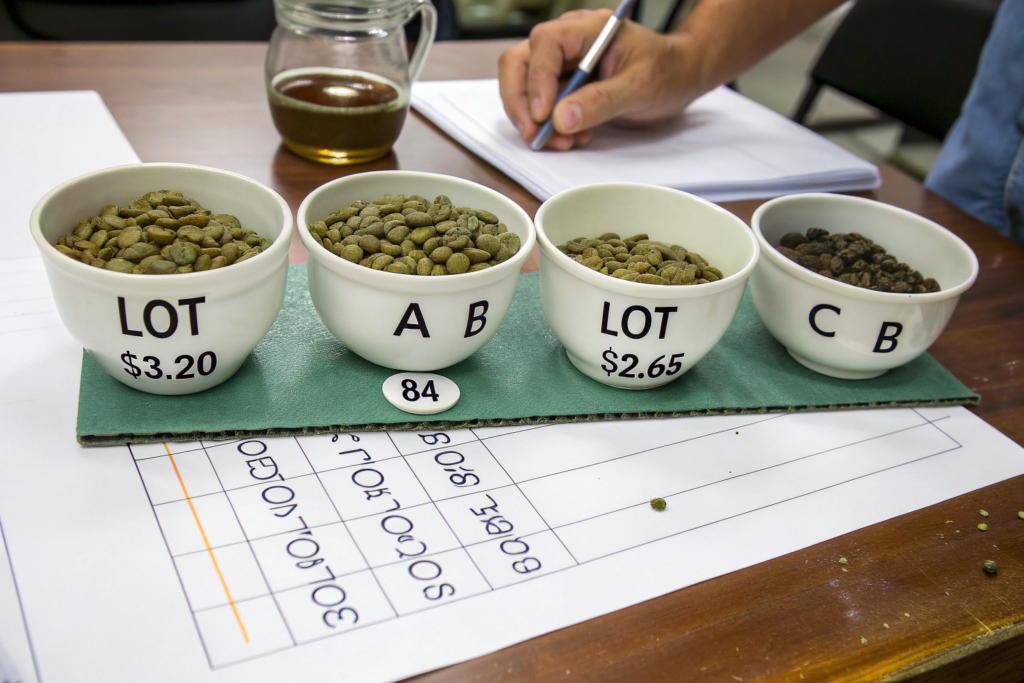
The SCA cupping score is the ultimate equalizer. A bean that looks slightly uneven but cups at 84 is worth more than a bean that looks perfect but cups at 80. The cup doesn't lie. The eye sometimes does. Some of the best value coffees I sell are lots that have a slightly higher percentage of peaberries mixed in, or a slight variation in bean color from a natural process that dried unevenly. The cupping score is still 84. The flavor is still rich, sweet, and complex. But the physical grade is not "premium" in the visual sense. A roaster who only buys "premium screen 17/18, zero color variation" will reject it. A roaster who cups it blind will buy it and save 15%.
What Defects Actually Matter for Flavor vs. Appearance?
The SCA defect system distinguishes between Category 1 defects, which affect flavor, and Category 2 defects, which are primarily visual. A full black bean is Category 1. It tastes like burnt rubber. One of these in a sample can ruin the cup. A slight insect damage hole that has healed over is Category 2. It looks ugly but contributes no flavor taint at normal roast levels.
Understand this distinction and use it. If a lot has zero Category 1 defects but a couple of Category 2 visual blemishes, the flavor will be clean. But the seller may have to discount the lot because high-end buyers demand visual perfection. You can step in and buy that "ugly but delicious" coffee at a discount. The end consumer never sees the green bean. They only taste the brewed cup. They will never know the bean had a slight chip in it before roasting. What they will know is whether the coffee tastes good. An often overlooked defect that does matter is "stinker" beans. These are beans that look normal but produce a foul, sour taste when roasted. They are caused by over-fermentation or bacterial contamination during processing. A visual inspection cannot catch them. Only cupping can. So, never buy a visually flawed lot without cupping it first. The cup is the final judge.
How Does Screen Size Affect Price Without Affecting Flavor?
Screen size is a sorting parameter, not a flavor parameter. A 16-screen bean from the same tree as an 18-screen bean tastes essentially the same. It's just smaller. But the market pays a premium for larger screen sizes because they roast more evenly in large commercial drum roasters and look more impressive in a sample.
This creates an arbitrage opportunity. If your roastery uses a fluid-bed roaster, or if you are a small-batch roaster who profiles each roast carefully, you can handle slightly smaller beans just fine. Buy the 15/16 screen lot instead of the 17/18 screen lot from the same harvest. The cup score is identical. The price might be 10% to 15% lower. The seller is happy to move the smaller beans, which are harder to sell to the premium market. You get the same flavor profile for less money. I have a buyer in Australia who specifically requests our smaller screen Catimor for his cold brew concentrate. The smaller beans extract faster in the cold brew process, which is actually a benefit for him. He pays a lower price, gets a better extraction yield for his specific product, and I clear inventory that doesn't fit the premium bag programs. Everyone wins.
Conclusion
Finding the cheapest high-quality Arabica is not about being the toughest negotiator at the table. It's about being the most strategic. You shift your attention away from the famous origins with inflated brand premiums and toward undervalued regions where quality has outpaced reputation. You cut out the intermediary layers and deal directly with farms that control their own processing and export. You time your purchases to align with the seller's cash flow needs, not your own convenience. And you buy based on cup score and chemical analysis, not cosmetic perfection.
The coffee that meets your quality bar at the lowest price exists. It is sitting in a warehouse right now, probably in a bag marked with an origin name that doesn't impress at dinner parties. But it will impress on the cupping table. That is where it matters.
If you want to test this approach with a sample from a farm that embodies all of these value principles, reach out to us. We cup our lots blind against the competition, and we price based on farm-gate reality, not origin hype. Contact Cathy Cai at cathy@beanofcoffee.com and ask for a current sample set with FOB quotes. Let the cup tell you what the brand names can't.