
You have questions. I know you do. Every serious buyer does. You are about to wire money to a supplier on the other side of the world. You are about to commit to a product you cannot touch until it arrives at your port. The uncertainty is real. I have been answering these questions for years. I have heard them in emails, on video calls, and across cupping tables. They are not foolish questions. They are the questions of a professional who wants to protect their business. Let me answer them for you, all in one place.
The most frequently asked questions by US buyers center on quality, logistics, compliance, and payment security. At BeanofCoffee, I welcome these questions. They are a sign of a serious, experienced buyer. My goal is to answer them clearly and honestly, so you can make a confident decision.
Here are the questions I hear most often. And here are my answers.
What Are the Most Common Questions About Quality and Grading?
The first question is almost always about quality. You want to know what you are buying. You want to know the grade, the screen size, the cup score. You want to know if the sample I sent you is representative of the container I will ship. This is the foundation of trust.
The most common quality questions are about cupping scores, screen size, moisture content, and defect counts. At BeanofCoffee, I provide a full specification sheet with every offer. The numbers are verified by independent testing. The sample I send is pulled from the exact lot that will be shipped. What you cup is what you get.
The quality question is really a consistency question. You want to know that the quality will be the same, shipment after shipment. My answer is in my process. My sorting is rigorous. My processing is standardized. My blending, when I blend, is data-driven. The consistency is built into the system.
How Do I Know the Container Will Match the Sample I Approved?
This is a specific, valid concern. A dishonest supplier can send a beautiful sample and then ship a lower quality container. How do you protect yourself? The answer is in the contract and in the verification. The contract specifies the quality parameters. The sample is sealed and retained by both parties. When the container arrives, you can pull a new sample and compare it to the approved sample. If they do not match, you have a basis for a claim. At BeanofCoffee, I also provide a pre-shipment sample. This is a sample pulled from the actual container load, just before it is sealed. I send this sample to you by courier. You can cup it while the coffee is on the water. If there is a problem, we have time to address it. This is the ultimate in transparency.
What Is the Shelf Life of Green Coffee and How Should I Store It?
Green coffee is a seed. It is alive. It ages. The clock starts at harvest. A washed Arabica, stored properly in a GrainPro bag in a cool, dry place, will maintain its quality for 9 to 12 months. After that, the acidity begins to fade, the aromatics diminish, and the cup becomes flat and woody. A natural process coffee has a shorter shelf life, maybe 6 to 9 months, because the fruit sugars are more volatile. Proper storage is essential. The coffee should be kept off the floor, away from direct sunlight, and protected from moisture and odors. A stable temperature, around 20 degrees Celsius, is ideal. I advise my clients to use their coffee within 6 months of arrival for the best cup. This is a fresh product, not a canned good.
What Do US Buyers Ask About Logistics and Shipping?
The second cluster of questions is about logistics. You want to know how the coffee gets from my farm to your door. You want to know the costs, the transit times, and the reliability. You want to know who is responsible for what.
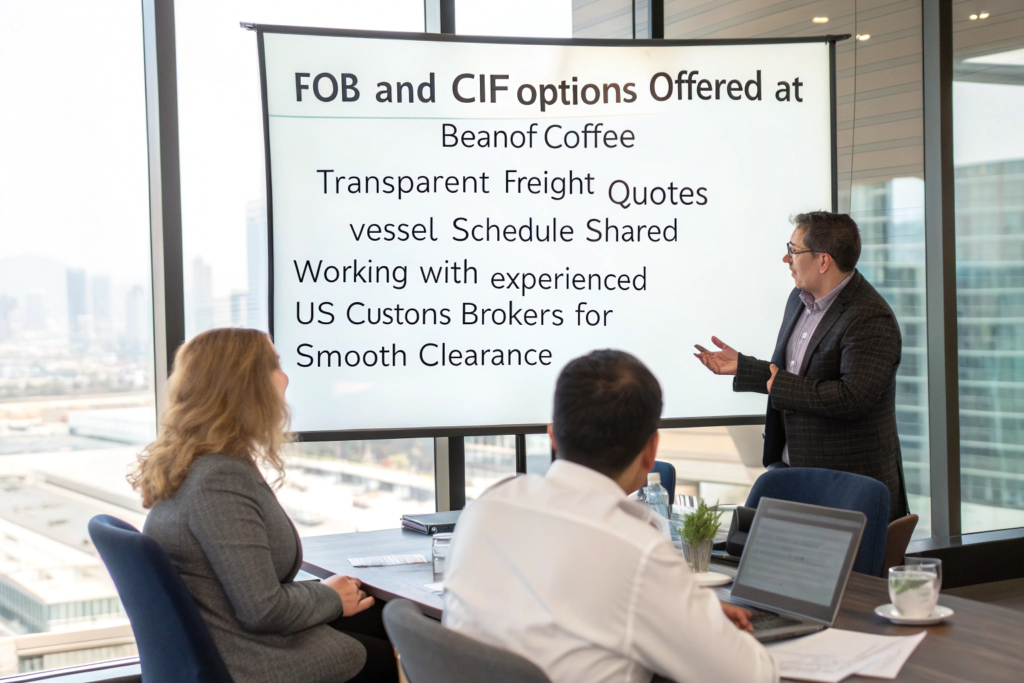
The most common logistics questions are about Incoterms, freight costs, transit times, and customs clearance. At BeanofCoffee, I offer both FOB and CIF options. I provide transparent freight quotes. I share the vessel schedule and the tracking information. I work with experienced US customs brokers to ensure a smooth clearance.
The logistics can seem complicated, but they are manageable with a good partner. I have shipped hundreds of containers to the US. The process is routine for me. It should be routine for you too.
What Is the Difference Between FOB and CIF and Which Should I Choose?
This is the most common Incoterm question. FOB, Free On Board, means I deliver the coffee to the vessel at the port of Shanghai. You, the buyer, take ownership and responsibility for the ocean freight, insurance, and destination charges. CIF, Cost, Insurance, Freight, means I arrange and pay for the ocean freight and insurance to your destination port. I handle the logistics. You just wait for the container to arrive. For a new buyer, or a buyer who does not have a strong logistics team, CIF is often the better choice. It is simpler. You get a single, all-in price. For a larger buyer with their own freight forwarder and negotiated rates, FOB might be more cost-effective. It gives you more control. There is no right answer. It depends on your specific situation. I am happy to quote both and let you compare.
How Long Does Customs Clearance Take at a US Port?
This is a question of timing. The answer depends on several factors. If your documentation is complete and accurate, and if the container is not selected for a physical inspection, the clearance can take 1 to 3 days. The FDA Prior Notice must be filed correctly. The customs entry must be filed by your broker. If the coffee is flagged for an FDA examination, the process can take a week or more. The key to a fast clearance is preparation. I provide my clients with a complete documentation package, so their broker has everything they need. I also work with brokers who specialize in coffee. They know the product codes, the regulations, and the potential issues. A good broker is worth their fee.
What Are the FAQs Around Compliance and Food Safety?
The US market is heavily regulated. You, as the importer, are legally responsible for the safety of the food you bring in. This is a serious responsibility. The questions around compliance reflect this.
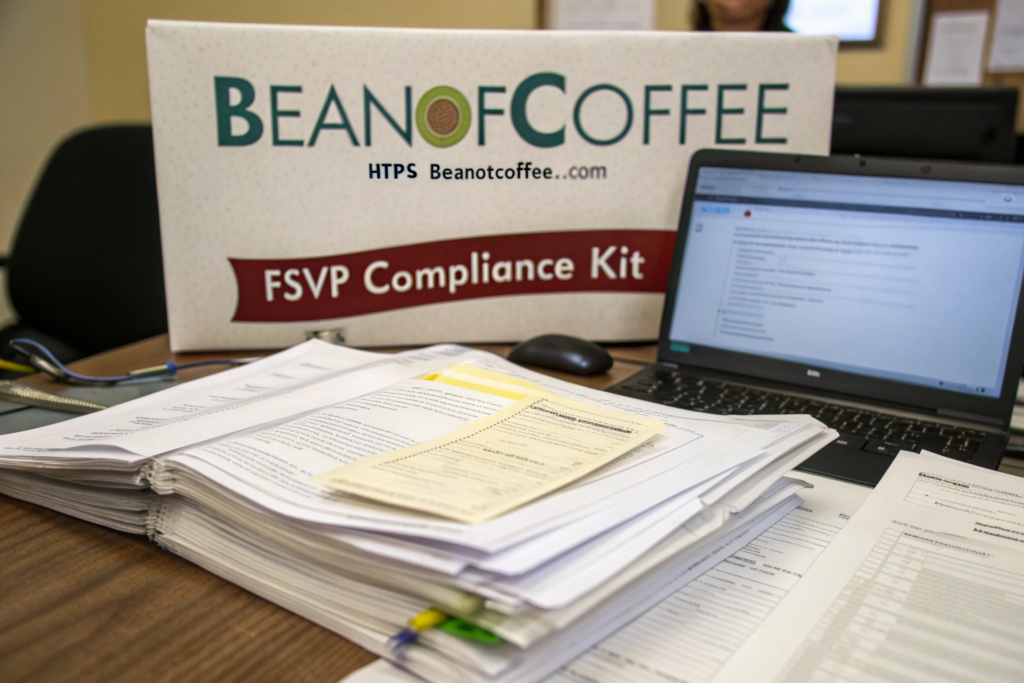
The most common compliance questions are about FSVP, FDA registration, and pesticide and mycotoxin testing. At BeanofCoffee, I provide a full FSVP compliance kit. My farm is FDA registered. Every export lot is tested by a third-party lab for pesticides and mycotoxins. The documentation is included with the shipment.
The regulations are complex, but they are manageable. The key is to have a supplier who understands the US system and who provides the necessary documentation. I make compliance easy for my clients. It is part of my service.
What Is the FSVP Rule and What Do I Need to Do?
The FSVP rule, the Foreign Supplier Verification Program, is part of the Food Safety Modernization Act. It requires you, the US importer, to verify that your foreign supplier is producing food that is safe. You must have a written FSVP plan. You must conduct a hazard analysis. You must evaluate your supplier's food safety practices. You must document your verification activities. This sounds like a lot of work, but it is manageable. My FSVP kit provides most of the documentation you need. It includes my food safety plan, my third-party audit certificate, and my lab results. You plug this into your own FSVP template. The FDA can ask to see your FSVP records at any time. Having a complete file is your best defense.
Are There Pesticide or Mycotoxin Limits I Need to Worry About?
Yes. The FDA enforces pesticide tolerances. If a coffee contains a pesticide residue above the allowed limit, it is in violation. It can be detained, or worse. My agronomy team controls the use of crop protection products. We use only what is approved for export. We test every lot. For mycotoxins, specifically Ochratoxin A, the FDA does not have a formal limit, but it does have guidance levels. The EU has a strict limit of 5 parts per billion. I test to the EU standard, which is stricter. This gives you a margin of safety. The lab reports are included in your documentation package.
What Do Buyers Ask About Payment Terms and Security?
The final cluster of questions is about money. You want to know how to pay. You want to know how to protect yourself. You want to know the terms.
The most common payment questions are about deposit percentages, payment methods, and credit terms. At BeanofCoffee, I offer standard payment terms for the industry. For new clients, a 30% deposit with the balance against a copy of the bill of lading is typical. I accept T/T bank transfers. For established clients, I can offer more flexible terms.
The payment is the moment of maximum risk. It is the moment when trust is tested. A clear, professional payment structure reduces this risk. It protects both parties.

What Is the Standard Deposit Structure for a First Order?
The standard is 30% deposit, 70% balance against copy of bill of lading. This is the industry norm for a reason. It is fair. The 30% deposit gives the supplier the working capital to prepare the shipment. The 70% balance, paid only after the supplier presents proof of shipment, protects the buyer. You are not paying the full amount until you know the coffee is on the water. Some suppliers might ask for 50%. You should negotiate. A 30% deposit is a reasonable starting point. At BeanofCoffee, I am comfortable with 30% for a first order. It signals that I am confident in my ability to deliver.
When Can I Expect More Flexible Payment Terms?
Flexible payment terms, like deferred payment or open account, are not given to strangers. They are earned over time. They are a reward for a history of reliable payment and consistent business. After several successful transactions, when we have built a relationship of trust, I am happy to discuss more flexible terms. This is the natural evolution of a strong partnership. It is a sign that we have moved from a transaction to a relationship. The goal is not to be suspicious forever. The goal is to build the trust that makes business smoother and more efficient for both of us.
Conclusion
These are the questions I hear most often from US buyers. They are the questions of a professional. They are the questions you should be asking. The answers are not secrets. They are the details of a well-run, transparent coffee export business. I am happy to answer them, and any other questions you have. The more you know, the better your decisions. The better your decisions, the stronger your business. A good supplier is not annoyed by questions. A good supplier welcomes them. They are the foundation of a successful partnership.
Ask me anything. Contact me, Cathy Cai, at cathy@beanofcoffee.com. I will answer your questions by email, on a video call, or in person on my farm. I will send you the documentation, the samples, and the references. I will give you the information you need to make a confident, informed decision. Your questions are the beginning of our conversation. Let's start talking.