
You're focused on the practicalities: sourcing, roasting, brewing, and selling. You're an expert in flavor profiles and extraction ratios. But sometimes, in the daily grind, it's easy to forget that you're not just selling a beverage. You're participating in a ritual with deep, global cultural significance. You might see coffee as a morning fuel or a tasty treat, but for billions of people, it's a centerpiece of social life, a catalyst for intellectual revolution, and a symbol of modern life itself. The pain point is that by overlooking this cultural depth, you might be missing the opportunity to connect with your customers on a much more profound level, to sell not just a product, but a story and a sense of belonging.
Honestly, the global cultural significance of coffee lies in its incredible adaptability; it acts as a universal catalyst for human connection, but it manifests in vastly different ways across cultures. In some places, it is a slow, sacred ritual for building community (like the Ethiopian ceremony). In others, it's the fuel for intellectual and artistic life (like the European coffee house). And in the modern world, it has become both a symbol of individual productivity and a passport to a globalized, cosmopolitan identity.
From my perspective here in China, I am witnessing this phenomenon in real-time. I see a traditionally tea-drinking culture rapidly adopting coffee, not just for its taste, but for what it represents: a connection to the wider world, a modern lifestyle, a new space for social interaction. We're not just growing beans on our Yunnan farms; we're growing a new cultural staple. Let's take a journey around the world to see the many faces of coffee.
Where Did It All Begin? The Mystical Roots in Ethiopia.
To understand coffee's cultural power, you have to go back to its mythical birthplace: the highlands of Ethiopia. Here, coffee is not a quick grab-and-go affair; it's a deeply spiritual and social ceremony that can last for hours.
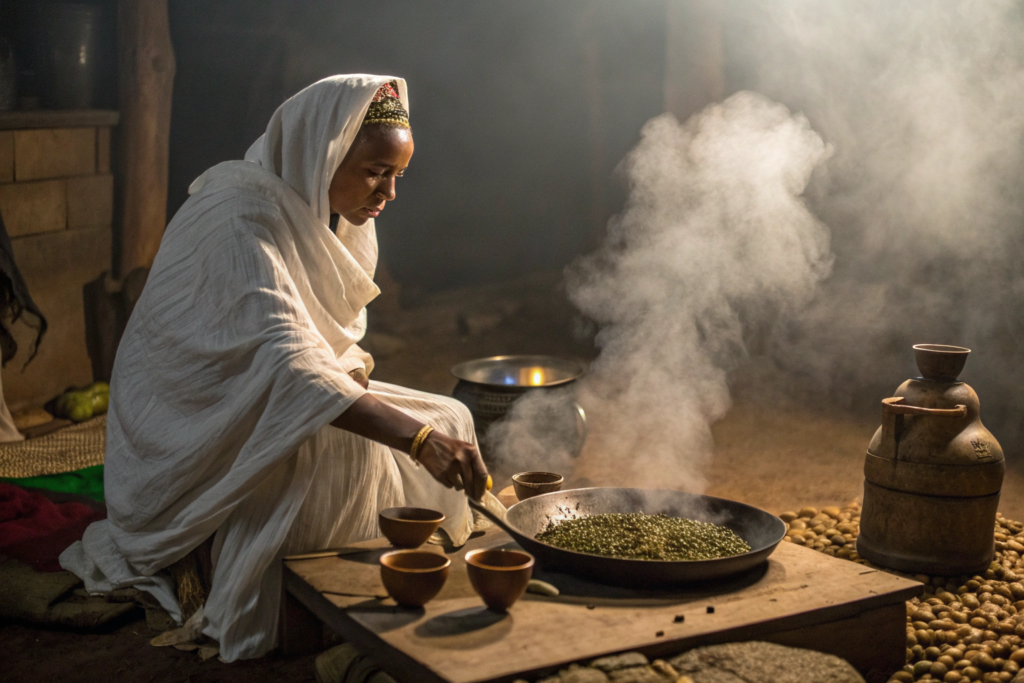
Isn't that just an old folk tale? While the story of Kaldi the goatherd and his dancing goats is a legend, the cultural reality of the Ethiopian coffee ceremony, or 'buna', is very real and practiced daily. It is the absolute heart of Ethiopian social and community life. To be invited to a coffee ceremony is a sign of deep respect and friendship. It's a process of transformation, from green bean to final cup, that is shared among friends, family, and neighbors. The ceremony is a deliberate, slow, and sensory experience. It's the antithesis of the modern, fast-paced coffee culture.
What happens in a coffee ceremony?
The ceremony is almost always performed by a woman and involves three distinct rounds of brewing.
- Roasting: She begins by washing and then roasting the green coffee beans in a pan over hot coals, wafting the aromatic smoke towards the guests as a blessing.
- Grinding & Brewing: The roasted beans are ground by hand with a mortar and pestle, then brewed in a traditional clay pot called a jebena.
- Serving: The coffee is poured in a single stream into small, handleless cups. The three rounds of serving are called awel, kale'i, and baraka, with each round getting progressively weaker but carrying its own spiritual significance.
What is its cultural function?
The ceremony is a vibrant vehicle for communication, a living tapestry woven from the threads of human interaction. It's where the latest news, fresh as morning dew, is shared in hushed tones and boisterous exclamations alike, rippling through the crowd like a gentle current. Gossip, that delicious blend of curiosity and camaraderie, flows freely here—whispered secrets and exaggerated tales that bind listeners closer, their eyes sparkling with shared intrigue. Politics, too, finds its stage in these gatherings, where heated debates unfold not with raised voices but with measured words and passionate gestures, each participant vying to shape the community's collective thought. Most profoundly, it is here that community bonds are forged and strengthened, like iron in the fire, as laughter mingles with tears, and hands clasp in solidarity. The air hums with a palpable sense of belonging, a daily affirmation of social connection that wraps around every soul present, warm and unyielding.
How Did Coffee Fuel the Mind of Europe? The Coffee House.
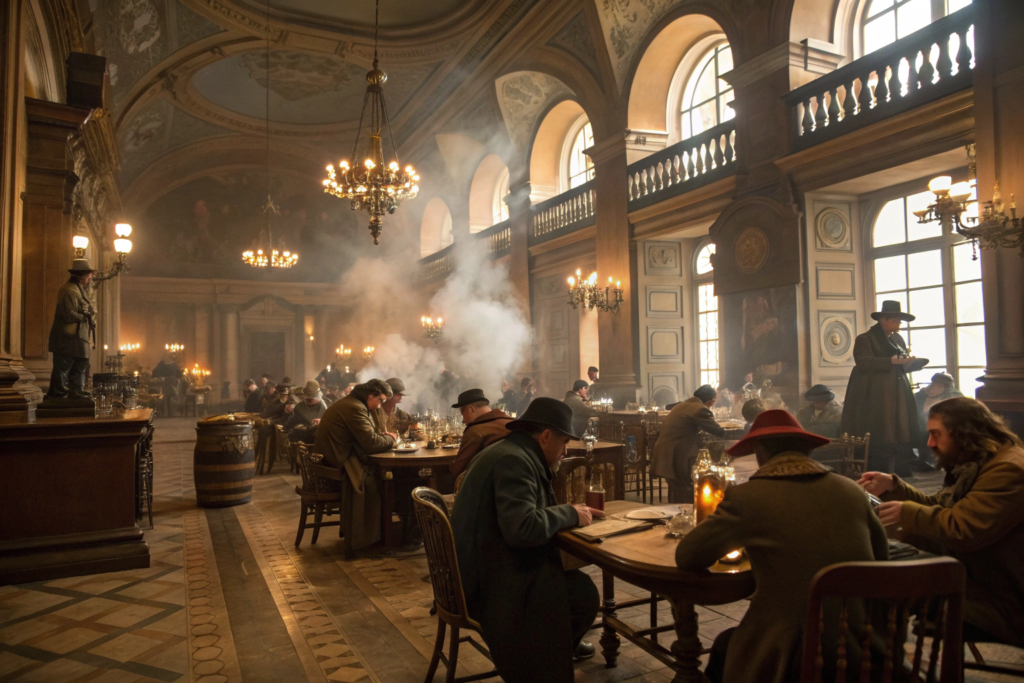
When coffee arrived in Europe in the 16th and 17th centuries, it didn't just offer a new taste; it offered a new state of mind. In a society largely fueled by alcohol (beer and wine were often safer to drink than water), coffee provided a beverage that stimulated the mind instead of dulling it.
So, people just sat around drinking coffee? They did, but it was what they did while drinking coffee that changed the world. The European coffee house became the engine of the Enlightenment. It was a new kind of public space, more egalitarian than the court or the tavern, where men from different social classes could gather to exchange ideas. For the price of a cup of coffee (a penny, hence the name "penny universities"), you could access the latest news, engage in political debate, and listen to the sharpest minds of the age.
These were not quiet, relaxing spaces. They were noisy, smoky, and electric with intellectual energy.
What was "born" in coffee houses?
- Modern Finance: Institutions like Lloyd's of London, the world's leading insurance market, began in a coffee house where merchants and ship-owners gathered to do business.
- Scientific Ideas: The Royal Society in London, one of the world's oldest scientific academies, held many of its early meetings and discussions in coffee houses.
- Political Revolutions: The cafes of Paris were hotbeds of revolutionary thought in the lead-up to the French Revolution. In America, the Boston Tea Party was planned in a coffee house, the Green Dragon Tavern.
How did this culture evolve?
The grand coffee houses of Vienna, with their plush velvet seating that sank softly under the weight of weary writers, polished marble tables etched with the faint marks of countless cups of rich, aromatic coffee, and tuxedoed waiters gliding silently between tables with trays balanced precariously yet effortlessly, became pulsating centers of artistic and literary life in the 19th and 20th centuries. The air hummed with the low murmur of passionate debate, the clink of porcelain cups, and the distant strains of a piano playing waltzes that seemed to weave through the very fabric of the establishment.
These were not mere places to sip coffee; they were the 'extended living rooms' for the city's most brilliant minds—writers scribbling furiously in notebooks, artists sketching the faces of fellow patrons, and thinkers lost in the labyrinth of ideas. Here, Sigmund Freud would linger for hours, his brow furrowed in concentration as he dissected the human psyche over a cup of strong black coffee, while Leon Trotsky, with his sharp gaze and intense demeanor, would engage in fiery discussions about revolution and ideology, his voice cutting through the ambient chatter like a blade.
What Does Coffee Mean in the Modern West?
In the 20th and 21st centuries, particularly in North America, coffee's cultural role split into two distinct, almost contradictory, paths.
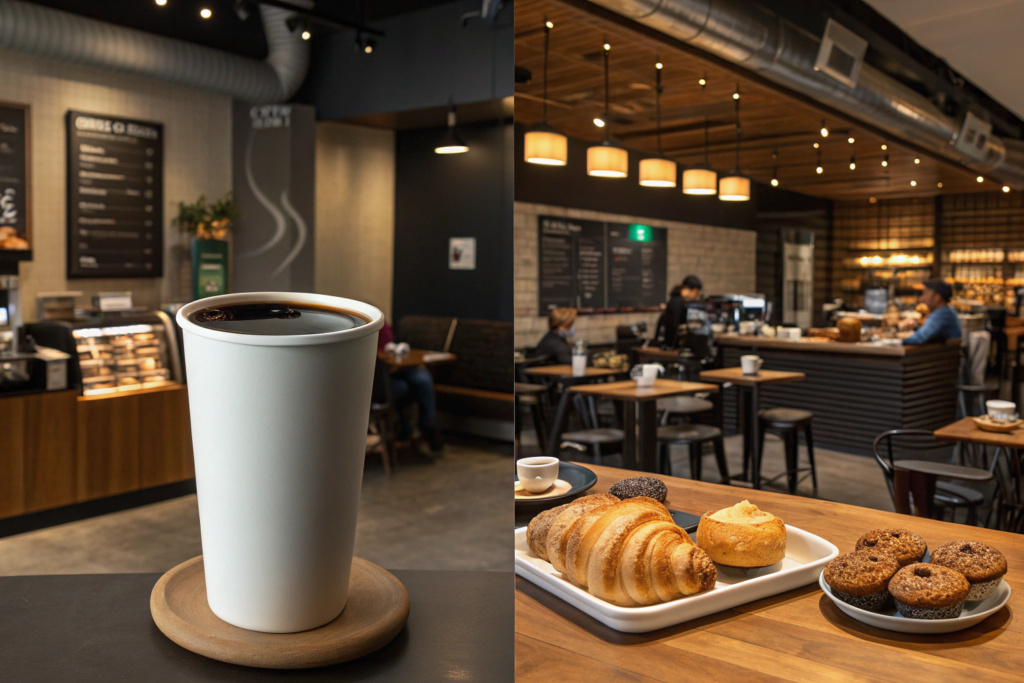
Is it just about getting work done? For many, yes. The rise of the commuter culture and the corporate world transformed coffee into a productivity tool. It became the essential "fuel" to start the day, the liquid motivation to get through a deadline. The large, utilitarian cup of drip coffee is a symbol of this pragmatic, functional relationship with the beverage. However, a parallel culture emerged, famously defined by Starbucks' founder Howard Schultz as "The Third Place."
What is "The Third Place"?
The concept, borrowed from sociologist Ray Oldenburg, refers to a place that is not home (the first place) or work (the second place), but a third place where people can connect, relax, and build community. The modern coffee shop, with its comfortable chairs, free Wi-Fi, and background music, was designed to be this third place. It's a semi-public, semi-private space for meetings, first dates, study sessions, and freelance work.
How has specialty coffee changed this?
The "Third Wave" of specialty coffee has added another layer to this culture. It has reintroduced a focus on craft, origin, and sensory experience, similar in spirit to the wine world. For many consumers, choosing a single-origin pour-over from a specific farm in Yunnan (like those from our company, Shanghai Fumao) is a statement of connoisseurship and a way to connect with a global story. It elevates coffee from a simple commodity back to an artisanal agricultural product.
What Is Coffee's Newest Frontier?
The most exciting chapter in coffee's cultural story is being written right now, right here in Asia. In countries like China, South Korea, and Vietnam, coffee is exploding in popularity, but it's being adopted for a unique set of cultural reasons.
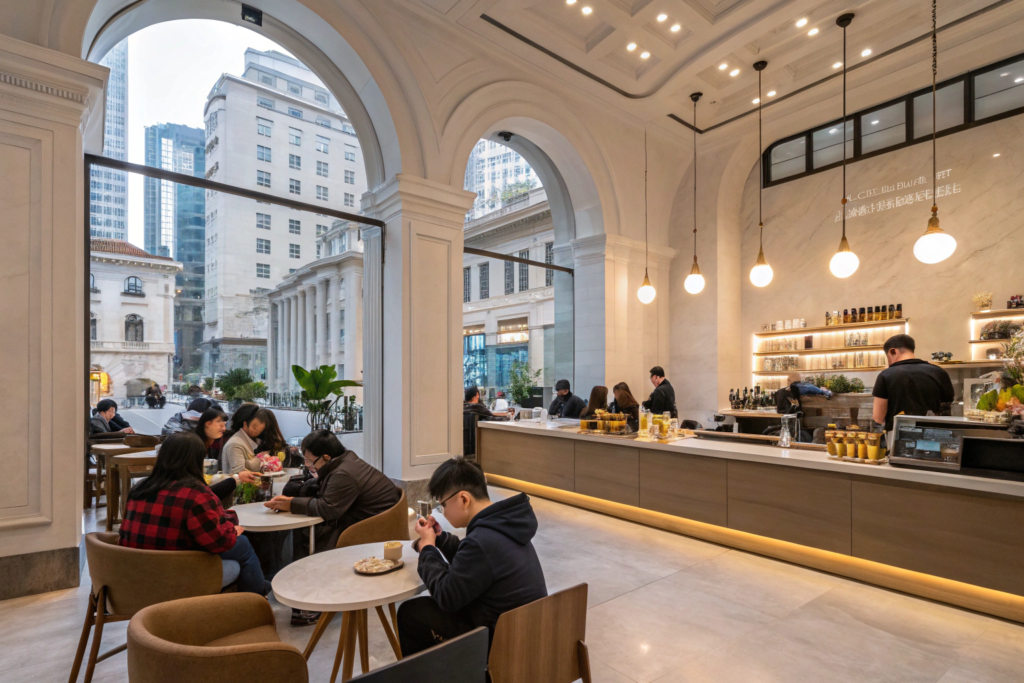
Are they just copying Western coffee culture? Not at all. They are adapting it and creating something entirely new. In many parts of Asia, coffee is less about the morning jolt and more about the afternoon social experience. It's a symbol of a modern, urban, and aspirational lifestyle. The cafe itself—its design, its aesthetic, its "Instagram-worthiness"—is often as important, if not more so, than the coffee itself. Here, coffee is a social currency and a key part of the modern consumer's identity.
What is unique about Asian coffee culture?
- The Cafe as a Destination: Cafes are often elaborately designed spaces, destinations in their own right. People will travel across a city to visit a cafe with a unique design or theme.
- Sweetness and Innovation: The palate often leans towards sweeter, more innovative drinks. Creations like Dalgona coffee from South Korea or the cheese-foam-topped coffees popular in China show a playful and creative approach.
- A Status Symbol: Drinking specialty coffee and being knowledgeable about it is a sign of sophistication and being globally connected. It's a way for young people to differentiate themselves from older, more traditional generations.
What is the role of local production?
The rise of local, high-quality production, like our efforts at shanghai Fumao in Yunnan, adds another powerful layer to this story. It allows for a "farm-to-cup" narrative that is both globally trendy and intensely local. Chinese consumers are beginning to take pride in the fact that world-class coffee is being grown in their own country, creating a new dimension of cultural significance.
Conclusion
From a sacred ceremony in Ethiopia to the engine of the Enlightenment in Europe, from a productivity tool in America to a symbol of modern life in Asia, coffee has proven to be a cultural chameleon. It is a constant, yet it is always changing. It is a deeply personal ritual, yet it is a globally connecting force. As a coffee professional, understanding this rich tapestry does more than just add trivia to your knowledge base. It allows you to appreciate the profound story contained within every bean you roast and every cup you serve. It connects you to a chain of human history, innovation, and connection that spans centuries and continents.
We are incredibly proud to be a part of this global story, contributing a new and exciting chapter from our farms in Yunnan, China. We invite you to explore this unique origin with us and share its story with your customers. Contact our coffee specialist at cathy@beanofcoffee.com to learn more.