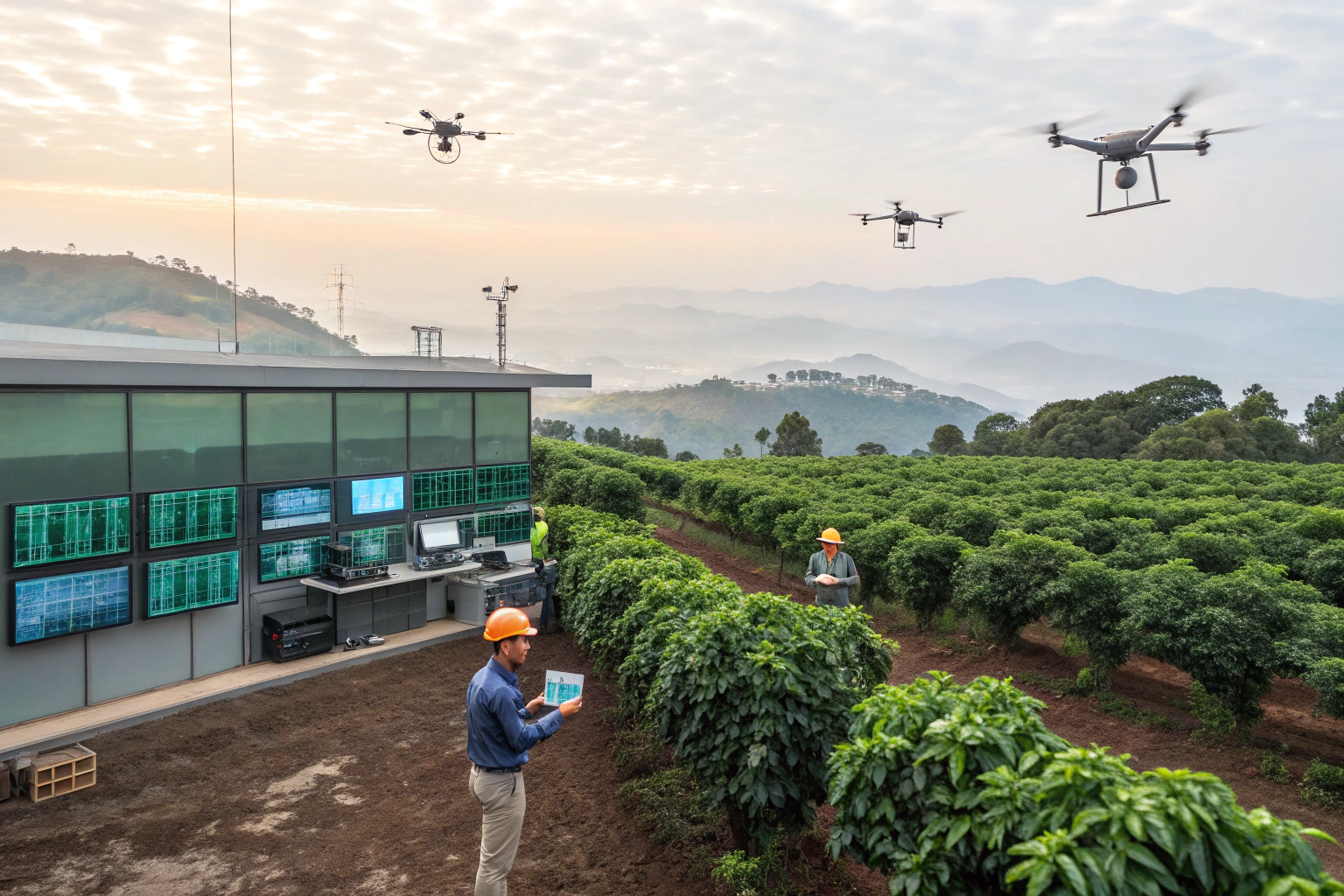
Let's be honest. When you think of coffee farming, you probably picture sun, soil, and hard work by hand. AI feels like something for tech companies, not plantations. But what if I told you the future of consistent, high-quality, and profitable coffee supply depends on it? For you, the buyer, the challenges are clear: unpredictable yields, fluctuating quality, climate change, and rising costs. These translate to your pain points: price instability and unreliable timeliness. The old ways are struggling to keep up. Something has to change.
The future of AI in coffee agriculture is about turning guesswork into precision. It's about using data—from satellites, drones, and ground sensors—to make every decision smarter, from planting to harvesting. For us at BeanofCoffee, with over 10,000 acres in Yunnan, AI isn't a distant concept; it's the toolkit we're adopting right now to secure your supply. It means predicting disease outbreaks before they happen, harvesting at the perfect moment, and ultimately delivering to you a product that is more stable, traceable, and efficient. The goal is simple: use technology to make nature more predictable for your business.
So, if you worry about how climate or farm inefficiencies will affect your future contracts, you're right to. The solution is coming from the fusion of agronomy and artificial intelligence. This isn't about replacing farmers; it's about empowering them with superhuman insight. Let's explore how this future is taking root.
How Can AI and Drones Optimize Plantation Health Monitoring?
Walking through thousands of acres to check each coffee tree is impossible. Problems are often spotted too late—when yellow leaves or fungal spots are already visible to the naked eye. By then, yield and quality have already suffered. This delay creates uncertainty in your supply volume. AI-powered drone monitoring changes this completely. It gives us a plant's-eye view, everywhere, almost in real time.
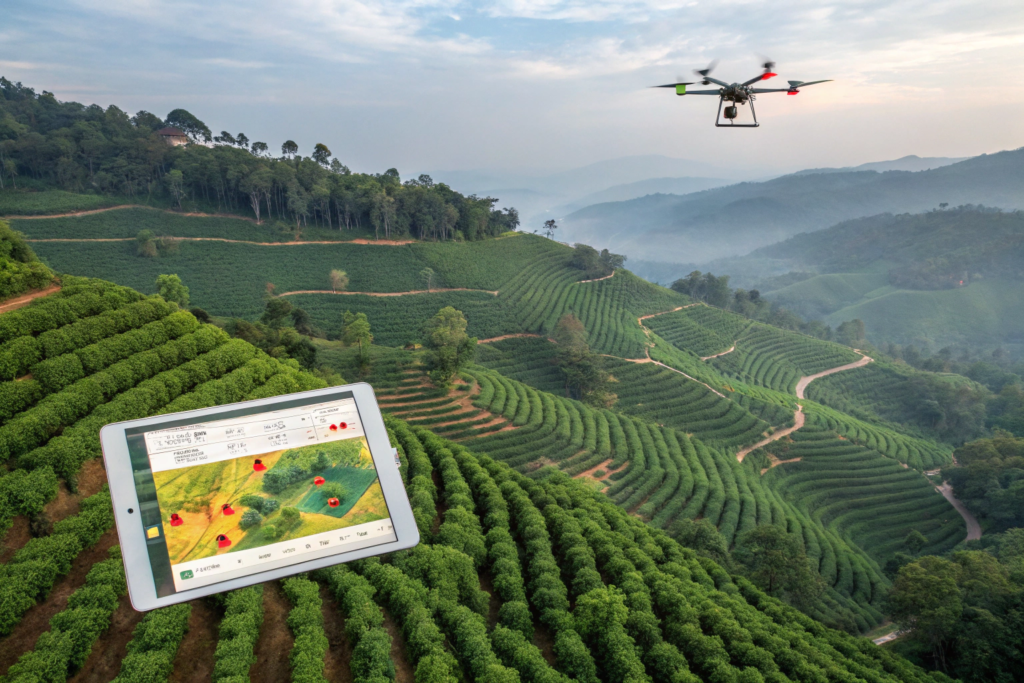
We deploy multispectral drones over our Yunnan plantations weekly. These drones don't just take pictures; they capture data across light spectrums the human eye can't see. This data feeds into AI models that we've trained to recognize early stress signals. For example, a tree starting to suffer from nutrient deficiency or early-stage Coffee Leaf Rust will reflect light differently long before it looks sick to a farmer. The AI flags these "problem zones" on a digital map. Our agronomists then go directly to those specific spots for targeted intervention. This is the shift from blanket treatment to precision care. For you, this means healthier trees, more consistent yields, and less risk of a disease wiping out a significant portion of your contracted lot.
What specific problems can AI detect that the human eye misses?
The human eye is good, but it's limited. AI can detect subtle changes in chlorophyll content (indicating nutrition or water stress), canopy density (predicting yield potential), and thermal signatures (signaling water stress or disease). For instance, a specific water mold might cause a tiny increase in leaf temperature before any visual symptom appears. Our AI algorithms are trained to spot this. Another key area is blossom counting. By analyzing drone images during flowering, AI can estimate potential yield months in advance with surprising accuracy. This gives us, and you, much better forecasting data for planning harvests and shipping schedules, directly addressing your need for timeliness and planning security.
How does this precision monitoring reduce the need for pesticides and fertilizers?
This is a huge benefit for quality and sustainability. Instead of spraying an entire field "just in case," we only treat the specific trees or areas flagged by the AI as at risk. This precision agriculture approach dramatically reduces chemical use. It's better for the environment, safer for our workers, and results in cleaner beans. For you as a buyer, especially if your market values organic or sustainably certified products, this AI-driven efficiency is a powerful backend story. It ensures compliance and reduces the risk of chemical residues, making your import process smoother and your brand story stronger.
How Will AI-Driven Harvesting Robots Impact Yield and Quality?
The coffee harvest is the most labor-intensive and critical moment. Pick too early or too late, and quality plummets. Labor shortages and rising costs make timing even harder. This directly affects the cup quality and quantity you receive. The future solution? AI-powered selective harvesting robots. While not yet ubiquitous, their development is rapid, and they promise to solve our—and your—biggest bottleneck.
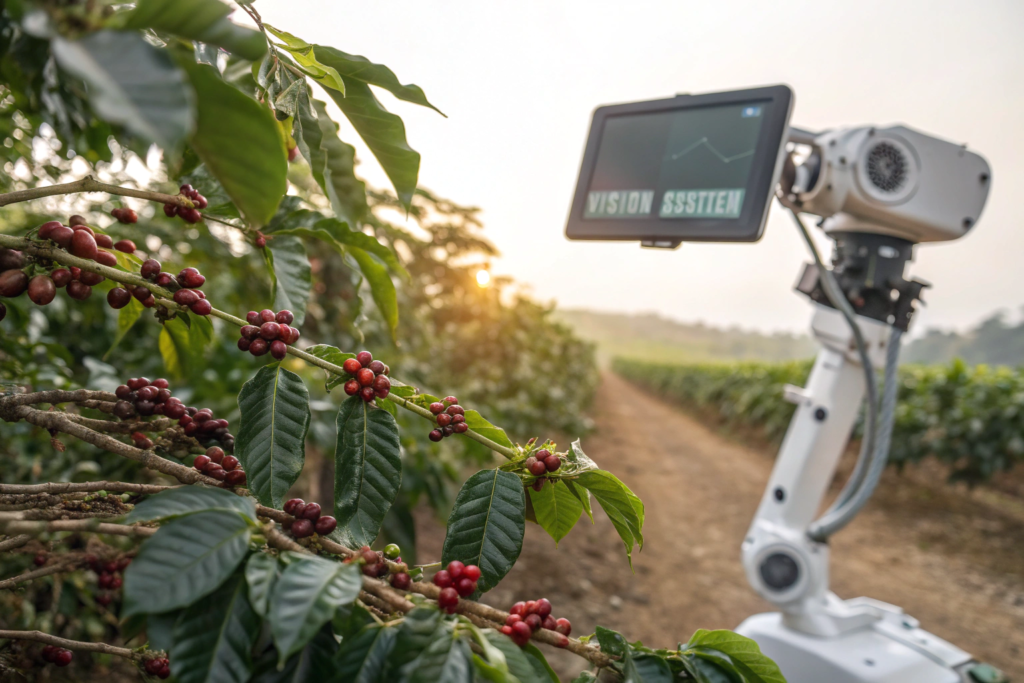
Imagine a robotic arm, guided by computer vision, moving through the coffee rows. Its AI system, trained on millions of images, can "see" each individual cherry and assess its ripeness based on color, size, and even slight texture differences. It then picks only the perfectly ripe red cherries, leaving the green ones to mature further. This selective harvesting, done 24/7 at a consistent pace, ensures optimal sugar content and flavor development in every bean picked. For a large-scale operation like ours, integrating such technology means we can guarantee a higher percentage of Grade A cherries in every shipment. It translates directly to more uniform roasting profiles and better cup scores for your brand.
Can robots really match the selective skill of human pickers?
The goal isn't to match, but to surpass human consistency over time. A human picker is incredibly skilled but can get tired, inconsistent, or influenced by speed incentives to strip branches. An AI-driven robot doesn't tire. It applies the same "perfect ripeness" standard to every single cherry, hour after hour. Current prototypes are achieving over 90% accuracy in identifying and picking ripe cherries. For commercial wholesale production where consistency across thousands of tons is key, this mechanical precision is invaluable. It removes a major variable from the quality equation, giving you a more predictable product.
What is the timeline for widespread use of coffee harvesting robots?
Full-scale deployment is likely 5-10 years away for most large plantations. The current phase is focused on R&D and pilot programs in countries like the US, Japan, and Australia. For us in China, we are actively monitoring and partnering with agri-tech firms to run trials. The initial use will be hybrid: robots handling the bulk of the harvest on flatter, more accessible terrain, while human teams focus on difficult slopes and fine-tuning. This timeline matters for you because it shows where the industry is investing. Partnering with a forward-thinking supplier like Shanghai Fumao means you are aligning with a source that is preparing for this efficiency leap, future-proofing your supply chain against labor crises and quality drift.
How Does AI Predictive Analytics Manage Climate and Disease Risk?
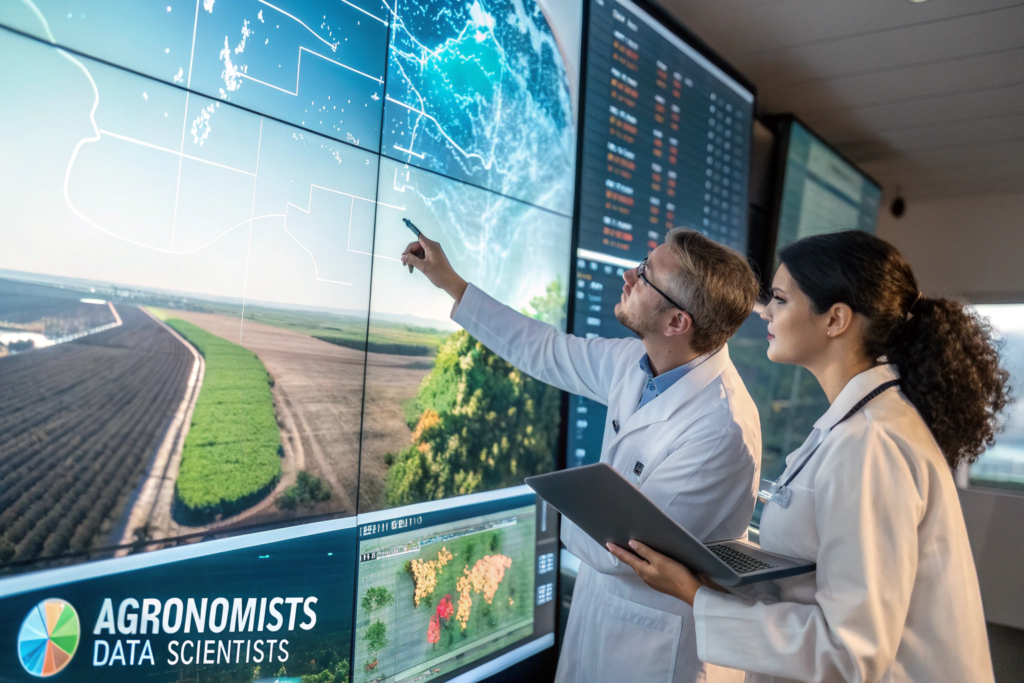
Climate change is the single biggest threat to global coffee supply. Erratic rains, unexpected frosts, and shifting pest patterns make farming a gamble. This gamble becomes your price and supply risk. AI's ability to analyze vast datasets—historical weather, satellite imagery, soil sensors, and global climate models—turns risk management into a science. It moves us from reaction to anticipation.
We are integrating AI predictive platforms that analyze hyper-local weather forecasts alongside data from our soil moisture sensors. The system can predict a high-risk window for a fungal disease like Coffee Berry Borer or Leaf Rust with 85-90% accuracy, up to two weeks in advance. It then sends an alert to our farm managers, not just saying "risk is high," but recommending an action: "Apply organic fungicide in Block B-5 within the next 48 hours for optimal prevention." This allows for proactive, minimal intervention. On a macro scale, these models help us decide which varieties to plant in which areas years in advance, adapting our entire plantation map to a changing climate to ensure long-term supply stability for our partners.
How can AI forecasts improve irrigation and water management?
Water is a precious resource. AI models process data from soil probes, evapotranspiration rates, and weather forecasts to calculate the exact water need of each plot. They can then automatically trigger precise drip irrigation only where and when it's needed. This smart irrigation prevents both drought stress and waterlogging. For you, efficient water use means better bean density and more resilient trees, which again translates to stable yield and quality. In regions facing water scarcity, this technology is becoming essential for sustainable, long-term production—a critical factor for your own ESG (Environmental, Social, and Governance) reporting.
Can AI predict micro-lot quality before harvest?
This is the holy grail for specialty buyers, and we're getting close. By correlating pre-harvest data (soil composition, sunlight exposure, rainfall patterns) with post-harvest cupping scores over many seasons, AI can begin to predict the potential quality profile of a specific micro-lot. It won't say "this will score 88 points," but it might predict "this block shows data patterns highly correlated with lots that exhibit citrus and floral notes." This allows for ultra-targeted harvesting and separate processing, creating unique, traceable lots for premium buyers. It adds a layer of scientific insight to the art of terroir.
How Will Blockchain and AI Create Ultimate Traceability and Trust?
You want proof—proof of origin, proof of ethical practices, proof of quality steps. Paper trails can be lost or forged. The future of trust is a transparent, unchangeable digital ledger powered by blockchain, fed by AI-automated data collection. This isn't just a marketing gimmick; it's a radical upgrade in supply chain security for you.
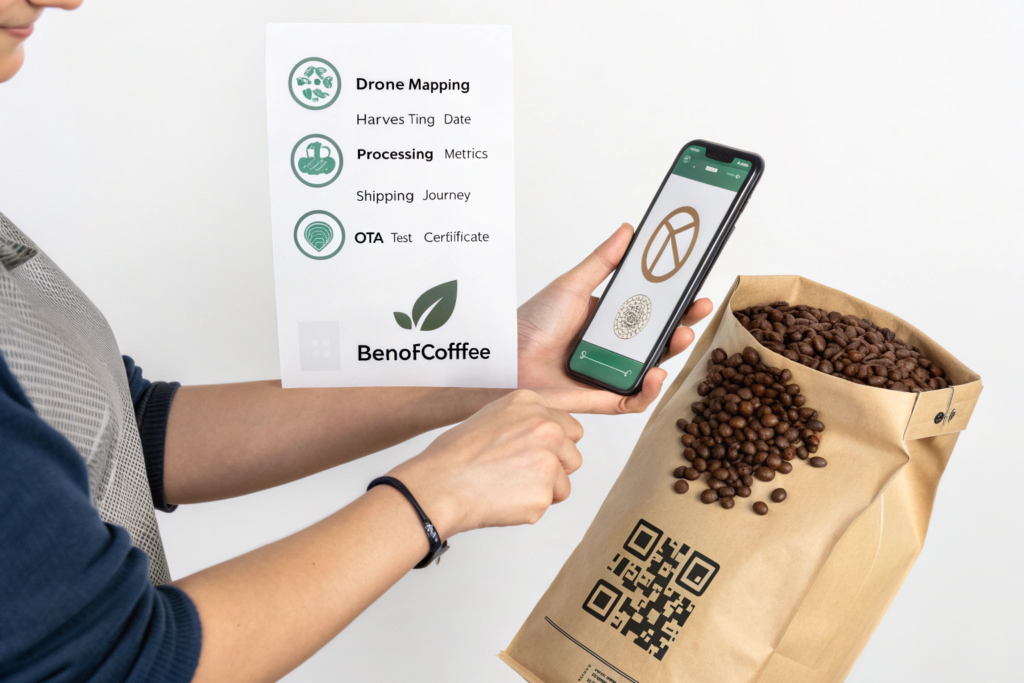
Here's how it works in our pilot projects: A drone (AI) confirms a harvest event in Block C-7 and records the GPS data and image. This is auto-logged as a "block" in the blockchain. The cherries go to a washing station where a sensor (AI) records the water pH and fermentation temperature, logging another block. At drying, moisture sensors feed data. At milling, optical sorters (AI) record bean size and defect count. Every step creates a verifiable, tamper-proof digital record. When you buy a bag, you scan a QR code and see this entire journey—not just a claim, but data-backed evidence. This addresses your sourcing key points of quality control and certification with unprecedented power. It turns our "reliable and trustworthy" claim into an interactive, verifiable fact.
How does this benefit large buyers and brand owners directly?
For you, it simplifies compliance and brand storytelling. Need to verify organic certification for an audit? Pull up the blockchain record showing no unauthorized chemical applications were logged. Want to market a "direct-trade, single-origin" story? Show the consumer the exact farm plot and harvest date. Need to investigate a quality inconsistency? Trace the problem back to a specific processing batch in minutes, not weeks. This level of supply chain transparency reduces your business risk, enhances your brand value, and builds deeper consumer loyalty. It makes your sourcing not just a cost center, but a competitive asset.
What is the role of smart contracts in this AI-driven system?
This is where it gets powerful for trade efficiency. A smart contract is a self-executing contract with terms written into code on the blockchain. Imagine a contract that says: "Payment of 70% will be released automatically upon verification of two events: 1) IoT sensor data confirms container sealed at port with temperature <25°C, and 2) Blockchain record shows SGS OTA test result of <1 ppb uploaded and verified." When those AI-verified conditions are met, the payment executes instantly, no paperwork, no delays. This addresses pain points around payment security and administrative inefficiency, making international trade faster and more secure for everyone.
Conclusion
The future of AI in coffee agriculture is not a replacement of the farmer's intuition, but its powerful amplification. It is a transition from artisanal guesswork to data-driven precision. This evolution promises a supply chain that is more resilient to climate shock, more efficient in resource use, more consistent in quality, and radically transparent. For you, the buyer, this means mitigating your core risks: price volatility from crop failure, quality inconsistency, and the administrative burdens of verification.
The question is no longer if AI will transform coffee farming, but how fast. The suppliers who invest in this future today are building the resilient, responsive supply chains that your business will depend on tomorrow.
Are you ready to source from a partner that is building the future of coffee? BeanofCoffee is integrating AI and data analytics to deliver unprecedented supply stability and transparency. To discuss how our tech-forward approach can benefit your business, contact Cathy Cai at cathy@beanofcoffee.com. Let's brew a smarter future together.