You sourced an 85-point Yunnan. The green sample was pristine. No defects. Uniform color. You've dialed in your roast profile a dozen times. You drop the batch. And as the cooling tray spins, your heart sinks. You see it. A confetti mix of light brown, dark brown, and a few that look almost scorched. Some beans are wrinkled. Some are smooth. It's uneven. You cup it. It's a mess. Muted acidity, papery dryness, and a hint of ashy bitterness all in the same cup. You paid for quality. You did the work. So why is the roast fighting you? You're asking: What invisible variable in this supposedly "high quality" bean is sabotaging my consistency?
An uneven roast, even with high-quality beans, is almost always caused by one of three physical inconsistencies in the green coffee that are invisible without specific measurement: inconsistent bean density, uneven moisture content, or a wide variation in bean size (screen size) within the same lot. "High quality" typically refers to a lack of defects and a high cupping score. It does not automatically guarantee the physical uniformity required for even heat transfer in a roaster. If a batch contains a mix of dense, high-altitude beans and softer, lower-altitude beans—even from the same farm—they will roast at different rates, resulting in an uneven batch.
I see this in my own cupping lab at Shanghai Fumao. Even coffee from our own estate can show variation if we're not meticulous about lot homogenization. Let me walk you through the three hidden culprits in your green coffee that are likely causing your roast inconsistencies, and how to identify them before you waste another batch.
How Does Inconsistent Bean Density Cause Uneven Roasting?
This is the most common, and most overlooked, cause of uneven roasting in "high quality" coffee. A coffee's cupping score is a sensory evaluation. Density is a physical measurement. They are related, but not identical.
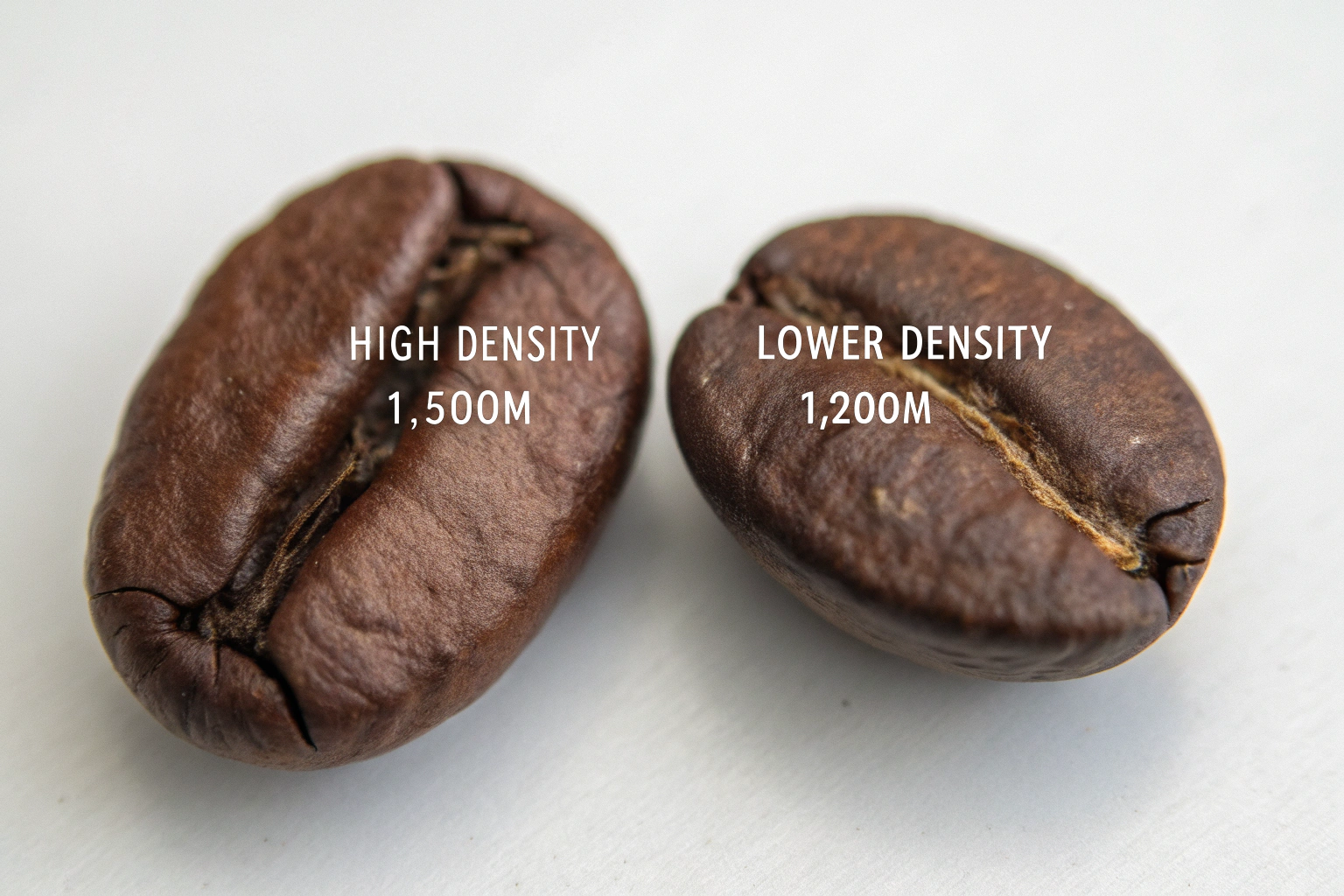
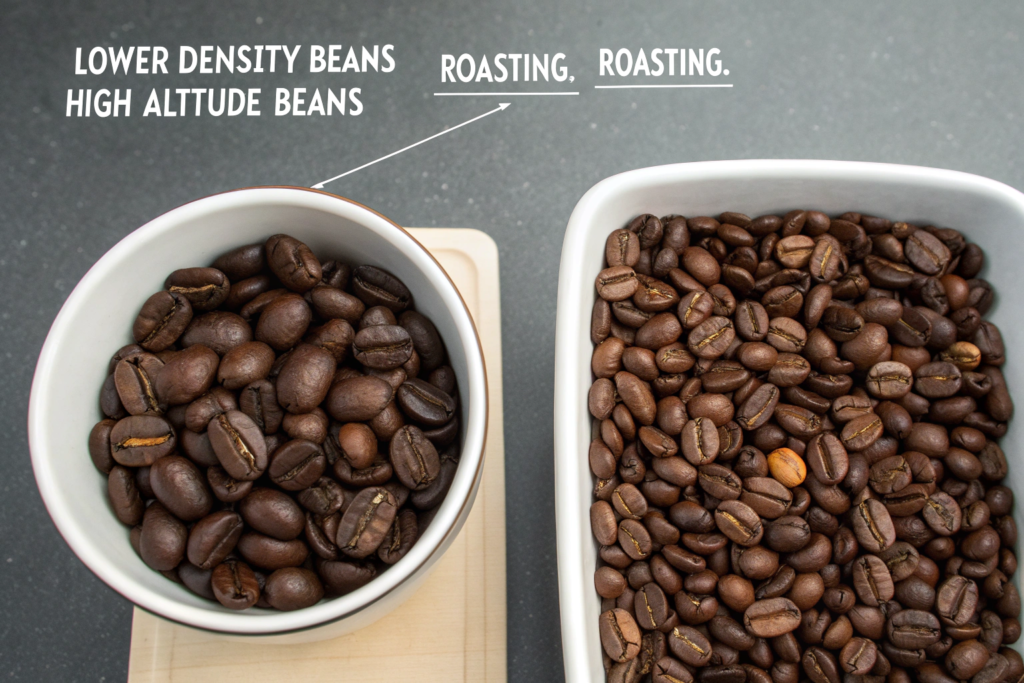
Bean density dictates how quickly a bean absorbs and transfers heat. A dense, high-altitude bean has tightly packed cells and requires more thermal energy and time to roast through. A less dense, lower-altitude bean (or a floater bean) has a more porous, open structure. It heats faster and roasts more quickly. If a batch of green coffee contains a mix of densities—which can happen even within a single estate if cherries from different elevations or tree health levels are commingled—the dense beans will be underdeveloped while the less dense beans are already approaching second crack. The result is a visibly uneven roast.
Why Would Beans from the Same Farm Have Different Densities?
A farm is not a flat, uniform laboratory. It has hills and valleys. Micro-climates. Variation is natural.
At Shanghai Fumao, our 10,000 acres span from roughly 1,200 meters to over 1,600 meters in elevation. A Catimor tree at 1,600 meters, subjected to cooler nights and greater temperature swings, will produce a significantly denser bean than a Catimor tree at 1,200 meters. Both beans might be perfectly ripe, defect-free, and cup at 84 points. But their physical density is different. If we were to simply mix the harvest from the top of the mountain with the harvest from the valley floor and call it a single "lot," we would be creating a density time bomb for the roaster. This is why lot segregation by elevation block is a critical, modern farming and processing practice. It's why we track our lots by GPS plot.
How Can I Test for Density Inconsistencies in My Green Coffee?
You can't measure the density of every bean. But you can do a simple, revealing test on a sample.
The "Water Test" for Density Variation:
- Take a 100-gram representative sample of your green coffee.
- Fill a large beaker or clear container with room-temperature water.
- Dump the beans into the water and stir gently for 10 seconds.
- Let the beans settle for 1 minute.
Observe the results:
- Sinkers: Beans that sink to the bottom are the densest. They are likely from higher altitudes or are the healthiest, most developed beans.
- Floaters: Beans that float on the surface are less dense. They may be underdeveloped, hollow, or from lower elevations. A few floaters (less than 3-5%) are normal. A large number of floaters indicates a significant density problem that will cause uneven roasting.
This simple test reveals the density stratification that is invisible to the naked eye. A truly uniform, high-quality lot will have very few floaters.
What Role Does Uneven Moisture Content Play in Roast Defects?
You measured the moisture content. It was 11.2%. Perfect. But that's an average reading. It doesn't tell you about the distribution of that moisture within the bean or across the batch.
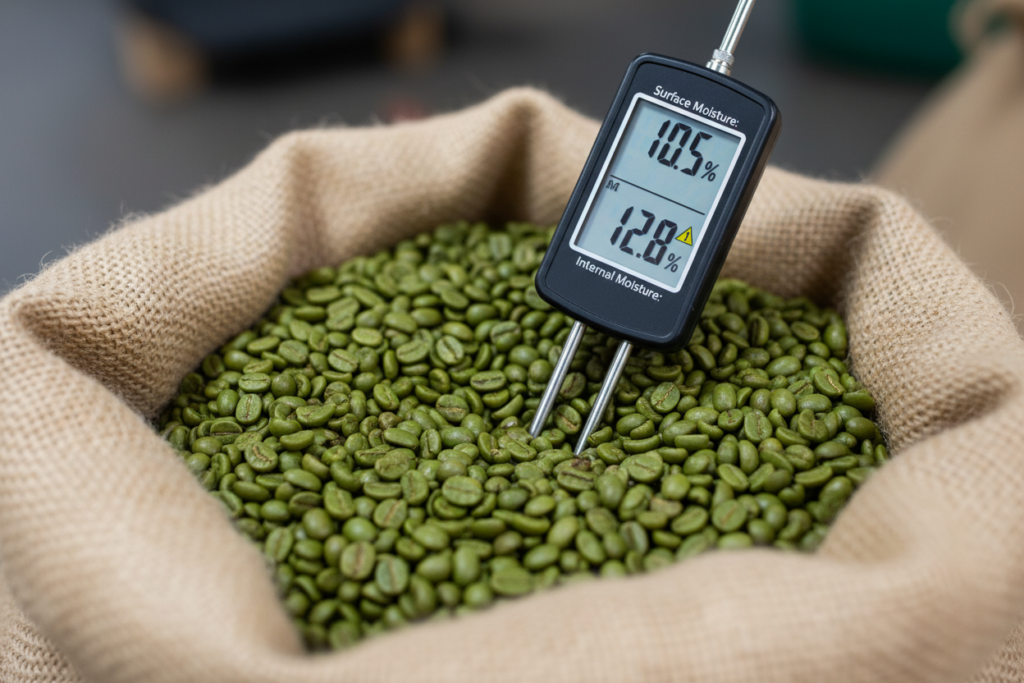
Uneven moisture content is a primary driver of roast defects like "tipping" and "facing." If a bean has a dry exterior but a wet interior, the surface will scorch and darken rapidly in the roaster while the inside is still cool and wet. This creates a bean that is dark on the outside and underdeveloped on the inside—the classic "baked" or "tipped" defect. This condition often results from coffee that was dried too quickly at high temperatures, sealing moisture inside, or coffee that was bagged before the internal moisture had fully equilibrated with the surface moisture.
What Is "Water Activity" and Why Is It a Better Predictor of Roast Consistency?
Moisture content tells you how much water. Water Activity (Aw) tells you how much of that water is free and mobile. A coffee with an acceptable moisture content of 11.5% can still have a dangerously high Water Activity of 0.65 if it was dried improperly.
This high Aw means the water is not chemically bound to the bean's structure. It's free to migrate and evaporate unevenly. In the roaster, this "free" water flashes to steam rapidly and erratically. The bean surface cools due to evaporative cooling, then overheats, leading to an uneven roast. A coffee with a low, stable Aw (below 0.55) will roast much more predictably. The water is bound and releases slowly and evenly. For the most consistent roasting, you should request both the moisture content and the water activity reading from your supplier. At Shanghai Fumao, we test Aw on every export lot. It's a non-negotiable quality parameter.
How Does the Resting Period After Drying Affect Roast Uniformity?
This is a step that separates the best mills from the average ones. After coffee is dried to 10-12% moisture, it needs to rest. This is called the "reposo" period.
Freshly dried coffee has an uneven moisture profile. The surface of the bean is often drier than the core. During the resting period (ideally 30-60 days in parchment, stored in a cool, dry warehouse), the moisture slowly migrates from the center of the bean to the surface, equalizing throughout. This process is called moisture equilibration. Coffee that is milled and exported immediately after drying, without this rest, is a nightmare to roast. It will be wildly inconsistent. A quality-focused supplier will allow the coffee to rest and stabilize before milling. This is an invisible but essential quality step. When you find a coffee that roasts beautifully and evenly, lot after lot, a proper resting period is a big part of the reason why.
Why Does Screen Size Variation Matter More Than You Think?
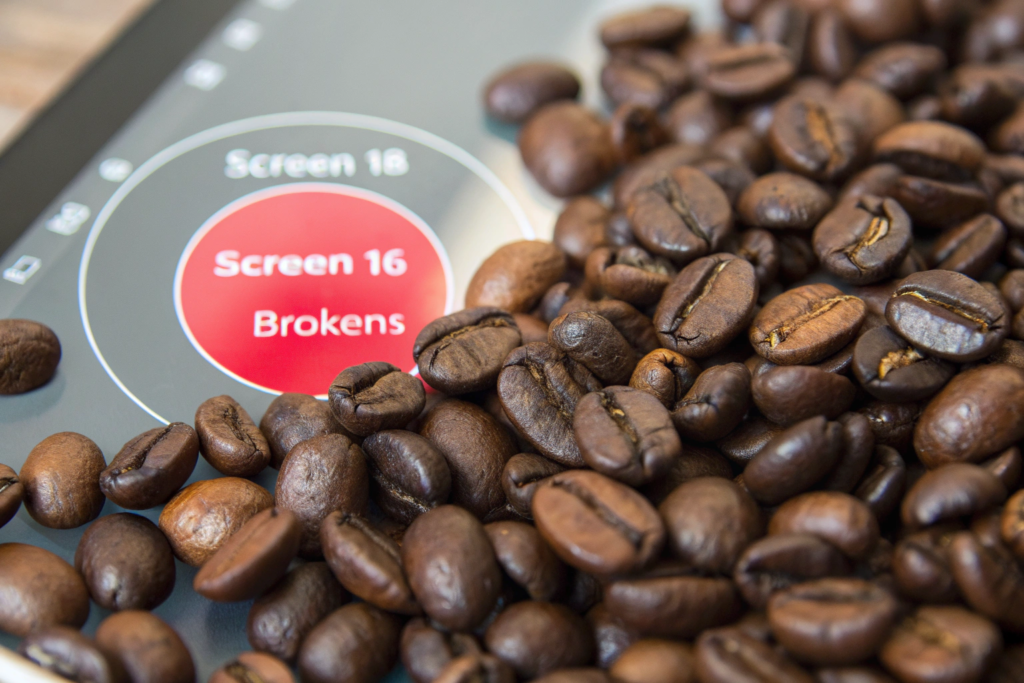
You see "Screen 18" on the spec sheet. You assume all the beans are roughly the same size. But "Screen 18" means the beans were retained on a screen with 18/64" holes. It doesn't mean they are uniformly that size. And it doesn't account for the broken beans that slipped through.
Screen size variation is a major cause of uneven roasting because surface area-to-mass ratio dictates heat absorption. Smaller beans and broken fragments have a much higher surface area relative to their mass. They heat up and roast much faster than larger, whole beans. If a batch contains a wide range of bean sizes—even if all are technically "Specialty Grade"—the smaller beans will scorch and over-develop while the larger beans are still reaching first crack. The result is a mix of burnt and underdeveloped flavors in the same batch.
What Is the "Peaberry Problem" in Roasting?
Peaberries are a natural mutation where the coffee cherry produces a single, round bean instead of two flat-sided beans. They are not a flavor defect. In fact, some roasters prize them.
But they are a roasting consistency problem. Because of their round shape and slightly different density, peaberries roast differently than flat beans. They have less surface area relative to their mass and tend to roll differently in the drum. If a lot contains a variable and unknown percentage of peaberries mixed with flat beans, the roast will be inherently uneven. A quality-focused dry mill will use specialized screens to separate peaberries from flat beans, allowing them to be sold as distinct, uniform lots. If you're buying a lot that is not specifically labeled "Peaberry," it should have a very low and consistent percentage of peaberries (less than 2-3%).
How Many Broken Beans Are Too Many for a Consistent Roast?
The SCA Green Coffee Standard allows for a certain number of broken beans per 350g sample as a Secondary Defect. But even a "passing" grade can contain enough broken pieces to cause visible roast unevenness.
Broken beans are the ultimate surface area-to-mass outliers. A small chip of a bean will roast almost instantly. It will be black and oily while the whole beans are still yellow. In a commercial drum roaster, these tiny fragments also tend to fall to the bottom of the bean mass, getting scorched by direct contact with the hot drum. While some broken beans are inevitable, a high-quality lot should have a minimal percentage. Visually inspect your green sample. If you see a significant amount of "chips" and fragments, you can expect an uneven roast, regardless of the coffee's cupping score. At Shanghai Fumao, our optical sorters are calibrated to eject not just color defects, but also a high percentage of broken fragments.
How Can I Adjust My Roast Profile to Mitigate These Physical Inconsistencies?
You can't fix a fundamentally flawed green coffee with a roast profile. But you can use your roaster to manage the minor, inherent physical variations present in even the best natural product. A rigid, one-size-fits-all profile will amplify inconsistency. A flexible, bean-responsive profile will minimize it.
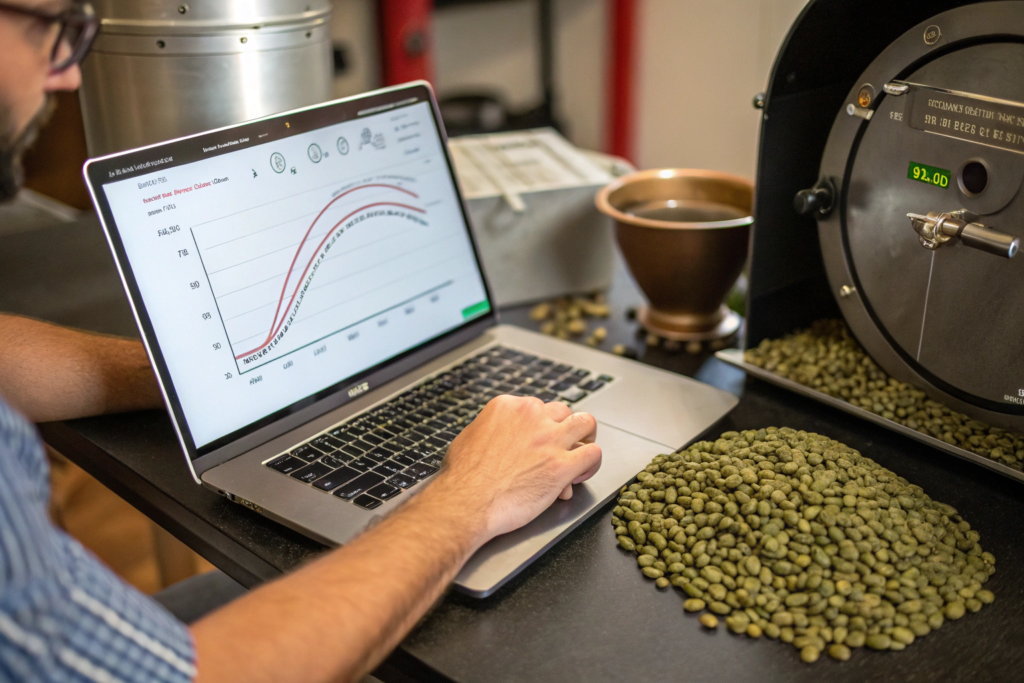
Mitigating physical inconsistencies in the roaster requires a shift in mindset from "roasting by time and temperature" to "roasting by bean response." Key adjustments include: (1) Using a slightly lower charge temperature to allow the entire bean mass to absorb heat more evenly, reducing the thermal shock on less dense or smaller beans. (2) Managing airflow carefully during the drying phase to ensure moisture is removed evenly from all beans. (3) Extending the Maillard phase slightly to allow the larger, denser beans time to "catch up" in their development. (4) Paying very close attention to the Rate of Rise (RoR) and making small, anticipatory adjustments rather than large, reactive ones.
Should I Lower My Charge Temperature for an "Unknown" Bean?
If you're roasting a new coffee and you suspect density or moisture variation, a more conservative, lower charge temperature is a wise starting point.
A very high charge temperature can "shock" the less dense beans, causing their surfaces to scorch and seal before the interior has a chance to heat up. This locks in vegetal, underdeveloped flavors. A lower charge temperature allows the entire bean mass—the dense beans, the less dense beans, the slightly smaller beans—to warm up more gently and uniformly. It gives the heat time to conduct to the center of the densest beans without burning the surface of the lightest ones. It's a more forgiving starting point. You can always add more heat later in the roast if needed. You can't undo a scorched bean. This is a principle taught in advanced roasting courses from the Roasters Guild.
How Can Airflow Management Help Even Out a Roast?
Airflow is your primary tool for controlling the environment inside the drum. It's not just about removing smoke and chaff. It's about managing heat transfer and moisture removal.
During the critical drying phase, when the beans are giving up their free moisture, sufficient airflow is essential. If the airflow is too low, moisture can stagnate in the drum, creating a "steam bath" effect. This can cause the beans to "bake" rather than roast, leading to flat, muted flavors. More importantly, uneven airflow can lead to uneven drying. The beans closest to the air inlet might dry faster than those further away. A consistent, appropriate airflow ensures that moisture is wicked away evenly from all beans, promoting uniform heat absorption in the subsequent phases. Learning to read your bean temperature probe and your environmental temperature probe in relation to your airflow settings is a key skill for achieving roast consistency.
Conclusion
An uneven roast from high-quality beans is a frustrating mystery, but it's a mystery with a physical explanation. The fault usually lies not in your roaster, but in the hidden, unmeasured physical inconsistencies of the green coffee: variations in bean density, uneven moisture equilibration, or a wider-than-expected range of bean sizes.
The path to a consistently even roast is a partnership. It requires you, the roaster, to be a detective—to perform the water test, to scrutinize the green sample, to question the spec sheet. And it requires a supplier who understands that true quality is not just a cupping score. It's a commitment to the meticulous, often invisible, physical preparation of the bean: lot segregation, proper resting, and precise dry milling.
If you're tired of fighting your roaster and want to work with coffees that are physically prepared for consistency, I invite you to learn more about our lot management and quality control protocols at Shanghai Fumao. My email is cathy@beanofcoffee.com.