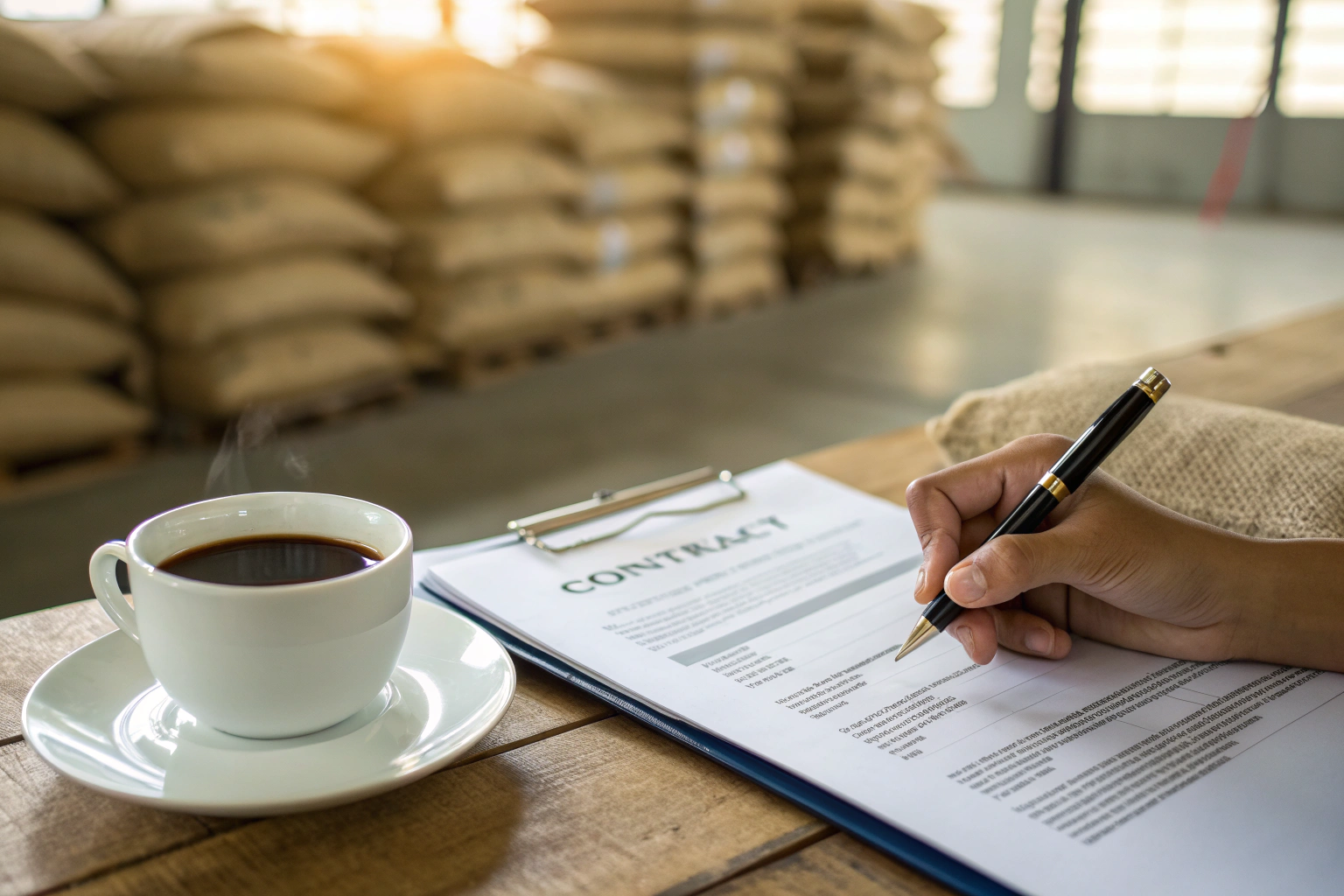
I shook hands on a deal with a roaster in Germany three years ago. We agreed on $3.40 per pound for a washed Arabica lot. The contract was signed. The coffee was processed and bagged, ready to ship. Then, over the next six weeks, the C market dropped 28 cents. The buyer called me, voice tight, and asked to renegotiate. He said his own customers had locked in prices based on our agreement, and now his margin was underwater before the container had even left Shanghai. I had a choice. Hold him to the contract and risk the relationship, or share the pain and preserve the partnership. I shared the pain. We split the difference. The deal closed, but neither of us was happy. That experience taught me a lesson I've never forgotten: a price that isn't stable isn't really a price. It's a bet.
Price stability in coffee contracts is the foundation of predictable business planning for both buyer and seller. When prices are stable, roasters can set wholesale menus, retailers can fix shelf prices, and producers can budget for the next harvest without fear of a sudden margin collapse. Stability does not mean the price never changes—it means the price is predictable, protected by mutual agreement against the wild swings that characterize the C market and the currency markets. A contract without price stability mechanisms is not a partnership. It is a gamble.
I run BeanofCoffee from Baoshan, and I've watched price volatility destroy relationships that should have lasted decades. I've also watched smart contract design protect partnerships through market crashes and spikes. Here's what I've learned about why stability matters, and how to build it into your agreements.
What Does Price Stability Actually Mean in a Coffee Contract?
Most people think price stability means a fixed number that doesn't move. That's one form of it. But it's not the only form, and it's not always the best one. A truly stable price is one that both parties can plan around. It might be fixed. It might float within a defined range. It might be adjusted according to a pre-agreed formula. The key word is "pre-agreed." Stability comes from knowing the rules of the game before the game starts, not from the specific number on the page.
Price stability in a coffee contract means the establishment of a pricing mechanism that both buyer and seller understand and accept before the contract is signed. This mechanism defines how the final price will be determined, what external factors will be considered, and how unexpected market movements will be handled. The mechanism provides a predictable framework within which both parties can budget, even if the exact final price is not fixed at the time of signing.

How Does a Fixed-Price Contract Differ From a Price-to-Be-Fixed Contract?
A fixed-price contract is exactly what it sounds like. The price per pound is set in the contract. $3.50 FOB. That's the price, regardless of what happens in the C market or the currency market between signing and shipment. The buyer knows their cost. The seller knows their revenue. Both can plan.
A price-to-be-fixed contract, often called a PTBF contract, is different. The differential is agreed upon—say, C market plus 20 cents. But the underlying C market price is not locked. The buyer, or sometimes the seller, has the right to "fix" the futures price at a later date, before a specified deadline. Until the fixation happens, the final price is unknown.
PTBF contracts are common in the industry. They offer flexibility. A buyer who believes the market will drop can delay fixation, hoping to catch a lower base price. A buyer who fears a spike can fix immediately. The risk is that the fixation decision becomes a market-timing game. If the buyer waits too long and the market spikes, their cost can jump significantly. If they fix too early and the market drops, they leave money on the table. This is not price stability. This is price uncertainty with a known differential. Both parties should understand the difference and choose the mechanism that fits their risk tolerance.
Can a Price Collar Provide Stability Without Freezing the Price?
A price collar is a compromise. It sets a floor and a ceiling for the C market component of the price. The floor protects the seller from a catastrophic crash. The ceiling protects the buyer from a ruinous spike. Within the collar, the price floats with the market.
I've used this structure with long-term partners. We might agree that the base C market price for the contract will be the average of the two weeks before shipment, but with a floor of 180 cents and a ceiling of 220 cents. If the market is at 190 during the pricing window, the buyer pays 190. If the market crashes to 160, the buyer pays the floor of 180. If the market spikes to 250, the buyer pays the ceiling of 220.
This structure shares the risk. The buyer is protected from extreme spikes. The seller is protected from extreme crashes. Both give up some upside. The buyer doesn't get the full benefit of a market crash. The seller doesn't get the full benefit of a market spike. But both can budget. The buyer knows the worst-case cost. The seller knows the worst-case revenue. That predictability is worth the potential upside sacrificed. A collar is a mutual insurance policy. It says, "We're in this together, within reasonable bounds."
How Does Price Volatility Damage the Buyer-Supplier Relationship?
Price volatility is not just a financial problem. It is a relationship problem. Every time the market makes a big move in one direction, one party wins and the other loses—at least on paper. The winner is supposed to feel good. The loser is supposed to accept it as business. In reality, both feel uneasy. The loser feels taken advantage of. The winner knows the luck could reverse on the next contract. Trust erodes.
Price volatility damages buyer-supplier relationships by creating winners and losers within a partnership that is supposed to be mutually beneficial. When a contract price becomes significantly disconnected from the market price before performance, one party is tempted to renegotiate, default, or deliver substandard quality to compensate. These behaviors corrode the trust that long-term coffee trade depends on. Stable pricing mechanisms prevent the market from turning partners into adversaries.

What Happens When the Market Crashes After a Contract Is Signed?
The market crashes. The buyer looks at the contract price—$3.50—and looks at the current market, where they could buy similar coffee for $3.00. They're staring at a $0.50 per pound disadvantage. On a 42,000-pound container, that's a $21,000 gap between their cost and their competitor's cost. The pressure is immense.
The buyer has two options, neither of them good. Option one: honor the contract, pay the high price, and absorb the loss. The relationship survives, but the buyer's business takes a hit. Resentment simmers. Option two: ask for a renegotiation. The supplier might agree, sharing the loss and preserving the relationship at a cost to their own margin. Or the supplier might refuse, and the buyer might walk away entirely, defaulting on the contract. The supplier is left with processed coffee and no buyer. Everyone loses.
I've seen this scenario play out. It's ugly. The only way to prevent it is to anticipate it. A contract with a price adjustment clause for extreme market moves—say, any move beyond 15% in either direction triggers a renegotiation in good faith—acknowledges that neither party controls the market. It builds a safety valve into the agreement. The conversation shifts from "you owe me" to "the market moved, how do we handle this together?" That shift preserves the relationship.
Why Do Sellers Sometimes Deliver Lower Quality When Prices Spike?
This is the dark side of a fixed-price contract in a rising market. The seller locked in a price of $3.50. The market spikes to $4.00. The seller is now delivering coffee at a price $0.50 below current market value. Every bag they ship is a bag they could have sold to someone else for more money.
A professional seller honors the contract. An unprofessional seller looks for ways to compensate. Maybe the best beans from that lot get quietly diverted to a higher-paying buyer. Maybe the container is filled with a slightly lower grade. The buyer receives coffee that doesn't quite match the pre-shipment sample. It's not a blatant defect, but the cup is a little flatter, the body a little thinner. The buyer complains. The seller shrugs. "Natural variation," they say.
This behavior is a poison in the supply chain. It's one of the reasons I advocate for mechanisms that keep the contract price connected to reality, even loosely. A seller who feels they are being treated fairly is a seller who delivers the quality they promised. A seller who feels trapped in a losing deal is a seller who rationalizes cutting corners. Price stability protects quality as much as it protects margins.
How Can Long-Term Contracts Build Predictability for Both Sides?
The best defense against price volatility is a relationship that spans multiple harvests. A single contract is a transaction. A series of contracts over three, five, ten years is a partnership. And a partnership changes the pricing conversation entirely. When both sides know they will be doing business together next year and the year after, the incentive to gouge on any single contract disappears.
Long-term contracts build predictability by smoothing the peaks and valleys of the spot market across multiple seasons. They allow both buyer and seller to invest with confidence—the buyer in brand-building and market development, the seller in farm improvements and quality upgrades. The longer the time horizon, the less any single market fluctuation matters, and the more the focus shifts to the quality, consistency, and mutual growth that benefit both parties over the long run.

What Is a Multi-Year Supply Agreement and How Does It Work?
A multi-year supply agreement is a framework contract. It sets the terms of the relationship for, say, three years. It specifies the annual volume, the quality specifications, the delivery schedule, and the pricing mechanism. It does not necessarily fix the price for three years. That would be impossible and foolish. Instead, it fixes the formula by which the price will be determined each season.
The agreement might specify that the price for each harvest will be negotiated 90 days before shipment, using the C market average of a defined window plus a fixed differential. Or it might specify a collar structure that applies to all shipments. Or it might specify a minimum and maximum volume with a flexible pricing mechanism. The specific mechanics vary. The constant is that both parties commit to the relationship, not just to a single transaction.
For me, as a producer with 10,000 acres in Baoshan, a multi-year agreement is gold. I know that a certain percentage of my crop is already spoken for. I can invest in new drying beds, in worker training, in organic certification, knowing that the buyer will be there to purchase the improved coffee. For the buyer, the agreement guarantees access to the specific lots they've built their brand around. They're not scrambling to re-source every season. The partnership itself becomes an asset.
Why Does Predictable Pricing Help Roasters Set Their Own Customer Commitments?
A roaster is not the end of the chain. They have customers—cafes, restaurants, grocery chains—who expect consistent pricing and consistent supply. A roaster's nightmare is winning a six-month contract to supply a cafe chain with a specific single-origin espresso, and then watching the green coffee cost double because of a market spike they didn't hedge.
Predictable pricing through a stable contract mechanism allows the roaster to price their own products with confidence. They can print a wholesale menu that's valid for the season. They can commit to a retail bag price without worrying that their margin will evaporate. They can build a brand around a specific origin without the risk of having to drop it because the price became unsustainable.
This is the part of the supply chain that consumers never see. They see a bag of coffee on a shelf with a consistent price and consistent quality. Behind that consistency is a series of stable contracts, stretching from the farm to the roaster. When one link in that chain becomes unstable, the consumer sees it as a price hike or a quality drop. Stable pricing at the import level is invisible to the end customer, but they feel its effects every morning. Predictability all the way down the chain is what builds brands that last.
What Contract Clauses Help Stabilize Prices Against External Shocks?
External shocks happen. A drought in Brazil. A currency devaluation. A new tariff announcement. A global pandemic. These events are not predictable, but they are inevitable. A contract that does not account for them is a contract that will break under pressure. The smartest contracts I've seen include clauses that anticipate the unanticipatable. They don't try to predict the shock. They try to define the process for responding to it.
Contract clauses that stabilize prices against external shocks include force majeure provisions that cover extraordinary events, hardship clauses that allow renegotiation when market conditions change fundamentally, and price review mechanisms that trigger automatically when specified indices move beyond defined thresholds. These clauses do not eliminate the shock, but they provide a structured response that prevents the contract from becoming a weapon.

How Does a Currency Adjustment Clause Protect Cross-Border Deals?
I've written about this before, but it belongs in any discussion of price stability. Coffee is priced in US dollars. I pay my workers in Chinese yuan. A European buyer earns euros. A Canadian buyer earns Canadian dollars. Somewhere in every transaction, currency risk sits waiting.
A currency adjustment clause defines a reference exchange rate at the time of contract signing. It specifies that if the exchange rate between the contract currency and the impacted party's operating currency moves beyond a defined band—typically 3% to 5%—the contract price will be adjusted to share the impact. The adjustment is usually a 50/50 split of the difference.
This clause prevents a silent margin erosion that neither party controls. The coffee is the same. The logistics are the same. But a 10% move in the EUR/USD exchange rate can wipe out a European roaster's entire margin on a container. Without a clause, the roaster absorbs the loss alone. With a clause, the loss is shared and manageable. The contract acknowledges that currency is an external factor, not a performance issue.
What Is a Material Adverse Change Clause and When Does It Apply?
A material adverse change, or MAC, clause is a broader and more powerful tool. It says that if an event occurs that fundamentally changes the economic basis of the contract, either party can request a review. The event must be external, unforeseeable, and significant enough to undermine the purpose of the agreement.
A new tariff that adds 25% to the landed cost of coffee qualifies. A pandemic that closes ports for two months qualifies. A sudden civil unrest that blocks the roads from the farm to the port qualifies. A normal C market fluctuation does not qualify—that's a known risk, not an unforeseeable shock.
The MAC clause does not dictate the outcome. It dictates the process. It requires the parties to meet and negotiate in good faith. If they cannot agree, the contract may provide for termination without penalty, or for binding arbitration. The value of the clause is that it prevents one party from being held to an agreement that the world has rendered impossible. It's a recognition that contracts exist in reality, and reality can change without warning.
Conclusion
Price stability is not about finding the perfect number and freezing it forever. It's about building a framework where the price is predictable, the risks are shared, and the relationship survives the market's inevitable mood swings. A fixed price that ignores reality is a fragile price. A price mechanism that acknowledges uncertainty—through collars, adjustment clauses, multi-year frameworks, and fair renegotiation processes—is a resilient one.
At BeanofCoffee, I want my buyers to sleep well after signing a contract. I want them to focus on roasting great coffee and building their brands, not checking the C market every morning with dread. That's why I'm open to discussing whatever pricing structure gives you that confidence—fixed, floating with a collar, multi-year with review windows, whatever fits your business model. If you want to talk about a stable sourcing partnership for Yunnan Arabica, Catimor, or Robusta, reach out to Cathy Cai at cathy@beanofcoffee.com. She can walk you through the options and help us build a contract that works for both sides, through good markets and bad. That's not just business. That's partnership.