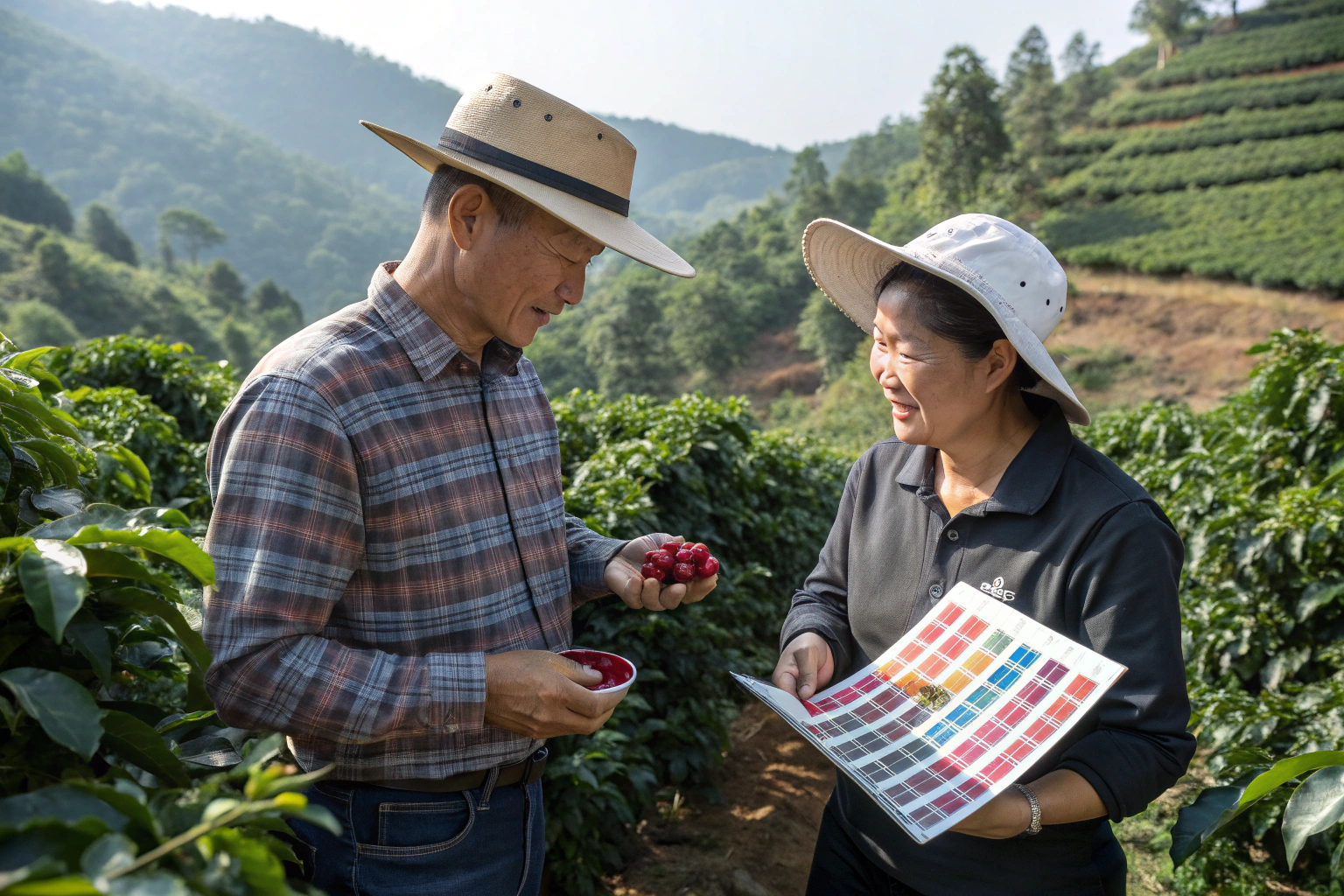
I watched a buyer from Australia make a mistake in our village a few years ago. He was standing in front of a group of smallholder farmers, talking through a translator. He was very professional. He used words like "SCA cupping protocol," "fermentation consistency," and "moisture content tolerance." The farmers nodded politely. They smiled. And after he left, they turned to me and asked, "What did he actually want us to do differently?" The buyer had communicated perfectly. And he had communicated nothing at all. The farmers didn't need a lecture on specialty coffee theory. They needed to know: "Pick only the red ones. Not the green ones. The red ones. We'll pay you more if you only pick the red ones."
Communicating quality needs to Chinese coffee farmers effectively requires translating abstract specialty standards into concrete, observable actions. It means showing a color chart, not describing a flavor profile. It means paying a quality premium immediately and transparently, not promising a vague bonus at the end of the season. It means respecting the farmer's existing knowledge while introducing new practices through demonstration and repeated, consistent feedback, not through a one-time training session.
I've spent over a decade bridging this gap at BeanofCoffee, between our own 10,000-acre plantation and the smallholder network we work with around Baoshan. The language barrier is real. The cultural barrier is real. But both can be overcome with the right approach. Here is what works.
Why Do Direct Translation and Theory Fail in Quality Training?
Words fail. They fail spectacularly in cross-cultural agricultural training. I learned this the hard way. Early in my career, I tried to explain "fermentation defect" to a group of farmers by describing the taste. "It's like overripe fruit, a little vinegary, a little rotten." The translator did her best. The farmers looked at me like I was describing a disease. One of them finally said, "But we don't eat rotten fruit. Why would we put rotten fruit in our coffee?" He was right. My description was meaningless because it didn't connect to any action he could take.
Direct translation of specialty coffee terminology fails because these terms describe sensory experiences that have no direct equivalent in the farmer's daily vocabulary. Theory-based training fails because it starts with the "why" when the farmer needs the "what" and the "how." A farmer who has never tasted their own roasted coffee cannot connect a processing step to a cupping note. Effective communication starts with visible, physical standards—color, texture, time, temperature—and builds toward understanding gradually.
What Is Lost When You Use Cupping Language With Farmers?
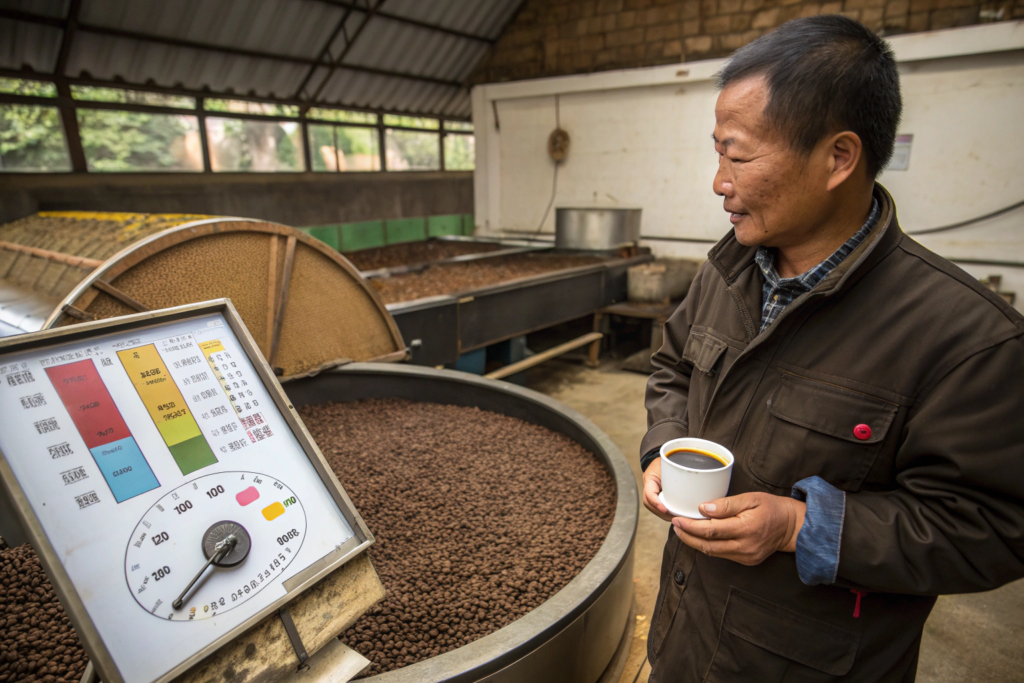
Cupping language is a highly specialized dialect of English, developed by and for coffee professionals in consuming countries. Terms like "bright acidity," "stone fruit notes," "clean finish," and "complex mouthfeel" are precise within the cupping community. Outside it, they are noise.
A Yunnan coffee farmer might have grown coffee for twenty years and never tasted a single cup of their own roasted beans. They sell cherry or parchment. The final beverage is an abstraction. Telling them that a different fermentation time will produce "a more pronounced malic acidity" is not helpful. They don't know what malic acid tastes like. They don't know what acidity means in a coffee context—in their experience, "acid" is a negative word, associated with spoiled food.
What does work is connecting the instruction to a physical outcome they can observe and be paid for. "Ferment for 18 hours, not 24, and the beans will dry to a lighter, more uniform color. The buyer pays more for that lighter color." This is a statement a farmer can act on. It connects the action (shorter fermentation) to the observable result (lighter color) to the incentive (higher price). No cupping vocabulary required.
Why Do Demonstration and Repetition Outperform Presentations?
A presentation is a one-way flow of information. It assumes the audience absorbs, understands, and retains what is said. In any training context, this is optimistic. In a cross-cultural, cross-language agricultural context, it is wishful thinking.
Demonstration is different. When I teach selective picking, I don't tell farmers to pick only ripe cherries. I walk into a row of trees with a basket, and I pick for ten minutes while they watch. I show them exactly which cherries I'm selecting. I show them which ones I'm leaving on the branch to ripen further. I pour my basket out on a tarp and invite them to sort through it and criticize my work. They usually find a few under-ripes I missed. That's good. That means they understand the standard.
Then I ask them to pick for ten minutes while I watch. I give immediate feedback. "Yes, that one. No, that one is still orange—leave it." This is slow. It's labor-intensive. It's the opposite of scalable. But it works. Repetition is the key. I don't do this once. I do it at the start of every harvest season, and I have my quality team do spot checks throughout the picking period. After three seasons, the farmers internalize the standard. They become the ones correcting new pickers. The demonstration becomes the culture.
What Visual Tools Bridge the Language Gap Most Effectively?
If words fail, images succeed. A photograph of a perfect cherry next to an under-ripe one is worth more than a thousand words of explanation in any language. Over the years, I've developed a set of visual tools that have become the backbone of our quality communication with farmers. These tools are low-tech, cheap, and instantly understandable. They don't require literacy, electricity, or translation.
Visual tools that bridge the language gap in coffee quality communication include ripeness color charts for selective picking, drying bed diagrams showing ideal layer thickness and turning schedules, defect posters with actual-size photos of black beans, insect damage, and mold, and simple thermometers and moisture meters with color-coded safe zones marked directly on the device. The principle is: show, don't tell. Make the standard visible.
How Does a Cherry Ripeness Color Chart Change Picking Behavior?
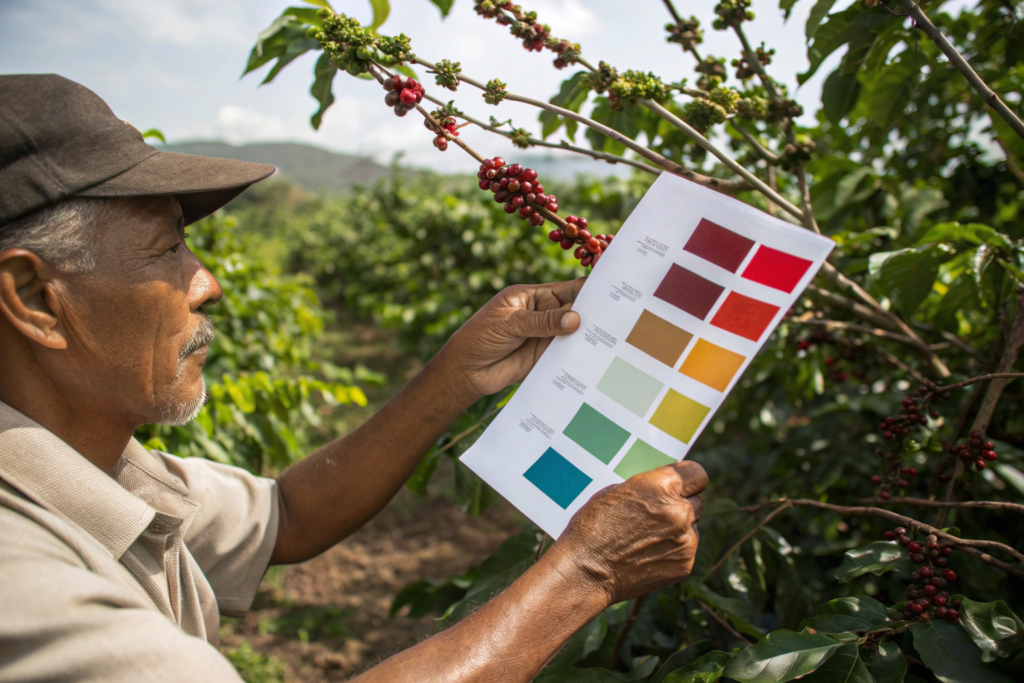
The simplest tool is a laminated card, about the size of a sheet of paper, printed with photographs of coffee cherries at five stages of ripeness. Stage 1: completely green. Stage 2: yellow-green, starting to color. Stage 3: orange, not ready. Stage 4: full red, perfect for picking. Stage 5: deep purple, over-ripe, still acceptable for some processes.
Every picker in our network carries one of these cards during harvest season. It's not a training document they saw once in a classroom. It's in their pocket. When they're unsure about a cherry, they hold it up next to the card and compare. The instruction is simple: pick stages 4 and 5 only. Leave stages 1, 2, and 3 on the branch.
The impact of this simple card is dramatic. Before we introduced it, our cherry rejection rate at the collection center was around 15%—meaning 15% of delivered cherry was under-ripe and had to be sorted out or rejected entirely. After one season with the card, the rate dropped to under 5%. The pickers weren't less skilled. They just had a clear, portable reference standard. The card translated "quality" from an abstract concept into a color they could see.
Can Simple Sorting Posters Reduce Defects at the Farm Level?
Defects happen at every stage of processing. Many of them are easy to see once you know what to look for. The problem is that most farmers have never been shown what a "black bean" or "insect damage" looks like in the context of quality standards. They see these things in their beans every day. They don't know they're considered defects.
We printed a set of large-format posters showing photographs of the most common defects, actual size, with a simple red X over each one. The posters are hung in the collection centers, the drying patios, and the sorting sheds. They show black beans, sour beans, insect-damaged beans, broken beans, and foreign matter like stones and sticks. The message is visual and immediate: these things do not belong in the good coffee.
During the hand-sorting stage, workers sit at long tables with the poster visible on the wall. They can glance up and compare. This constant, passive reinforcement is more effective than any lecture. It also empowers workers to make sorting decisions independently, without a supervisor standing over them. They know the standard. They can see it on the wall.
How Do Payment Incentives Reinforce Quality Communication?
All the visual tools and demonstrations in the world will fail if the payment system doesn't reward the behavior you're teaching. Farmers are businesspeople. They respond to incentives, just like any businessperson. If a farmer who delivers perfectly sorted, ripe cherry gets the same price per kilo as a farmer who delivers a mixed bag of ripe and under-ripe, the quality training is just noise. Money talks. Quality premiums talk louder.
Payment incentives are the most powerful quality communication tool available. A transparent, immediate quality premium—paid at the point of delivery, based on objective, observable criteria—teaches quality standards faster than any training program. When farmers see their neighbor receiving a higher price for better cherry, the motivation to adopt the new practices shifts from external instruction to internal desire. The payment system is the curriculum.
Why Should Quality Premiums Be Paid Immediately at Delivery?
Delayed rewards don't work. A promise of a quality bonus at the end of the harvest, calculated based on the average quality of all deliveries, is too abstract. The farmer can't connect a specific action on a specific day to a payment three months later. The feedback loop is too long.
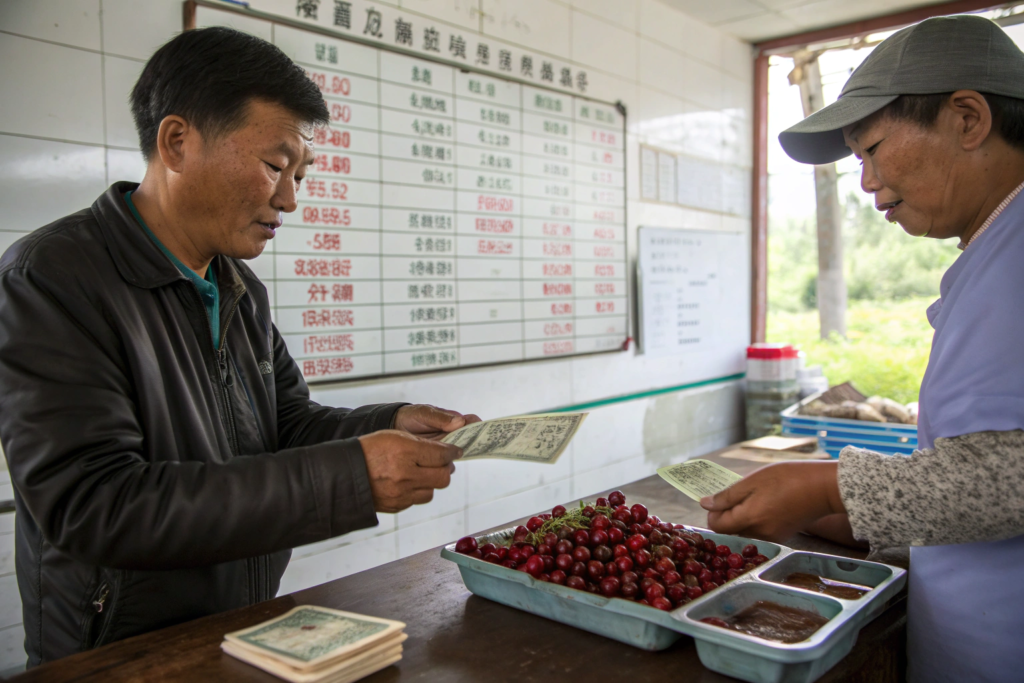
Immediate payment at the collection point closes the loop instantly. The farmer delivers a basket of cherry. The quality technician inspects it on the spot, using the visual standards everyone has been trained on. The cherry is graded: A, B, or reject. A-grade cherry gets the premium price. B-grade gets the standard price. Rejected cherry goes back with the farmer. The farmer is paid on the spot for the accepted cherry.
The psychological impact is powerful. The farmer walks away with more money in their hand than the farmer who delivered B-grade cherry. They know exactly why—the color chart, the sorting, the care in picking. Tomorrow, they'll try to get the A-grade price again. The incentive is tangible, immediate, and directly linked to the quality behavior. This is not complicated behavioral science. It's basic human nature.
How Does a Transparent Grading System Build Trust?
Trust is the foundation of any long-term buyer-supplier relationship. At the farm level, trust between the farmer and the collection center is essential. If the farmer believes the grading is arbitrary, or that the quality technician favors certain farmers, the incentive system collapses.
Transparency means the grading criteria are public and objective. The color chart is the standard. The defect count is the standard. The moisture reading, if applicable, is the standard. The farmer can watch the inspection happen. They can see the technician sort the sample. They can question a decision, and the technician can point to the visual reference. "This cherry is stage 3, not stage 4. See the orange color? Compare it to the chart." The evidence is right there.
I also recommend posting prices publicly. A simple board at the collection center: A-grade cherry, X yuan per kilo. B-grade cherry, Y yuan per kilo. Every farmer sees the same numbers. There's no secret deal for a favored few. This transparency builds trust in the system. And trust in the system means farmers invest in quality improvements, because they believe the promised premium will actually be paid. Broken promises destroy quality programs faster than any other single factor.
How Can Ongoing Feedback Loops Sustain Quality Improvements?
One-time training is a seed. Ongoing feedback is water and sunlight. Without it, the seed dies. I've seen buyers invest significant money in a pre-harvest training program, then disappear until the container is ready to ship. The farmers revert to old habits. The quality gains fade. Sustaining quality requires a feedback loop that operates throughout the harvest cycle and across seasons.
Ongoing feedback loops sustain quality improvements by providing farmers with regular, specific information about how their coffee performed. This feedback should include both positive reinforcement when standards are met and constructive guidance when they are not. The most powerful feedback connects the farmer's daily actions to the final cup quality, ideally by having farmers taste their own roasted coffee and hear the buyer's evaluation of it.
Why Should Farmers Taste Their Own Coffee?
Most coffee farmers have never tasted their own coffee. They sell green beans or cherry. The final product is consumed thousands of miles away, by strangers. The farmer has no sensory connection to the result of their labor. This is a profound gap, and closing it transforms quality conversations.
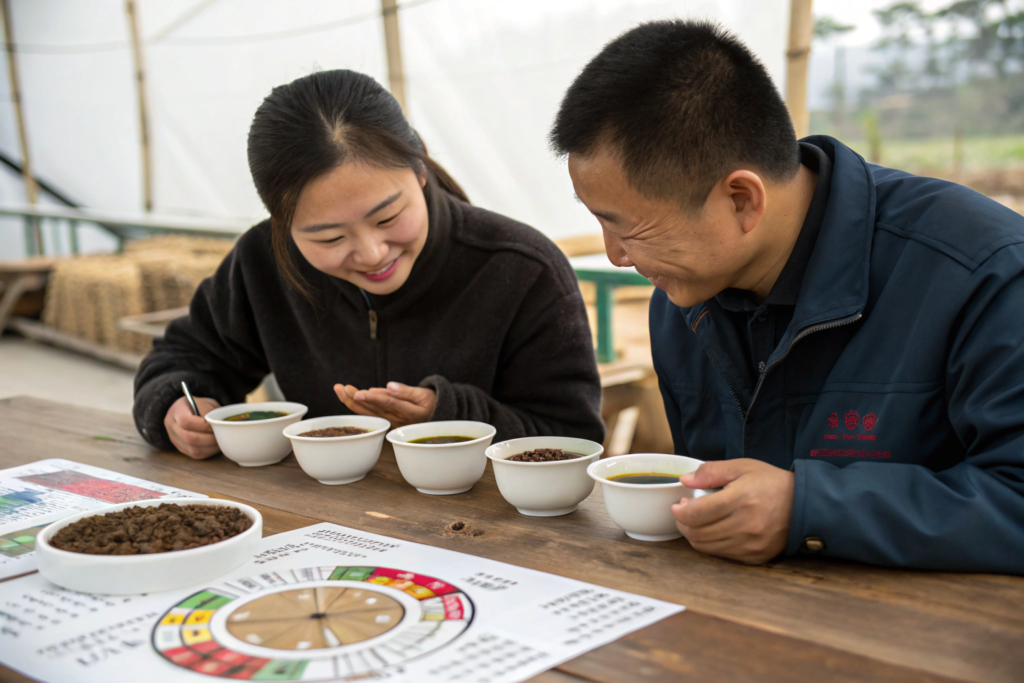
Once a year, during the harvest, I organize cupping sessions for the farmers in our network. We roast samples of their individual lots. We set up simple cupping bowls. We teach them to slurp, to evaluate, to compare. The first time a farmer tastes coffee from their own farm is often an emotional moment. Some are surprised. Some are proud. Some are disappointed. "This tastes like dirt. Why does it taste like dirt?" That's a quality question, coming from the farmer themselves.
When a farmer has tasted the difference between a clean, sweet cup and a cup with a fermentation defect, they understand quality at a gut level. They don't need a cupping score. They need to know: "Did I make something delicious?" After a cupping session, conversations about picking ripeness and fermentation time become personal, not abstract. The farmer wants their coffee to taste good because they've tasted it and they care.
What Information Should a Post-Harvest Quality Report Include?
A post-harvest quality report is a document that closes the season's feedback loop. It goes back to the farmer, or the cooperative leader, summarizing how their coffee performed against the contracted standards. It is not a legal document. It is a teaching document.
The report should include the green grading results—moisture content, water activity, screen size distribution, defect count. It should include the cupping score and cupping notes, written in simple language, translated into Chinese. It should include a comparison to the previous season's results, highlighting improvements and areas that still need work.
If a farmer's lot scored 84 this year and 81 last year, that's a celebration. The report should say: "Your score improved. The cupper noted a cleaner finish and more sweetness. The changes you made to your drying bed management are working." If a lot scored lower, the report should be gentle but specific: "The cupper noted a slight earthy note. This can come from drying the beans too slowly or on a dirty surface. Let's look at your drying setup together before next season."
This report, delivered in person if possible, tells the farmer that their work was seen and evaluated. It tells them that quality is not a mystery—it's a measurable outcome they can influence. And it sets the stage for next season's training, which now builds on data, not just theory.
Conclusion
Communicating quality needs to Chinese coffee farmers is not about better translation or fancier training materials. It is about shifting the entire communication model from abstract instruction to concrete demonstration, from delayed bonuses to immediate rewards, and from one-way lectures to ongoing feedback loops. The farmers in Yunnan are skilled, experienced, and motivated. They want to produce good coffee. What they need from buyers is clarity, not complexity.
At BeanofCoffee, this is how we work with our smallholder network every day. We use color charts and sorting posters. We pay quality premiums at the delivery point. We cup with farmers and share the results. It's not glamorous. It's practical. And it works. If you're sourcing from Yunnan and want to build a direct communication channel with the farmers who grow your coffee, reach out to Cathy Cai at cathy@beanofcoffee.com. She can share our training materials, connect you with our quality team, and help you translate your specific needs into actions a farmer can see, do, and be paid for. The best quality standards are the ones that get picked into the basket.