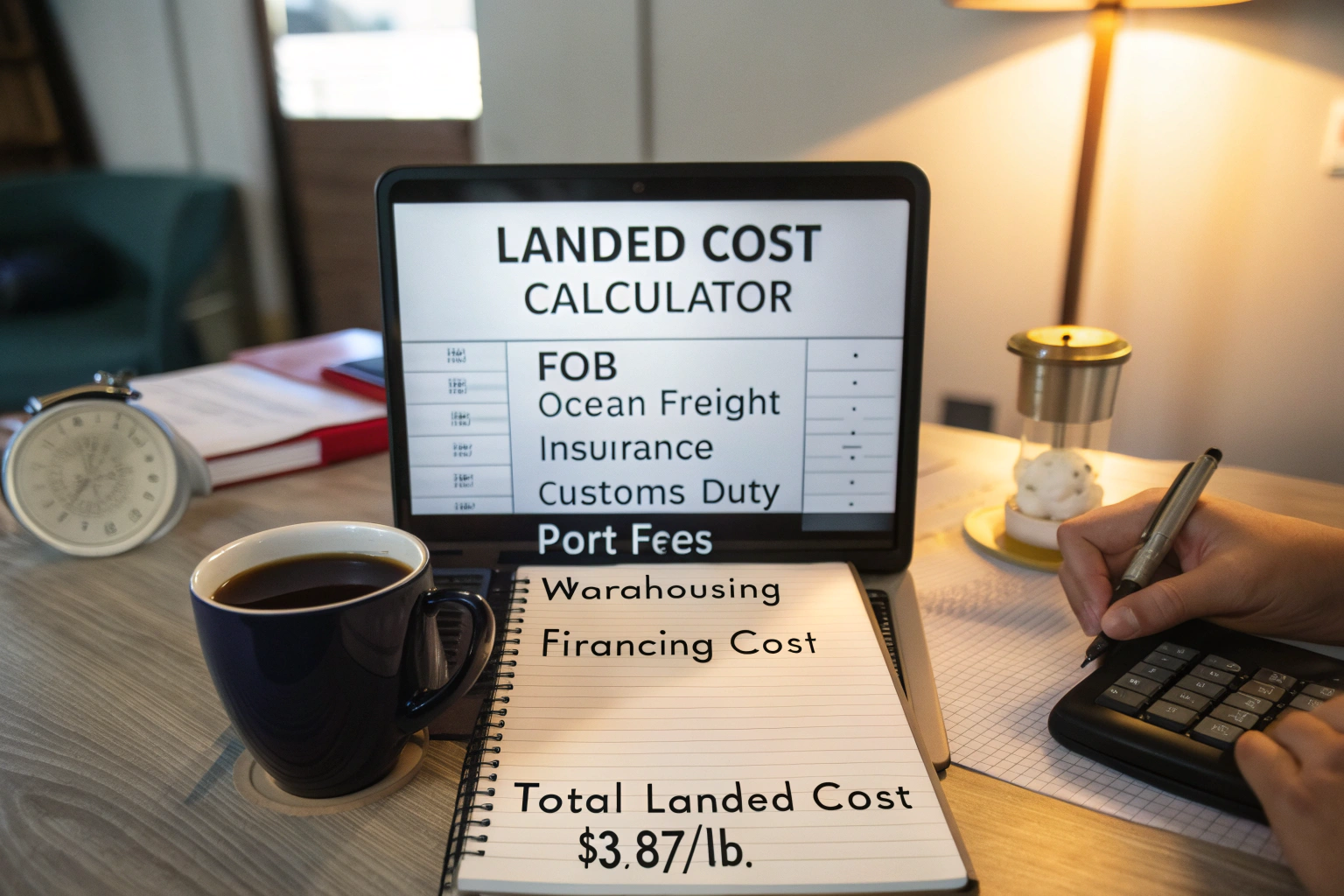
I once sat with a roaster in Texas who was convinced he was buying coffee at $2.80 a pound. He showed me the invoice. The FOB price was indeed $2.80. Then I asked him to pull out his freight forwarder's bill, his customs broker's statement, his warehousing invoice, and his bank's wire transfer receipt. We added everything up on a napkin. His actual cost per pound, sitting in his warehouse ready to roast, was $3.62. He had been underpricing his coffee for two years without realizing it. He thought he was making a 20% margin. He was breaking even.
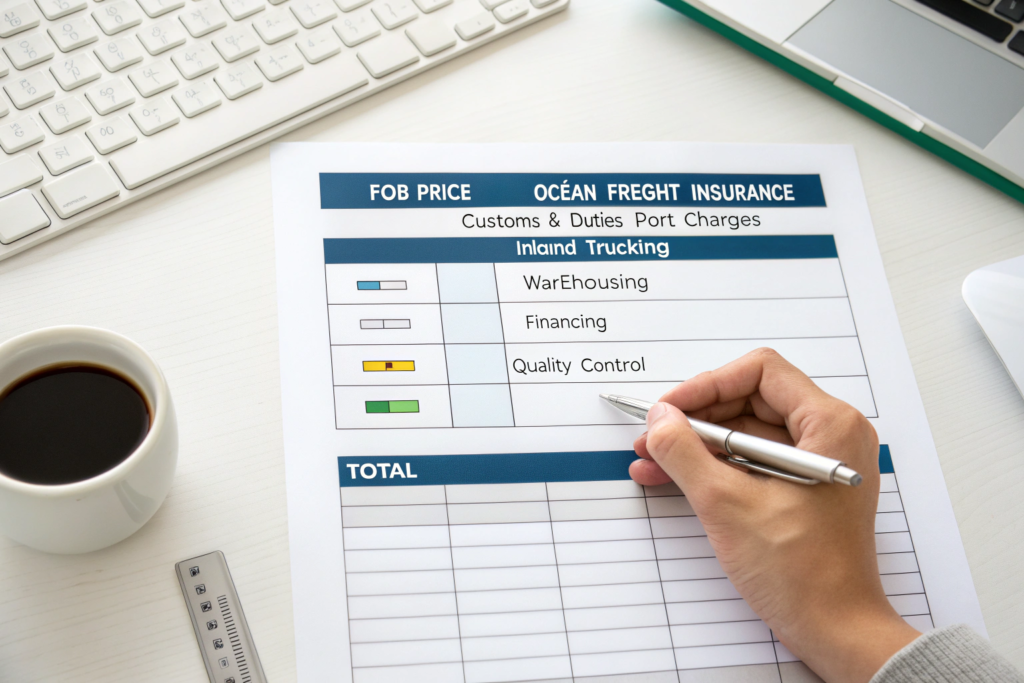
The true landed cost of imported coffee is the sum of the FOB price, ocean freight, insurance, customs duties and fees, port and handling charges, inland transportation to the warehouse, warehousing and inventory carrying costs, financing costs including currency exchange and payment terms, and the cost of quality control and sampling. Every one of these line items must be included to know what a pound of green coffee actually costs delivered to your roastery.
The FOB price is only the beginning. The invoice from the supplier is the down payment on the real cost. The journey from the origin port to your roasting machine has many hands extended, and each one takes a cut. If you do not account for every cut, you do not know your margin. If you do not know your margin, you cannot price your coffee profitably.
What Are the Core Components of a Coffee Landed Cost Calculation?
The landed cost is a chain of expenses. If one link is missing, the calculation is wrong. The chain starts with the price of the coffee at the origin port and ends when the coffee is sitting in your warehouse, ready to roast. Every step in between adds cost.
The core components of a coffee landed cost calculation are the FOB price, which is the coffee loaded onto the ship at origin, ocean freight and insurance to the destination port, customs duties and broker fees at import, port terminal handling and inspection charges, inland transportation from the port to the roastery warehouse, and warehousing and inventory carrying costs including storage, handling, and the cost of capital tied up in inventory.
These costs are not theoretical. Each one appears on a bill from a specific service provider. The freight forwarder bills for ocean freight. The customs broker bills for clearance. The trucking company bills for drayage. The warehouse bills for storage. The bank bills for the wire transfer. A complete landed cost calculation collects all of these bills and divides the total by the number of pounds of green coffee received.
How Is the FOB Price Structured and What Does It Include?
FOB stands for Free On Board. It is the price of the coffee delivered to the ship at the origin port. The seller is responsible for all costs up to that point. The buyer assumes responsibility once the coffee crosses the ship's rail.
The FOB price includes the cost of the green coffee itself, the domestic transportation from the mill to the port, the export documentation, the phytosanitary certificate, the fumigation if required, and the port loading charges. It does not include ocean freight, insurance, or anything after loading. When a supplier quotes an FOB price, the buyer knows exactly what is covered and what is not. The FOB price is the cleanest comparison point between suppliers because it isolates the cost of the coffee and origin-side handling from the variable shipping costs.
What Freight and Insurance Costs Should Be Budgeted?
Ocean freight is the largest single cost after the coffee itself. It is quoted by freight forwarders based on container size, route, and current market conditions. A 20-foot container from Shanghai to Los Angeles costs less than the same container from Shanghai to Rotterdam.
Insurance covers loss or damage to the cargo during transit. It is typically a small percentage of the cargo value, often 0.3% to 0.5%. The cost is small. The protection is significant. A container lost overboard in a storm, damaged by a fire, or spoiled by a refrigeration failure is a total loss without insurance. The insurance premium is a non-negotiable line item in a professional landed cost calculation. Freight and insurance together are often quoted as CIF, Cost, Insurance, and Freight, by the forwarder.
What Customs, Port, and Inland Charges Add Up?
The destination side costs catch many roasters by surprise. The container does not magically appear at the roastery door once it clears the ship.
Customs duties on green coffee into North America are typically zero under the harmonized tariff schedule code 0901.11, but the customs broker still charges a fee for filing the entry. Port terminal handling charges cover the unloading of the container and its movement within the port. Inspection fees may apply if customs or food safety authorities examine the container. Inland transportation, often called drayage, covers the trucking from the port to the warehouse. If the container is moved by rail to an inland destination, the rail freight and local drayage from the rail terminal to the warehouse add further cost. Each of these line items has its own invoice.
How Do Financing Costs and Currency Exchange Affect Landed Cost?
Money has a cost. The money used to pay for the coffee, the freight, and the duties is either borrowed from a bank or taken from the business's working capital. Either way, there is a cost. The bank charges interest. The working capital has an opportunity cost, what it could have earned if invested elsewhere.
Financing costs and currency exchange affect landed cost by adding interest charges on the capital tied up from the moment the coffee is paid for at origin until it is sold as roasted coffee, and by exposing the buyer to exchange rate fluctuations if the purchase is denominated in a foreign currency. These costs are often overlooked but can add several cents per pound.
The timeline matters. A roaster who pays a 30% deposit when the contract is signed, the 70% balance when the coffee ships, and then waits 30 days for the ocean transit, 5 days for customs clearance, and 10 days for trucking is financing the coffee for 45 to 75 days before it arrives. Then it sits in inventory for another 30 to 90 days before it is roasted and sold. The total financing period can be 4 to 6 months.
How to Calculate the Cost of Capital for Coffee Inventory?
The cost of capital is the annual interest rate on the money used to buy the coffee, applied to the time the money is tied up. If a roaster uses a line of credit at 8% annual interest, and the coffee is held for an average of 90 days from payment to sale, the financing cost is 2% of the coffee's value.
On a $20,000 container of coffee, that is $400 in interest, or about $0.01 per pound. A penny does not sound like much. But add the financing cost on the freight, the duties, and all the other pre-paid expenses, and the total financing cost can be $0.02 to $0.04 per pound. For a roaster with tight margins, that is real money. The calculation is simple: multiply the total cash outlay by the annual interest rate, then multiply by the fraction of the year the money is outstanding.
What Currency Risks Should Importers Hedge Against?
Coffee is traded internationally in U.S. dollars. If the roaster's business operates in Canadian dollars, euros, or another currency, the exchange rate between their local currency and the U.S. dollar directly affects the landed cost.
A roaster in Canada who budgets a landed cost of CAD $5.00 per pound based on an exchange rate of 1.30 CAD per USD will see their cost jump to CAD $5.38 if the exchange rate moves to 1.40. The FOB price in dollars did not change. The freight did not change. The currency moved, and the local cost moved with it. Hedging currency risk, either through forward exchange contracts with a bank or by holding U.S. dollar accounts, is a standard practice for larger importers. Smaller roasters can mitigate the risk by pricing their coffee in local currency based on a conservative exchange rate assumption.
What Is the Difference Between FOB, CIF, and Landed Cost Pricing?
The language of coffee trade includes terms that define exactly what is included in a quoted price. Misunderstanding these terms leads to budget errors and disputes. The three essential terms are FOB, CIF, and Landed Cost.
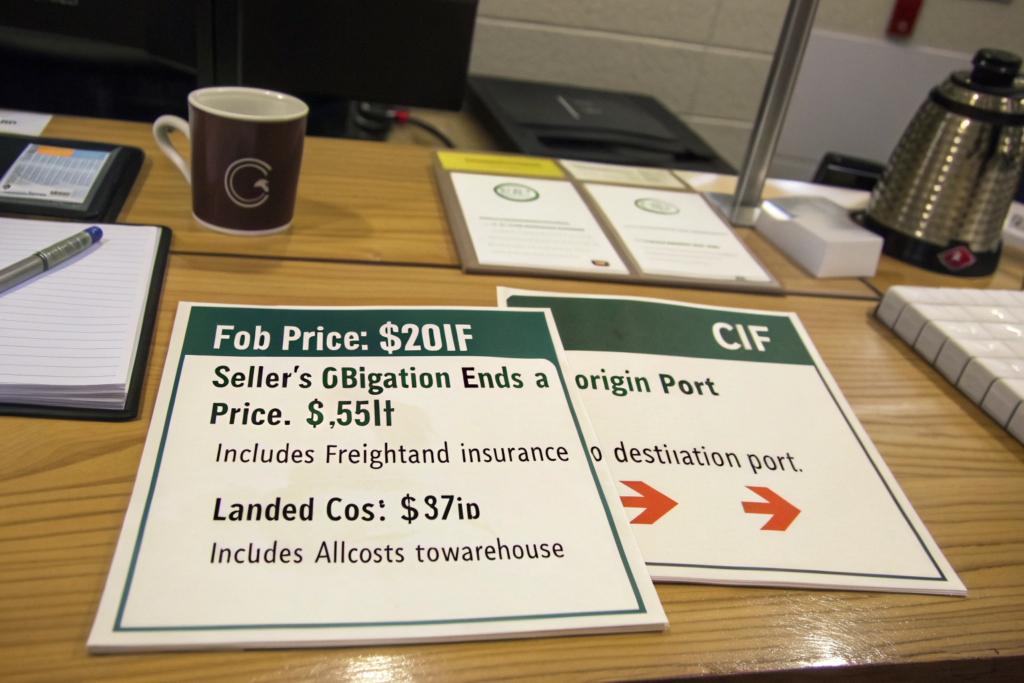
FOB is the price of the coffee loaded at the origin port, with all origin costs included. CIF is the FOB price plus ocean freight and marine insurance to the destination port. Landed Cost is CIF plus all destination-side costs, including customs clearance, port charges, inland transportation, warehousing, and financing, representing the total cost to have the coffee sitting in your warehouse ready to roast.
A supplier quoting FOB is responsible for getting the coffee to the ship. A supplier quoting CIF is responsible for getting the coffee to the destination port. A supplier quoting Landed Cost is responsible for getting the coffee to the buyer's warehouse. Most specialty coffee transactions are quoted FOB. The buyer arranges freight and handles destination logistics. This gives the buyer control over shipping choices and costs.
Why Is FOB the Standard Quotation for Specialty Coffee?
FOB is the standard because it creates a clean handoff. The seller handles everything in their country. The buyer handles everything from the ship onward. The responsibility is clear. The costs are transparent.
When a buyer compares FOB prices from two different origins, they are comparing the cost of the coffee and the origin-side logistics only. The comparison is fair. If one supplier quotes CIF and another quotes FOB, the buyer must unpack the CIF quote to separate the coffee cost from the freight cost for an apples-to-apples comparison. FOB simplifies sourcing decisions. It is the purest expression of the coffee's price.
How Should a Roaster Build a Landed Cost Template?
A landed cost template is a spreadsheet that lives on the roaster's computer and is used for every purchase. It should list every cost line item with blank fields for the current quote or invoice amount.
The template starts with the FOB price per pound. Then ocean freight per pound, calculated by dividing the total container freight by the net pounds shipped. Then insurance. Then customs broker fee, divided by pounds. Then port charges. Then drayage to warehouse. Then warehouse receiving fee. Then financing cost. Each line item has a per-pound cost. The sum is the landed cost per pound. The template should be updated with actual invoices after each shipment to compare estimated costs to actual costs.
What Hidden Fees Do Coffee Importers Often Overlook?
The line items on a freight forwarder's bill are not always obvious in advance. Some costs emerge only when something goes wrong, or when something goes right but triggers a fee. The experienced importer budgets for these contingencies. The inexperienced importer is surprised by them.
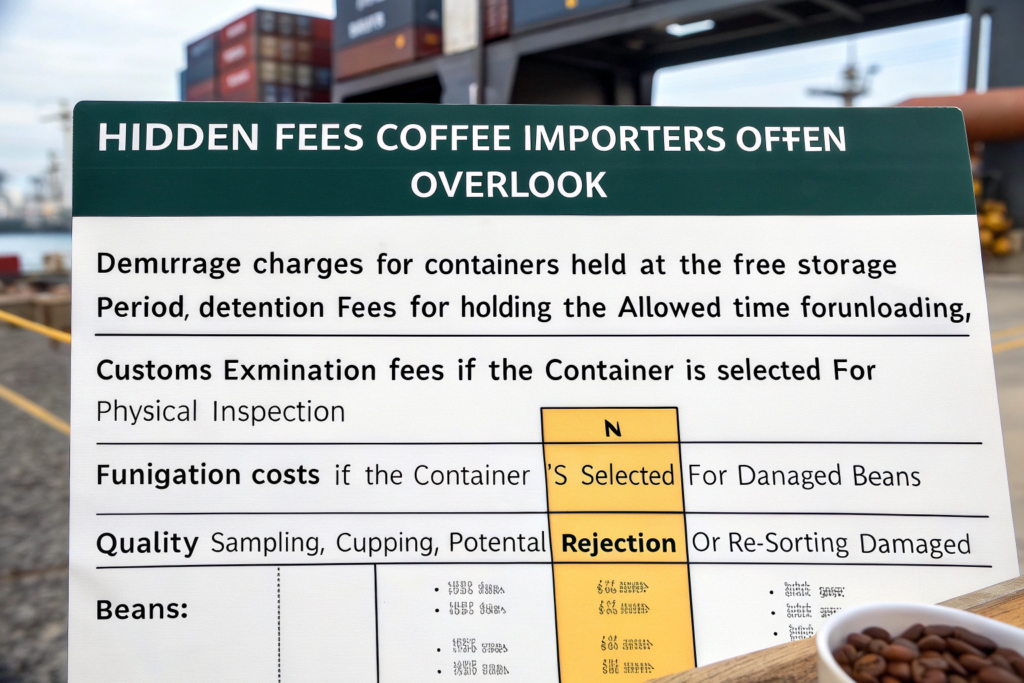
Hidden fees that coffee importers often overlook include demurrage charges for containers held at the port beyond the free storage period, detention fees for holding the container beyond the allowed time for unloading, customs examination fees if the container is selected for physical inspection, fumigation costs if pests are found, and quality-related costs including sampling, cupping, and potential rejection or re-sorting of damaged beans.
Demurrage and detention are the most common and most expensive surprises. A container that sits at the port for an extra week because the customs paperwork was late can rack up hundreds of dollars in demurrage. The same container held at the roastery beyond the free detention period because the warehouse is full can rack up similar charges. These fees are avoidable with planning but unavoidable once incurred.
What Is the Cost of Quality Control in the Landed Cost Equation?
Quality control is not a one-time expense. It begins with the pre-shipment sample, which the supplier provides, but the buyer often pays for courier shipping. It continues with arrival samples, pulled from the container and sent to a cupping lab or evaluated in-house.
If a quality dispute arises, the cost escalates. An independent surveyor may need to inspect the container. A third-party lab may need to test for moisture or mycotoxins. If the coffee requires re-sorting due to a higher-than-expected defect count, the sorting cost and the weight loss from removed defects add to the landed cost. These quality-related costs are variable and unpredictable, but they are real. A prudent importer budgets a quality contingency of 1% to 2% of the cargo value.
How Should Shrinkage and Weight Loss Be Accounted For?
Green coffee loses weight during transit and storage. Moisture evaporates. Beans break. Dust accumulates at the bottom of bags. The weight of coffee that goes into the roaster is always slightly less than the weight on the bill of lading.
A shrinkage allowance of 0.5% to 1% is typical. On a 20,000-kilogram container, 1% shrinkage is 200 kilograms. That is 440 pounds of coffee that were paid for but cannot be roasted. The cost of that lost coffee must be spread across the remaining pounds, slightly increasing the per-pound landed cost. The shrinkage allowance should be built into the landed cost template as a standard line item.
Conclusion
The true landed cost of imported coffee is a number that many roasters never fully calculate. They focus on the FOB price because it is the biggest and most visible number. But the difference between the FOB price and the actual cost of coffee sitting in the warehouse can be $0.50 to $1.00 per pound or more. That difference is the margin. Ignore it, and the business is flying blind.
The discipline of calculating landed cost is not complicated accounting. It is collecting every invoice associated with a shipment and dividing by the pounds received. It is updating a spreadsheet template with actual costs and comparing them to estimates. It is asking the freight forwarder, the customs broker, and the warehouse for their fee schedules before the coffee ships, not after.
If you are sourcing coffee from our farm in Yunnan and want to build an accurate landed cost model for your specific shipping lane, we can help. We provide transparent FOB pricing, detailed container loading specifications, and can recommend freight forwarders familiar with our origin. Contact Cathy Cai at cathy@beanofcoffee.com with your destination port and volume, and she will provide the information you need to plug into your landed cost template. Know your numbers. Your margin depends on it.