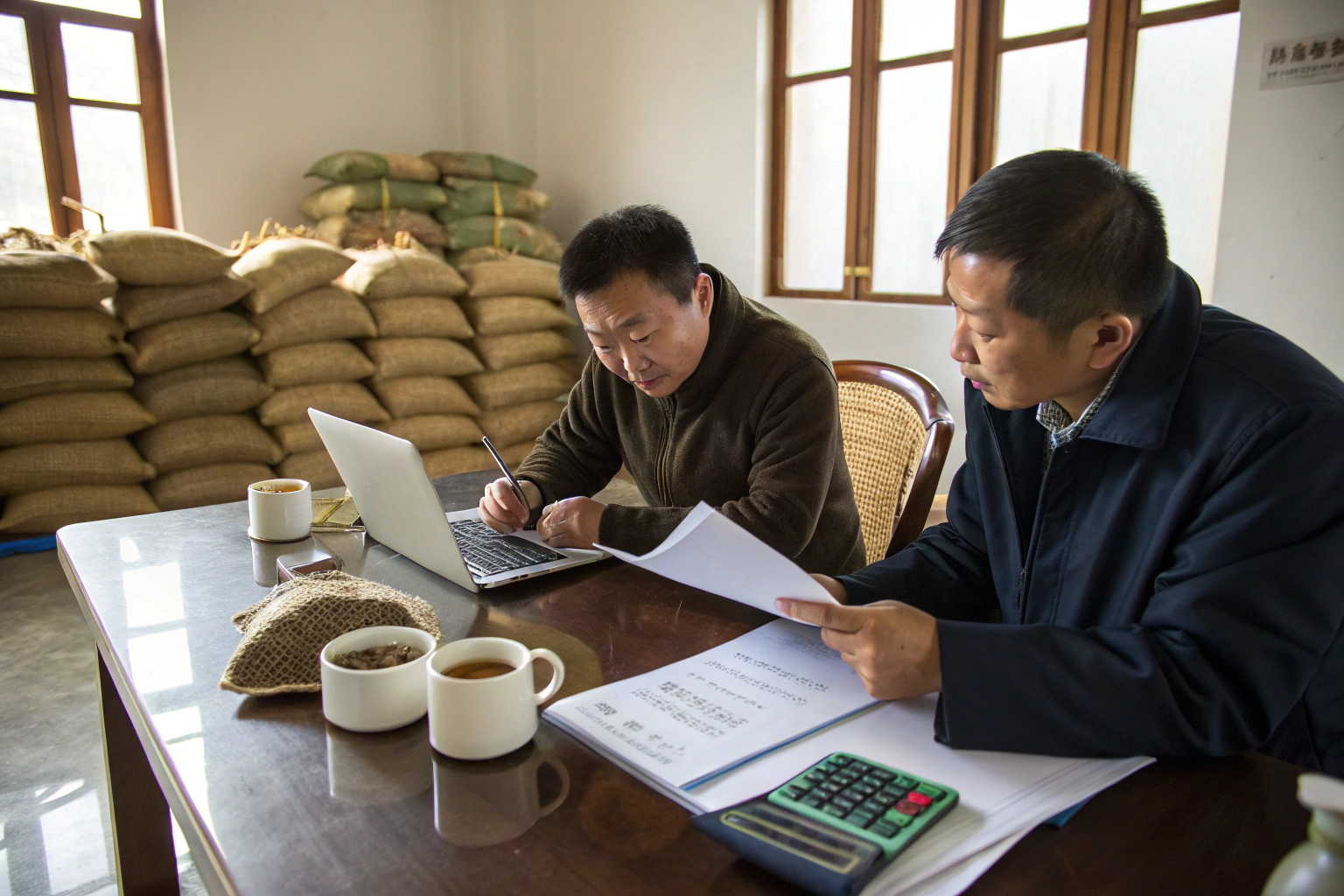
If you source coffee from China, you may look at the bean price first. That is normal. But the bean price is only one number. Ron, I know you care about price and timeliness. You also care about tariffs, quality, payment, and security. If you only compare the bean price, you may miss the real cost. Then your margin drops. Then your buyer asks why the coffee is late or expensive. That is a hard problem.
A total cost analysis for coffee sourcing adds every cost from farm to warehouse. It includes green bean price, processing, sample roast, production roast, packing, inland transport, ocean freight, insurance, tariffs, customs fees, currency exchange, payment fees, storage, and delay risk. The goal is to find the true landed cost per kilo or per bag.
This article will show you how to do it step by step. I will use my experience as a Chinese coffee exporter. I will also share how we work at BeanofCoffee. Then you can compare suppliers with clear numbers.
What Costs Do Coffee Buyers Usually Forget?
You may think you already know the costs. You see the quote. You see the shipping line. You see the tariff code. But many costs hide in small steps. A delay at port can cost money. A failed sample can cost time. A weak bag can cost a whole batch. So, you need to look deeper.
Hidden costs in coffee sourcing often include sample fees, courier charges, quality inspection, re-roasting, repacking, storage, demurrage, customs exams, currency loss, and payment transfer fees. These costs do not show up in the bean price, but they can change your final margin by 5% to 20%.
At BeanofCoffee, we list these costs for buyers. We do not want surprises. We want a clear landed cost. That helps everyone plan better.
Another way to look at this is simple. A low quote is not always cheap. A high quote is not always expensive. The real question is what is included. If the supplier leaves out freight or insurance, the price looks low. But you pay later.
| Hidden Cost | Why It Matters |
|---|---|
| Sample courier | Adds speed but costs money |
| Quality inspection | Catches defects before shipment |
| Repacking | Fixes bag or label problems |
| Demurrage | Charges for port delays |
| Currency exchange | Changes the real price |
| Transfer fee | Cuts into payment amount |
Which Small Fees Add Up Quickly?
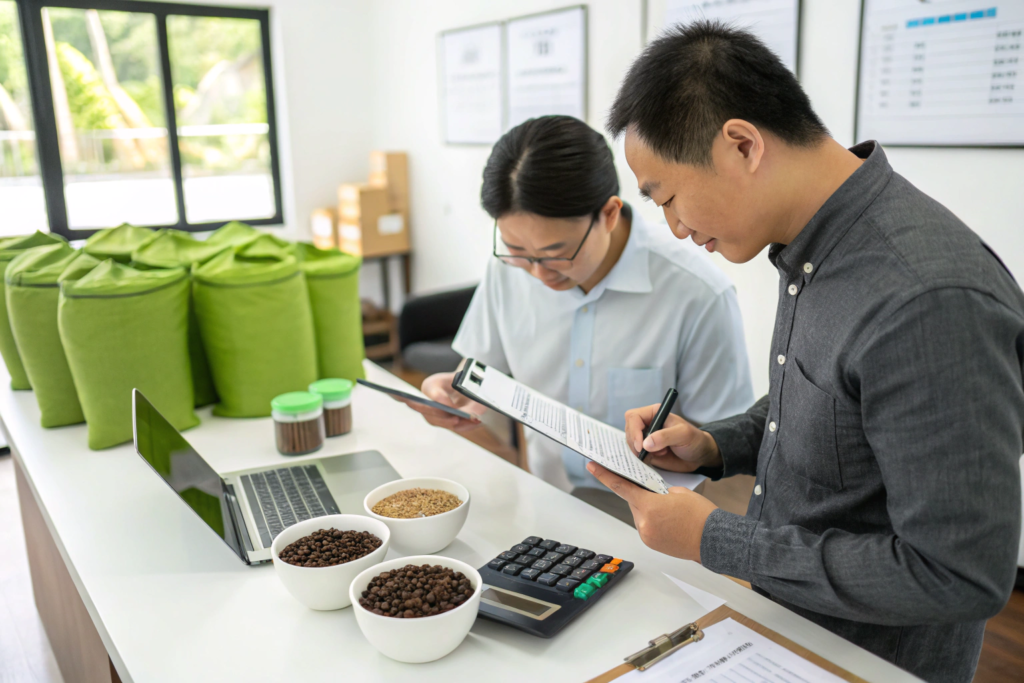
The small fees that add up quickly are often the ones buyers ignore. Sample courier fees can run $80 to $150 per box. Third-party quality inspection can cost a few hundred dollars. But it can save thousands. You can read more about landed cost from Investopedia and trade basics from Trade.gov. These costs are not huge alone. But they add up. I tell buyers to put them in the first column of their cost sheet. Do not hide them in "misc." That word kills clear thinking. A buyer once told me he lost $4,000 on a single container because he forgot demurrage. The ship was late. The port charged him for storage. He had no buffer in his budget. So, he had to cut his marketing spend. That hurt his launch. Small fees are not small when they hit at the wrong time.
How Does Payment Method Affect Total Cost?
Payment method affects total cost more than many buyers think. A 30% deposit and 70% before shipment is common. A letter of credit adds bank fees. A longer payment window may add supplier risk. Currency moves also matter. If the yuan or dollar shifts, the price can change. The WTO and XE currency tools can help you track trade rules and exchange rates. I always ask buyers to compare two prices with the same payment terms. If one supplier gives a lower price but asks for full prepayment, the risk is higher. That risk has a cost. You may not see it on the invoice. But you feel it if something goes wrong. For example, if you pay 100% upfront and the coffee fails quality check, you have no leverage. So, payment terms are not just a finance detail. They are a risk tool.
How Do You Calculate the Real Landed Cost?
Now you may want a formula. I like simple steps. First, get the FOB price. Then add freight and insurance. Then add tariffs and customs. Then add inland transport and storage. Then add payment and currency costs. Then divide by the real usable kilos. That gives you the landed cost.
To calculate landed coffee costs, start with the supplier price, then add freight, insurance, duty, customs clearance, port fees, inland trucking, storage, and financial fees. Divide the total by the net weight after roast loss and defect loss. This shows the true cost per sellable kilo.
This formula helps you compare China, Brazil, Colombia, or Vietnam. It also helps you compare Arabica, Robusta, and Catimor.
At BeanofCoffee, we often help buyers build this sheet. We know that a container of green coffee is not the same as a container of packed roasted coffee. Weight, volume, and tariff codes change. So, the math changes too.
| Cost Step | Example Question |
|---|---|
| FOB price | What is the price at the port? |
| Freight | Is it per container or per kilo? |
| Insurance | What value is covered? |
| Duty | What is the tariff code? |
| Clearance | Who pays the broker? |
| Inland | How far is the warehouse? |
| Roast loss | How much weight is lost? |
What Formula Should Buyers Use?
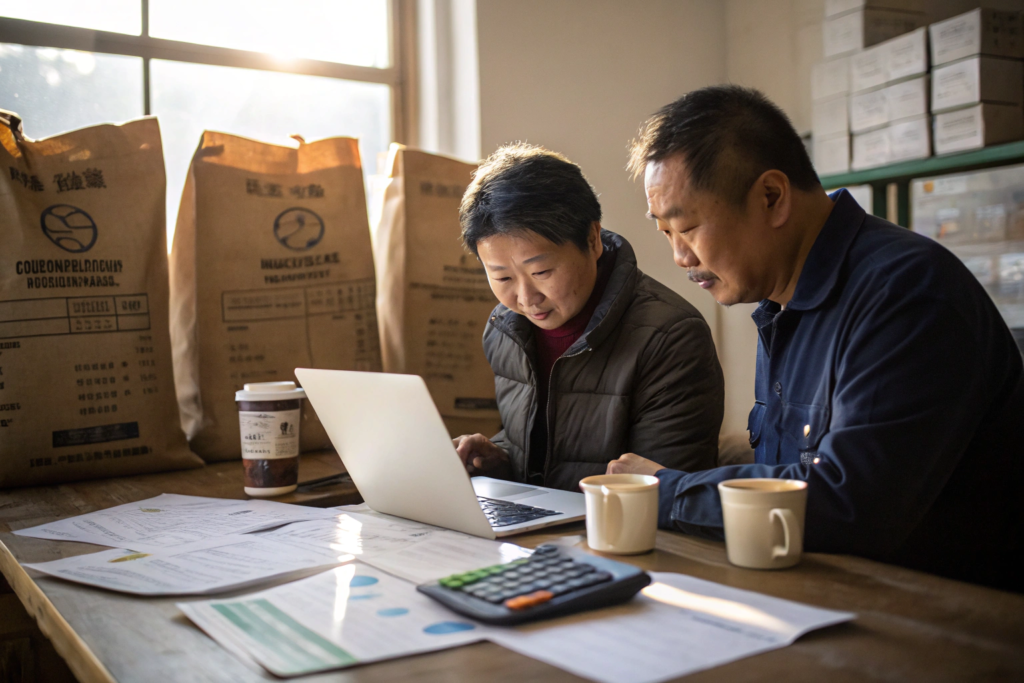
The formula buyers should use is simple. Start with the FOB price per kilo. Then add freight per kilo. Then add insurance per kilo. Then add duty per kilo. Then add customs and port fees per kilo. Then add inland trucking per kilo. Then add storage per kilo. Then add payment and currency fees per kilo. Then divide by the yield. Yield is the sellable weight after roast loss and defects. For example, if you buy 1,000 kg at $4 per kilo, your base cost is $4,000. Add $800 freight, $100 insurance, $300 duty, $150 customs, $200 trucking, and $50 fees. That is $5,600. If roast loss is 15%, you sell 850 kg. Your real cost is $6.59 per kilo. That is very different from $4. You can check Freightos and Flexport for freight estimates. But always use your own numbers. Every route is different.
Why Does Roast Loss Matter So Much?
Roast loss matters because it changes your sellable weight. Green coffee loses water weight during roasting. A 15% loss is normal. A 20% loss is high. If you sell roasted beans, this loss hits your margin. If you sell green beans, the loss happens at your buyer's roaster. But you still need to know the number. You can read more from Coffee Chemistry and Roastmasters. I tell buyers to test roast loss on a sample first. Then use that number in the cost sheet. Do not guess. A small change in yield can change your price per bag. For example, a 5% yield difference on a 1,000 kg order is 50 kg. At $5 per kilo, that is $250. That is real money. So, roast loss is not a small detail. It is a core cost driver.
Why Do Tariffs and Freight Change Coffee Margins?
You may have a good bean price. But tariffs and shipping can still hurt you. A tariff change can add thousands of dollars to a container. A sailing delay can push your coffee past a sales season. Then you must store it. Then you must discount it. That is real money.
Tariffs and freight change coffee margins because they are large, variable, and hard to control. A tariff code error can raise duty. A port delay can raise storage and demurrage. A missed sailing can raise air freight or lost sales. These costs often hit after the buyer has already set the selling price.
So, you need to plan early. You need to check codes. You need to book space. You need to keep buffer time.
At BeanofCoffee, we share sailing schedules and document drafts early. That helps buyers see risks before they become costs.
| Risk | Cost Impact |
|---|---|
| Wrong tariff code | Higher duty and exams |
| Port congestion | Demurrage and delay |
| Blank sailing | Missed sales window |
| Currency move | Higher landed cost |
| Document error | Customs hold |

How Do Tariff Codes Affect Your Duty Rate?
Tariff codes affect your duty rate directly. The rate depends on the product and the country. Green beans, roasted beans, and cold brew concentrate may have different codes. You can check U.S. Customs and Border Protection and the USITC HTS for U.S. rules. A small code mistake can cause a hold. A hold can cause storage fees. It can also cause missing paperwork. I tell buyers to confirm the code before production. Then confirm it again before shipment. Rules can change. So, one check is not enough. You need a partner who watches these details. For example, a buyer once used the code for roasted coffee instead of green coffee. The duty rate was higher. He paid an extra $1,200 on one container. That was a costly typo. So, always double-check.
What Happens When a Sailing Is Delayed?
Sailing delays hurt margin because coffee is often tied to a season or a promotion. If your cold brew launch is in June, a July arrival is too late. You may need air freight. That can cost five to ten times more. You may need to buy local coffee at a higher price. The FAO coffee and Maersk track global supply and shipping conditions. They show that shipping and weather can move markets. I have seen buyers lose sales because they did not plan buffer time. So, I always add two to three weeks of buffer for ocean freight. It is not perfect. But it helps. One buyer told me he lost a $30,000 retail order because his container arrived three weeks late. The store moved to another brand. That is a hard lesson. So, buffer time is not wasted time. It is insurance.
How Can Buyers Compare Coffee Suppliers Fairly?
You may have three suppliers. One is cheap. One is fast. One has great quality. How do you choose? You cannot compare only the bean price. You must compare the full package. That includes quality, terms, documents, and risk.
Buyers can compare coffee suppliers fairly by using the same cost sheet, the same Incoterm, the same payment terms, the same quality standard, and the same delivery window. They should also check certifications, sample roast results, production capacity, and communication speed.
This method takes more work at the start. But it saves money later. It also helps you build a long-term supply chain.
At BeanofCoffee, we welcome this kind of comparison. We want buyers to see the full picture. Then they can decide with facts.
| Comparison Point | Fair Question |
|---|---|
| Price | Is it FOB, CIF, or DDP? |
| Quality | What is the cupping score? |
| Sample | Was it a sample roast or production roast? |
| Documents | Are certificates ready? |
| Time | What is the sailing schedule? |
| Payment | What are the terms and fees? |
| Risk | What happens if quality fails? |

What Data Should You Request First?
Before you sign, request clear data. Ask for moisture, defect count, screen size, cupping score, and harvest date. Ask for food safety records from the FDA and export service information from USDA AMS. Ask for packing photos. Ask for a production roast plan. Ask for a shipping schedule. Ask for payment terms in writing. This data helps you avoid surprises. It also helps you compare suppliers in a fair way. I know this sounds like a lot. But it is better than a failed shipment. A failed shipment costs more than a few extra emails. For example, one buyer asked for a moisture reading before shipment. The reading was high. We dried the beans again. That saved the shipment. Without that data, the beans could have molded in transit. So, data is not paperwork. It is protection.
How Do You Avoid Common Comparison Mistakes?
You avoid common comparison mistakes by staying consistent. Use the same weight for every quote. Use the same Incoterm for every quote. Use the same payment terms for every quote. Do not mix FOB and CIF in one sheet. That creates false winners. You can read more from Perfect Daily Grind and Daily Coffee News for common sourcing issues. I also tell buyers to check communication speed. A supplier who replies in one day is different from one who replies in one week. Speed matters when problems happen. Another mistake is ignoring certifications. A cheap bean without the right papers may cost more later. So, compare the full package. Then decide. Do not fall in love with a low price. Fall in love with a clear landed cost and a reliable partner.
Conclusion
A total cost analysis is not just a math exercise. It is a risk plan. You start with the bean price. Then you add samples, freight, insurance, tariffs, customs, storage, currency, payment fees, and roast loss. Then you divide by sellable kilos. This gives you the real landed cost. You also compare suppliers with the same terms. You check quality, documents, and shipping time. This process protects your margin. It also helps you sleep better. If you want a partner who shares data and answers hard questions, please contact us at BeanofCoffee. We own over 10,000 acres of coffee bean plantations in Baoshan City, Yunnan Province. We export Catimor, Arabica, and Robusta. We support raw beans and processed, packaged products. For orders, samples, and export details, please contact Cathy Cai at cathy@beanofcoffee.com.