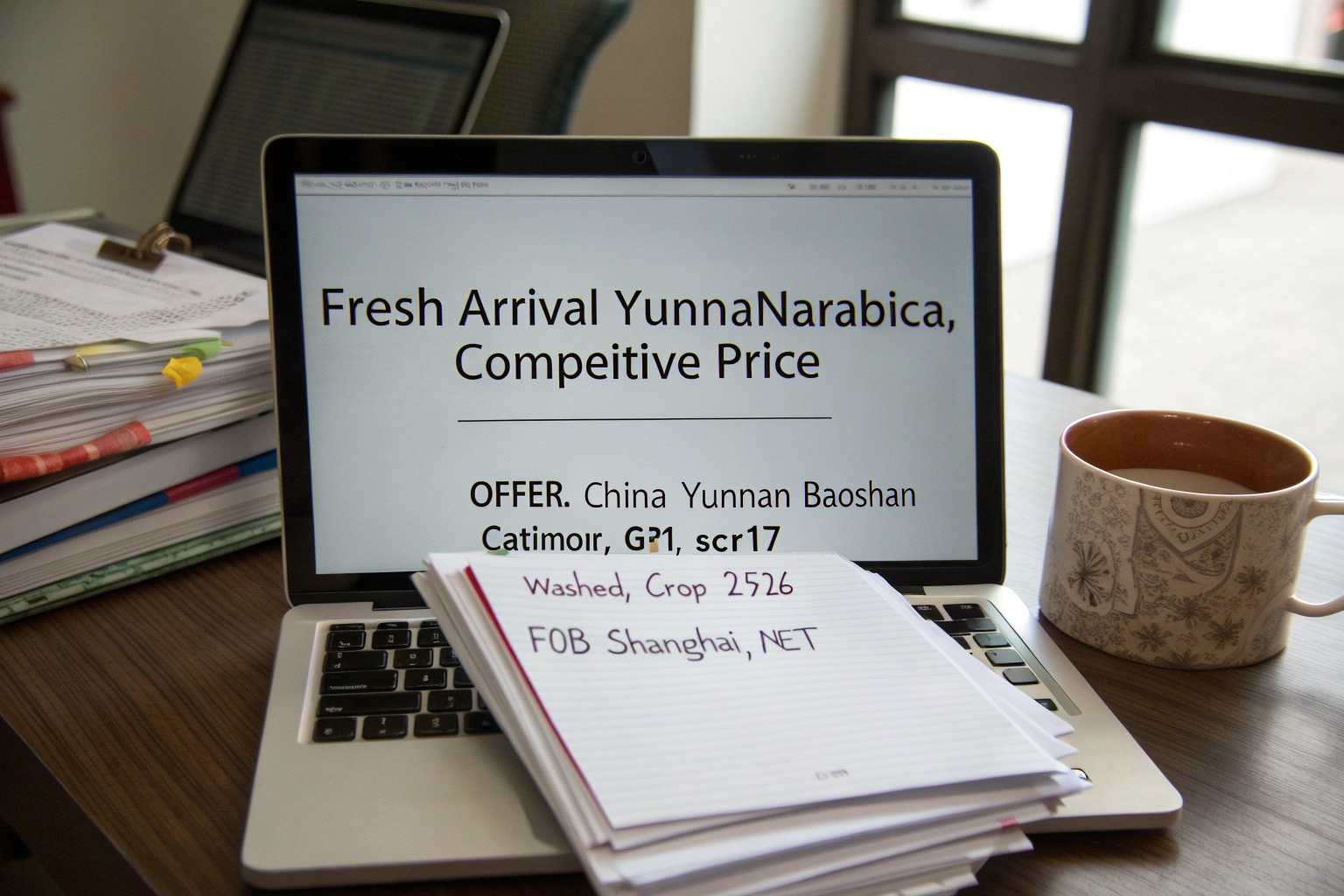
You get the PDF. The subject line says "Fresh Arrival Yunnan Arabica, Competitive Price." You open it. The first line reads: "Offer: China Yunnan Baoshan Catimor, Gr1, Scr17/18, washed, crop 25/26, FOB Shanghai, nett." Okay. You understand "Baoshan" and "washed." The rest? Scr17/18? Nett? It feels like a test you didn't study for. You don't want to look like a rookie by asking the supplier to explain every single term. So you nod along. You might even sign the contract based on a vague feeling. This is dangerous. A misunderstood offer sheet is the birthplace of disputes, bad deals, and wasted containers.
Decoding a coffee offer sheet is about recognizing a dozen standard abbreviations that describe physical quality, processing, and shipping terms. Once you know these codes, you can instantly compare offers for true value. At BeanofCoffee, my offer sheets are fully transparent, but I still want every buyer to speak the language fluently.
The jargon is not there to confuse you. It's there to be precise. Let's translate the code, line by line.
What Do Physical Coffee Bean Grading Terms Actually Mean?
The first cluster of jargon describes the bean itself. Size, defects, shape. These terms are a direct window into what you will see when you open the bag. They predict roasting behavior. They predict cup consistency. Ignoring them is like buying a car without looking at the engine specs.
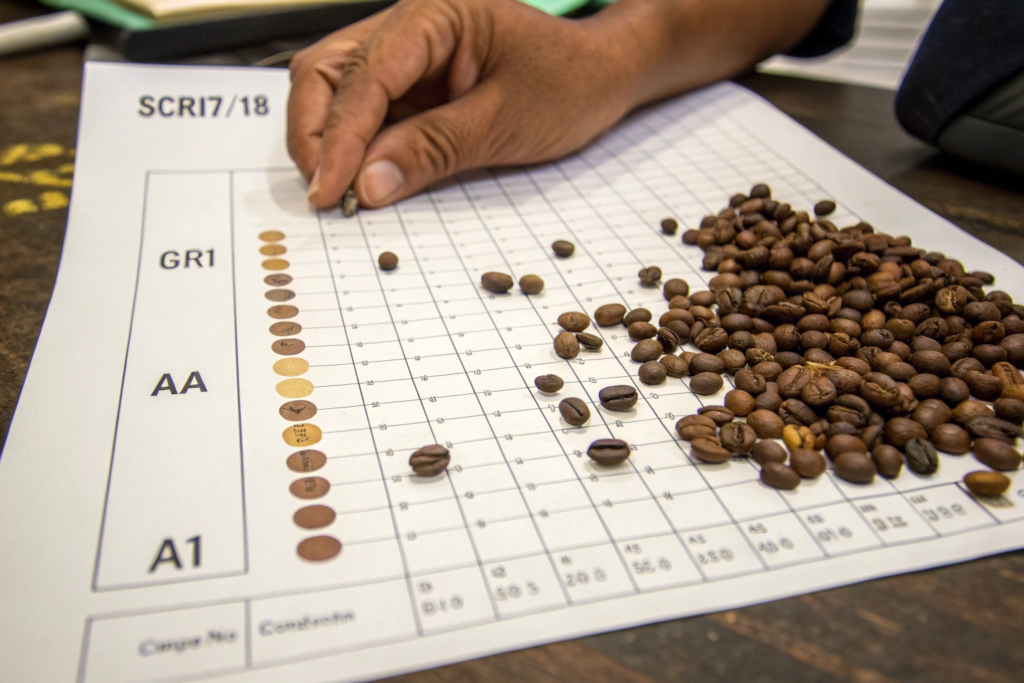
Physical grading terms like Scr17/18, Gr1, and AA define the screen size, defect count, and bean shape. These are objective measurements, not marketing fluff. A "Scr17/18" on my offer sheet means the beans are large and uniform, ideal for even roasting. This grading is done mechanically at our Baoshan dry mill and is verified by export-standard sieves.
Screen size is not a flavor descriptor. But it directly impacts your roast.
What Is Screen Size and Why Does Scr17/18 Matter?
Screen size is measured by passing green beans through metal sieves with numbered holes. The number is the diameter in 1/64ths of an inch. Scr17 means the beans sit on a screen with holes of 17/64 inches. They are large beans. Scr14 would be small beans. A Scr17/18 grade means the lot is predominantly large beans. Large beans, in general, roast more evenly. There is more thermal mass in each unit. The heat transfer is more predictable. Small beans scorch easily. If you buy a "Scr14" lot and try to dark-roast it, you might end up with a bitter, burnt mess. But Scr17/18? It takes a Vienna or French roast beautifully. It also looks premium. A bag of big, uniform beans sells itself. When you see "Scr15/16" on a cheaper offer, now you know. The beans are medium-sized. The price should be lower. It's not a defect, just a different specification. Match the screen size to your roast profile.
What Does Grade 1 (Gr1) Signify in an Export Context?
Grade 1, or Gr1, is the highest commercial grade in many origin countries, including China's export standard. It refers to the maximum allowable number of physical defects in a 300-gram sample. Defects include things like full blacks, sours, broken beans, shells, and foreign matter like sticks or stones. A Grade 1 lot might allow only 8 to 11 minor defects per sample. A Grade 2 lot allows more. A Grade 3 lot more again. This is a cleanliness and sorting standard. Gr1 means the dry mill ran the beans through a density table, a color sorter, and a hand-picking line. It means the final product is exceptionally clean. For a roaster, Gr1 means fewer stones to break your grinder burrs. Fewer quakers that taste like peanuts. Higher cup consistency. When a supplier just writes "high quality" without a grade, be suspicious. Ask for the numeric grade. Gr1 is a specific, auditable promise.
How to Interpret Shipping and Price Terms Like FOB and "Nett"?
Now you leave the bean and enter the transaction. The back half of the offer sheet defines who pays for what, when ownership transfers, and whether the price has any wiggle room. This is where money changes hands. Misreading "FOB" or "nett" can cost you thousands in unexpected logistics fees.
Shipping terms like FOB define the exact point where cost and risk transfer from seller to buyer. "Nett" means the price is firm, with no hidden discounts or commissions built in. At BeanofCoffee, I prefer FOB Shanghai because it gives the buyer control over ocean freight. I state "nett" to signal a transparent, no-negotiation pricing model.
Know the boundaries of the deal. FOB draws a line on a map.
What Is the Difference Between FOB, CIF, and EXW for Coffee?
These are Incoterms. Think of them as checkpoints in a relay race. EXW, or Ex Works, means you pick up the coffee at my dry mill gate. You pay for every kilometer of transport after that. It's the maximum buyer responsibility. FOB, or Free On Board, means I deliver the coffee to the named vessel at the port of Shanghai. I clear Chinese export customs. I pay the port handling at origin. The risk and cost transfer to you once the coffee crosses the ship's rail. CIF, or Cost, Insurance, and Freight, means I pay for the coffee, the insurance, and the main ocean freight to your destination port. The risk still transfers at origin, but I arrange and pay for the main carriage. A lot of small roasters love CIF because it's an all-in price. But a professional buyer who has a great freight forwarder relationship might prefer FOB. They want control of the vessel choice. There's no right answer. But you must know which column you are standing in.
Why Does the Term "Nett" Appear on Direct Trade Offers?
"Nett" is a tiny word with sharp teeth. It means the price is final. No discounts. No retroactive rebates. No negotiation. In the traditional trader model, prices are often inflated with a hidden margin that the trader can "give back" during a negotiation. It's a dance. The asking price is $4.00. You offer $3.70. They counter at $3.85. Everyone feels like they won. The "nett" price rejects this game. It says $3.85 is the price. It's based on the farm's real cost structure plus a fair margin. I use "nett" pricing because I want the conversation to be about the coffee's value, not about who is a better haggler. It saves time. It builds trust. You don't have to second-guess whether you left money on the table. The price is the price. Focus on the cup score, not the discount.
What Do Crop Year and Processing Codes Tell You About Freshness?
Coffee is an agricultural product. It has a vintage. The crop year on the offer sheet tells you how old the coffee is, or will be, when it reaches you. This is a huge indicator of potential cup life.
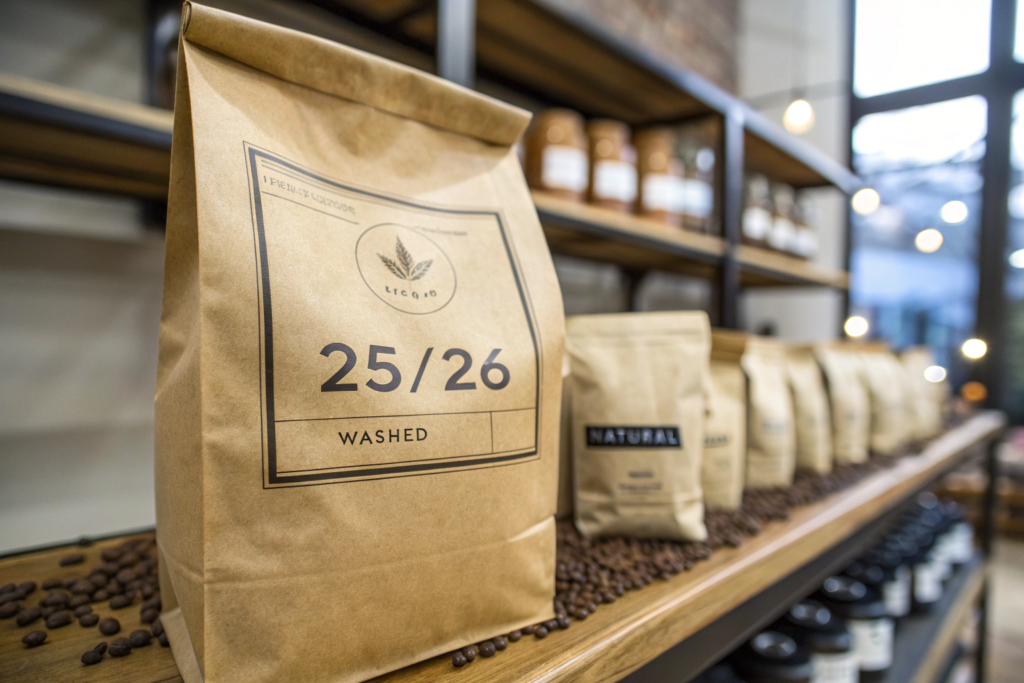
The crop year code, like "25/26," is your freshness map. It tells you the harvest window the coffee came from. Washed and Natural codes tell you the processing method, which drastically affects shelf life. At BeanofCoffee, I always list the exact crop cycle so you can plan your inventory rotation with confidence.
Buying past-crop coffee is not always bad. But you must know that's what you are doing.
How to Read Harvest Dates and Avoid Buying Old Crop?
Yunnan's harvest season runs from roughly October to February. A "crop 25/26" label means the coffee was harvested in the most recent October-to-February window. If the offer sheet says "crop 24/25" and the current date is August 2026, that coffee is already 18 to 22 months old. It is past crop. The acidity has flattened. The aromatics are fading. It might still be usable for a milk-heavy espresso blend, but it's no longer a bright, lively single-origin. Some brokers try to sell past-crop coffee by just omitting the crop year. A blank space is a red flag. Always ask. "Which harvest is this from?" If the answer is vague, walk away. Freshness is not a guarantee of quality, but staleness is a guarantee of mediocrity.
How Do Processing Codes (W, N, H) Impact Inventory Rotation?
After the grade, you see a single letter. W. N. H. Semi-W. These are shorthand for processing. W is Washed. N is Natural. H is Honey. They are not just flavor labels. They are shelf-life predictors. Washed coffee has the cleanest, most stable shelf life. With a GrainPro bag, a washed Yunnan can hold its character for 12 months easily. Natural coffee ages faster. The fruit sugars on the bean are hygroscopic. They pull moisture. The wild, fruity notes peak at 6 to 9 months post-harvest and then start to turn into boozy, overripe notes. Honey sits in the middle. So, if you are offered a Natural processed lot with a crop date of 14 months ago, factor in the age. You are buying on the downslope of its flavor curve. That's not necessarily a deal-breaker, but it demands a discount. Use the processing code plus the crop year to calculate the true remaining cup life.
How to Use an Offer Sheet to Estimate Your Real Landed Cost?
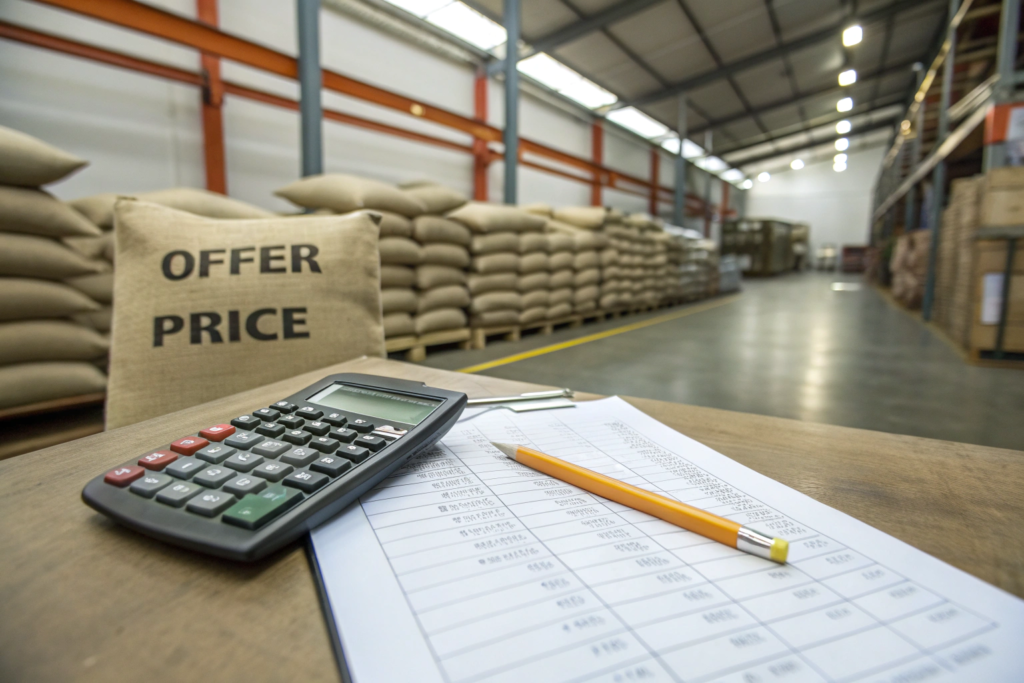
The offer sheet price is not the price you pay. It's just the starting number. The real price is the landed cost: what that coffee costs, per pound, sitting in your warehouse. The pro buyer calculates this on the back of the offer sheet, in pencil, before they even reply to the email.
The FOB price is maybe 70% of your true cost. The rest is ocean freight, insurance, U.S. customs duties, broker fees, and inland trucking. I help my clients at BeanofCoffee build a landed cost calculator so they can model their exact margin before they commit to a lot.
The best offer on paper might be the worst offer on your dock. Do the math.
What Is the Formula for Calculating Coffee Landed Cost?
The formula is a simple addition, but the inputs are specific. You start with the FOB price per pound. Add the ocean freight per pound. Add the marine insurance per pound. That gives you the CIF price. Then you add the U.S. coffee import duty. Wait. For green coffee, the duty is currently zero under most harmonized code classifications. That's a gift. Then you add the customs broker fee, the terminal handling charges at the port, and the trucking to your door. The trucking can be a killer if you are far inland. A roaster in Denver has a much higher landed cost than a roaster in Los Angeles. The same FOB offer generates two different realities. One common mistake is to forget the currency exchange risk. If you priced in Euros and pay in Dollars, the market can move between contract and settlement.
How to Compare Two Offers with Different Incoterms Fairly?
You get Offer A: $3.80 FOB Shanghai. Offer B: $4.40 CIF Los Angeles. Which is better? You can't eyeball it. You have to convert Offer B to an FOB equivalent. Get a freight quote for a single container from Shanghai to L.A. Let's say it's $2,400 for a 20-foot container holding 42,000 pounds. That's $0.057 per pound. Insurance is $200. That's negligible. Port charges are $800. Add it up. The total from FOB to landed duty paid is maybe $0.12 per pound. Offer A landed is $3.80 plus $0.12 equals $3.92. Offer B landed is $4.40. Offer A is $0.48 per pound cheaper. Now you know. The CIF offer looked competitive as a total number but was hiding a fat freight margin. Always reduce offers to a common denominator. Apples to apples. This calculation takes five minutes and is the most profitable math you will do all week.
Conclusion
The coffee offer sheet is a second language. But it's a small language. Maybe twenty core words. Scr17/18. Gr1. FOB. Nett. Crop 25/26. Washed. Once you have the vocabulary, the offer sheet transforms from a confusing memo into a precise, technical description of a physical product. Screen size tells you how the bean will roast. Grade tells you how clean it is. FOB draws the line of your responsibility. Nett tells you the price is honest. The crop year tells you the age. And the landed cost formula tells you the real price in your warehouse. Master this jargon, and you stop being a passive receiver of offers. You become a sharp, informed negotiator.
Let's practice with a real offer. Email me, Cathy Cai, at cathy@beanofcoffee.com. I will send you our latest Baoshan Catimor offer sheet. I will walk you through every line item on a quick call. You will see the screen size, the grade, the ship date, and the price logic. No smoke. No mirrors. Just a clean, decoded offer for your next great roast.