I got an email last week that made me wince. A small roaster from Florida had wired a 30% deposit to a "supplier" he found on a B2B platform. The website was slick. The prices were magical. The samples arrived—decent. But the container? It never came. The phone number went dead. The address was a virtual office in Shenzhen. He lost $15,000. That's the dark side of sourcing from China. The opportunities are huge, but so are the traps. The pain is real: you're sitting thousands of miles away, looking at a screen, trying to figure out who is a real farmer and who is a middleman with a Photoshop license.
Finding a reliable coffee bean supplier in China requires verifying physical farm ownership, checking direct export licenses, demanding live video tours, and testing traceability from the specific lot back to a specific mountain. The most reliable partners are vertically integrated exporters in Yunnan who control the soil, the processing, and the shipping under one roof.
Why does reliability matter more than price? Because a cheap container of mystery beans that arrives moldy, or doesn't arrive at all, isn't cheap. It's a catastrophe. I own 10,000 acres of coffee plantation in Baoshan, Yunnan. I've been on both sides of this equation. I've been the buyer, skeptical and cautious. Now I'm the supplier, trying to prove my legitimacy to people who've been burned before. Let me walk you through exactly how to separate the real from the fake, the stable from the shaky, so your next deposit lands in safe hands.
What Certifications Should a Chinese Coffee Exporter Have?
Certifications are the first filter. They're not a guarantee of perfection—nothing is—but they are a baseline. A supplier without any verifiable certifications is like a driver without a license. They might be excellent, but why take the risk? The Chinese coffee industry has matured fast. The serious exporters have invested heavily in international standards. The fakes haven't, because certification costs money and time they'd rather not spend.
A reliable Chinese coffee exporter should hold at minimum: a valid food safety management certification (ISO 22000 or FSSC 22000), an organic or ethical certification (USDA Organic, EU Organic, or Rainforest Alliance) that matches your target market, and a direct export license registered with Chinese customs. These documents must be verifiable in public databases, not just PDF attachments.
When a buyer asks me for certifications, I don't just send the paper. I send the certificate number. I say, "Here. Look it up on the USDA Integrity database. Type in the code. See my farm name, my product scope, my expiry date." That transparency is the point. A supplier who gets defensive, who says "trust me," who claims their certificate is "being renewed" for six months—walk away. Real certifications are audited annually by third-party bodies. At BeanofCoffee, our FSSC 22000 audit is a grueling two-day process where inspectors comb through every record, every cleaning log, every pest control report. It's a pain, but it means when a US buyer submits our paperwork to their FDA customs broker, it clears without a hitch. That's the value—not the paper itself, but the smooth customs clearance it enables.
How to Verify Organic and Fair Trade Certifications?
Verification is easier than most buyers think. Every major certification has a public, searchable database. The trick is knowing where to look and what to look for. A fake certificate might look perfect visually—same logo, same font, same layout. But the database doesn't lie.
For USDA Organic certification, go to the USDA Organic Integrity Database. Type in the operation name exactly as it appears on the certificate. Does it return a result? Is the status "Certified"? Does the scope include "Coffee, unroasted" or just some vague category like "agricultural products"? A mismatch in scope is a red flag. For EU Organic, the system is slightly different. Since 2025, the EU's TRACES NT system handles organic import certificates. A legitimate exporter will issue a Certificate of Inspection (COI) for each shipment, generated in real-time in the TRACES system. If a supplier offers you an EU Organic certificate but can't produce a COI for the specific container, something is off. For Rainforest Alliance, their website has a "Find Certified" search tool. You can look up the certificate code. The certificate also has a validity date. I've seen certificates that expired three years ago, still being passed around. Always check the dates. For Fair Trade, the system works through FLOCERT. A genuine Fair Trade supplier has an FLO ID. You can verify it with FLOCERT directly. If a supplier claims multiple certifications but only shows you one scannable code that's a broken link, be suspicious. Any legitimate exporter is proud of these credentials. We pay a lot of money and work very hard to earn them. We want you to check. The USDA Organic Integrity Database is your free tool for American-bound organic claims.
What Food Safety Standards Matter for Importing Coffee?
Organic and ethical certs are about values. Food safety certs are about survival. If your green coffee arrives with mycotoxins or pesticide residues above the legal limit, your shipment is rejected at the port. You eat the cost. That's not a theoretical risk. I've seen it happen to careless buyers.
The baseline standard is HACCP—Hazard Analysis and Critical Control Points. It's a systematic approach to identifying where contamination can occur and preventing it. But the gold standard, especially for the EU and increasingly for large US buyers, is GFSI-benchmarked certification. This means FSSC 22000 or BRCGS. These go beyond HACCP. They cover building construction, equipment design, traceability systems, and supplier management. For coffee, the critical control points are usually at the drying stage. If coffee is dried on dirty concrete or near livestock, it can pick up ochratoxin A, a harmful mold toxin. Our drying patios at BeanofCoffee are raised African beds, off the ground, with specific sanitation protocols. The FSSC 22000 audit checks this. Another critical point is foreign material—stones, metal, plastic. Our dry mill has multiple rare-earth magnets and an optical sorter that photographs every single bean and ejects any defect or foreign object with a puff of air. If a supplier can't explain their foreign material controls, they don't have any. Food safety isn't glamorous, but it's the foundation. A supplier who skimps on food safety will eventually ship a contaminated container. The GFSI benchmarked standards explain the full requirements. If your supplier's certificate isn't from a GFSI-recognized scheme, ask why not.
How to Verify a Coffee Supplier Without Visiting the Farm?
Not everyone can fly to Yunnan. I get it. Flights are expensive, time is tight. A decade ago, that meant blind trust. Now, technology makes farm visits optional—not for the relationship (in-person still matters), but for the initial verification. You can audit a supplier from your roastery desk if you know what to demand and what to spot.
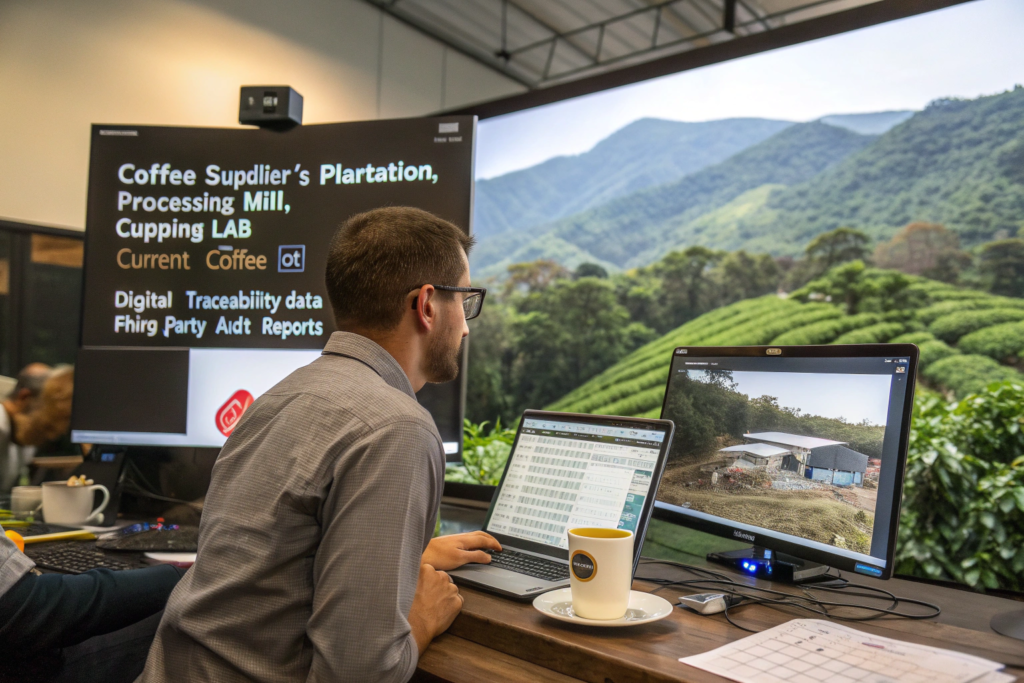
Remote verification of a coffee supplier requires a live, unscripted video walkthrough of the plantation, the processing mill, and the cupping lab—all in one continuous call. Demand to see specific landmarks, current weather, and a live cupping of their current lot. Combine this with digital traceability data and third-party audit reports for a complete picture without leaving your office.
I do these calls regularly. A buyer will WhatsApp me at a random time—not scheduled weeks in advance—and say, "Show me the drying beds." I walk outside, point the camera at the patios, and show them the parchment. No time to clean up, no time to stage anything. That's the test. A supplier who always has an excuse—"The farm is too far," "The wifi is bad," "Let me schedule that next week"—is hiding something. Maybe the farm is smaller than claimed. Maybe the processing is dirtier than admitted. Maybe the supplier has never actually been to the farm because they're a trader, not a grower. A live, unscripted video call is the single most powerful verification tool you have. It's free and instant. Use it ruthlessly. At BeanofCoffee, we encourage this. I'd rather spend 20 minutes showing you the real operation than lose a potential partnership to doubt.
What Questions Should You Ask During a Live Video Tour?
A video tour is only as good as the questions you ask. Don't just passively watch. Interrogate the scene. The goal is to catch inconsistencies that a staged video would reveal. A real farm has real farm stuff—mud, tools, workers, noise. A fake tour looks like a quiet, empty warehouse.
Here's my checklist for a live video verification. First, ask them to walk to the edge of the plantation and show the altitude marker or a recognizable mountain peak. Yunnan farms are on steep slopes. If they're showing you flat land, they're not in the coffee belt. Second, ask to see the fermentation tanks. Are they clean? Are they in use? A mill that hasn't processed coffee recently will have dry, dusty tanks. During harvest season, they should be wet and active. Third, ask to see the cupping lab. Have them brew a cup of their current lot right there on camera. Watch their technique. Do they know how to cup? A trader who can't cup is a red flag. A farmer who cups daily is a green flag. Fourth, ask to see the warehouse. How is the parchment stored? In GrainPro bags or open jute? Is it clean and organized? Fifth, ask a question they can't script: "What was the Brix reading on this lot at harvest?" or "What varietal is planted on the north-facing slope?" A real farmer answers instantly. A middleman fumbles. Finally, ask for a close-up of the green beans. You're looking for uniformity, color (should be even, not mottled), and absence of black or insect-damaged beans. If the video feed is conveniently blurry when showing the beans, that's intentional. High-quality questions reveal high-quality suppliers. The SCA Coffee Technicians Guild offers courses on equipment and processing that can sharpen your eye for detail.
How to Use Third-Party Inspection Services for Added Security?
Even with a great video call, you might want a professional on the ground. Third-party inspection services are your hired eyes and ears. Companies like SGS, Bureau Veritas, or coffee-specific services can visit the supplier's facility, audit their operations, and sample their stock. This adds a layer of formality and legal weight.
The process works like this. You commission an inspection. You specify what you want checked: quantity, quality, packaging, loading supervision. The inspector goes to the supplier's warehouse. They count the bags. They draw a representative sample using international sampling protocols. They seal the sample and send it to an independent lab, or they ship it to you. They also photograph the container loading, so you know exactly what went into the box and how it was handled. This service costs a few hundred dollars. On a $50,000 container, that's negligible. It's insurance. If the inspector finds a problem—say, the coffee has more defects than the contract allows—you can refuse the shipment before it leaves port. That's much cheaper than refusing it after it arrives at your roastery. Some buyers use inspection services for every single shipment. Others use them only for new suppliers. Either way, it's a powerful signal. A reliable supplier welcomes inspectors. I have zero issues with a client hiring SGS to audit our loading. Why would I? It confirms what I've already told them. A supplier who resists, who says "that's not necessary," is afraid of what the inspector will find. Don't skip this step if you're placing a large order with a new partner. The SGS coffee inspection services page outlines exactly what they can do for you. It's money well spent.
How to Negotiate Price and Payment Terms with Chinese Exporters?
Negotiation isn't a battle. It's a problem-solving session. The Chinese business culture, at least in the coffee sector now, has moved beyond the old bazaar-style haggling. Serious exporters want long-term partnerships, not one-off deals. They're willing to be flexible on payment and pricing if the relationship makes sense. But you need to know the levers to pull.
Negotiating with Chinese coffee exporters works best when you bundle a volume commitment with flexible payment terms. Instead of demanding the absolute lowest FOB price, ask for a fixed differential contract, split the terms into a 30/70 T/T structure, and secure value adds like free samples, branded packaging, or pre-paid freight discounts.
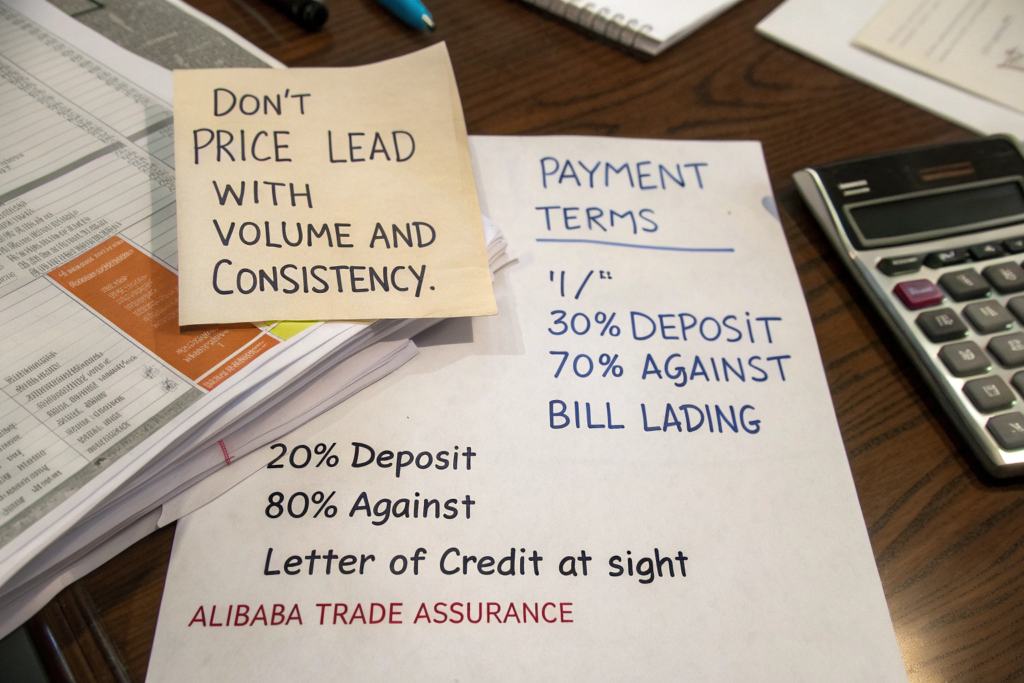
The first rule: don't lead with price. Lead with volume and consistency. When a buyer tells me, "I need one container, cheapest possible," I know they're price-shopping and will leave me next season. I'm less inclined to give them my best rate. When a buyer says, "I'm looking for a long-term partner for three to four containers a year," my ears perk up. I'll sharpen my pencil on the price because the lifetime value of that client is high. Payment terms are where you can find hidden value. Standard T/T is 30% deposit, 70% against the bill of lading copy. That's fair and common. But if you're a new client, you might want more security. Ask for 20% deposit and 80% against scanned documents, or negotiate for a Letter of Credit at sight. L/Cs have bank fees, but they offer ironclad security for a first transaction. Alibaba Trade Assurance is another option—it's essentially an escrow service where Alibaba holds the money until you confirm shipment. I use it with first-time buyers because it builds trust instantly. The platform itself acts as the neutral party. At BeanofCoffee, we're flexible on these terms because we understand the anxiety of wiring money across the ocean. A seller who insists on 100% upfront payment from a new client is a risk you don't need to take.
What Are the Best Incoterms for Coffee Imports from China?
Incoterms decide who pays for what and when the risk shifts from seller to buyer. Choosing the wrong one can cost you thousands. The most common Incoterms for Chinese coffee exports are FOB, CIF, and DAP. Each has its place, depending on your logistics capability.
FOB means Free On Board. I, as the seller, get the container onto the ship at Shanghai or Shenzhen. My responsibility ends when the container clicks onto the deck. After that, the ocean freight, insurance, and destination charges are yours. Choose FOB if you have a strong relationship with a freight forwarder and you want to control the shipping line. You might get a better freight rate with your own contracts. CIF means Cost, Insurance, Freight. I pay for the goods, the insurance, and the ocean freight to your destination port, like Long Beach or Rotterdam. This is the "easy" option. You just handle customs clearance and inland trucking. DAP means Delivered at Place. I pay for everything right to your roastery door. I rarely recommend DAP for international shipments. I don't know your local trucking market. I'd just mark up a local trucker, and you'd pay the margin. The smart play for most mid-sized roasters is CIF. You get a single, predictable price per pound delivered to your port. You don't worry about freight rate swings. I negotiate the shipping because I'm booking containers every week and have volume leverage with the lines. You focus on roasting. Check the official ICC Incoterms 2020 rules for the exact legal definitions. Knowing these terms makes you look professional and prevents hidden port fees from surprising you.
How to Structure a Long-Term Contract That Protects Both Sides?
A long-term contract in coffee is a marriage. It needs to survive market crashes and price spikes. If the contract only benefits one side when the market moves, the other side will break it. A good contract shares the pain and the gain.
The most effective structure I've used is a fixed differential over the C-market with a price floor and ceiling. Here's how it works. We agree that you'll pay the ICE Arabica futures price for the delivery month, plus a fixed differential—say, plus 15 cents per pound. That differential covers my quality premium, my processing cost, my margin. It's fixed for the contract year. If the C-market crashes to $1.50, your price is $1.65. That's your floor. But if the C-market spikes to $3.50, your price is $3.65. That might break your budget. So, we add a cap. "Differential is +15 cents, but the total price will never exceed $3.20 per pound." That means if the market goes crazy, I absorb the excess. In return, you commit to the volume. This structure means I get guaranteed volume, so I can plan my harvest and allocate trees. You get price protection against catastrophic spikes. It aligns our interests. We both want stable, predictable business. The contract should also specify quality parameters—maximum defects, minimum cup score, screen size, moisture content. If the coffee doesn't meet spec, you have the right to a discount or refusal. And it should specify force majeure clauses—what happens if a typhoon closes the port, or a pandemic hits. Fair contracts protect both sides. A supplier who offers a one-sided contract isn't looking for a partnership. They're looking for a victim. The Specialty Coffee Association contracts provide templates and guidance for fair green coffee contracts.
How to Manage Shipping and Logistics from China to the US and Europe?
Logistics is where the savings live and the disasters breed. A great coffee at a great price is worthless if it sits in a warehouse for six weeks or arrives with condensation damage. The physical journey from our drying patios in Baoshan to your roastery in Texas or Hamburg is a chain of handoffs. Every link is a potential failure point. Managing it well is as important as cupping the sample.
Managing coffee logistics from China requires booking space 4-6 weeks in advance, insisting on food-grade containers with GrainPro liners, using a freight forwarder experienced in FDA/USDA clearance, and building a 2-3 week buffer into your inventory planning to absorb port congestion or customs holds. Fast, direct shipping routes are worth the premium.
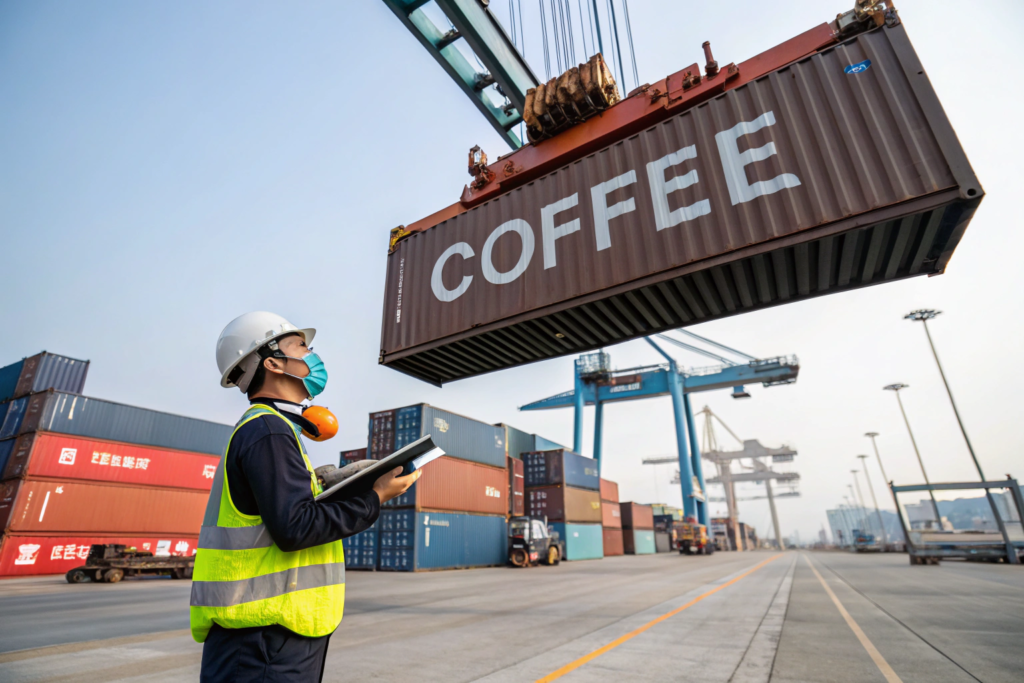
The first decision is the port of loading. Shanghai and Shenzhen are the big ones. Shenzhen is closer to Yunnan by truck, so we often use it. The transit time to the US West Coast is roughly 14-18 days. To Europe, it's 25-30 days via the Suez, or slightly longer if vessels re-route. Then there's the container itself. You must specify a food-grade container. Never accept a container that previously carried chemicals, hides, or anything with a strong odor. Coffee absorbs smells like a sponge. A container that carried garlic will ruin a whole load of specialty Arabica. I inspect every container before loading. I open the doors, I smell it, I check the seals. If it smells off, I reject it. The second non-negotiable is GrainPro bags. These are hermetic, multi-layer plastic liners that seal the green beans away from moisture and oxygen. Jute bags alone are not enough for a 30-day sea voyage. The humidity swings in the container will degrade the coffee. A GrainPro liner locks the water activity where we set it. The freight forwarder is your partner in crime. Pick one who knows coffee, knows FDA prior notice filing, and has a responsive team. A good forwarder communicates delays proactively, not after you're already panicking.
How to Avoid Container Condensation and "Coffee Bag Sweat"?
This is a physics problem. A container leaves Yunnan in the cool morning. It sits on a hot dock in Shenzhen. The ship sails through the tropics. The container exterior heats up. The air inside warms, and moisture migrates from the beans to the air. Then the ship hits a cold front at night. The container walls cool. The moisture condenses on the ceiling and drips down onto the top bags. This is container rain. It ruins the top layer of coffee.
The solution has multiple layers. Layer one: the GrainPro bag. It acts as a waterproof shell around the beans. Even if the container rains, the coffee inside the liner stays dry. Layer two: container desiccants. We hang large moisture-absorbing poles along the container walls. They capture the humidity before it condenses. Layer three: ventilated containers, used carefully. Some shippers use containers with small vents. But this can backfire if the outside air is humid. I prefer a sealed container with aggressive desiccants. Layer four: correct stuffing. We don't pack the coffee directly against the container walls. We leave an air gap using cardboard or spacer pallets. This prevents the bags from touching the cold, wet metal. Layer five: educate the receiver. When the container arrives, open the doors and ventilate it immediately. Don't let it sit sealed on a hot tarmac. Let the air pressure and temperature equalize. These steps cost a bit more upfront, but they prevent the total loss of cargo. A container of coffee with mold on the top bags is a financial disaster. The World Coffee Research storage guidelines offer more detail on optimal conditions for green coffee during transit.
What Is the Realistic Lead Time from Yunnan to a US Port?
Everyone wants the coffee yesterday. But realistic planning prevents frantic phone calls. The timeline from Yunnan to a US port is not instant. Understanding each step lets you plan your inventory and avoid running out of roasted coffee while waiting for the ship.
Here's the breakdown. Once you place an order and the coffee is milled and ready, the first step is trucking. It takes about 2-3 days to truck a container from Baoshan to Shenzhen port. Then the container needs to be booked onto a vessel. We aim for a cut-off date—the last day the container can be delivered to the terminal—about 5-7 days before sailing. Then the vessel sails. Transit to the US West Coast: 14-18 days. Transit to the US East Coast (via Panama Canal): 25-30 days. Then customs clearance at the destination port. If the paperwork is clean and the FDA prior notice is filed correctly, this takes 1-3 days. Then chassis availability and trucking to your roastery: 2-5 days. So, a realistic door-to-door timeline from Baoshan to, say, Dallas, is about 35 to 45 days. That's from the day the container is loaded at our mill. But that assumes everything goes smoothly. In coffee logistics, something often doesn't. A port gets congested. A vessel is delayed by a storm. Customs does a random inspection. My advice: always add a two-week buffer. If you need the coffee by June 1st, plan for it to arrive by May 15th. The cost of carrying an extra two weeks of inventory is far lower than the cost of shutting down your roastery because the container is stuck at sea. Predictability is the goal. A reliable supplier communicates the milestones: "Container loaded," "Vessel departed," "ETA updated." At BeanofCoffee, we send these updates automatically. You shouldn't have to chase us for tracking. The Freightos freight rate calculator can also give you a sense of current transit times and port congestion levels.
Conclusion
Finding a reliable coffee supplier in China isn't about luck. It's about process. It starts with certification verification—checking those numbers in public databases. It deepens with a live video tour where you ask smart, unscripted questions and see the farm, the mill, and the cupping lab in real time. It strengthens with a fair contract that uses a fixed differential, balanced payment terms, and clear quality specs. And it's secured with meticulous logistics: food-grade containers, GrainPro liners, desiccants, and a realistic timeline that includes a buffer for the unexpected. Every step filters out the fakes and leaves you with the real, committed suppliers who treat coffee exporting as a profession, not a scam.
We've built BeanofCoffee on exactly this transparency. We own the land. We hold the certs. We answer the video calls. And we ship containers that arrive on time, with the quality matching the sample you cupped. That's not a marketing slogan. It's our daily operation.
If you're ready to source from a Chinese supplier who won't disappear after the deposit, let's start with a conversation. My export director, Cathy Cai, can walk you through our certifications, schedule a live farm tour via video, and send you a pre-shipment sample so you can cup our current harvest. Reach her at: cathy@beanofcoffee.com.